


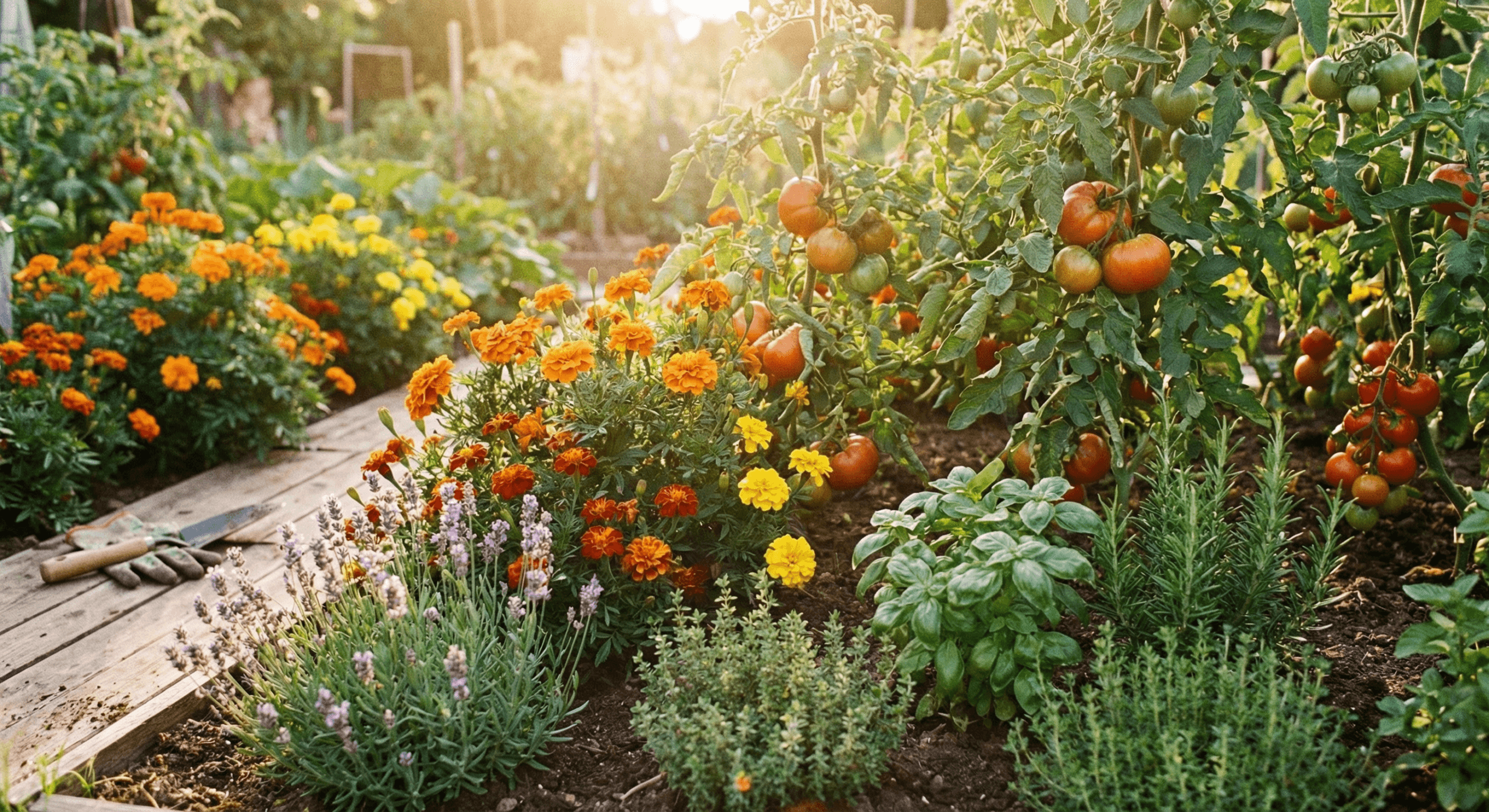
Before reaching for sprays and treatments, consider one of the most powerful pest control tools available: the plants themselves. The RHS pest and disease guide identifies common garden pests and how to deal with them… Garden Organic provides comprehensive advice on managing garden pests organically… Many plants produce natural chemicals that repel insects, mask the scent of desirable crops, or attract predators that control pests. Understanding companion planting for pest control can transform your approach to garden protection. In this comprehensive simple guide, we’ll cover everything you need to know.
Related: Garden Planning 101: Mapping Out Your Garden Space Composting Kitchen Waste: Beyond the Basics
For more on essential summer gardening:, see our guide.
For more on essential mulching: single, see our guide.
This is not about a single magic plant solving all your pest problems — it is about creating garden ecosystems where pest pressure is naturally reduced.
Looking for quality gardening tools and supplies? Browse our recommended garden products — hand-picked by the GardenWizz team.
Proven Natural Pest: Simple: Natural: How Companion Planting for Pest Control Works
Repellent Aromas
Strongly aromatic plants confuse pest insects searching for their host plants. An aphid searching by scent for a rose bush has a much harder time finding it when surrounded by a sea of pungent lavender, mint, or sage.
Trap Cropping
Some plants are more attractive to certain pests than others. By growing these “trap crops” at the edges of your garden, you draw pests away from your main crops, where they can be controlled more easily.
Attracting Beneficial Insects
Ladybirds, lacewings, hoverflies, and parasitic wasps are among the most voracious predators of garden pests. Adult hoverflies feed on nectar and pollen, so flowering plants — particularly those with open, flat flowers — attract them to your garden where their larvae devour aphids.
The Best Pest-Repelling Plants
Herbs That Repel Aphids
– Mint — Repels aphids, ants, and cabbage white butterflies. Plant around the edges of borders or in containers (remember: mint needs containing). Peppery-smelling spearmint is particularly effective.
– Dill and fennel — Repel aphids and attract beneficial insects including ladybirds and hoverflies. Buglife pollinator resources has detailed guidance on this topic. RHS pest and disease guide has detailed guidance on this topic.
– Chives — Repel aphids and carrot fly. A row of chives between your carrots and the rest of the garden is a classic companion planting technique.
– Garlic — The sulphurous compounds in garlic repel a wide range of pests including aphids, cabbage white butterflies, and carrot fly.
Marigolds (Tagetes)
Perhaps the most celebrated companion plant. Marigolds repel whitefly from tomato plants when grown alongside them, deter aphids and cabbage white butterflies, and attract hoverflies throughout the summer.The roots also produce thiophene compounds that suppress soil nematodes. RHS soil testing guide has detailed guidance on this topic. The RHS soil testing guide provides detailed advice on understanding your soil type…
Plant marigolds in vegetable beds, around tomatoes, and interspersed among brassicas for best effect.
Nasturtiums
The opposite of a trap crop — nasturtiums are so attractive to aphids that they draw them away from your valuable crops. Check nasturtiums regularly and hose off or squash aphid colonies.This sacrifice plant approach keeps your roses, RHS roses growing guide has detailed guidance on this topic.beans, and other crops cleaner.
Lavender
The strong scent of lavender confuses and repels many insect pests. It is particularly effective against aphids, cabbage white butterfly, and flea beetles. Plant lavender along paths, around vegetable beds, or among roses.
Rosemary and Sage
Both repel cabbage white butterfly and carrot fly. Plant in kitchen gardens and around brassicas. Rosemary, in particular, is a strong deterrent for cabbage moth.
Parsley
Parsley attracts beneficial insects including hoverflies and parasitic wasps. It is also said to deter asparagus beetle. Let some parsley flower — the umbel flowers are particularly attractive to beneficial insects.
The Science of Companion Planting
It is worth being honest: while companion planting has a strong evidence base for some combinations, it is not a precise science. The effectiveness depends on:
– Plant density (sparse companion plants are much less effective than dense plantings)
– Weather conditions
– Pest pressure levels
– Whether the companions flower at the same time as pest populations peak
A strong, diverse planting scheme with many flowering herbs and deterrent plants creates the most consistently effective results.
Combinations That Work
Tomatoes + basil + marigolds:
Classic companion planting. Basil is said to improve tomato flavour and repels aphids and whitefly. Marigolds deter whitefly and repel soil nematodes.
Brassicas + lavender + rosemary + sage:
All four repel cabbage white butterfly with their strong scents. Plant them interspersed with your brassicas or around the edges of your brassica bed.
Carrots + chives + dill + parsley:
The strong aromatic herbs mask the scent of carrots, confusing carrot fly. Let some flowering dill and parsley attract beneficial insects.
Roses + lavender:
Lavender planted at the base of roses confuses and repels aphids. Both have similar soil and sun requirements. A rose and lavender border is also visually stunning.
Beyond Plants: Other Natural Pest Controls
Companion planting works best as part of an integrated approach:
– Encourage birds: Dense hedges and berry-producing shrubs provide habitat for birds that eat insects
– Provide overwintering habitat: bug hotels, log piles, and undisturbed corners support beneficial insect populations
– Physical barriers: netting over brassicas, fleece over carrots (to exclude carrot fly), and copper tape around pots (to deter slugs) all have their place
– Biological controls: nematodes for slugs and vine weevil; predatory mites for spider mite; ladybirds for aphid control
FAQ: Natural Pest Deterrents
Do companion plants really work?
Yes — certain combinations are well-supported by evidence. Marigolds with tomatoes, strong herbs with brassicas, and alliums with carrots are all effective. The key is growing companion plants densely enough to create a genuine effect.
What is the best plant for repelling all garden pests?
No single plant repels all pests. A diverse mix of strongly aromatic herbs, flowering companion plants, and deterrent alliums creates the most comprehensive protection.
Do marigolds repel slugs?
Not as effectively as they deter some insect pests. Strong-smelling plants like lavender and rosemary are better for deterring slugs. Use other methods (nematodes, beer traps, copper tape) alongside companion planting for slug control.
How many companion plants do I need?
More than you might think. A single marigold at the end of a row will not protect a tomato plant. Interplanting throughout the growing area — roughly 1 companion plant per 2-3 square feet of crop — is more effective.
Can I rely entirely on companion planting for pest control?
Companion planting reduces pest pressure significantly but is rarely sufficient on its own in high-pest situations. It works best as part of an integrated pest management approach, combined with good garden hygiene, physical barriers, and biological controls when needed.
What plants attract beneficial insects?
Flowering plants with open, flat flowers — particularly members of the umbel family (dill, fennel, cow parsley, wild carrot), along with lavender, phacelia, poached egg plant (Limnanthes), and calendula. Let some of your herbs and vegetables flower to attract beneficial insects.
Final Thoughts
Companion planting is one of the most rewarding aspects of organic gardening — working with nature rather than against it, using plants to create balance in the garden rather than reaching for chemical solutions. It will not eliminate all pest problems, but it will significantly reduce them and create a garden that is resilient, biodiverse, and healthier as a result.
For more on organic gardening, read our guide to Organic Gardening. And for specific pest management, see our guide to Pest and Disease Management.
Continue Reading
- 5-Step Essential Garden Tools: What Every UK Gardener Needs
- Complete Guide to Week 12 Spring Garden Jobs: May 17-23
- Complete Guide to Week 11 Spring Garden Jobs: May 10-16
- Complete Guide to Week 10 Spring Garden Jobs: May 3-9
- Complete Guide to Week 9 Spring Garden Jobs: April 26 – May 2
Frequently Asked Questions
When is the best time to do this?
The best time depends on your climate zone and what you are growing, but generally early morning or late afternoon when temperatures are cooler works best for most garden tasks.
How often should I check on my garden?
Regular attention is key — check your garden every few days during the growing season. This helps you catch problems early before they become serious.
Can beginners do this?
Absolutely! Start with a few simple tasks and build up gradually. Most garden jobs are beginner-friendly with the right guidance.
What is the most important thing to remember?
Consistency matters more than perfection. Little and often beats occasional marathon sessions. Even 10-15 minutes of daily attention yields great results.
