


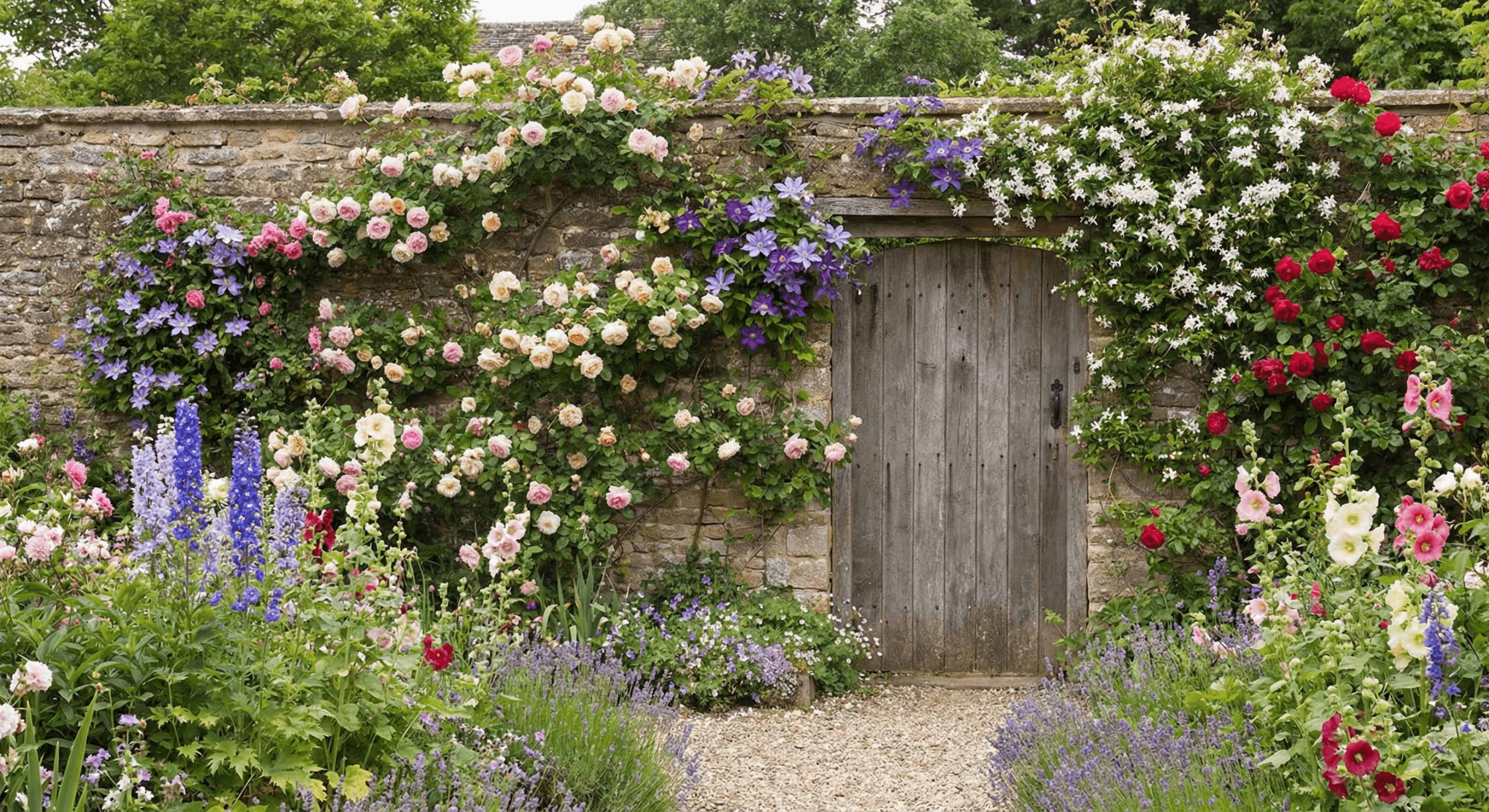
A bare wall or fence is one of the most underused assets in a UK garden. Climbers and wall-trained plants transform stark, lifeless surfaces into living walls – covering ugly boundaries, softening hard landscaping, providing privacy, and creating habitats for birds and insects. They also improve insulation of walls and buildings, and can significantly reduce noise.
5-Step Climbing Plants: What You’ll Need
Before you start, gather these essentials:
- Climbing roses collection — Collection of 3 fragrant climbing roses for walls and fences
- Clematis plants — Assorted clematis plants for climbing on walls and pergolas
- Plant supports — Framework plant support wires for walls and fences
- Rootgrow mycorrhizal fungi — Rootgrow for improved establishment of climbing plants
Choosing the right climbing plant depends on several factors: the aspect of your wall (south-facing will support more sun-loving plants than a north-facing one), the height and spread you need, whether you want evergreen cover or seasonal interest, and how much maintenance you are willing to give.
Understanding How Climbers Attach
Different climbers attach themselves to walls and supports in different ways, which affects how you train them and what support they need:
- Twiners (jasmine, honeysuckle, clematis): Wrap their stems around supports. Need trellis, wires, or mesh to climb.
- Root climbers (ivy, climbing hydrangea, Virginia creeper): Develop small aerial roots that grip surfaces directly. Can damage mortar on old brickwork.
- Scramblers (roses, honeysuckle): Have thorns or stiff stems that hook over supports. Need tying in to a framework.
- Tendril climbers (passion flower, Chilean guava): Develop tendrils that coil around thin supports. Need trellis or wires.
- Self-clinging climbers (ivy, climbing hydrangea): Adhere directly to surfaces via aerial roots. Minimal support needed once established.
Best Evergreen Climbers
For year-round cover and privacy, evergreens are essential. They provide continuous habitat for wildlife and keep your garden looking alive through winter.
Ivies (Hedera): The most reliable evergreens for shade. Hedera helix varieties are particularly useful, with many cultivars offering different leaf shapes and variegation. Ivies are vigorous and will cover large areas quickly. Excellent for north-facing walls. Avoid the non-native Hedera colchica if you are in a rural area – it can become invasive.
Climbing hydrangea (Hydrangea petiolaris): A magnificent self-clinging climber for a large wall. Produces large, flat white flower heads in early summer. Slow to establish but long-lived. Tolerates deep shade and north-facing positions exceptionally well. Deciduous but the winter silhouette of the cinnamon-coloured stems is attractive.
Euonymus fortunei: A self-clinging evergreen that also works as ground cover. Varieties like Emerald Gaiety and Emerald n Gold provide year-round colour. Tougher than it looks – tolerates pollution, shade, and coastal conditions.
Trachelospermum jasminoides (Star jasmine): One of the finest evergreens for a warm, sheltered wall. Highly fragrant white flowers in summer, glossy dark green leaves. Will tolerate temperatures down to about -5C, so best on a south or west-facing wall in most of the UK. Worth the extra care.
Best Flowering Climbers
Clematis: The most diverse and popular group of climbing plants, with hundreds of varieties flowering in every season. For walls and fences:
- Clematis montana: Masses of small white or pink flowers in spring. Very vigorous – cover a large wall or pergola quickly. Ideal for a north wall.
- Clematis viticella: Summer-flowering with bell-shaped flowers in purple, pink, or red. Prune hard in late winter (Group 3 pruning) – easy to manage.
- Clematis tangutica: Yellow lantern-shaped flowers followed by spectacular fluffy seed heads. Summer into autumn.
- Large-flowered hybrids: The dramatic double and single clematis most people think of – varieties like Nelly Moser, The President, and Jackmanii. Most need Group 2 pruning (light trim after first flush).
Climbing roses: The quintessential wall climber. For a south or west-facing wall:
- Madame Alfred Carriere: Pale blush white, highly fragrant, repeat-flowering. Vigorous and healthy. Excellent for a north wall too.
- Guinivere: Deep rose pink, cupped blooms, fragrant. Repeat flowers freely.
- Sombreuil: Creamy white, quartered blooms, intense fragrance. More moderate growth.
- Zephirine Drouhin: Thornless, deep pink, very fragrant. One of the best for a north wall. Repeat flowers through summer.
Jasmine (Jasminum officinale): Highly fragrant white flowers from June to September. Vigorous, twining, and semi-evergreen (loses leaves in cold winters). Best on a warm, sheltered wall. Train on wires or trellis.
Honeysuckle (Lonicera): Wonderfully fragrant, especially at night. Serotina has cream and pink tubular flowers over a long period. Excellent for a north or east-facing wall. Needs tying in to a support as it is a scrambler rather than a true climber.
Planting and Establishing Climbers
Climbers are often planted against walls where the soil is particularly dry (rain shadow from the eaves) and the mortar may be alkaline. Prepare the planting hole well – dig in generous quantities of organic matter and ensure good drainage. Water thoroughly after planting and throughout the first growing season.
The best time to plant is autumn or spring, when the soil is moist and workable. Avoid planting in summer when conditions are too dry, or mid-winter when the ground is frozen.
Once established, climbers generally need little care beyond annual pruning to keep them within bounds. Train new growth horizontally to encourage more flowering shoots to develop.
A wall or fence covered in a well-chosen climber is one of the most beautiful and productive features a garden can have. Whether you want fragrant summer evenings with jasmine, spring colour from clematis, year-round privacy with ivy, or the romance of a climbing rose, there is a climber for every situation in every UK garden.
Frequently Asked Questions
When is the best time to do this?
The ideal time depends on your climate and the specific plants involved. Generally, early morning or late afternoon are best to avoid the heat of the day.
How often should I check on this?
Check your garden at least once a week during the growing season to catch any issues early and keep on top of tasks.
Can I do this in a container instead?
Many garden tasks can be adapted for containers. Use a good quality potting compost and ensure containers have adequate drainage holes.
What if I don’t have the right tools?
Start with the basics — a trowel, fork, gloves, and watering can will get you a long way. Add tools as you need them.
Related Articles
For more help with your garden, check out these related guides:
- Proven Garden Planning 101: Mapping Out Your Garden Space
- Proven Community Garden Guide: Joining and Starting One
- Ground Covers: The Best Alternatives to Grass
- Beginner’s Guide to Growing Sweet Peas
- Best Plants for Pollinators
- Herb Garden Hub
- How to Build a Raised Bed
Continue Reading
- 5-Step Essential Garden Tools: What Every UK Gardener Needs
- Complete Guide to Week 12 Spring Garden Jobs: May 17-23
- Complete Guide to Week 11 Spring Garden Jobs: May 10-16
- Complete Guide to Week 10 Spring Garden Jobs: May 3-9
- Complete Guide to Week 9 Spring Garden Jobs: April 26 – May 2
Frequently Asked Questions
When is the best time to do this?
The best time depends on your climate zone and what you are growing, but generally early morning or late afternoon when temperatures are cooler works best for most garden tasks.
How often should I check on my garden?
Regular attention is key — check your garden every few days during the growing season. This helps you catch problems early before they become serious.
Can beginners do this?
Absolutely! Start with a few simple tasks and build up gradually. Most garden jobs are beginner-friendly with the right guidance.
What is the most important thing to remember?
Consistency matters more than perfection. Little and often beats occasional marathon sessions. Even 10-15 minutes of daily attention yields great results.
