


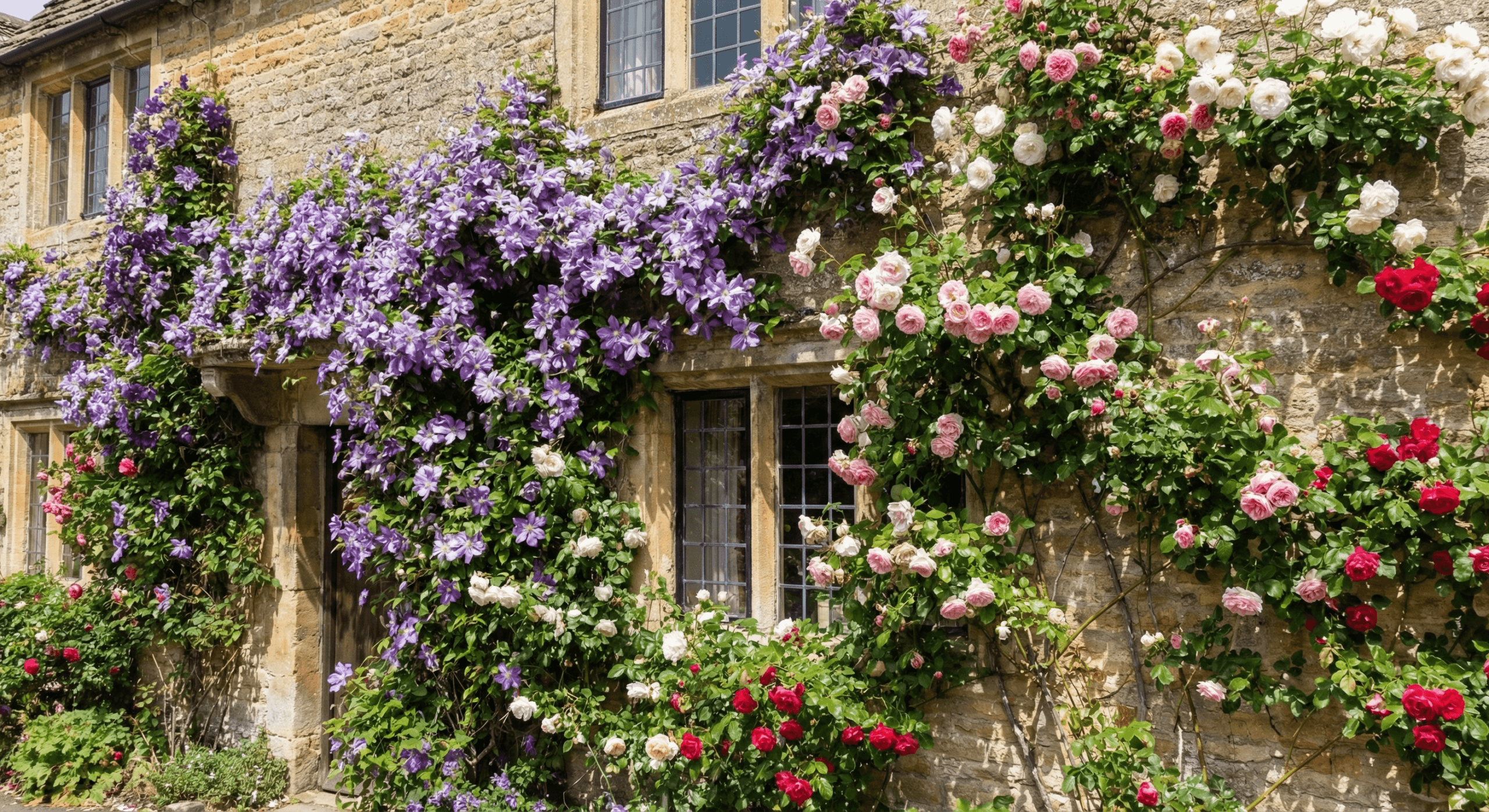
Climbing plants are among the most transformative additions a UK gardener can make to an outdoor space. A bare fence or wall that offers nothing to the eye becomes a living tapestry of foliage, flower, and sometimes fruit. Beyond aesthetics, climbers provide shelter for wildlife, improve the insulation of walls, reduce noise, and can even help manage rainwater. Choosing the right climber for your situation — and training it correctly in its early years — is what determines whether you end up with a thing of beauty or an unmanageable tangle.
5-Step Climbing Plants: What You’ll Need
Before you start, gather these essentials:
- Climbing plants (roses, clematis, jasmine) — Collection of climbing plants for walls and fences
- Plant supports — Plant supports and training wires for climbers
- Trellis — Wooden trellis panels for climbing plants
- Fertiliser — Balanced fertiliser for climbing plants
- Gardening gloves — Durable gardening gloves for pruning and training
Understanding How Climbers Climb
Different climbers use different mechanisms to attach themselves to surfaces, and understanding this determines how to support them and where they can be grown:
- Twining stems: Plants like honeysuckle and wisteria wrap their stems around supports. They need something to wrap around — wires, trellis, mesh, or narrow poles.
- Root tendrils or adhesive pads: Virginia creeper and Boston ivy use small root-like holdfasts to cling directly to walls and surfaces. Self-clinging, requiring no support framework.
- Leaf tendrils: Jasmine and clematis have leaf stalks that curl around supports. They need a fine-mesh support to grip — not wide slats or poles.
- Thorned scrambling: Climbing roses and pyracantha have thorns that hook into support structures. They need to be tied in initially; they don’t cling on their own.
- Twining leaf stalks: Sweet peas use tendrils that wrap around supports. They need netting, mesh, or strings to climb.
Best Climbers for a South-Facing Wall
A south-facing wall is the most valuable growing position in the UK garden — warm, sheltered, and sun-lit for most of the day. These conditions suit plants that need heat to perform well:
Citrus (dwarf forms): In mild areas or a greenhouse/conservatory, citrus like kumquats and calamondins thrive on a south-facing wall in summer, moved under cover in winter.
Grapevines: Extremely well-suited to a south-facing wall. A single vine can cover a significant area, providing both foliage and fruit. Prune hard in winter to keep it manageable.
Jasmine (Jasminum officinale): Highly fragrant white flowers from June to September. Needs support (wires or trellis) and benefits from being tied in during establishment. Semi-evergreen in mild winters.
Passiflora (passion flower): Exotic-looking flowers from July to September. May be damaged in harsh winters but regenerates from the base. Needs wires or trellis.
Bougainvillea: Spectacular colour from summer through autumn in mild areas. Best grown in a pot that can be moved under cover in winter.
Best Climbers for Shaded Walls and Fences
North and east-facing walls receive little direct sun and present a different challenge. The plants that thrive here are those adapted to woodland conditions:
Ivies (Hedera): The most reliable shade-tolerant climbers. Evergreen, vigorous, and excellent for wildlife — dense ivy cover provides shelter for insects, birds, and nesting sites. Many cultivars available with different leaf shapes and variegation. Cut back hard if becomes too vigorous.
Honeysuckle (Lonicera): Performs better in partial shade than full sun, where the flowers fade quickly. Highly fragrant, attractive to moths and bees. Best on a mesh or wire support.
Clematis montana: A vigorous, shade-tolerant clematis that will cover a large north-facing wall quickly. Masses of small white or pink flowers in spring. Prune immediately after flowering if needed to control size.
Virginia creeper (Parthenocissus): Self-clinging, covering walls in vivid red autumn colour. Excellent for large bare walls in shade. Will attach firmly to any surface — keep away from roof tiles.
Best Climbers for Fences
Fences are usually narrower and less massive than walls, and climbers on fences need to be tied in and guided more actively than self-clinging wall plants:
Climbing roses: The classic choice for fence climbing. Hundreds of varieties available, from large-flowered Hybrid Teas to clusters of smaller flowers in Floribunda types. Choose repeat-flowering varieties for longest display. Roses need initial tying to fence rails; they don’t cling.
Clematis: An enormous genus with varieties for every position. Large-flowered hybrids (Clematis patens and C. lanuginosa types) flower from late spring to early summer and again in late summer if pruned correctly. Smaller, more vigorous types like C. montana cover large fences quickly.
Jasmine: Fragrant and attractive, jasmine covers fences well with support. Train young plants by tying in the main stems horizontally to encourage flowering shoots to grow from all nodes.
Thornless Blackberry: A productive and vigorous climber, covering a fence quickly and bearing fruit in summer. Training on horizontal wires makes harvest easier.
Training and Support Systems
New climbers need help finding their footing. For twining and tendril climbers, install a support framework before or immediately after planting:
- Horizontal wires: The simplest and most effective support for most climbers. Space wires 30-40cm apart vertically, and run them horizontally along the fence or wall. Use vine eyes to hold wires 5-10cm away from the wall surface (allowing air circulation and making it easier to tie stems).
- Wooden or metal trellis: Provides a larger surface area for climbers to grip and weave through. Attach to walls or fence posts, leaving a gap behind for air circulation.
- Mesh netting: A cheaper alternative to trellis. Chicken wire or plastic mesh works well for tendril climbers like sweet peas and jasmine.
Planting and Establishment
The most important time for a climber is its first two to three years. Prepare the planting hole well — add a generous amount of organic matter, as climbers are usually planted in inhospitable positions (against walls and fences) where soil quality is often poor from being sheltered from rain.
Plant slightly away from the wall or fence to give roots room to spread into better soil. Water regularly in the first growing season, especially during dry spells. Apply a mulch annually around the base to conserve moisture and feed the plant.
Once established, climbers are generally low-maintenance, but most benefit from an annual trim to keep them within bounds and encourage fresh, vigorous growth. Prune flowering climbers at the appropriate time for their flowering season — spring-flowering climbers after flowering; summer-flowering climbers in late winter or early spring.
Combining Climbers
More than one climber can be trained on the same support, creating a layered effect of different foliage, flowers, and seasons. The key is choosing climbers that don’t compete too aggressively and that have complementary flowering times. Combine a spring-flowering climber with a summer-flowering one, or a foliage-focused climber with a flowering one to extend the season of interest.
Classic combinations: a repeat-flowering climbing rose trained with a late-summer Clematis viticella hybrid; a spring-flowering clematis (C. montana) with a summer-flowering jasmine; Virginia creeper (autumn colour) with a spring-flowering wisteria.
Frequently Asked Questions
When is the best time to do this?
The ideal time depends on your climate and the specific plants involved. Generally, early morning or late afternoon are best to avoid the heat of the day.
How often should I check on this?
Check your garden at least once a week during the growing season to catch any issues early and keep on top of tasks.
Can I do this in a container instead?
Many garden tasks can be adapted for containers. Use a good quality potting compost and ensure containers have adequate drainage holes.
What if I don’t have the right tools?
Start with the basics — a trowel, fork, gloves, and watering can will get you a long way. Add tools as you need them.
Related Articles
For more help with your garden, check out these related guides:
- Best Climbing Plants for UK Walls and Fences
- Understanding Your Soil Type: Clay Sandy Loam or Chalk
- Beginner’s Guide to Sweet Peas
- Best Plants for Pollinators
- Herb Garden Guide
Continue Reading
- 5-Step Essential Garden Tools: What Every UK Gardener Needs
- Complete Guide to Week 12 Spring Garden Jobs: May 17-23
- Complete Guide to Week 11 Spring Garden Jobs: May 10-16
- Complete Guide to Week 10 Spring Garden Jobs: May 3-9
- Complete Guide to Week 9 Spring Garden Jobs: April 26 – May 2
Frequently Asked Questions
When is the best time to do this?
The best time depends on your climate zone and what you are growing, but generally early morning or late afternoon when temperatures are cooler works best for most garden tasks.
How often should I check on my garden?
Regular attention is key — check your garden every few days during the growing season. This helps you catch problems early before they become serious.
Can beginners do this?
Absolutely! Start with a few simple tasks and build up gradually. Most garden jobs are beginner-friendly with the right guidance.
What is the most important thing to remember?
Consistency matters more than perfection. Little and often beats occasional marathon sessions. Even 10-15 minutes of daily attention yields great results.
