


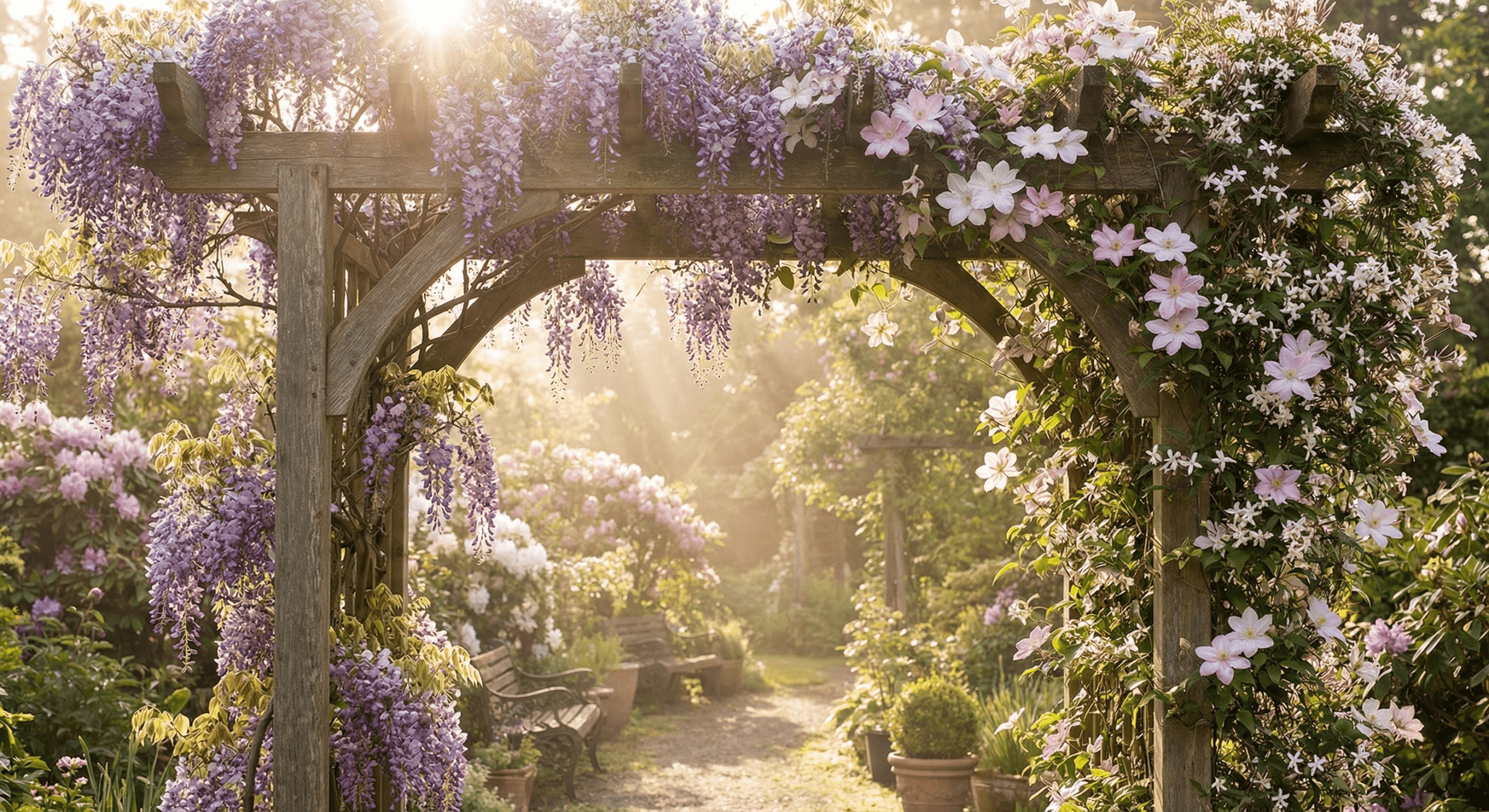
Climbing plants are the garden’s great multipliers — they take what you already have and make it look three times more interesting. A plain wooden fence covered in sweet peas becomes a living curtain of fragrance. A bare brick wall softened by a climbing hydrangea develops a character no amount of paint could achieve. Whether you have a grand pergola or a simple fence post, there’s a climber for every situation. In this comprehensive essential guide, we’ll cover everything you need to know.
Related: Garden Planning 101: Mapping Out Your Garden Space Natural Pest Deterrents: Plants That Repel Pests
For more on essential summer gardening:, see our guide.
For more on essential mulching: single, see our guide.
Looking for quality gardening tools and supplies? Browse our recommended garden products — hand-picked by the GardenWizz team.
Climbing Plants: Vines: Essential: Climbing: Understanding How Climbers Cling
Knowing how a climber attaches itself will save you no end of frustration:
– Twining stems — Plants like honeysuckle and jasmine spiral around supports. They need something thin to wrap around — wires, twine, or narrow trellis.
– Root-like tendrils — Virginia creeper and Boston ivy produce adhesive pads that stick directly to walls and surfaces. No support structure needed.
– Hooked thorns — Roses with climbing habits lean against their support, RHS roses growing guide has detailed guidance on this topic.held in place by their hooked thorns. Tie them in initially.
– Aerial roots — Climbers like Hydrangea petiolaris produce small roots along their stems that grip surfaces directly.
– Scramblers — Plants like jasmine and many climbing roses don’t technically climb — they lean and scramble. They need tying to supports.
The Best Climbing Plants to Choose
For Flowering Drama
Clematis is the queen of climbing plants, with varieties to suit every situation. Large-flowered hybrids like ‘Nelly Moser’ and ‘Jackmanii’ are spectacular on walls and obelisks. For early spring colour, go for the Montana group — vigorous scramblers smothered in small, scented flowers. Late-season interest comes from the viticella group, which flowers from July to October.
Jasmine (Jasminum officinale) is one of the most powerfully fragrant climbers you can grow. Its white summer flowers perfume an entire garden. It’s a twining climber, so give it wires or trellis to climb on. It’s hardy in most UK gardens but appreciates a sheltered spot.
Wisteria is a truly magnificent climber — once established. Its cascading racemes of purple, pink, or white flowers in late spring are genuinely breathtaking. But be warned: wisteria is a commitment.It needs strong, solid supports (it becomes very heavy), annual hard pruning, RHS pruning guide has detailed guidance on this topic.and patient gardeners — young plants can take 5–7 years before they flower.
Honeysuckle (Lonicera) is a wonderful choice for a fence or pergola, offering highly scented tubular flowers that attract moths and bumblebees. ‘Hall’s Japan’ is a particularly reliable and vigorous variety.
For Year-Round Structure
Hydrangea petiolaris (climbing hydrangea) is a slow starter but an absolute corker once established. It produces large, flat heads of white flowers in summer and has beautiful peeling bark in winter. It’s self-clinging and happy on north-facing walls — two things many climbers won’t tolerate.
Virginia creeper (Parthenocissus quinquefolia) is the fast-track to a beautiful wall. Its vivid crimson autumn colour is one of the great seasonal spectacles. It attaches by adhesive pads and needs no support structure. The downside: it’s very vigorous and can get into gutters and eaves if not kept in check.
Ivy (Hedera) is unfairly maligned.Native ivy supports more wildlife than almost any other plant in the British Isles — its autumn berries are vital bird food, RHS soft fruit guide has detailed guidance on this topic RHS winter garden tasks has detailed guidance on this topic..and its evergreen leaves provide shelter for overwintering insects. Modern varieties like ‘Sugar Time’ have beautiful variegated foliage and make excellent, low-maintenance wall covers.
For Quick Results
Sweet peas (Lathyrus odoratus) aren’t true climbers in the woody sense — they’re annuals that grow from seed each year. But they climb enthusiastically (up to 2m in a season) and produce the most extraordinarily fragrant flowers you can imagine. The key is regular cutting — the more you pick, the more they bloom.
Russian vine (Fallopia baldschuanica) is terrifyingly vigorous and has earned a bad reputation as a garden thug. Don’t plant it unless you want to cover a large, structureless eyesore very quickly — and even then, think very carefully first.
Planting and Training Climbing Plants
Most climbing plants are best planted in autumn or spring. Dig a hole at least 30cm away from the base of a wall or fence (the soil there is often very dry) and incorporate plenty of organic matter. The RHS soil testing guide provides detailed advice on understanding your soil type…
Initial training is important. Tie stems to their support in the right direction to encourage even coverage. After that, most climbers need little assistance.
Pruning and Maintenance
Pruning depends entirely on the climber type:
– Clematis are divided into pruning groups depending on when they flower — follow the group-specific guidance
– Wisteria needs two prunes a year: a summer prune (August) to control growth and a winter prune (January/February) to encourage flowering spurs
– Virginia creeper and ivy can be cut back hard each year if they get out of hand
FAQ: Climbing Plants
What climbing plants grow on north-facing walls?
Hydrangea petiolaris, ivy, and most climbing roses will tolerate north-facing aspects. Clematis also does reasonably well, though flowering may be reduced compared to other aspects.
Do climbing plants damage walls?
Generally no, especially with modern mortared brick or render. Self-clinging climbers like ivy and Virginia creeper don’t penetrate the surface — they stick using adhesive pads. Watch for climbers getting into roof tiles, gutters, and under eaves.
What is the fastest-growing climbing plant?
Russian vine and Virginia creeper are among the fastest, but both require very active management. For a slightly more manageable pace, try honeysuckle or a vigorous clematis.
Can I grow climbing plants in containers?
Yes — use a large container (at least 45cm), a sturdy obelisk or trellis support, and a soil-based compost. Wisteria, jasmine, and compact clematis varieties all work well in containers.
How do I stop my climbing rose from becoming leggy?
Train main stems horizontally to encourage side shoots. Shorten side shoots after flowering, and remove the oldest stems entirely every few years to encourage fresh growth from the base.
Final Thoughts
Climbing plants transform gardens. They take flat, uninspiring spaces and turn them into living walls of colour, texture, and fragrance. The secret is choosing the right climber for your specific situation — matching the plant’s growth habit to your available space, support structure, and light conditions. Get that right, and your garden will reach new heights, quite literally.
For more garden transformation ideas, check out our guide to Vertical Gardening: Grow Up, Not Out, for Bigger Harvests.
