




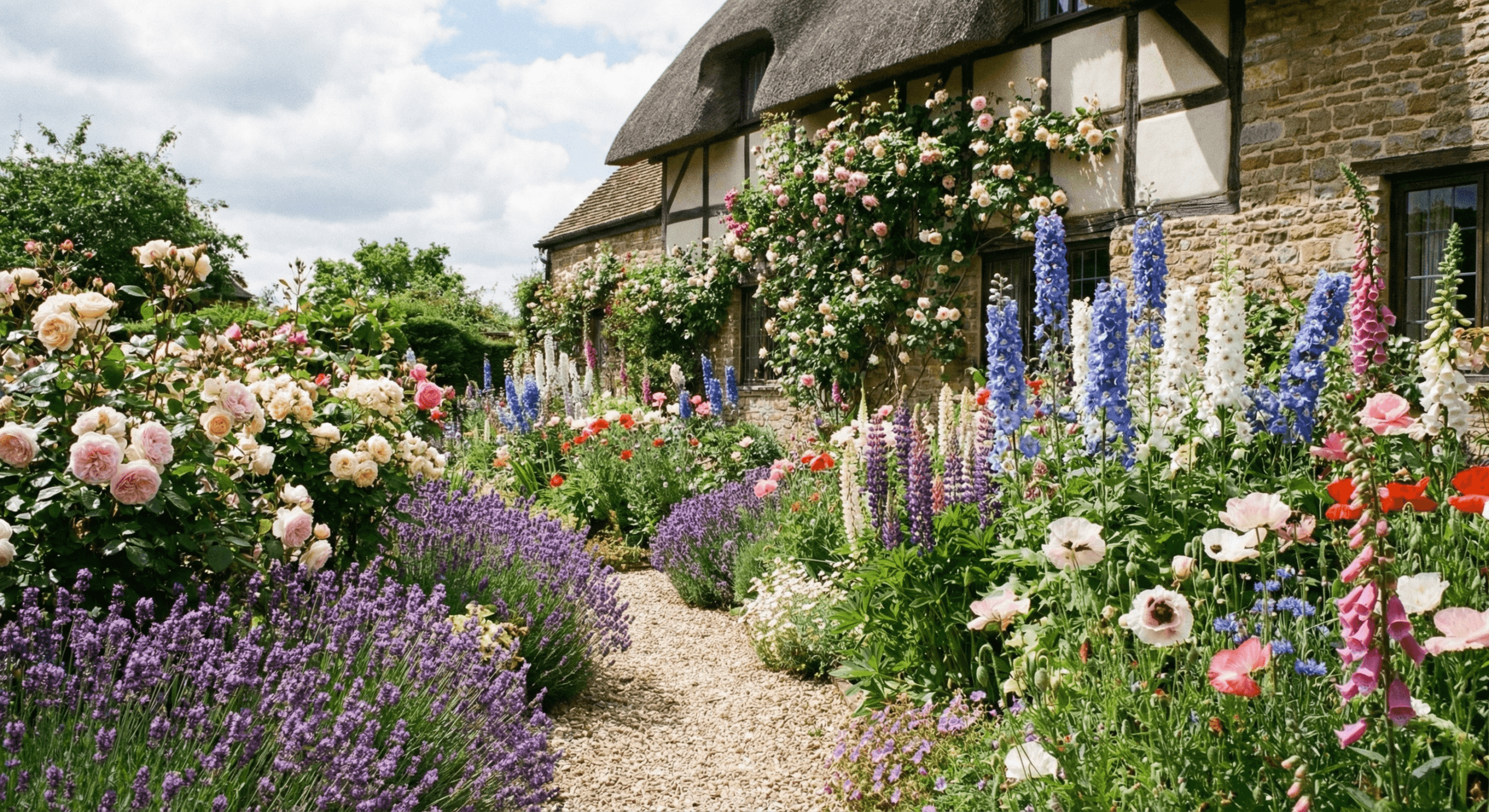
Perennial flowers are the backbone of any beautiful garden. Unlike annuals, which complete their lifecycle in a single season, perennials return year after year — growing larger and more floriferous with each passing season. They’re the gift that keeps giving, and the UK is blessed with an extraordinary range of reliably hardy perennials that thrive in our climate. For more detail, see our UK pollinator-friendly plants.
Perennial Flowers Gardens:: What You’ll Need
Before you start, gather these essentials:
- Lavender plants — English lavender plants for borders and pots
- Geranium plants — Hardy geraniums for ground cover and borders
- Delphinium plants — Tall delphiniums for dramatic cottage garden displays
- Garden fork — For planting and dividing perennial clumps
- Mulch — Organic mulch to suppress weeds and retain moisture
- Plant food — Balanced fertiliser for healthy flowering
Why Grow Perennials?
Once established, perennials require far less work than annuals — no replanting every year, no buying new seeds or modules. They’re also better for pollinators, as many form deep-rooted relationships with specific insects over time. A well-planted perennial border provides colour from late spring through to autumn, and some — like hellebores and bergenia — offer winter interest too.
The key is choosing the right mix: plants that flower at different times, have varying heights and textures, and suit your particular soil and aspect.
Top 10 Perennials for UK Gardens
These are the most reliable, widely grown, and beautiful perennials for UK conditions:
1. Lavender (Lavandula)
The quintessential UK garden plant. English lavender (Lavandula angustifolia) is fully hardy, drought-tolerant, evergreen, and beloved by bees. ‘Hidcote’ and ‘Munstead’ are classic, compact varieties. Plant in full sun in well-drained soil — lavender hates wet feet. Prune lightly after flowering to keep plants compact.
2. Hardy Geraniums (Geranium spp.)
Not to be confused with pelargoniums (the tender “geraniums” sold in garden centres), hardy geraniums are superb ground-cover plants that flower reliably in partial shade. ‘Rozanne’ is the famous long-flowering variety with violet-blue blooms from June to frost. ‘Johnson’s Blue’ is another popular choice.
3. Delphiniums
The stars of the cottage garden, with tall spires of blue, purple, pink, or white flowers in June and July. They’re imposing and dramatic but surprisingly easy to grow in rich, well-drained soil. ‘Black Knight’ and ‘King Arthur’ are reliable hybrids. Feed well and stake tall varieties to prevent wind damage.
4. Achillea (Yarrow)
Achillea is a tough, drought-tolerant perennial with flat flower heads that are irresistible to butterflies and hoverflies. ‘Paprika’ has red flowers fading to pink, ‘Cerise Queen’ is vibrant pink. They’re also excellent cut flowers. Cut back after first flowering for a second flush in autumn.
5. Astrantia (Masterwort)
An elegant, understated perennial that thrives in dappled shade — perfect for those tricky spots under trees. Astrantia major has pin-cushion flowers surrounded by papery bracts in shades of white, pink, and deep red. ‘Shaggy’ (white) and ‘Hadspen Blood’ (deep red) are excellent varieties.
6. Helenium (Sneezeweed)
Heleniums bring bold, warm colour to the garden from July to October — bridging the late-summer gap when many other perennials have finished. ‘Moerheim Beauty’ has copper-red flowers, ‘Sahin’s Early Flowerer’ is orange-yellow. They’re vigorous and reliable in any reasonable soil.
7. Lupins
Lupins are RHS Chelsea Flower Show classics for good reason — tall spires of densely packed flowers in almost every colour. Russell hybrids are the most popular garden varieties. They prefer well-drained soil and full sun. Cut back after flowering for a second, smaller flush.
8. Salvia nemorosa
A compact, easy-going perennial with spires of violet-blue flowers from May to August. ‘Ostfriesland’ (deep violet) and ‘Amethyst’ (lighter blue) are excellent, long-flowering varieties. Drought-tolerant once established and loved by bees.
9. Phlox paniculata
Garden phlox produces big, billowy heads of scented flowers in pink, white, lavender, and red from July to September. They prefer richer soil and benefit from good mulching. ‘David’ is an excellent white variety. Watch for powdery mildew in dry summers.
10. Rudbeckia (Black-eyed Susan)
Rudbeckia fulgida ‘Goldsturm’ is one of the most reliable border perennials — golden yellow daisies with dark centres from August to October. It thrives in any reasonable soil and increases happily over the years. Great for cutting and for late-season pollinators.
Planting and Aftercare
Plant perennials in spring or autumn. Spring planting gives plants a full season to establish before their first winter. Prepare the ground by digging in a generous amount of compost — especially on clay or sandy soils. Water well after planting and keep watered during dry spells in the first year.
Mulch borders annually with 5-8cm of well-rotted compost or bark — this suppresses weeds, retains moisture, and feeds the soil as it breaks down. A balanced granular fertiliser applied in spring gives plants a boost.
Dividing Perennials
Most perennials benefit from division every 3-4 years. This prevents them from dying out in the centre and keeps them vigorous and flowering well. The best time to divide is spring or autumn. Simply dig up the clump, split it into sections with a spade or two forks back-to-back, and replant the healthiest outer pieces.
Feeding
Perennials are not heavy feeders, but a boost in spring helps them grow strongly. Apply a balanced fertiliser (like blood, fish, and bone) in March or April. Avoid high-nitrogen feeds after midsummer — these encourage soft growth that’s vulnerable to frost and slugs.
Perennials are the most rewarding long-term investment you can make in your garden. Start with a few varieties, see what thrives in your particular conditions, and gradually build a border that gives you colour from spring to autumn for years to come.
Frequently Asked Questions
When is the best time to grow flowers in the UK?
Sow annuals in spring (March-May). Plant perennials in spring or autumn.
Do I need any special equipment?
Seed trays, compost, and a sunny spot in the garden.
Can beginners do this?
Yes! Many flowers are very easy to grow from seed.
How long does it take?
Annuals flower in 8-12 weeks. Perennials may take a full season.
Continue Reading
- 5-Step Essential Garden Tools: What Every UK Gardener Needs
- Complete Guide to Week 12 Spring Garden Jobs: May 17-23
- Complete Guide to Week 11 Spring Garden Jobs: May 10-16
- Complete Guide to Week 10 Spring Garden Jobs: May 3-9
- Complete Guide to Week 9 Spring Garden Jobs: April 26 – May 2
Frequently Asked Questions
When is the best time to do this?
The best time depends on your climate zone and what you are growing, but generally early morning or late afternoon when temperatures are cooler works best for most garden tasks.
How often should I check on my garden?
Regular attention is key — check your garden every few days during the growing season. This helps you catch problems early before they become serious.
Can beginners do this?
Absolutely! Start with a few simple tasks and build up gradually. Most garden jobs are beginner-friendly with the right guidance.
What is the most important thing to remember?
Consistency matters more than perfection. Little and often beats occasional marathon sessions. Even 10-15 minutes of daily attention yields great results.


