




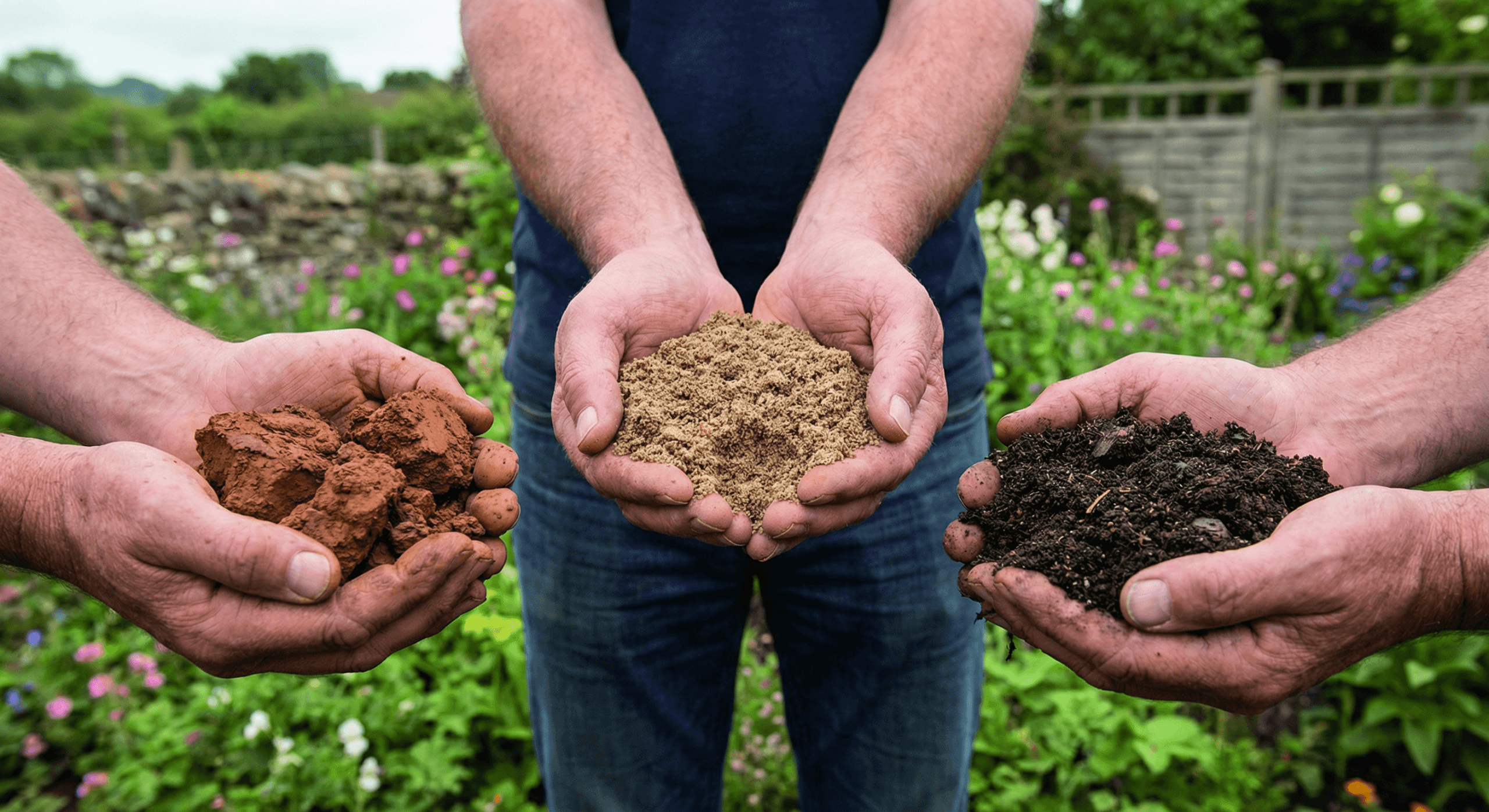
Every garden soil has a character shaped by its geological origins, and understanding that character is one of the most valuable things a gardener can learn. Soil type determines what will grow well, what nutrients are available, how often you need to water, and how to approach improving it. It sounds complex, but identifying your soil type is straightforward, and once you know what you’re working with, everything else falls into place.
5-Step Understanding Soil: What You’ll Need
Before you start, gather these essentials:
- Soil testing kit — Comprehensive soil testing kit for pH and nutrients
- Compost — Organic compost to improve all soil types
- Horticultural grit — Horticultural grit for improving drainage
- Sandy loam topsoil — Quality sandy loam topsoil for raised beds
- Gardening gloves — Durable gardening gloves for soil work
The Simple Test: The Feel Test
The easiest way to identify your soil type is to take a handful of moist soil and squeeze it in your palm. Press it between your thumb and forefinger to form a ribbon:
- If it feels gritty and won’t hold together in a ball, you have sandy soil.
- If it feels smooth and silky, holds together well, and forms a distinct ribbon when pressed, you have clay soil.
- If it feels smooth but also slightly gritty, holds together but not too sticky, and forms a weak ribbon, you likely have a loam — the gardener’s ideal.
- If it fizzes when you add a splash of vinegar, you have a chalky or limy soil (calcium carbonate-rich).
Clay Soil
Clay soils are formed from very fine particles that pack together tightly, leaving little pore space for air and water. This makes them slow to drain, slow to warm in spring, and prone to becoming very hard and cracked in summer drought. However, clay soils are also nutrient-rich and have excellent water-retention — once improved, they can be extraordinarily productive.
The key to improving clay soil is adding organic matter — lots of it, consistently, over years. Well-rotted compost, leaf mould, and farmyard manure are the best amendments. Each year, a layer of 5-10cm worked into the top 15-20cm of soil will gradually transform its structure. Earthworms and soil organisms do the rest, incorporating the organic matter deeper into the profile and creating the aggregates that give good soil its crumbly structure.
Gypsum (calcium sulphate) is sometimes recommended as a clay soil improver — it helps flocculate clay particles, but its effect is modest compared to organic matter and is most effective on sodium-rich clay soils. Grit can also be added to improve drainage, but without organic matter, grit alone is of limited benefit.
Vegetables that thrive on clay: brassicas (cabbage, kale, broccoli), pumpkins,Courgettes, runner beans (which actually prefer heavier soils), and perennial vegetables like rhubarb and globe artichokes.
Avoid on heavy clay: carrots and parsnips (they fork and struggle), early spring potatoes (too wet), and Mediterranean herbs without significant drainage improvement.
Sandy Soil
Sandy soils are the opposite of clay — made from large particles that drain fast and warm up quickly in spring, but also dry out rapidly and struggle to retain nutrients. Nutrients are held in the water film around sand particles, but that water drains fast, taking nutrients with it. Sandy soils are easy to work, rarely compact, and are naturally well-aerated.
The challenge with sandy soil is keeping it moist and nutrient-rich. The key amendments are organic matter — particularly well-rotted compost and manure — which improves both water and nutrient retention. A consistent regime of mulching and digging in organic matter every season will gradually transform sandy soil into a more moisture-retentive growing medium.
Polymer water-retaining granules can be added to container compost to help with water retention, and liquid feeding during the growing season compensates for nutrient leaching.
Vegetables that thrive on sandy soils: carrots and parsnips (grow perfectly straight and smooth), early potatoes (easy to harvest), lettuce, radishes, and most Mediterranean herbs (which love the sharp drainage).
Avoid on sandy soils without amendment: brassicas (nutrients wash through too fast), sweetcorn, and fruiting vegetables that need consistent moisture.
Loam Soil
Loam is the ideal — a balanced mix of sand, silt, and clay particles that gives the best of all worlds: good drainage, good moisture retention, good nutrient-holding capacity, and a structure that’s easy to work. A well-managed loam is dark, crumbly, and full of earthworms. If you have a loam, you’ve won the soil lottery — focus on maintaining it rather than dramatically changing it.
Maintain loam by regularly adding organic matter (compost, manure, leaf mould) to replace what is used up or lost through erosion. Loam isn’t maintenance-free — nutrients are consumed by crops and by soil organisms, and need replenishing. An annual mulch of compost and a rotation of green manures keeps loam productive indefinitely.
Almost anything grows well on loam. It’s the ideal all-round soil for vegetables, fruit, and flowers.
Chalk and Alkaline Soils
Chalky soils are derived from chalk or limestone bedrock and are characterised by a high pH (alkaline). Plants grown in chalky soils may show chlorosis (yellowing leaves) caused by iron being locked up in alkaline conditions — particularly visible on acid-loving plants like rhododendrons, azaleas, and blueberries.
Chalky soils are often shallow — the topsoil may be only 15-20cm deep before you hit the chalk subsoil, which tree roots cannot penetrate. This limits the range of plants that can be grown, particularly deep-rooted vegetables.
Improving chalky soil requires large amounts of organic matter applied consistently. The organic matter acts as a buffer against the alkaline conditions and improves the soil’s moisture and nutrient-holding capacity. Avoid using acidic materials like pine needles or oak leaves as mulch — they will acidify locally but have limited long-term effect on chalk soil pH.
Vegetables that tolerate or prefer alkaline/chalky conditions: brassicas, asparagus, sweetcorn, leeks, and most Mediterranean herbs.
Avoid on chalky soils: acid-loving fruits (blueberries, cranberries), ericaceous plants, and potatoes (which tend to get scab disease in alkaline conditions).
Testing Your Soil’s pH
A simple soil testing kit reveals your soil’s pH — its acidity or alkalinity on a scale of 1-14, where 7 is neutral. Most vegetables grow best in slightly acidic to neutral soil (pH 6.0-7.0). Knowing your pH helps you choose appropriate crops and identify problems:
- pH below 6.0: Acidic soil. Add lime to raise pH if growing brassicas.ericaceous plants may struggle.
- pH 6.0-7.0: Ideal range for most vegetables.
- pH above 7.0: Alkaline/chalky. Add sulphur to lower pH (slowly) or choose crops tolerant of alkaline conditions.
Getting the Most From Your Soil Type
Whatever your soil type, regular additions of organic matter are the single most effective improvement you can make. It improves drainage in clay, adds body to sand, and buffers pH in chalk. It introduces and sustains beneficial soil organisms, which are ultimately responsible for soil fertility. Gardeners with any soil type who consistently add organic matter will find their soil improves year on year, regardless of what it started as. The goal is not to change your soil type entirely — that would take decades — but to work with what you have and create the best possible growing conditions within it.
Frequently Asked Questions
When is the best time to do this?
The ideal time depends on your climate and the specific plants involved. Generally, early morning or late afternoon are best to avoid the heat of the day.
How often should I check on this?
Check your garden at least once a week during the growing season to catch any issues early and keep on top of tasks.
Can I do this in a container instead?
Many garden tasks can be adapted for containers. Use a good quality potting compost and ensure containers have adequate drainage holes.
What if I don’t have the right tools?
Start with the basics — a trowel, fork, gloves, and watering can will get you a long way. Add tools as you need them.
Related Articles
For more help with your garden, check out these related guides:
- Best Climbing Plants for UK Walls and Fences
- Best Climbing Plants for UK Walls and Fences
- Beginner’s Guide to Sweet Peas
- Best Plants for Pollinators
- Herb Garden Guide
Continue Reading
- 5-Step Essential Garden Tools: What Every UK Gardener Needs
- Complete Guide to Week 12 Spring Garden Jobs: May 17-23
- Complete Guide to Week 11 Spring Garden Jobs: May 10-16
- Complete Guide to Week 10 Spring Garden Jobs: May 3-9
- Complete Guide to Week 9 Spring Garden Jobs: April 26 – May 2
Frequently Asked Questions
When is the best time to do this?
The best time depends on your climate zone and what you are growing, but generally early morning or late afternoon when temperatures are cooler works best for most garden tasks.
How often should I check on my garden?
Regular attention is key — check your garden every few days during the growing season. This helps you catch problems early before they become serious.
Can beginners do this?
Absolutely! Start with a few simple tasks and build up gradually. Most garden jobs are beginner-friendly with the right guidance.
What is the most important thing to remember?
Consistency matters more than perfection. Little and often beats occasional marathon sessions. Even 10-15 minutes of daily attention yields great results.


