

At a glance
- Best type for pots: Short-rooted salad radishes, which are small, quick and easy to fit into an ordinary container.
- Compost: Peat-free multipurpose or potting compost in a pot with open drainage holes.
- Sowing depth: About 1cm deep for salad radishes; about 2cm for winter and oriental types.
- Spacing: Roughly 2.5–5cm between salad radishes, and 15–20cm for larger winter and oriental radishes.
- Time to harvest: Salad radishes are typically ready in about six to eight weeks, depending on variety, sowing date and weather.
- Watering: Keep the compost consistently moist; uneven moisture is a common cause of split or poorly swollen roots.
Choose the right radish for a pot

Salad radishes are the most widely grown type and the natural choice for containers. They are small and fast growing, and they can be sown in containers from spring through summer. Look for varieties with an Award of Garden Merit (AGM), which indicates they have performed well in trials. 'French Breakfast' is one AGM summer radish, with cylindrical red and white roots.
Winter radishes are hardy, larger and slower growing. They are sown in late summer for harvesting through winter. Oriental radishes, often called Japanese, daikon or mooli radishes, usually form a long white tapering root and are slow growing. Both need more space and time than salad types, so give them a deeper, wider container if you want to try them in pots.
Pot size, compost and drainage
For short-rooted salad radishes, aim for a large container at least 30cm wide and deep, filled with peat-free multipurpose compost. A shallower 15–20cm container can work for a quick batch of salad radishes, but it holds less compost and dries out faster, so you will need to water more attentively.
For a long-rooted winter or oriental variety, check the expected root length before buying a pot. Choose a deep container with room for the full root, or sow directly into deep soil if you cannot provide that depth. Fill pots with peat-free potting compost. Use a pot with open drainage holes. If you are reusing an undrained plastic container, drill holes in the base before filling it, or choose a different pot.
Sowing and spacing in containers
Sow salad radish seeds about 1cm deep and 2.5–5cm apart, with 15cm between rows. Radish seeds sown outdoors typically take 7–10 days to germinate. Thinning should not be necessary if you sow salad radishes at least 2.5cm apart, and larger winter and oriental radishes at least 15cm apart. If seedlings do come up too close together, remove the smaller, weaker ones as soon as possible to restore the correct spacing.
For winter radishes, sow in July or August about 2cm deep, spacing seeds 15–20cm apart depending on the variety, with 15cm between rows. Sow oriental radishes in spring and summer in a similar way to winter radishes. For a regular supply, sow radish seed directly into warm soil in beds, containers or grow bags every few weeks through summer.
Watering, thinning and troubleshooting
Keep the compost consistently moist to encourage rapid, even growth and succulent roots that do not split. Roots that go short of water may fail to swell, while inconsistent watering can cause them to split. Plants in containers are particularly susceptible to drying out, so water regularly and check the compost rather than following a fixed schedule.
Roots may also fail to swell because of dry conditions, heat or overcrowding. Flowering, or bolting, may happen in hot, dry weather, in which case the root will not develop properly. In warm weather, choose a cooler location in light shade, out of midday sun. Split roots are usually caused by uneven moisture levels, so water during dry spells to keep growth steady. Split roots are usually still edible.
Slugs and snails can damage young radish leaves, so put protection in place after sowing and check seedlings regularly. Flea beetles eat tiny holes in the leaves, but the damage is usually only cosmetic and does not hinder growth. Cabbage root fly larvae tunnel into the roots, especially in late summer. They are unlikely to trouble fast-growing salad radishes, but may cause problems with slower-growing winter and oriental types that are in the ground for longer. Cover those crops with biodegradable fleece or insect-proof netting.
Harvest, storage and repeat cropping
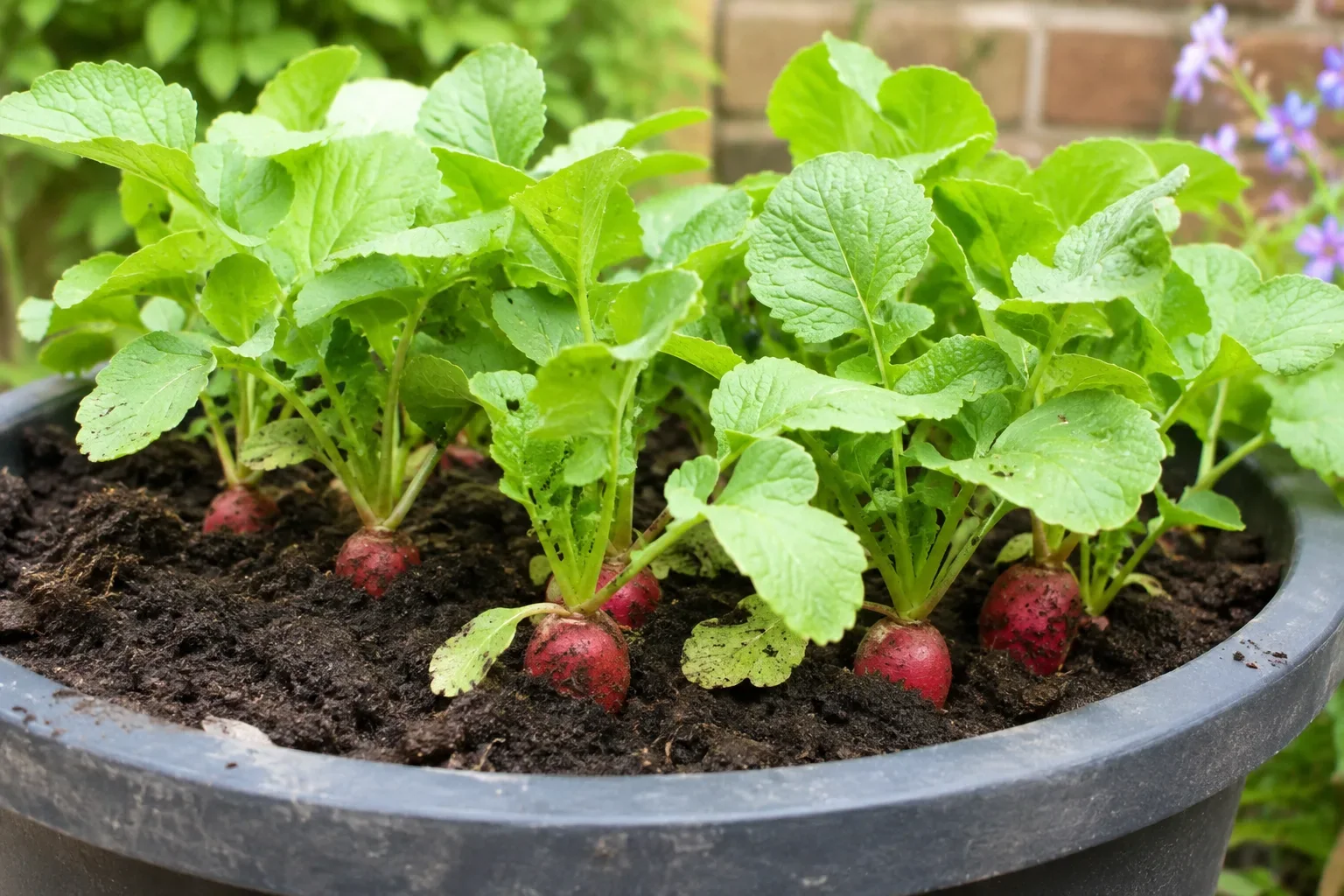
Harvest salad radishes young, when the roots are about 2.5cm in diameter and mildly peppery. Early sowings take a little longer, typically ready in six to eight weeks. If left to get too large or old, or to grow slowly, they become pithy, hot and inedible. Pull as required and eat fresh, when crunchy and at their best.
Winter radishes can be left in the ground and dug up as required through winter, or lifted in November and stored in a fridge or similarly cool place. Protect roots left in the ground with cloches, biodegradable fleece or cardboard in freezing weather.
After a pot radish batch is done, top up the compost and sow again every 2–3 weeks. This keeps a steady supply of small, tender roots through the growing season.
UK seasonal timing
Sow salad radishes in spring, early summer and late summer for best results. Avoid sowing in hot, dry weather, as plants tend to bolt. Spring sowings, when rain is plentiful, are often more successful than summer sowings, when heat and drought may cause poor root development or premature flowering.
If you want an early crop, sow from February in pre-warmed soil protected with cloches. Exact timings vary by cultivar and region, so use these windows as a guide rather than a fixed calendar for every part of the UK. In colder northern and Scottish sites, soil and weather warm more slowly, so wait until conditions are genuinely workable rather than sowing to a date.
Related growing guides
For more on choosing and filling containers, see GardenWizz's guide to containers for growing vegetables. It includes radish-specific depth guidance and covers other quick crops that work well in pots.
Step by step
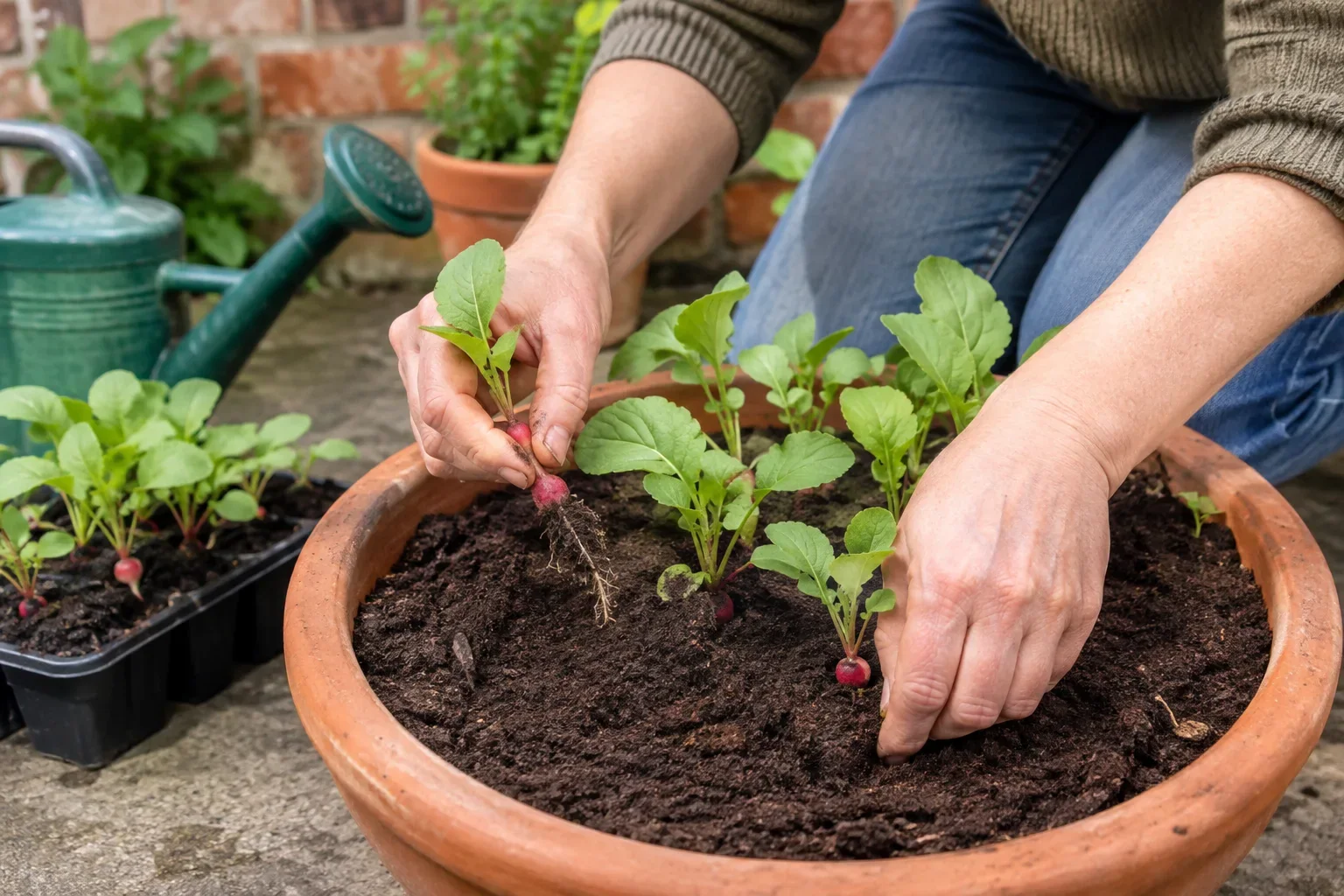
- Fill a pot with drainage holes with peat-free multipurpose compost. Dampen the compost before sowing so the surface is ready to take the seed.
- Sow salad radishes about 1cm deep and 2.5–5cm apart (or winter and oriental types about 2cm deep and 15–20cm apart). Thin crowded seedlings once you can handle them.
- Check the compost throughout the crop. Water when it begins to dry and let surplus water drain from the pot.
- Pull a radish to see how the roots are developing. Harvest the rest as they reach a useful size, then sow another small batch if growing conditions suit.
Frequently asked questions
Can I grow radishes in a shallow window box?
Choose short-rooted salad radishes and check the box has drainage. Give longer varieties deeper containers so the roots have space to form. The seed packet can help you identify the root shape before you choose a pot.
Why are my radishes all leaves?
Thin crowded plants and keep the compost consistently moist. Check whether the plants are making flower stems, especially during hot weather. If the crop has bolted, start a fresh batch when conditions suit the variety.
How do I avoid harvesting every radish on the same day?
Sow part of a pot at a time or use several pots and stagger the sowings. Mark the sowing date on a label. Start checking the earliest batch first, and pull individual radishes as soon as they are ready.
Useful tools and supplies
Affiliate links may earn GardenWizz a commission at no extra cost to you.