

A spider stretched across a web between the roses is usually easier to identify than a small brown one disappearing beneath a flowerpot. Both belong in a healthy garden, but they need different identification clues.
The most reliable approach is to combine appearance, web type, behaviour and location. Colour alone is rarely enough: spiders can vary within a species, while males and young spiders may look quite different from mature females.
You do not need to catch a spider to make a useful identification. A clear photograph, a look at its surroundings and a few notes will often reveal a recognisable species or family. Where several species look alike, identifying the group is a perfectly good result.
Before you start: observe without disturbing
Take a phone or camera into the garden and, if useful, a hand lens for looking more closely without touching. Wear suitable gloves when moving pots, logs or other garden materials, but remove them for camera work rather than trying to handle a spider.
Leave occupied webs, egg sacs and retreats intact. Avoid pulling a spider from a hole or lifting loose bark simply to expose it.
Choose your moment:
- A still morning makes webs easier to photograph, particularly when dew outlines the silk.
- A sunny spell can reveal jumping spiders on walls, fences and foliage.
- Dusk or early evening is useful for spiders that emerge from retreats after dark. Use a torch without probing into their shelter.
Spiders have eight legs and two main body sections. Harvestmen also have eight legs, but their bodies appear as a single compact oval rather than a distinct abdomen joined to the front section by a narrow waist. They are arachnids, but not spiders.
How to identify a garden spider, step by step

1. Note exactly where you found it
“On the patio” is less useful than “at the mouth of a silk-lined crack in a sunny brick wall”.
Record whether the spider is:
- Sitting in the centre of a web.
- Hiding beside a web in a folded leaf or crevice.
- Running over soil, paving or low vegetation.
- Waiting motionless on a flower.
- Exploring a wall, fence or garden building.
Habitat will not settle the identification on its own, but it helps narrow the possibilities.
2. Look at the web before the spider
A web is often the clearest clue available.
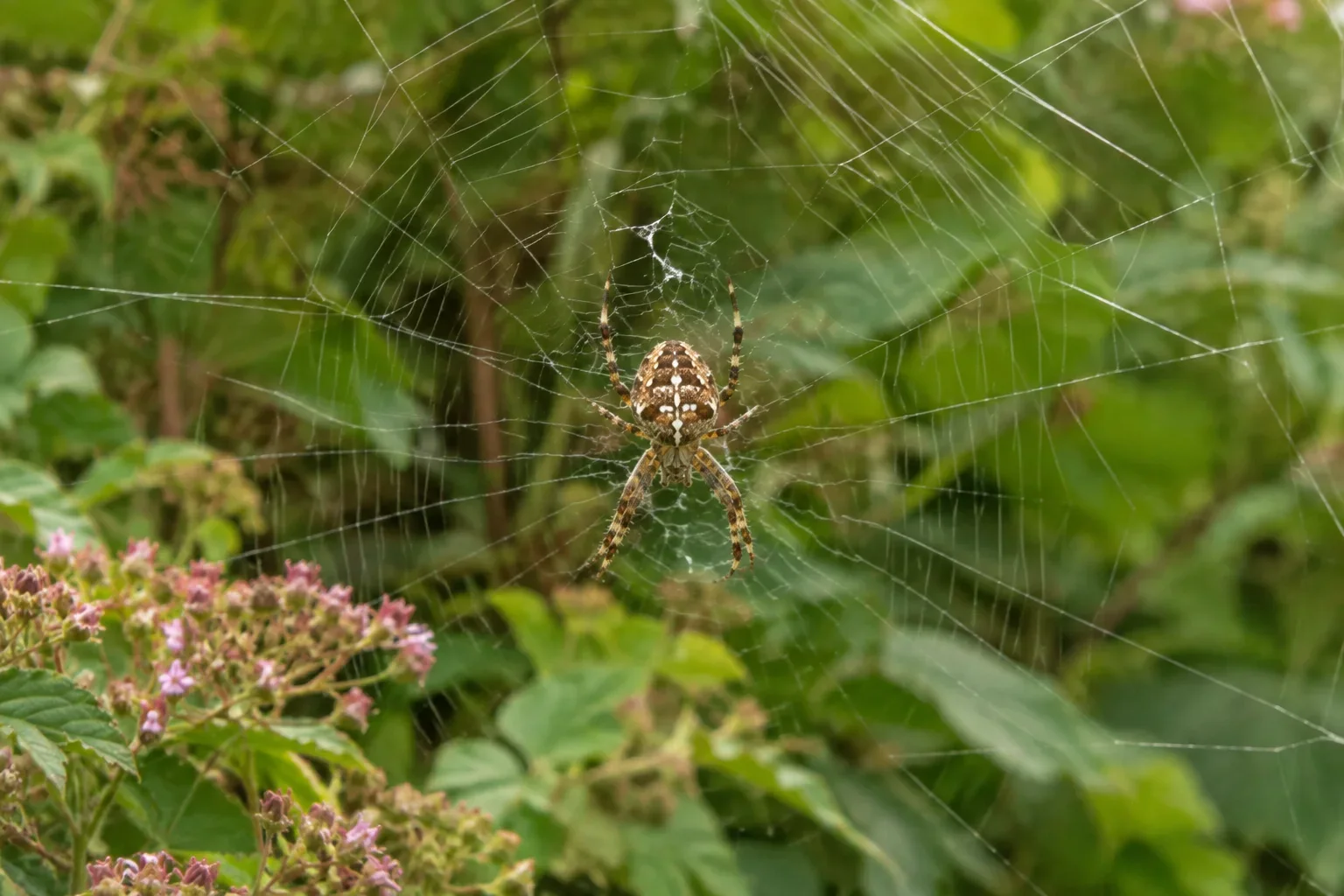
Orb webs have radiating spokes and a spiral of catching silk. Garden cross spiders and missing-sector orbweavers make versions of this familiar design.
Sheet webs resemble a thin hammock or platform, sometimes with a funnel leading into shelter. Several spider groups build them, so check the spider as well.
Irregular tangles are less orderly, often tucked beneath ledges or around sheltered corners. False widows are among the spiders that use this type of web.
Some spiders hunt without a prey-catching web. Wolf spiders pursue prey on the ground; jumping spiders stalk and pounce; crab spiders often wait in ambush.
An apparently empty web may have its owner hidden nearby. Follow a silk line with your eyes rather than tugging it.
3. Photograph useful details
Take one photograph showing the spider in its setting, then closer views if you can do so without disturbance.
The most useful details are the abdomen’s pattern, body shape, leg markings and the arrangement of the eyes. A top view is often helpful, but a side or front view can add important information.
Keep the original photograph rather than relying on an enlarged screenshot. If possible, include a familiar object nearby for scale, without placing anything against the spider or its web.
4. Compare several features
Check the following together:
- Is the abdomen rounded, elongated or flattened?
- Are there spots, stripes, chevrons or a leaf-shaped marking?
- Are the legs banded, spiny, slender or noticeably thick at the front?
- Does the spider sit, run, jump or move sideways?
- Does the web match the proposed identification?
Phone identification apps can suggest possibilities, but treat the result as a starting point. A confident-looking label is not proof, especially for small brown spiders.
Common UK garden spiders to recognise
Garden cross spider — Araneus diadematus
This is the familiar spider in a large orb web between shrubs, fences and garden plants.
Look for a rounded abdomen carrying pale spots that usually form a cross. Background colour varies from pale brown to orange-brown or much darker shades, so the cross is more useful than the overall colour.
Large mature females become particularly conspicuous in late summer and autumn. A male or young spider may be less immediately recognisable.
Best clue: a pale abdominal cross combined with a conventional orb web.
Missing-sector orbweaver — Zygiella x-notata
Often found around window frames, fences and garden buildings, this spider makes an orb web with a distinctive gap: a sector lacks the usual catching spiral. A signal thread runs through that space towards the spider’s retreat.
The spider commonly has a pale, silvery-looking abdomen with a darker central pattern, but the web is often the stronger clue.
Best clue: an orb web with a missing wedge and a retreat nearby. Do not mistake a randomly damaged web for this deliberate structure.
Nursery web spider — Pisaura mirabilis
A long-bodied spider of grasses, herbaceous growth and other vegetation, the nursery web spider often rests with its front legs extended forwards.
It is generally brown or grey-brown, with a pale stripe along the centre of the front body section and a variable darker pattern on the abdomen.
Females carry an egg sac in their jaws before placing it in a silk nursery among vegetation and guarding the young.
Best clue: its elongated shape and resting posture; an egg sac held at the front provides another useful clue.
Wolf spiders — family Lycosidae
These are the quick-moving, usually brown spiders seen running across bare soil, paths and short vegetation. They hunt rather than relying on a prey-catching web.
Their markings can resemble those of other brown spiders. Eye arrangement helps confirm the family in a sufficiently clear close-up, but species-level identification is often difficult.
A female may carry a rounded egg sac attached at the rear. Later, the spiderlings ride on her abdomen.
Best clue: active ground hunting, sometimes with an egg sac carried behind rather than in the jaws.
Zebra jumping spider — Salticus scenicus
A small, compact spider with bold black-and-white markings, often seen on sunny walls, fences and garden furniture.
It moves in short bursts, turns to inspect its surroundings and can leap between surfaces. Its large forward-facing eyes are striking in a close photograph.
Best clue: contrasting zebra-like markings combined with alert, stop-start movement. Other jumping spiders occur in gardens, so not every small jumping spider is this species.
Crab spiders — family Thomisidae
Crab spiders have prominent front legs that extend sideways, giving them a crab-like stance. Some wait on flowers for visiting insects; others live on foliage, bark or near the ground.
The flower crab spider, Misumena vatia, can be white or yellow, sometimes with reddish markings. Its occurrence is more localised than that of many familiar garden spiders, so colour alone should not be used to name it.
Best clue: sideways-held front legs and an ambush posture. Family-level identification is often the sensible stopping point.
False widows — genus Steatoda
False widows make irregular webs in sheltered places, including sheds, greenhouses and beneath outdoor fittings. They typically have a rounded abdomen and comparatively slender legs.
The noble false widow, Steatoda nobilis, may have a pale cream pattern on a dark, glossy abdomen, but markings vary. Other Steatoda species can look similar, and supposed “skull” patterns are not a reliable identification test.
Best clue: body shape, abdominal pattern and a sheltered tangle web considered together. Avoid identifying a false widow from dark colour alone.
Lace-web spiders — genus Amaurobius
These sturdy, dark spiders often live around walls, fences, window frames and crevices. Their silk can look woolly or lace-like, particularly around the entrance to a retreat.
Several British species resemble one another. A photograph may support a genus-level identification without resolving the exact species.
Best clue: lace-like silk around a crack, with the spider often appearing near its entrance after dark.
Common mistakes and difficult sightings
Assuming every large brown spider is the same
Long-legged house spiders may turn up in sheds and garden buildings, while wolf spiders and nursery web spiders occur outdoors. Compare proportions, behaviour and web structure rather than size alone.
Expecting colour to stay consistent
Lighting, age and individual variation can alter a spider’s appearance. Wet silk and camera flash can also obscure markings. Revisit in better light if the photograph is unclear.
Forcing an exact species identification
Some spiders require microscopic examination of adult features for reliable identification. “Wolf spider” or “lace-web spider” may be more accurate than an unsupported species name.
If identification matters, ask a specialist recording group or experienced arachnologist, supplying photographs, date and location.
Handling a spider to test whether it is dangerous
Do not pick up, squeeze or provoke a spider. Photograph it in place. If one needs moving from an awkward indoor position, use a container and card rather than bare hands, where this can be done safely.
If a suspected bite causes significant or worsening symptoms, seek medical advice rather than relying on a photograph-based identification.
Seasonal follow-up and garden care
In spring and summer, look for active hunters on foliage, flowers and sunny surfaces. Late summer and autumn bring conspicuous mature orbweavers and their webs. Their increased visibility does not necessarily mean the garden has suddenly gained more spiders.
During winter, activity is less obvious, but spiders and egg sacs remain in sheltered places. Take care when clearing stems, moving stored pots or tidying sheds.
After observing a spider, leave its web and retreat undisturbed where practical. Retain some sheltered vegetation, leaf litter and undisturbed corners, and avoid unnecessary pesticide use.
Keep a simple seasonal photo record. Returning to the same web or patch of vegetation can reveal details missed on the first visit—and turn an uncertain glimpse into a much more confident identification.

Useful tools and supplies
Affiliate links may earn GardenWizz a commission at no extra cost to you.