Clustered bellflower
Campanula glomerata
The Gardening Year
Best months in UK gardens · full planting calendar →
🖨 Print-friendly care cardAt a Glance
| Botanical name | Campanula glomerata |
|---|---|
| Common name(s) | Clustered bellflower |
| Family | Campanulaceae |
| Plant type | perennial |
| Height × Spread | 20–90 cm × 50–100 cm |
| Position | Full sun |
| Soil | fertile neutral to alkaline, moist but well-drained |
| Flowering | June–September |
| Toxicity | Not yet established. Do not assume this plant is safe for people or pets. |
| Native range | North Temperate Zone of Eurasia, from Britain to Japan |
Overview
Campanula glomerata belongs to the bellflower family, Campanulaceae. Kew’s Plants of the World Online accepts the scientific name and describes the species as a perennial of temperate Eurasia, including Great Britain within its native range. The Royal Horticultural Society also records clustered bellflower as native to Great Britain and Ireland.
Its garden character comes from a combination of strong upright stems, dark green foliage and tightly grouped flowers. The plant spreads by short rhizomes to form an increasingly substantial clump. That growth can be useful when a border needs a dependable patch of summer colour, although neighbouring plants should be given enough room. Rhizomatous does not automatically mean invasive: its performance will vary with soil, moisture and competition, and an expanding clump can be divided when it becomes too broad.
Clustered bellflower works naturally in a herbaceous border, a cottage-style planting or the lighter edge of a woodland garden. Its flower colour is clearest where the heads can be seen against contrasting foliage. Full sun generally supports sturdy flowering growth, while partial shade is also suitable and may help delicate flower colours last. A position with good drainage is more important than providing winter wrapping.
The species is the subject of this guide. Named selections can differ in vigour, height, flower size and pest observations, so cultivar descriptions should not be treated as measurements for every Campanula glomerata. In particular, the familiar selection ‘Superba’ is distinct from the unselected species.
Appearance
Fresh shoots rise from the perennial rootstock in spring and develop into erect, leafy stems. The lower leaves have stalks, while leaves higher on the stem are attached more closely. The foliage is dark green and broadly ovate, providing a solid background for the saturated flower colour.
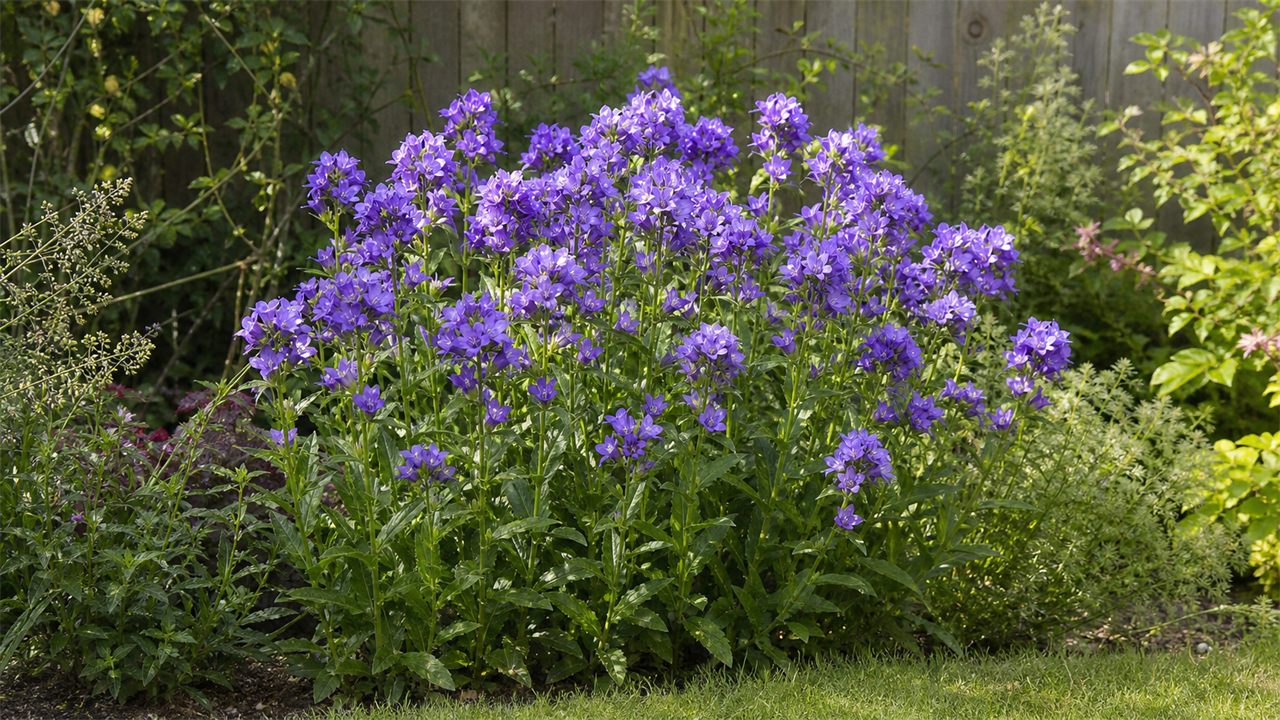
The defining feature is the inflorescence. Bell-shaped flowers sit close together in a dense cluster, principally at the top of the stem, with leafy bracts around them. This compact head gives the plant a bolder, more upright outline than bellflowers with scattered or dangling blooms. Flowers are usually deep violet-blue, although white-flowered plants also occur. The garden display is best described as summer flowering because timing varies with locality, weather and site; a botanical account for the typical subspecies records flowering and fruiting in June and July.
The RHS describes the species at about 45 cm high and gives a broader mature height range of 10–50 cm, with a spread of 50–100 cm. Individual plants may sit at different points within those ranges. Rich soil, moisture, age and the identity of a named selection can all affect the final dimensions. The stems are normally self-supporting in an open site, but crowded growth or overly lush conditions can reduce the neatness of the clump.
After flowering, seed can develop unless the stems are cut back. The top growth is deciduous, dying down as the growing season ends and returning from below ground. Marking the position of a newly planted clump can help prevent accidental disturbance while it is dormant.
Growing Conditions
Choose a site in full sun or partial shade. In much of the UK, an open border with several hours of direct light gives a strong display. Light afternoon shade is a useful alternative in a warm, exposed garden and may slow the fading of delicate colours. Deep, dry shade is less suitable because the species prefers both useful light and reliable soil moisture.
The best soil is fertile, moisture-retentive and free draining. The species is suited to chalk, sand or loam and prefers neutral to alkaline conditions. These preferences make it a good candidate for many limy or chalk-influenced gardens, provided the soil does not dry out severely. On very free-draining sandy ground, incorporate suitable organic matter before planting to improve moisture retention and watch new plants closely during dry spells.
Heavy soil requires a different judgement. Persistent winter wet is a greater concern than low temperature for an established plant. Do not place the crown in a hollow where water collects. Improve the structure and drainage of a workable heavy soil, or select a raised or naturally better-drained position. A site that stays saturated for long periods is unsuitable even if it looks adequately moist in summer.
Allow for the eventual spread rather than planting several young specimens tightly together. Adequate spacing also improves airflow, which is helpful where foliar diseases have occurred. Clustered bellflower combines well with perennials that enjoy similar soil but should not be allowed to smother small, slow-growing neighbours as its clump matures.
Planting and Care
Plant while the soil is workable, avoiding frozen ground, severe drought and waterlogged conditions. Dig a hole wide enough to settle the roots without bending them, keep the crown at approximately its previous soil level, firm gently and water thoroughly. Continued watering is important during establishment. Thereafter, aim for evenly moist soil during active growth, especially in prolonged dry weather, while allowing surplus water to drain away.
The available species evidence does not establish a special feeding regime. Begin with fertile soil rather than applying heavy routine feeds. If an established clump grows poorly, first check light, moisture, drainage and competition before deciding that nutrients are lacking. This avoids producing unnecessarily soft growth or masking a siting problem.
Cut back the flowering stems after the main display. This reduces self-seeding and may encourage a second flush. Where seed is wanted for propagation, leave a limited number of healthy stems to mature rather than retaining every spent head. Remove the remaining dead top growth in autumn or once it has ceased to be ornamental, taking care not to damage the crown.
Division is the most direct way to manage an enlarged clump and produce matching plants. Lift and split established growth in spring or autumn, retaining healthy rooted sections and replanting them promptly at their original depth. Water divisions in and do not let their roots dry out while they re-establish. Spring division gives a full growing season before winter; autumn division is best undertaken while soil conditions remain suitable.
The species can also be raised from seed. Seed-grown plants may vary, particularly where nearby campanulas have contributed pollen, so this method is not the way to preserve the exact characteristics of a named cultivar. Basal softwood cuttings can be taken in spring: select fresh shoots from near the base and handle them before the tissue becomes tough. These propagation methods require clean material and steady moisture without saturation.
Seasonal care is straightforward. In spring, clear damaging debris from emerging shoots, divide overcrowded clumps if necessary and check for slugs and snails. Through summer, maintain moisture during dry spells and cut back spent flowering stems. Autumn offers another division window and a chance to remove declining growth. In winter, inspect drainage after prolonged rain; a correctly sited established plant needs no routine frost wrapping, but no degree of cold hardiness compensates for persistently saturated soil.
Common Problems
Slugs and snails are the most likely pests, particularly around soft new shoots. Inspect emerging growth promptly rather than waiting until whole stems have disappeared. Reduce unnecessary hiding places immediately around the crown and use a garden-appropriate control approach where damage is significant. Avoid assuming that aphids are a defining species problem: the evidence reviewed mentions them on the named selection ‘Superba’, not as a species-wide certainty.
Rust, powdery mildew and leaf spot are possible diseases. Symptoms differ, but discoloured patches, powdery coatings or spotted leaves should prompt closer inspection. Good spacing and airflow reduce the humid, stagnant conditions in which foliage problems can become more troublesome. Remove badly affected leaves and clear diseased debris rather than leaving it packed around the crown. Keep the plant adequately watered at soil level during dry weather, since stressed plants can be less resilient, but do not turn the root zone into a permanently wet site.
Weak flowering often points to unsuitable growing conditions rather than disease. Excessive shade, severe dryness, waterlogged soil or crowding by stronger neighbours can all limit performance. Review the site as a whole before adding feed. Floppy, congested growth can likewise indicate that the clump needs division or that conditions are encouraging growth that is too lush.
No authoritative species-specific veterinary or poison-control evidence was identified in the reviewed horticultural sources to classify Campanula glomerata as either safe or toxic to cats and dogs. It should therefore not be labelled “pet-safe”. If a pet is suspected of eating the plant and becomes unwell, contact a veterinary professional promptly and provide the plant’s botanical name where possible.
Popular Varieties
The reviewed evidence for this article verifies one named selection, Campanula glomerata ‘Superba’. The RHS describes ‘Superba’ as a vigorous plant that can form a wider colony, reaching about 60 cm and carrying deep violet-purple flowers approximately 3 cm long. These are cultivar-specific details and should not be transferred to every plant sold simply as Campanula glomerata.
No further named cultivars were sufficiently documented in the reviewed horticultural sources to support a reliable three-item list. Rather than presenting unverified names, gardeners should check the full label and buy from a supplier that states whether a plant is the species, ‘Superba’ or another independently documented selection. The unselected species remains a valid choice where a naturally variable, vigorous clustered bellflower is wanted.
When comparing plants, prioritise verified mature size, flower colour and growth habit over promotional wording. A compact selection may be preferable beside smaller perennials, while a vigorous colony-former needs more space. White and violet-blue flower colours occur within the species, but a colour description alone does not establish a cultivar identity. Keep the label after planting so later decisions about spacing, division and propagation can be based on the plant actually purchased.
Evidence basis: RHS species profile, RHS ‘Superba’ profile, RHS Campanula guide, Kew Plants of the World Online and Kew’s account of the typical subspecies.
Pests and Diseases
| Problem | Symptoms | Management |
|---|---|---|
| Powdery mildew | White, dusty fungal growth appears on leaves and stems, often causing distortion. | Improve air circulation and water at the base; apply a fungicide if severe. |
| Slugs and snails | Irregular holes in leaves and silvery slime trails on foliage and soil. | Use physical barriers, iron phosphate pellets, or hand-pick at night. |
| Aphids | Clusters of small soft-bodied insects on new growth, often accompanied by sticky honeydew. | Spray off with water or use insecticidal soap; encourage natural predators like ladybirds. |
| Root rot | Yellowing, wilting leaves despite moist soil, often due to poor drainage. | Ensure well-draining soil and avoid overwatering; remove affected plants if severe. |
Or browse the full plant problem solver to diagnose an issue by symptom.