Japanese Spiraea
Spiraea japonica
The Gardening Year
Best months in UK gardens · full planting calendar →
🖨 Printable care card (PDF)At a Glance
| Botanical name | Spiraea japonica |
|---|---|
| Common name(s) | Japanese Spiraea |
| Family | Rosaceae |
| Plant type | shrub (Deciduous, perennial shrub) |
| Height × Spread | 1.2–2 m × 1.2–2 m |
| Position | Full sun, Partial shade |
| Soil | Moist but well-drained; fertile, well-drained soil; rich, moist loam; tolerates alkaline soils |
| Flowering | June–August |
| Toxicity | Not known to be toxic to humans, dogs, cats or livestock. |
| Native range | Japan, China, and Korea |
Overview
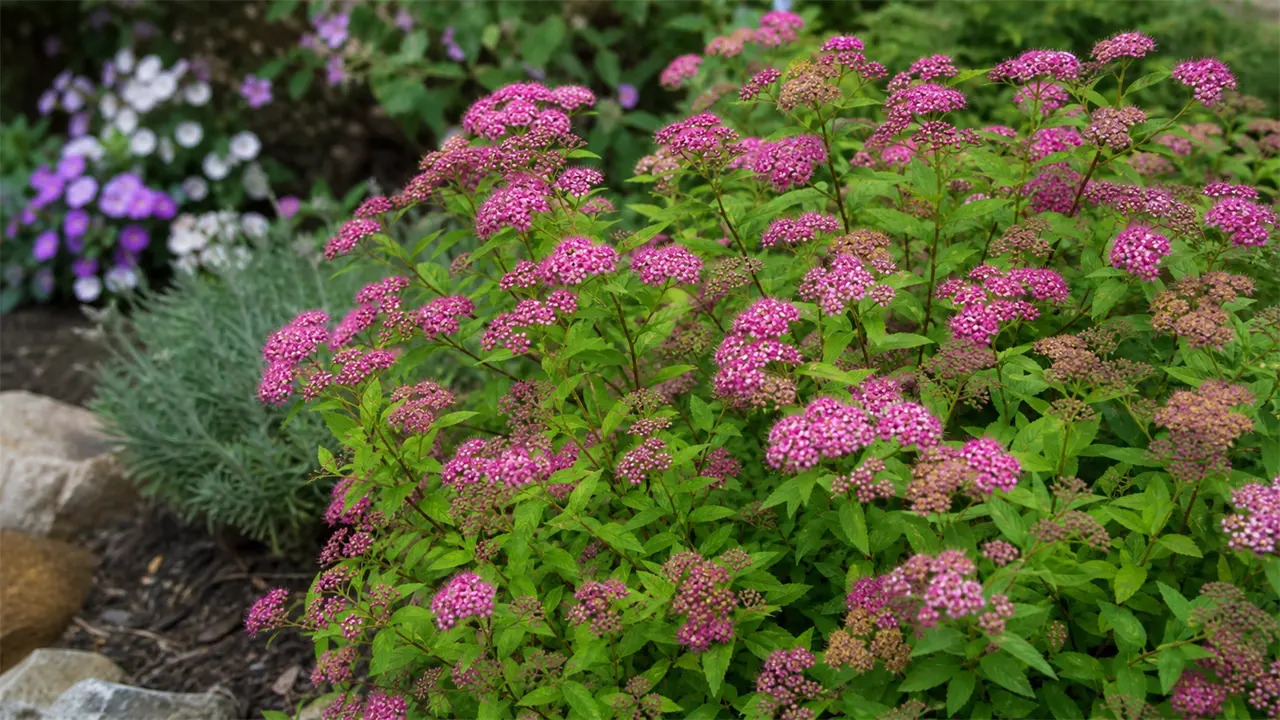
Japanese spiraea (Spiraea japonica) is a compact, deciduous flowering shrub in the family Rosaceae, native to Japan, China and Korea. It is widely planted across the UK in mixed borders, low informal hedges, banks, and ground-cover groupings, valued for its reliability, its tolerance of a wide range of soils, and its dense show of pink or crimson flowers carried in flat-topped clusters (corymbs) from early to late summer. Mature plants reach roughly 60–120 cm in height with a similar spread, depending on cultivar, and most modern cultivars are derived from the species and from crosses with the closely related Spiraea albiflora. Japanese spiraea is hardy across most of the UK, tolerates urban pollution, and performs reliably on heavy clay as well as lighter loams.
Appearance
The plant forms a low, mounded, twiggy shrub with erect to slightly arching shoots that emerge from ground level. Stems are slender, brown to reddish-brown when young, becoming greyer with age, and the bark on older wood peels in thin vertical strips. Leaves are alternate, simple, ovate to lanceolate, 4–10 cm long, with finely serrated margins. Foliage colour varies notably between cultivars: many forms flush bronze or reddish in spring, mature to mid-green through summer, and take on dull yellow or russet tints in autumn before leaf fall. A number of cultivars retain golden or lime-yellow foliage throughout the growing season, with the brightest colour produced on young growth.
Flowers are small, five-petalled, and carried in dense, flattened corymbs 5–10 cm across at the tips of the current season's shoots. The typical wild species is mid-pink, but cultivars span pale blush-pink through rose-pink to deep carmine. Individual blooms are short-lived but each cluster opens over several weeks, giving an extended display from June into August. Fruits are small, dry follicles that ripen in late summer; they are ornamentally insignificant and most gardeners remove spent flowerheads as part of routine maintenance.
Growing Conditions
Japanese spiraea is among the more adaptable flowering shrubs for UK gardens. It performs best in full sun, where flowering is profuse and foliage colour on golden-leaved cultivars is at its most intense, but it tolerates light dappled shade, particularly in southern England. Soil can range from slightly acidic to moderately alkaline; a pH between about 5.5 and 7.5 is acceptable. The plant is tolerant of clay, provided drainage is not waterlogged in winter, and it establishes well on chalk, loam, and improved sandy soils. Mulching in spring with well-rotted organic matter is beneficial on thin or free-draining ground.
Siting should take account of the shrub's spreading habit; allow at least 90 cm between plants for specimen use, or 60 cm for informal hedging. Japanese spiraea is reasonably wind-tolerant and is suitable for exposed and coastal gardens, although salt-laden maritime winds may scorch young foliage in spring. Container cultivation is possible using a loam-based compost such as John Innes No. 3, though long-term performance is better in open ground. The plant has a hardiness rating that allows reliable cultivation across all but the most exposed or northerly UK locations; gardeners in colder inland or upland sites should verify suitability locally before planting.
Planting and Care
Planting is best done between October and March, while the plant is dormant, avoiding periods when the ground is frozen or waterlogged. Container-grown stock can be planted at any time of year provided irrigation is supplied during dry spells in the first growing season. Prepare the planting hole at least twice the width of the rootball and to the same depth, incorporating garden compost or well-rotted manure into the backfill for poorer soils. Water in well and apply a 5–8 cm organic mulch, keeping it clear of the stems.
Watering is essential during the first full growing season; thereafter established plants tolerate short dry spells without intervention. In containers, watering is required throughout the growing season whenever the top 2–3 cm of compost feels dry. Feeding need only be light: a single application of a balanced slow-release fertiliser in early spring, or a top-dressing of well-rotted compost, is sufficient for border plants. Overfeeding produces leafy growth at the expense of flower.
Pruning is the key annual task. Japanese spiraea flowers on wood produced in the current year, so pruning is carried out in late winter or early spring (February to March), before buds break. There are two common approaches. The first is hard annual pruning: cut all stems back to within 10–15 cm of the ground, removing weak and crossing shoots entirely. This produces vigorous new growth and large flower clusters at a uniform height, and is the standard method for cultivar groups such as 'Anthony Waterer' and 'Goldflame' when grown as ground cover. The second is a renewal approach: remove roughly one third of the oldest stems to ground level each year, leaving younger stems intact and shortening remaining growth by one third. This gives a more naturally shaped shrub, around 1–1.2 m tall, suitable for specimen planting. Light deadheading of spent flowerheads in late summer, although not essential, can tidy appearance and may encourage a smaller secondary flush on some cultivars.
Propagation is straightforward. Semi-ripe cuttings 8–12 cm long, taken from healthy current-season shoots in July or August and inserted into a 50:50 mix of peat-free multipurpose compost and sharp sand or perlite, root readily under a propagating lid or in a shaded cold frame. Hardwood cuttings taken in late autumn also succeed. Seed propagation is possible but slow and will not come true to cultivar.
Seasonal care is modest. In spring, apply mulch and feed, then prune as above. During summer, monitor for aphids on tender new growth and water container-grown plants in dry spells. In autumn, allow the plant to enter dormancy without further intervention. Winter protection is generally unnecessary in the UK, except for container specimens in very exposed positions, where the pot can be moved against a wall or wrapped in hessian.
Common Problems
Japanese spiraea is largely trouble-free in UK gardens. Pests are uncommon; the most frequently observed is the green aphid, which colonises young shoots in late spring and may cause slight leaf curl. Heavy infestations are unusual and respond to squashing, a strong jet of water, or, in severe cases, a fatty acid-based insecticide. Capsid bugs can occasionally cause distorted new growth.
Diseases are infrequent. Powdery mildew may appear on plants grown in dry shade with poor air circulation; improving airflow by light pruning, and ensuring consistent watering at the base rather than over the foliage, normally controls it. Fireblight (Erwinia amylovora) is a notifiable bacterial disease of the Rosaceae family; although spiraea is not one of the most commonly affected hosts, affected shoots showing characteristic shepherd's-crook wilting should be cut back at least 30 cm below visible symptoms and disposed of by burning or local-authority collection. Leaf spot fungi may cause small dark markings late in the season but are rarely significant.
Non-pathological issues include chlorosis on very alkaline soils, which manifests as yellowing between the leaf veins and is best addressed with chelated iron or by mulching with organic matter to gradually moderate pH. Frost damage to early spring growth can occur after a late cold snap; affected shoots usually recover once warmer weather returns.
Toxicity: Japanese spiraea is not considered toxic to humans, dogs, cats, or livestock. There is no widely cited veterinary warning; however, as with many garden plants, the foliage and flowers may cause mild stomach upset if ingested in quantity by pets, and gardeners with grazing animals may prefer to site plants away from paddock boundaries.
Popular Varieties
Several cultivars of Spiraea japonica are widely available from UK nurseries and garden centres. The following are well-established, long-selling forms and are reliable choices for British gardens:
- 'Anthony Waterer' — the best-known cultivar, with bronze-tinted young foliage maturing to mid-green, and crimson-pink flower clusters in mid to late summer. Upright habit, reaching around 90–120 cm.
- 'Goldflame' — a popular golden-leaved form, with orange-red spring growth turning bright yellow in summer and russet in autumn. Rose-pink flowers. Height roughly 60–90 cm.
- 'Goldmound' — a compact selection with vivid lime-yellow foliage through summer, pink flowers, and a lower, mound-forming habit to around 60 cm. Useful for the front of a border.
- 'Little Princess' — a small, mounded shrub to about 50–60 cm, with neat mid-green leaves and pale pink flower clusters. Often used in low maintenance and ground-cover plantings.
- 'Magic Carpet' — selected for its strongly coloured foliage, flushing red and bronze in spring, maturing to a golden-yellow with reddish tips, with pink flowers. Compact, to roughly 60 cm.
- 'Crispa' — distinguished by deeply cut, almost jagged leaf margins; bronze-tinted foliage and pink flowers. Height around 60–90 cm.
Several of the above have received the Royal Horticultural Society's Award of Garden Merit (AGM); check current AGM listings on the RHS website before purchase, as the AGM status of individual cultivars is reviewed periodically. Cultivar names, and AGM status, occasionally change over time, so confirm at point of sale.
Cultivars and Varieties
| Cultivar | Height | Flower | Notes | AGM |
|---|---|---|---|---|
| 'Dart' | — | — | RHS AGM (H6) | ✓ |
| 'Nana' | — | — | RHS AGM (H6) | ✓ |
Pests and Diseases
| Problem | Symptoms | Management |
|---|---|---|
| Powdery mildew | A white, dusty fungal growth appears on leaves and stems, often causing distortion or yellowing. | Improve air circulation by thinning dense growth and apply a fungicide if severe. |
| Honey fungus | The shrub declines rapidly with wilting leaves and dieback, often with white fungal mats under bark. | Remove infected plants entirely to prevent spread to neighbouring vegetation. |
| Slugs and snails | Irregular holes are eaten in young leaves and shoots, often accompanied by slimy trails. | Use physical barriers like copper tape or apply organic slug pellets around the base. |
| Aphids | Clusters of small soft-bodied insects gather on new growth, causing leaf curling and sticky residue. | Squash by hand or spray with a strong jet of water; use insecticidal soap if infestation persists. |
| Root rot | Foliage turns yellow and wilts despite moist soil, indicating poor drainage or waterlogged roots. | Ensure soil is well-drained and avoid overwatering; improve soil structure with grit if necessary. |
For step-by-step help, read Controlling Aphids Naturally, Dealing with Slugs and Snails and Treating Powdery Mildew. Or browse the full plant problem solver to diagnose an issue by symptom.
Recommended Products
GardenWizz earns a commission from qualifying purchases made through affiliate links on this page (including links within the article) — as an Amazon Associate, and from Thompson & Morgan via the Awin network. This does not affect the price you pay. See our disclaimer for details.