
Creating a Rain Garden
A rain garden is a shallow, planted dip in the lawn or border that catches roof and paving runoff, lets it soak into the ground, and filters it through plant roots on the way down. In a UK garden it…
Why build a rain garden
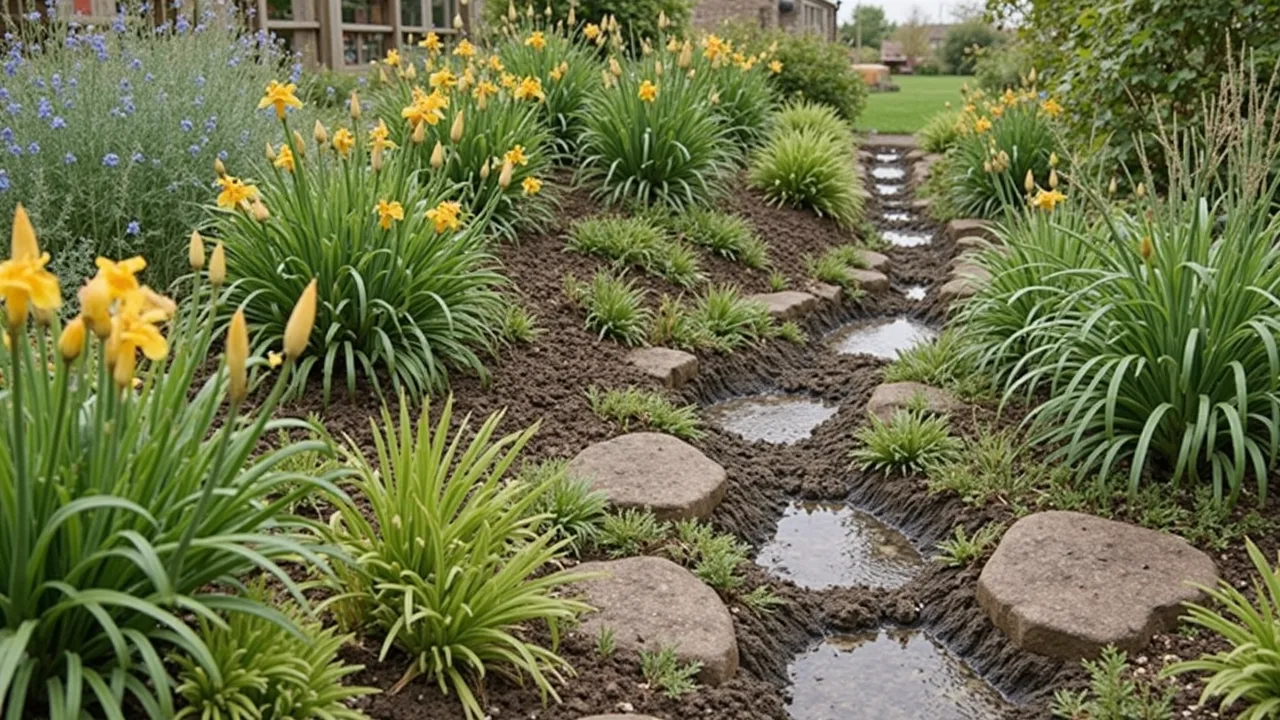
A rain garden is a shallow, planted dip in the lawn or border that catches roof and paving runoff, lets it soak into the ground, and filters it through plant roots on the way down. In a UK garden it does three useful jobs at once: it stops the patio turning into a skating rink every October, it takes the pressure off a clay soil that puddles for days, and it gives you a damp-but-not-boggy bed that moisture-loving perennials actually enjoy. It is not a pond — it drains within 24–48 hours — and it is not a soakaway, which is a plain hole filled with rubble. A rain garden is a living filter.
The right time to build one is autumn or early spring. Autumn (September to November) is best in most of England and Wales: the ground is workable, plant roots establish over winter, and the bed is ready to do its job by the time the first heavy rains arrive. Spring (March to April) is the second-best window, especially in the north and Scotland. Avoid building in summer when the soil is dry and hard, and avoid winter when it's saturated and smears into clods.
What you'll need
- Site: a spot at least 3 m from the house foundations and 1.5 m from any boundary, on level or very gently sloping ground. It must be lower than the downpipe or paved area draining into it, or you will be shovelling water uphill.
- Size: aim for a basin 10–20% of the roof area draining into it. A standard 3 m x 5 m garden shed roof (15 m²) needs roughly a 2 m x 4 m bed; a 6 m² patio downpipe needs about 1 m x 1.5 m.
- Depth: dig 15–25 cm below the original soil level for a sandy or loamy soil; 10–15 cm is enough on clay because the surrounding ground won't let water drain any faster.
- Soil mix: roughly 50–60% existing topsoil, 30–40% sharp sand, 10–20% well-rotted garden compost. The point is a free-draining layer about 30 cm deep that water passes through in under 48 hours.
- Plants: 5–7 plants per square metre. Choose UK-hardy perennials that tolerate wet feet in winter and dry conditions in summer (see list below).
- Inlet and overflow: a 75–100 mm pipe or channel stone-trash from the downpipe, and a small overflow at the far side so the basin never sits full for more than a day.
- Tools: spade, half-moon edger, wheelbarrow, rake, spirit level, and a 30 m hosepipe to test the inflow.
Step-by-step
- Mark out the shape. Use a hose or sand-line to sketch a kidney, oval, or teardrop — long edges are easier to mow around than circles. A bed 1.5–4 m across in any direction is workable by hand.
- Check the fall. Lay a spirit level on a long plank from the downpipe to the centre of the planned basin. You need a drop of at least 5 cm across the run. If the garden is flat, you can raise the inlet slightly with a small stone channel or a short rubble-filled trench.
- Strip the turf. Cut and stack it — you can reuse it elsewhere or pile it grass-down to rot.
- Dig the basin. Aim for 15–20 cm deep at the centre, sloping up to original ground level at the edges. A 2 m x 4 m bed at 15 cm deep removes roughly 1.2 m³ of soil — a wheelbarrow and a Saturday morning.
- Loosen the base. Fork over the bottom of the basin to a further spade's depth. On heavy clay, this is the most important step: do not skip it, or the basin will hold water for a week.
- Add the soil mix. Tip in your topsoil/sand/compost blend, rake it level, and firm by foot. The finished surface should sit 10–15 cm below the surrounding lawn.
- Set the inlet and overflow. Run a downpipe diverter or a short channel of pea shingle from the downpipe to the basin edge. On the far side, dig a 10 cm-wide overflow trench 5 cm below the basin's top edge, leading to a soakaway, ditch, or storm drain.
- Plant. Set plants in groups of three or five of the same species — drifts read better than a mixed salad. Plant to the same depth as they were in their pots, firm in, and water thoroughly.
- Mulch. Spread 5–7 cm of bark or pea shingle over the whole bed to suppress weeds, hold moisture, and stop rain splashing soil onto the foliage.
- Test it. Run a hosepipe into the inlet for 20 minutes. The basin should fill, then drain to less than half-full within 24 hours and be empty inside 48. If it is still half-full after a day, you need more sand in the mix or a deeper overflow.
Good plants for a UK rain garden
Aim for a mix of moisture-lovers and tough perennials. Iris sibirica, Ligularia 'The Rocket', Hemerocallis (daylily), Astilbe, Lythrum salicaria (purple loosestrife), Caltha palustris (marsh marigold) for the wettest centre. Eupatorium (Joe Pye weed), Astrantia, Geranium 'Rozanne', Hosta, and Geum for the sloping sides. Carex and other ornamental sedges give winter structure. Avoid thirsty annuals and anything that hates wet feet, such as lavender, rosemary, and most Mediterranean herbs.
Common mistakes
- Siting too close to the house. Three metres is the minimum from foundations; less and you risk damp. Also keep the basin at least 1.5 m from fences and boundaries.
- Digging too deep. A 40 cm pit on clay becomes a permanent pond. Stick to 10–25 cm — the soil mix, not the depth, does the work.
- Skipping the overflow. Without one, a storm will push the basin over its edge and erode the surrounding lawn. Always have a planned escape route for surplus water.
- Using builder's sand or unwashed sand. It sets like concrete. Use sharp sand (also sold as grit or concreting sand at any builders' merchant) so the mix stays free-draining.
- Planting in rows. A rain garden looks like a border, not a veg patch. Use drifts of three to seven of the same plant.
- Leaving it unmulched. Bare soil in a sunken bed turns to a weedy sump by the second summer. Mulch is not optional.
Troubleshooting
- Basin still full after 48 hours. The mix is too clay-heavy or the subsoil was not forked. Re-dig the centre, add 20% more sharp sand, and re-test.
- Water runs straight off the surface and out the overflow. The bed has silted up. Lift the mulch, top-dress with 5 cm of fresh compost, and check the inlet isn't washing soil in — a layer of pea shingle at the inlet fixes this.
- Plants sulk or rot. They are probably the wrong species for the wettest zone. Move true bog plants (Caltha, Iris sibirica, Ligularia) to the centre and replace border-edge plants with astilbe, geranium, or carex.
- More mosquitoes than expected. A rain garden that drains in under 48 hours will not breed mosquitoes — they need a week. If you see larvae, the drainage is too slow; see the first point.
- Lawn dies around the rim. That is normal for the first season — the surrounding soil is genuinely wetter. It usually recovers by the second summer as plant roots take over the work.
A well-built rain garden needs almost no maintenance after the first year: a spring cut-back, an autumn mulch top-up, and the occasional weeding session. The real reward is the first time you watch a July downpour sheet off the patio, vanish into the bed, and stay there — out of the drain, off the road, and growing the plants.
Plants in this guide






Recommended Products
GardenWizz earns a commission from qualifying purchases made through affiliate links on this page (including links within the article) — as an Amazon Associate, and from Thompson & Morgan via the Awin network. This does not affect the price you pay. See our disclaimer for details.
Related Articles
More → Garden Design
How to Attract Birds to Your Garden
12 June 2026A garden with birds is a working garden. They eat aphids, caterpillars, slugs and snails; they pollinate as they forage; and they tell you, quickly, when something in your patch is out of balance.…
 Garden Design
Best Climbing Plants for UK Walls and Fences
12 June 2026A bare fence or blank wall is wasted growing space. Choose the right climber and that same square metre of garden becomes flowers from May to October, shelter for nesting birds, a windbreak for the…
 Garden Design
Planting a Shady Border
11 June 2026A shady border is the bit of garden everyone calls "the difficult patch" — the north-facing wall, the strip under the hedge, the side return nobody walks down. Planted badly, it stays bare or fills…