Marigolds
Tagetes
The Gardening Year
Best months in UK gardens · full planting calendar →
🖨 Printable care card (PDF)At a Glance
| Botanical name | Tagetes |
|---|---|
| Common name(s) | marigolds |
| Family | Asteraceae |
| Plant type | annual (Can be annuals or perennials; in the UK they don't survive frost, so are grown as half-hardy annuals.) |
| Height × Spread | 0.1–2.2 m × — |
| Position | Full sun |
| Soil | moderately fertile, well-drained soil; pH Acid, Alkaline, Neutral |
| Flowering | June–November |
| Toxicity | No specific toxicity is listed by the RHS. This is not a guarantee of safety — check with a vet or the ASPCA before pets or children eat any plant. |
| Native range | Central and Southern Mexico and several other Latin American countries |
Marigolds (Tagetes) are among the most widely grown summer bedding and container plants in the United Kingdom, valued for their long flowering season, ease of cultivation and tolerance of exposed conditions. Native to the Americas and brought into European horticulture from the sixteenth century onwards, they are tender perennials usually grown as half-hardy annuals in British gardens, providing dependable colour from late spring until the first frosts of autumn.
Overview
Tagetes is a genus of around 50 accepted species within the daisy family (Asteraceae), the majority originating from Mexico and Central America. The plants most commonly encountered in UK gardens are Tagetes patula (French marigold), Tagetes erecta (African marigold, also called Aztec or American marigold) and Tagetes tenuifolia (signet marigold). Despite the common names, all are New World plants; the "African" and "French" labels reflect early trade routes rather than true origins.
In British cultivation, marigolds function primarily as seasonal infill: bright, floriferous, and forgiving of poor soil. They are frequently planted in municipal bedding schemes, on allotments, and in mixed containers on patios. Companion planting associations with tomatoes, both traditional and contested in horticultural research, remain a common reason for their inclusion on vegetable plots. All parts of the plant are aromatic, with a pungent, somewhat pungent foliage scent that most gardeners find distinctive rather than unpleasant.
Appearance
Marigolds are bushy, fast-growing plants with deeply divided, pinnate leaves arranged in opposite pairs along the stem. The foliage is typically mid- to dark green and, in many cultivars, finely cut. The leaves carry the genus's characteristic strong scent when bruised, arising from glands distributed across the leaf surface.
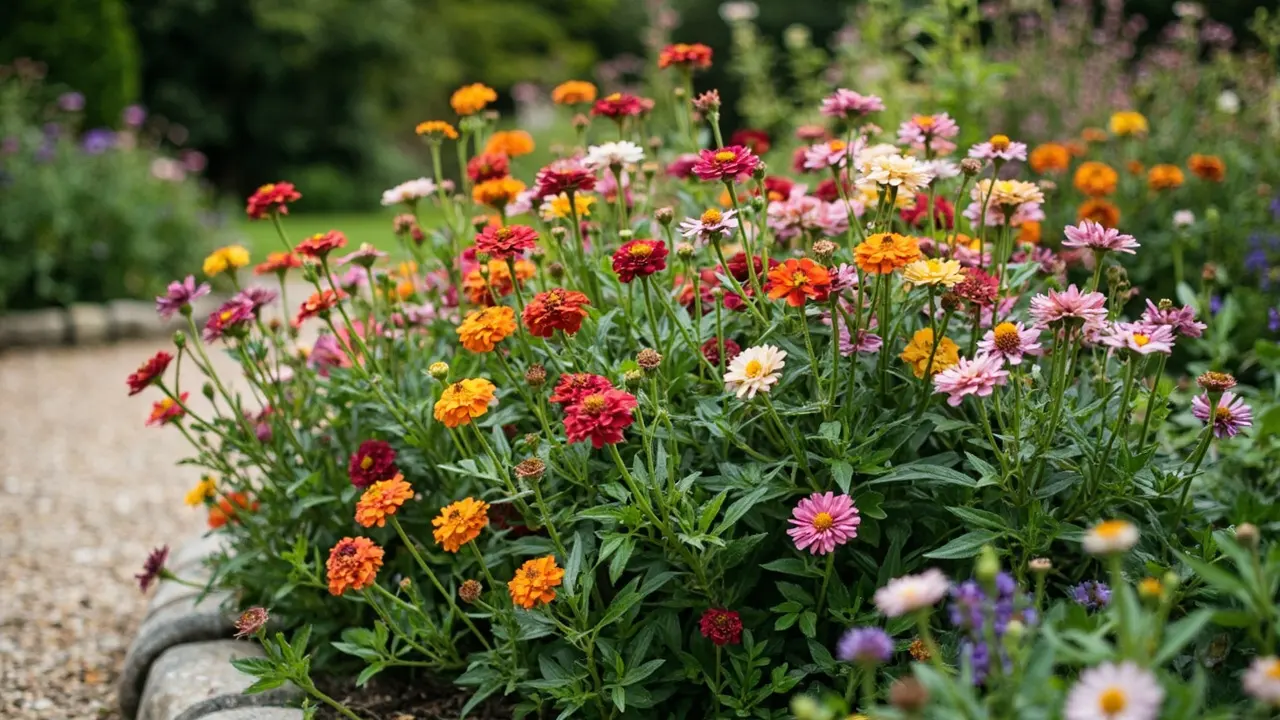
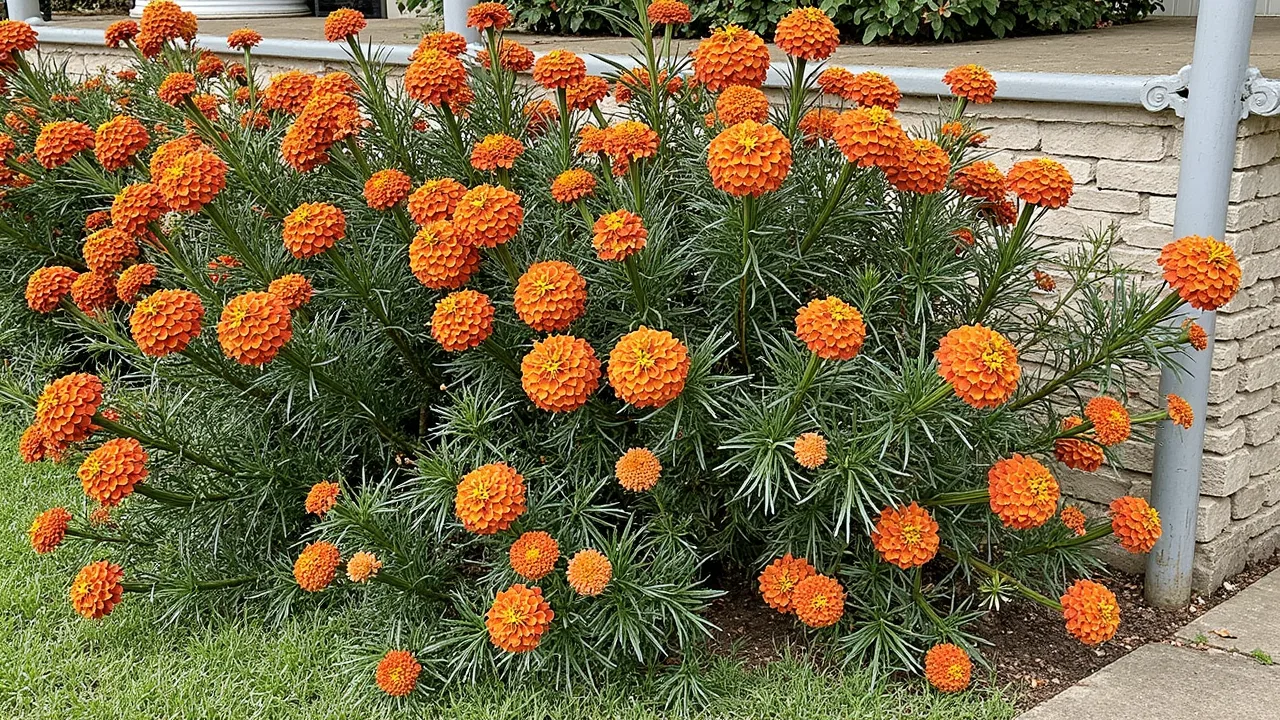
The flowers are composite heads, technically capitula, comprising a central disc of small true florets surrounded by a single or double row of ray florets that resemble petals. Colour ranges through every shade of yellow, gold, orange, mahogany and rusty red, with bicolour and "crested" forms common in modern cultivars. Flower form varies by species: Tagetes patula tends to produce smaller, often multi-layered heads; Tagetes erecta produces large, fully double, globe-shaped heads; Tagetes tenuifolia produces masses of small, single flowers.
Habit differs by species. French marigolds typically reach 15-30 cm in height with a mounded, slightly spreading form. African marigolds grow upright to 60-90 cm, occasionally taller in sheltered sites. Signet marigolds are compact and bushy, usually 20-30 cm tall, with notably finer foliage and a milder, citrus-tinged scent.
Growing Conditions
Marigolds perform best in full sun, requiring at least six hours of direct light daily to maintain compact growth and continuous flowering. They tolerate light shade, particularly in southern England, but stems become leggy and flowering is reduced in deeper shade. A sheltered site is preferable in northern and exposed coastal districts, where strong winds can snap the taller African types.
Soil requirements are modest. Marigolds grow in any reasonably fertile, well-drained garden soil and tolerate a wide pH range, roughly 6.0 to 7.5. They dislike cold, waterlogged ground, which causes root rot, and they sulk in heavy clay that remains wet through late spring. Improving heavy soils with garden compost before planting is sufficient preparation for most situations; additional feeding is rarely required at the planting stage.
Hardiness in the UK is limited. The Royal Horticultural Society classifies most commonly sold Tagetes cultivars as half-hardy annuals, generally considered tender down to around -1 °C to -5 °C depending on the source. They are killed by any sustained frost and are not reliably perennial outdoors in mainland Britain, although a few plants occasionally survive mild winters in coastal south-west England and the Isles of Scilly. Gardeners in colder regions should treat them strictly as annuals.
Planting and Care
Sowing and planting: Under cover, sow seed in March or April in seed trays or modules at about 18-21 °C. Seedlings germinate within 5 to 14 days and should be pricked out once the first true leaves have formed. Harden off for 7 to 10 days before planting out after the last frost, typically late May or early June across most of the UK, mid-May in mild southern counties, and into early June in Scotland and the north. Direct sowing outdoors is possible from late May once the soil has warmed.
Watering: Water newly planted marigolds regularly until established, usually two to three weeks. Mature plants are reasonably drought tolerant but flower more freely with consistent moisture. Water at the base of the plant in the morning to keep foliage dry and reduce the risk of fungal disease. Container-grown plants need daily watering in warm weather.
Feeding: Marigolds are light feeders. Over-rich soil or heavy nitrogen applications produce leafy growth at the expense of flowers. A single application of a balanced granular fertiliser at planting, or a fortnightly liquid feed of tomato fertiliser at half strength for container plants, is sufficient.
Pruning and deadheading: Regular deadheading is the single most important task. Removing spent heads every week or two extends flowering well into autumn. Light trimming of straggly stems mid-season can rejuvenate leggy plants, particularly French marigolds in containers.
Propagation: Propagation is by seed. Marigolds are not generally propagated by cuttings, as the plants are replaced annually. Open-pollinated types come reasonably true from saved seed; F1 hybrids will not. Collect seed heads in late summer, dry them indoors, and store in a cool, dry place.
Seasonal care: Spring is for sowing and ground preparation. Summer is the main flowering and deadheading period, with vigilant watering in dry spells. In autumn, lift and compost plants after the first hard frost cuts them down. In winter, no action is required as the plants have completed their cycle.
Common Problems
Slugs and snails attack young seedlings, particularly in damp conditions, and can decimate a freshly planted bed overnight. Calcium-based pellets, beer traps, or hand-picking at dusk are the standard controls.
Aphids, particularly black bean aphid (Aphis fabae), cluster on growing tips and flower buds in mid to late summer. They rarely kill established plants but distort new growth. A strong jet of water, or insecticidal soap for severe infestations, usually suffices.
Grey mould (Botrytis cinerea) can affect marigolds in cool, wet summers or where plants are overcrowded. Symptoms include fuzzy grey growth on fading flowers and damp patches on stems. Improving air circulation by spacing plants properly and removing affected material promptly are the main controls; fungicide treatment is rarely justified in domestic gardens.
Powdery mildew appears as a white powdery coating on leaves during hot, dry periods, especially on container-grown French marigolds under stress. Watering consistently and avoiding foliar wetting help; resistant cultivars are available.
Damping off affects seedlings, particularly those sown too densely or in cold, wet compost. Using fresh, free-draining seed compost, clean trays, and adequate ventilation prevents most losses.
Marigolds are occasionally implicated in phytotoxic reactions in nearby plants, notably beans and members of the cabbage family, through root exudates. Rotation in vegetable plots is a sensible precaution.
Popular Varieties
Tagetes patula 'Bonanza' is a widely sold F1 French marigold series, prized for its compact 20-25 cm habit, early flowering, and large, crested bicolour heads in shades including 'Bonanza Bolero', 'Bonanza Bee' and 'Bonanza Flame'. It is a popular choice for edging and container work.
Tagetes erecta 'Crackerjack' is a traditional open-pollinated African marigold producing fully double, globe-shaped flowers in mixed yellow, gold and orange on 60-75 cm stems. It remains a common choice for cutting and for traditional bedding displays.
Tagetes tenuifolia 'Lemon Gem' is a signet marigold with masses of small, single lemon-yellow flowers and finely cut, edible-scented foliage. It grows to about 25 cm, flowers profusely, and is widely used as an edging plant. 'Tangerine Gem' and 'Red Gem' are closely related cultivars in orange and deep red respectively.
Tagetes patula 'Naughty Marietta' is a heritage French marigold, an heirloom variety dating from the early twentieth century, with single, flat, golden-yellow flowers marked with maroon at the base. It reaches 30-40 cm and is frequently recommended for cottage garden plantings and pollinator borders.
Tagetes erecta 'Inca II' is an F1 African marigold series bred for uniform 30-35 cm plants with very large, fully double heads in yellow, gold and orange, including the well-known 'Inca II Yellow' and 'Inca II Orange'. Its compact height makes it suitable for containers and exposed sites.
Cultivars and Varieties
| Cultivar | Height | Flower | Notes | AGM |
|---|---|---|---|---|
| 'African marigolds' | — | — | usually referring to cultivars and hybrids of Tagetes erecta | |
| 'French marigolds' | — | — | usually referring to hybrids and cultivars of Tagetes patula, many of which were developed in France | |
| 'Zenith Golden Yellow' | — | — | RHS AGM (H2) | ✓ |
| 'Zenith Lemon Yellow' | — | — | RHS AGM (H2) | ✓ |
| 'Zenith Yellow' | — | — | RHS AGM (H2) | ✓ |
Pests and Diseases
| Problem | Symptoms | Management |
|---|---|---|
| legume crop | antibacterial thiophenes exuded by the roots | do not plant near legume crops |
| deer-, rabbit-, rodent- and javelina or peccary-resistant | — | — |
Or browse the full plant problem solver to diagnose an issue by symptom.
Companion planting
✔ Grows well with: Courgette, potato, Pumpkin, tomato.
Full companion planting chart →
Marigolds in our guides
- Best Plants for Wet and Boggy Soil in UK Gardens
- How to Grow Pumpkins and Winter Squash
- Creating a Rain Garden
- Designing a Wildlife Pond
- The Cut Flower Garden Revival
- Five Reliable Plants to Sow in UK Gardens This June
Recommended Products
GardenWizz earns a commission from qualifying purchases made through affiliate links on this page (including links within the article) — as an Amazon Associate, and from Thompson & Morgan via the Awin network. This does not affect the price you pay. See our disclaimer for details.