Petunia
Petunia x hybrida
The Gardening Year
Best months in UK gardens · full planting calendar →
🖨 Printable care card (PDF)At a Glance
| Botanical name | Petunia x hybrida |
|---|---|
| Common name(s) | Petunia |
| Family | Solanaceae |
| Plant type | annual (Half-hardy perennials and annuals grown as annuals in the UK) |
| Height × Spread | 15–30 cm × 91–122 cm |
| Position | Full sun, Partial shade |
| Soil | fertile, well-drained soil; rich soil with well-rotted compost or soil conditioner in borders; peat-free, multi-purpose potting compost for pots and containers |
| Flowering | June–October |
| Toxicity | — |
| Native range | — |
> DRAFT — Review hold. Do not publish. This article is part of a held review cycle and must remain tagged DRAFT until release is approved.
A short-lived garden hybrid grown for its long display of trumpet flowers from late spring until the first autumn frosts, Petunia × hybrida (also treated horticulturally as Petunia × atkinsiana) sits in the nightshade family Solanaceae and behaves as a tender perennial in warm climates but as a half-hardy annual across most of the UK.
Overview
Petunia × hybrida is a complex garden hybrid of South American petunia species, bred over more than a century into the compact, mounding, spreading and trailing cultivar groups that fill UK bedding schemes, patio containers and hanging baskets each summer. Garden petunias are best treated as half-hardy annuals: they grow quickly from seed or bought plugs, flower heavily through the warmer months and are finished by the first hard frost of autumn. Most modern types are grown for sheer floral display rather than scent, although a few series retain a light evening fragrance. With regular deadheading, feeding and watering, a single plant can carry colour for four to five months, which is why petunias remain a default choice for sunny UK containers from late May through to October.
Appearance
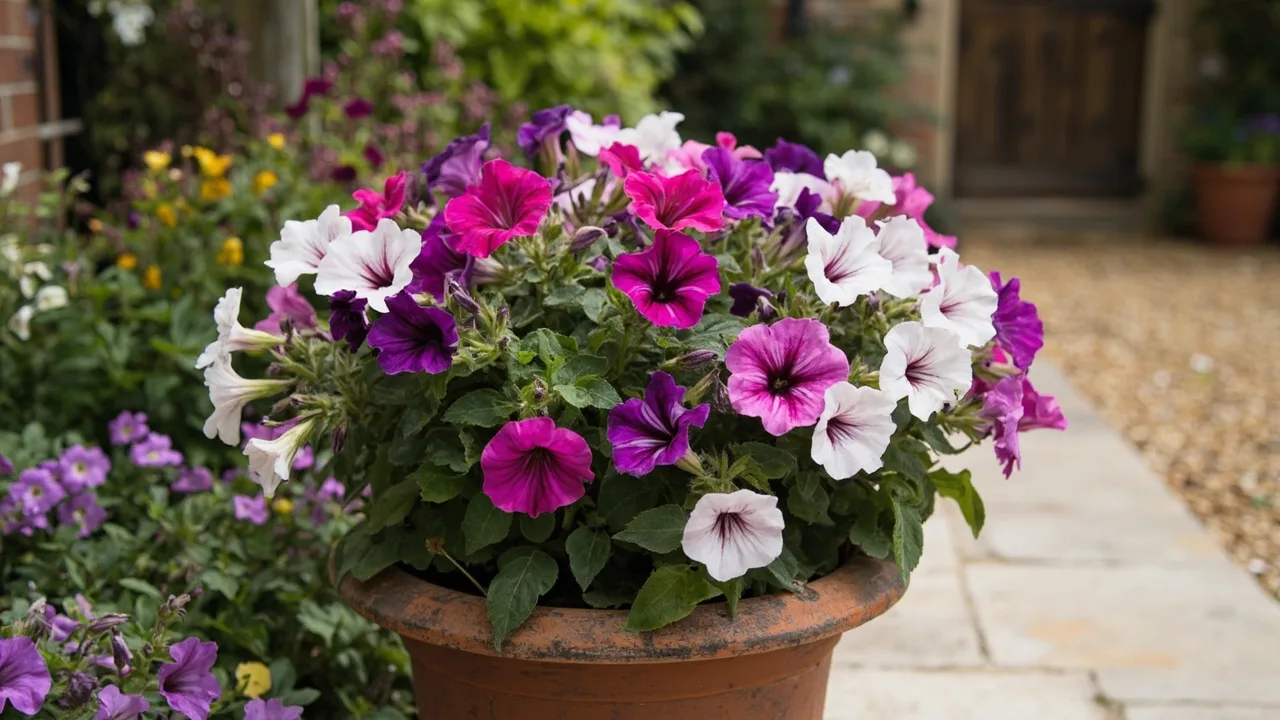
Petunias form a low, bushy plant with soft, branching, slightly sticky green stems. Leaves are simple and entire, mainly ovate, mid-green and softly hairy, arranged alternately along the stem though the uppermost leaves can appear almost paired. The flowers are the plant's defining feature: each bloom is solitary, carried in the upper leaf axils, with a narrow tubular base that flares open into a broad, five-lobed funnel face. Cultivar groups vary the flower form from single, flat-faced blooms to gently ruffled singles and dense, rose-like doubles, with a colour range that spans white, cream, pink, salmon, red, magenta, violet, blue-purple, pale yellow and a wide spread of striped, veined and picotee bicolours.
Growth habit depends on the series. Compact bedding petunias make neat mounds of 15–25 cm; mid-height multiflora and milliflora types form rounded plants of 20–35 cm; spreading and trailing petunias — the Surfinia and Wave types familiar in hanging baskets — build long, arching stems that can trail 60–90 cm over the edge of a container. Foliage stays modest in volume: the show is always the flower.
Growing Conditions
Full sun is essential for the heaviest flowering. Petunias tolerate very light shade, but stems stretch, blooms thin and colours wash out in anything more than partial sun, and container plants in a north-facing position will under-perform compared with the same variety on a south-facing patio. Soil should be fertile and moisture-retentive yet freely draining — a peat-free multipurpose container compost suits baskets and pots, while beds benefit from garden soil improved with well-rotted compost before planting.
Petunias are frost-tender. Young plants raised under glass must be hardened off for at least a week before being placed outside, and planting out should wait until the risk of frost has passed in your area, typically late May in the south of England and into early June further north and in colder pockets. Shelter matters: petunias' soft stems snap easily in strong winds, so a sunny, sheltered spot beside a wall, fence or hedge suits them better than an exposed bed.
For containers, choose a peat-free multipurpose compost with added John Innes or a dedicated basket-and-container mix to hold moisture through summer. Petunias in hanging baskets dry fast and may need watering twice a day in hot spells.
Planting and Care
Sow seed under cover from late winter to early spring, typically February to April, pressing the dust-like seed onto the surface of moist, fine compost without covering it, because petunia seed needs light to germinate. Keep trays warm and bright at around 18–21 °C; seedlings usually appear within 7–14 days. Grow them on in good light, pot them up once they have a couple of true leaves and harden them off gradually before planting out after the last frost. Bought plugs and garden-ready plants follow the same frost-free planting rule.
Water regularly so the compost stays evenly moist but never waterlogged. Hanging baskets and small patio pots dry very quickly in summer and may need daily or twice-daily watering in warm weather. Once plants are flowering freely, feed every seven to ten days with a high-potassium liquid feed — the tomato-type feeds sold for flowering patio plants work well — to sustain new blooms through the season.
Deadhead faded flowers with their short stalks on traditional grandiflora and multiflora types to keep displays tidy and encourage continued blooming. Many modern spreading and trailing series are self-cleaning, dropping old blooms without help, but they still benefit from an occasional tidy. Pinch out the growing tips of young plants once they have established to encourage branching, and trim back any straggly mid-summer stems by a few centimetres to refresh the plant and stimulate a new flush of flowers. Propagation is straightforward from cuttings: a non-flowering shoot trimmed below a node and rooted in moist compost under cover will form a new plant, useful for over-wintering a favourite trailing variety on a bright windowsill.
Common Problems
Aphids and thrips colonise the soft young growth and flower buds of petunias, particularly in dry, sheltered positions. Inspect plants regularly and act early with integrated pest-management methods — a strong water wash, biological controls in glasshouses, or a current-authority-approved treatment for outdoor use — to keep populations from establishing.
Slugs and snails damage young plants and can chew the petals of low-growing flowers, especially in damp springs. Vine weevil grubs are a particular risk in hanging baskets and containers, where they chew the roots and cause sudden wilting; use biological nematode treatments in late summer where vine weevils have been a problem, or refresh the compost annually. Powdery mildew can appear on stressed plants where air movement is poor and watering has been inconsistent, while persistently wet, poorly drained compost encourages root and crown rots. The fix in most cases is cultural: improve airflow, water at the base of the plant rather than over the foliage, and avoid leaving pots sitting in water.
A few physiological disorders also appear in petunias. Bud drop, where flowers abort before opening, is usually linked to dry compost or sudden temperature swings rather than disease. Yellowing lower leaves in mid-summer are often a sign of nitrogen hunger and respond quickly to a balanced liquid feed.
Popular Varieties
Petunia breeding has produced many named series; the cultivars below are widely stocked by UK growers and illustrate the range of habits available.
- Surfinia — the original trailing petunia series, still the benchmark for hanging baskets. Vigorous stems trail 60–90 cm and bear large, weather-tolerant flowers in a wide colour range; the RHS records the blue-flowered 'Surfinia Blue' (also sold as 'Sunblu') as a representative of the series.
- Wave — a spreading, ground-hugging series that combines bedding and trailing uses. Plants spread broadly across beds and trail over container edges with flowers held slightly above the foliage; the RHS records 'Wave Pink Improved' as a representative of the series.
- Amore — a compact, mounding series marketed for its contrasting veining and bicolour patterns; the RHS records 'Amore Queen of Hearts' (Damorqueen, PBR) as a representative cultivar.
- Celebrity and Frenzy — compact, mounding multiflora bedding series used for mass displays in parks and large gardens; the RHS records named selections including 'Celebrity Mid Blue', 'Frenzy Pink Morn' and 'Frenzy Rose'.
When choosing, match the habit to the site: compact mounding types for edging and small pots, spreading and trailing types for baskets, window boxes and the front of a border.
Sources & Further Reading
- Royal Horticultural Society — Petunia plant profile: https://www.rhs.org.uk/plants/190790/petunia/details (accessed 2026-07-21).
- Royal Horticultural Society — Petunia 'Surfinia Blue' (Sunblu) plant profile: https://www.rhs.org.uk/plants/121281/petunia-surfinia-blue-(-sunblu-)-(surfinia-series)/details (accessed 2026-07-21).
- Royal Horticultural Society — Petunia 'Wave Pink Improved' (Wave series) plant profile: https://www.rhs.org.uk/plants/241582/petunia-wave-pink-improved-(wave-series)/details (accessed 2026-07-21).
- Royal Horticultural Society — Petunia 'Amore Queen of Hearts' plant profile: https://www.rhs.org.uk/plants/354145/petunia-amore-queen-of-hearts-damorqueen-pbr-amore-series/details (accessed 2026-07-21).
- Royal Horticultural Society — AGM Ornamentals list, Petunia 'Celebrity Mid Blue', 'Frenzy Pink Morn', 'Frenzy Rose': https://www.rhs.org.uk/plants/pdfs/agm-lists/agm-ornamentals.pdf (accessed 2026-07-21).
- Royal Botanic Gardens, Kew — Plants of the World Online (POWO), Petunia × hybrida entry: https://powo.science.kew.org/taxon/urn:lsid:ipni.org:names:331845-2/general-information (accessed 2026-07-21).
- BBC Gardeners' World — How to grow petunias: https://www.gardenersworld.com/how-to/grow-plants/how-to-grow-petunias/ (accessed 2026-07-21).
- Royal Horticultural Society — Deadheading plants advice: https://www.rhs.org.uk/garden-jobs/deadheading-plants (accessed 2026-07-21).
Pests and Diseases
| Problem | Symptoms | Management |
|---|---|---|
| Slugs and snails | Irregular holes chewed in leaves and flowers, often accompanied by silvery slime trails. | Use physical barriers like copper tape or crushed eggshells, and apply iron phosphate-based pellets. |
| Vine weevil | Notched edges on leaves above ground and root damage causing wilting below ground. | Apply systemic insecticides to the soil or use biological controls like nematodes in late summer. |
| Powdery mildew | White, dusty fungal growth on leaves and stems, potentially causing distortion. | Ensure good air circulation, avoid overhead watering, and treat with a sulphur-based fungicide if severe. |
| Botrytis blight | Grey mould developing on flowers and foliage, particularly in damp or humid conditions. | Remove affected plant parts promptly and improve ventilation to reduce humidity around the plant. |
| Aphids | Clusters of small soft-bodied insects on new growth, often accompanied by sticky honeydew. | Spray off with a strong jet of water or use insecticidal soap; encourage natural predators like ladybirds. |
For step-by-step help, read Controlling Aphids Naturally, Dealing with Slugs and Snails and Treating Powdery Mildew. Or browse the full plant problem solver to diagnose an issue by symptom.
Recommended Products
GardenWizz earns a commission from qualifying purchases made through affiliate links on this page (including links within the article) — as an Amazon Associate, and from Thompson & Morgan via the Awin network. This does not affect the price you pay. See our disclaimer for details.