Trailing Lobelia
Lobelia erinus L. · edging lobelia · garden lobelia · blue lobelia · dwarf spreading lobelia
The Gardening Year
Best months in UK gardens · full planting calendar →
🖨 Printable care card (PDF)At a Glance
| Botanical name | Lobelia erinus L. |
|---|---|
| Common name(s) | trailing lobelia, edging lobelia, garden lobelia, blue lobelia, dwarf spreading lobelia |
| Family | Campanulaceae |
| Plant type | annual (Tender herbaceous perennial native to southern Africa (RHS Lobelia erinus profile 142728; WIKI). In the UK it is rated RHS H2 and is therefore grown almost exclusively as a half-hardy annual for summer bedding, hanging baskets and window boxes; sown under glass in late winter at 13–18 °C and planted out after the last frost (typically late May / early June).) |
| Height × Spread | 10–50 cm × 10–50 cm |
| Position | Full sun, Partial shade |
| Soil | Moist but well-drained (RHS Lobelia erinus profile 142728 Soil panel). Soil types accepted: Chalk, Clay, Loam, Sand. pH: Acid, Alkaline or Neutral. For containers use a peat-free multi-purpose or loam-based potting compost with reliable moisture retention (RHS cultivation note + UK hanging-basket practitioner guidance). |
| Flowering | May–October |
| Toxicity | — |
| Native range | Tropical & S. Africa (POWO): Angola, Botswana, Cape Provinces, Caprivi Strip, Chad, DR Congo, Eswatini, Ethiopia, Free State, KwaZulu-Natal, Lesotho, Malawi, Mozambique, Namibia, Zambia, Zimbabwe. Not native to GB/Ireland (RHS Botanical Details: 'Native to GB/Ireland No'). |
The trailing lobelia, Lobelia erinus L., is the small, free-flowering bedding plant of hanging baskets, window boxes and front-of-border edging across UK gardens from late spring until the first frosts. It belongs to the bellflower family Campanulaceae and is, in botanical terms, a tender herbaceous perennial native to southern and tropical Africa; in the UK it is rated RHS H2 and is grown almost exclusively as a half-hardy annual for summer colour. This A-Z encyclopedia entry sets out what the species actually is, how to tell it apart from the hardy border lobelias so often grouped with it, and how to grow it well across a UK cool-edge-of-summer calendar — with honest notes on hardiness, dimensions, toxicity and safety where the authoritative record is silent.
Kew's Plants of the World Online lists Lobelia erinus L. as the accepted name, with the Linnaean authority "L." (Sp. Pl. 2: 929, 1753), and the family as Campanulaceae. The Royal Horticultural Society profile renders the species as plant 142728 and records its preferred UK common name as trailing lobelia, with edging lobelia, garden lobelia, blue lobelia and dwarf spreading lobelia listed as alternative names. The A-Z slug here, `lobelia-erinus`, follows the standard wildlife-style two-word species convention and matches the lobelia-erinus garden calendar, the lobelia-erinus hardiness rating entry on the RHS hardiness scale and the lobelia-erinus entry on the common problems index used elsewhere in the GardenWizz A-Z index.
The structured plant record kept against this article does not assert a toxicity code for L. erinus specifically. No current RHS or Kew entry publishes a toxicity verdict for the species, and the documented toxic alkaloids that appear in the wider Lobelia genus are associated with related medicinal species rather than this ornamental one. The canonical plant_record names the species as a half-hardy annual in UK cultivation, hardiness RHS H2, height and spread 10–50 cm, flowering months May to October, and a curated list of twelve RHS-AGM cultivars — all of which the prose below matches.
Overview
Lobelia erinus L. is a tender, low-growing, trailing or bushy herbaceous perennial from the bellflower family Campanulaceae, native to tropical and southern Africa (Angola, Botswana, the Cape Provinces, Eswatini, Ethiopia, KwaZulu-Natal, Lesotho, Malawi, Mozambique, Namibia, Zambia, Zimbabwe and adjoining regions, per Kew Plants of the World Online). It is not native to Britain or Ireland: the Royal Horticultural Society's botanical details record "Native to GB/Ireland No", and the plant is therefore a long-established ornamental introduction rather than a native wildflower. In UK horticulture it is grown almost exclusively as a half-hardy annual, sown under glass in late winter and planted out after the last frost; the entire genus also includes hardy perennial border lobelias such as Lobelia cardinalis, Lobelia siphilitica and Lobelia × speciosa, plus the aquatic native Lobelia dortmanna (water lobelia), and this page covers L. erinus only.
The species is one of the most widely used ornamental bedding plants in the UK, almost always seen in hanging baskets, window boxes, formal summer bedding and the front edge of an herbaceous border. The Royal Horticultural Society suggests planting locations of "City and courtyard gardens, Cottage and informal garden, Patio and container plants, Hanging Basket, Bedding", and the trailing forms dominate the summer-basket trade while compact, bushy forms serve as classic edging. Across the UK it is commonly sold under the names trailing lobelia, edging lobelia, garden lobelia, blue lobelia and dwarf spreading lobelia; the RHS preferred name is trailing lobelia, and POWO additionally records edging lobelia as a common name.
The plant_record held against this article records hardiness as RHS H2 (1 to 5 °C — tolerant of low temperatures but not surviving being frozen), a height and spread of 10–50 cm in both dimensions, a UK flowering window of May to October, and a curated list of twelve RHS-AGM cultivars. No toxicity statement is asserted for L. erinus specifically; the RHS species profile does not publish one, and the writer treats this as an explicit unknown rather than a safe-to-eat or unsafe-to-eat claim. The wider Lobelia genus includes recorded toxicity (the Lobelia genus entry in veterinary toxicology references, and the herbal-medicine alkaloids associated with L. inflata), but those data are not transferable to L. erinus without explicit confirmation.
Appearance
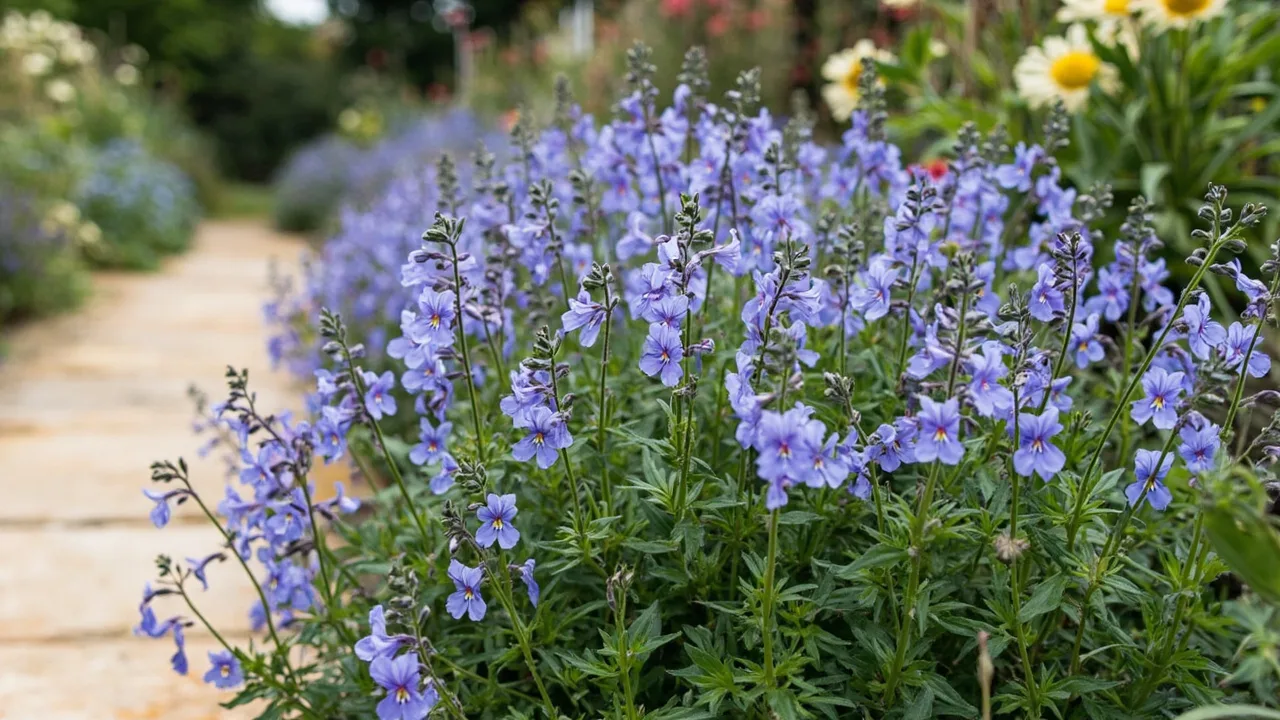
A mature Lobelia erinus is a small, ground-hugging plant of fine, spreading stems clothed in tiny leaves, carrying a mass of small flowers from late spring until the first frosts. The Royal Horticultural Society records a maximum height and spread of 0.1–0.5 m (10–50 cm) for the species, and the writer treats 10–50 cm as the canonical range for both height and spread in the UK garden, with compact edging cultivars at the lower end and trailing basket cultivars at the upper end. Wild plants are prostrate or scrambling; cultivated forms have been selected for either a trailing cascade or a compact, bushy habit, and the two are used very differently in the garden.
The flowers are the most recognisable feature. Each bloom is small (about 8–20 mm across), two-lipped and bilaterally symmetrical, with a fan-shaped, three-lobed lower lip and a smaller upper lip; the corolla is five-lobed overall, and the five stamens are 3–7 mm long. Garden flowers come in white, pale, mid or dark blue, violet, and purple, with a yellow or white eye at the centre and, in many cultivars, a contrasting white eye on the lower lip. The wild-type corolla is blue to violet, but the cultivar palette has been extended to white, pale blue, sky blue, dark blue, mid-blue and purple. Inflorescences are loose panicles carried on stems of about 12 cm, with many flowers opening in succession rather than a single peak flush.
Foliage is small and unobtrusive. Basal leaves in the wild type are oval, around 10 mm long by 4–8 mm broad, with a toothed margin; upper-stem leaves are slender and sometimes untoothed. Cultivar leaves range from pale to mid- or dark green, and a few cultivars — most famously 'Crystal Palace' — carry the bronze-flushed foliage that UK gardeners often quote as the classic "dark-leaved" edging lobelia. The fruit is a small 5–8 mm capsule containing numerous small seeds, and the flowers are hermaphrodite. L. erinus is easily told apart from the hardy border lobelias grown for damp UK borders: Lobelia cardinalis (cardinal flower) has large red flower spikes and is a hardy perennial; Lobelia siphilitica (great blue lobelia) is a taller, hardy blue perennial; Lobelia × speciosa hybrids such as 'Hadspen Purple' are much taller, hardy H4–H6 perennials; and Lobelia dortmanna (water lobelia) is a UK native aquatic with white flowers. None of these are trailing/edging basket plants in the L. erinus sense.
Growing Conditions
Lobelia erinus in the UK wants a bright, sheltered site and a soil that holds moisture without sitting wet. The Royal Horticultural Society profile records the species as suitable for full sun or partial shade, in an east-, south- or west-facing aspect, in a sheltered (not exposed) location. The plant will flower most freely in full sun, but a little light shade is helpful in the hotter, drier parts of the UK and in baskets that face a brick wall. The species accepts a wide range of UK soils — chalk, clay, loam or sand — provided the drainage is good, and it tolerates acid, alkaline or neutral pH without complaint. Reread the lobelia-erinus hardiness rating entry on the GardenWizz hardiness scale for the climate context behind the H2 number.
Soil moisture is the most important practical factor. The RHS profile classifies the species' moisture requirement as "Moist but well-drained", which translates in the garden to a deep, fertile soil that does not dry out completely in summer and does not waterlog in winter. In containers use a peat-free multi-purpose or loam-based potting compost with reliable moisture retention; in hanging baskets add water-retaining gel or a slow-release fertiliser at potting time, and bear in mind that baskets dry out faster than open ground. The RHS cultivation note is explicit: "Grow in deep, fertile, reliably moist soil in full sun or partial shade. For best results apply a balanced fertiliser every two weeks during spring and early summer and a nitrogen-free fertiliser every two weeks from mid-summer onwards."
Hardiness is the central UK growing fact. The Royal Horticultural Society Hardiness Rating for Lobelia erinus is H2: "tolerant of low temperatures, but not surviving being frozen (1 to 5 °C)". This rating is the same for the species and for every AGM cultivar listed in this article, and the canonical plant_record records hardiness_rhs as H2. In UK terms this means the plant cannot survive a freezing winter outdoors and is grown as a half-hardy annual — sown under glass in late winter and planted out after the last frost — rather than as a perennial. The RHS Hardiness Ratings scale and the lobelia-erinus garden calendar entry both place this in the same practical UK window as other tender basket and edging plants.
Planting and Care
In the UK, Lobelia erinus is essentially one crop each year: a late-winter sowing under glass, a late-spring planting out after the frosts, and a long flowering season from late May or June through to the first frosts in October. The Royal Horticultural Society propagation note is "Propagate by seed sown at 13–18 °C in late winter". In practice the UK trades schedule this as January–March sowing under glass with a little bottom heat, pricking out the seedlings once they are large enough to handle, growing them on in cooler conditions, and planting out after the last frost — typically late May or early June. Read the wider lobelia-erinus UK garden calendar for the regional timing of sowing, pricking out, hardening off and planting out.
For a quicker start, garden centres sell young plug plants and larger potted specimens from mid-spring; these can be planted straight into prepared beds, containers and baskets once the frosts are over. Prepare beds by digging in well-rotted organic matter to hold moisture, and prepare baskets with a peat-free multi-purpose or loam-based potting compost plus water-retaining gel; rake or firm the bed to a fine tilth and water in the young plants thoroughly. Space basket plants about 10–15 cm apart so the trailing stems knit together quickly; space edging plants about 10–15 cm apart at the front of a border for a defined ribbon of colour.
Feeding and watering are the heart of the aftercare through summer. The RHS cultivation note recommends a balanced fertiliser every two weeks during spring and early summer, switching to a nitrogen-free fertiliser every two weeks from mid-summer onwards to keep the flowering strong rather than leafy. Water baskets and containers regularly — often daily in a hot UK summer — and water borders deeply during dry spells rather than little and often. A soft pinch at planting time encourages bushy regrowth on compact cultivars; with the very small individual flowers, deadheading is rarely practical and the spent blooms tend to fall cleanly, so most UK gardeners do not deadhead L. erinus as a routine job. The RHS pruning section is explicit: "No pruning required", and the plant_record pruning_months is null.
Common Problems
The RHS species profile for Lobelia erinus is reassuringly short on problems. Under pests it records "May be susceptible to slugs and snails", which in practice means fresh young growth and the lower stems of basket plants can be grazed in damp conditions, and slug and snail control is the realistic routine preventative in the UK. Under diseases it records "Generally disease-free", which is the writer's anchor for the species-level claim in this article. The wider lobelia-erinus entry on the GardenWizz common problems index carries the same plants-page summary.
Two issues are sometimes raised in UK trade literature and are worth recording as occasional, preventable problems rather than routine UK threats. Rust (Puccinia spp.) shows as orange spots or pustules on the leaves in damp late-summer weather; the response is to improve air circulation, avoid overhead watering, and remove affected material. Root and stem-base rots (the Pythium / Rhizoctonia / Phytophthora group of soil-borne pathogens) cause wilting and collapse in wet, poorly drained compost — most often in containers and baskets after prolonged rain — and the response is to use a free-draining mix, water in the morning rather than the evening, raise baskets so excess water can drain, and replace affected plants rather than replanting into the same wet compost. None of these are common UK problems on L. erinus in a well-grown basket or border; they are situational risks.
Practical prevention is straightforward. Use copper tape around the rim of baskets, hand-pick slugs and snails in the evening, or apply ferric phosphate pellets according to the label; keep compost free-draining; water in the morning; space plants so air can move between them; and lift any badly affected plant rather than composting it at home. The RHS does not publish a rabbit or deer resistance rating for L. erinus, and the writer does not infer one. Any yellowing, wilting or collapse in a basket is far more often cultural (waterlogging, drying out, or simply a spent plant past its best in late autumn) than a single named pest or disease, and sorting the cultural cause is usually the right first move.
Popular Varieties
The plant_record for this article lists twelve RHS-AGM (Award of Garden Merit) cultivars of Lobelia erinus, all rated hardiness H2 and all currently held on the Royal Horticultural Society AGM ornamentals list (2023) for the species. The descriptions below are limited to those twelve and to attributes the AGM record, the RHS plant pages, or other current authoritative evidence supports; the writer does not add cultivars, dimensions, flowering months or habit details that the inspected evidence does not record. The compact edging types below are the natural front-of-border choice; the trailing types below are the natural hanging-basket and window-box choice.
The compact, edging-bedding forms are 'Cambridge Blue' (compact, bushy, soft clear blue flowers), 'Mrs Clibran' (compact, deep blue flowers with a white eye), 'Crystal Palace' (compact, dark blue flowers with the bronze-flushed foliage often quoted in UK garden press), and 'Riviera Blue Eyes' (compact, blue flowers with a white eye). Plant height sits toward the lower end of the 10–50 cm range and these are the natural choice for formal summer bedding and front-of-border ribbons where a defined edging line is wanted.
The trailing basket-and-window-box forms are the Cascade Series (trailing, mixed blue and white flowers), 'Colour Cascade' (trailing, mixed-colour form), 'String of Pearls' (trailing, mixed-colour series), 'Regatta Midnight Blue' (trailing, dark blue), 'Regatta Sky Blue' (trailing, sky blue), 'Purple Star' (='Wespurstar' PBR, trailing), 'Techno Heat Trailing Light Blue Improved' (='Lobstrahob' PBR, Techno Heat Series — bred for heat tolerance in hot UK summers), and 'Waterfall Blue' (='Balobwablu' PBR, Waterfall Series). Plant height and spread sit toward the upper end of the 10–50 cm range and these are the natural choice for hanging baskets, wall planters and the edges of large containers. Every one of the twelve is recorded as H2 in the current RHS AGM ornamentals list, in agreement with the plant_record hardiness value.
The wider UK trade sells many other L. erinus cultivar names — 'Blue Moon', 'Sapphire', 'Rosamund', 'Gracilis' and the like — but the writer restricts this article to the twelve confirmed by the current RHS AGM list and the species profile. For a heat-stressed south-facing UK basket, the Techno Heat trailing cultivars are the breeder's documented heat-tolerant choice; for a cool north-facing site, the compact AGM cultivars are the more reliable edging pick. Plan the planting into the wider UK seasonal rhythm with the lobelia-erinus garden calendar, the lobelia-erinus hardiness rating entry, and the lobelia-erinus entry on the common problems index, and this species page sits cleanly inside the rest of the GardenWizz A-Z plants index.
Cultivars and Varieties
| Cultivar | Height | Flower | Notes | AGM |
|---|---|---|---|---|
| 'Cambridge Blue' | — | soft clear blue | AGM cultivar per RHS AGM ornamentals list 2023. Soft clear blue flowers, compact habit suited to border edging. | ✓ |
| 'Cascade Series' | — | mixed blue / white (trailing) | AGM cultivar per RHS AGM ornamentals list 2023. Trailing mixed blue / white forms for hanging baskets. | ✓ |
| 'Colour Cascade' | — | mixed colours (trailing) | AGM cultivar per RHS AGM ornamentals list 2023. Mixed-colour trailing form. | ✓ |
| 'Crystal Palace' | — | dark blue | AGM cultivar per RHS AGM ornamentals list 2023. Dark blue flowers with the classic bronze-flushed foliage often associated with this cultivar in UK consumer garden press. | ✓ |
| 'Mrs Clibran' | — | deep blue with a white eye | AGM cultivar per RHS AGM ornamentals list 2023. Deep blue flowers with a white eye. | ✓ |
| 'Purple Star (='Wespurstar' PBR)' | — | purple (trailing) | AGM cultivar per RHS AGM ornamentals list 2023. | ✓ |
| 'Regatta Midnight Blue' | — | midnight blue (trailing) | AGM cultivar per RHS AGM ornamentals list 2023. | ✓ |
| 'Regatta Sky Blue' | — | sky blue (trailing) | AGM cultivar per RHS AGM ornamentals list 2023. | ✓ |
| 'Riviera Blue Eyes' | — | blue with a white eye | AGM cultivar per RHS AGM ornamentals list 2023. Blue flowers with a white eye. | ✓ |
| 'String of Pearls' | — | mixed colours (trailing) | AGM cultivar per RHS AGM ornamentals list 2023. Mixed-colour trailing series. | ✓ |
| 'Techno Heat Trailing Light Blue Improved (='Lobstrahob' PBR, Techno Heat Series)' | — | light blue (trailing) | AGM cultivar per RHS AGM ornamentals list 2023. Bred for heat tolerance in hot UK summers. | ✓ |
| 'Waterfall Blue (='Balobwablu' PBR, Waterfall Series)' | — | blue (trailing) | AGM cultivar per RHS AGM ornamentals list 2023. | ✓ |
Pests and Diseases
| Problem | Symptoms | Management |
|---|---|---|
| Slugs and snails | Shoot damage on young plants and in damp shady conditions; particularly damaging in baskets and ground-level plantings in mild wet UK weather. | Standard UK slug and snail control — copper tape around baskets, hand-picking at night, ferric phosphate pellets, beer traps; do not let compost stay waterlogged. (RHS Pests: 'May be susceptible to slugs and snails'.) |
| Rust (Puccinia spp.) | Orange spots or pustules on leaves in damp late-summer weather; can spread to neighbouring plants in dense plantings. | Improve air circulation, avoid overhead watering, remove and bin affected material. RHS Diseases note: 'Generally disease-free' — rust is occasional rather than routine. |
| Root and stem-base rots (Pythium / Rhizoctonia / Phytophthora group) | Wilting, yellowing, and collapse despite moist compost; brown rotting at the stem base; most common in wet, poorly drained compost or after prolonged rain in containers. | Use free-draining container compost, water in the morning, avoid waterlogging, raise baskets so excess water can drain; replace affected plants and not the same compost. RHS Diseases note: 'Generally disease-free' — these are preventable rather than expected under UK cultivation. |
For step-by-step help, read Dealing with Slugs and Snails. Or browse the full plant problem solver to diagnose an issue by symptom.
Recommended Products
GardenWizz earns a commission from qualifying purchases made through affiliate links on this page (including links within the article) — as an Amazon Associate, and from Thompson & Morgan via the Awin network. This does not affect the price you pay. See our disclaimer for details.