English Lavender
Lavandula angustifolia · Common lavender
The Gardening Year
Best months in UK gardens · full planting calendar →
🖨 Printable care card (PDF)At a Glance
| Botanical name | Lavandula angustifolia |
|---|---|
| Common name(s) | English lavender, Common lavender |
| Family | Lamiaceae |
| Plant type | shrub (evergreen shrub) |
| Height × Spread | 60–90 cm × 60–90 cm |
| Position | Full sun |
| Soil | Well-drained chalk, loam or sand; neutral to alkaline pH; low to moderate fertility |
| Flowering | July–August |
| Toxicity | Mildly toxic to dogs and cats if ingested |
| Native range | Mediterranean basin (Spain, France, Italy) |
English lavender (Lavandula angustifolia) is one of the most widely planted shrubs in British gardens, valued for its silver foliage, summer flower spikes and long-lasting scent. The quick-care table below summarises the essentials for UK growers; the rest of the article covers each point in detail.
Overview
Lavandula angustifolia, commonly called English lavender, is an evergreen subshrub in the family Lamiaceae, native to dry, sunny slopes of the western Mediterranean. It has been grown in British gardens since at least the sixteenth century and remains a staple of cottage gardens, formal edging, gravel gardens and dry, sunny borders. Mature plants form rounded, woody mounds roughly 60 to 90 cm tall, with flowering stems rising 15 to 30 cm above the foliage in high summer. The leaves are narrow, lance-shaped and covered in fine grey hairs, which give the plant its characteristic pale appearance and help it to tolerate drought and reflected heat. The flowers, borne on unbranched spikes from late June through August, range in colour from pale lilac to deep violet-blue in the species and its cultivars. Several forms have been awarded the Award of Garden Merit by the Royal Horticultural Society, recognising their reliability in typical British garden conditions. The plant is widely used as a low informal hedge, as path edging, and as a nectar source for bees, hoverflies and butterflies. It is also grown commercially in Norfolk, Suffolk and Kent for essential-oil production.
Appearance
Lavandula angustifolia is a small, bushy subshrub with a woody base and soft, current-season growth above. The leaves are opposite, narrowly lance-shaped, 2 to 6 cm long, and densely covered in stellate hairs that produce the silvery, almost felted look characteristic of the plant. When bruised, the foliage releases a strong, clean, slightly camphoraceous scent that persists in dried material for months.
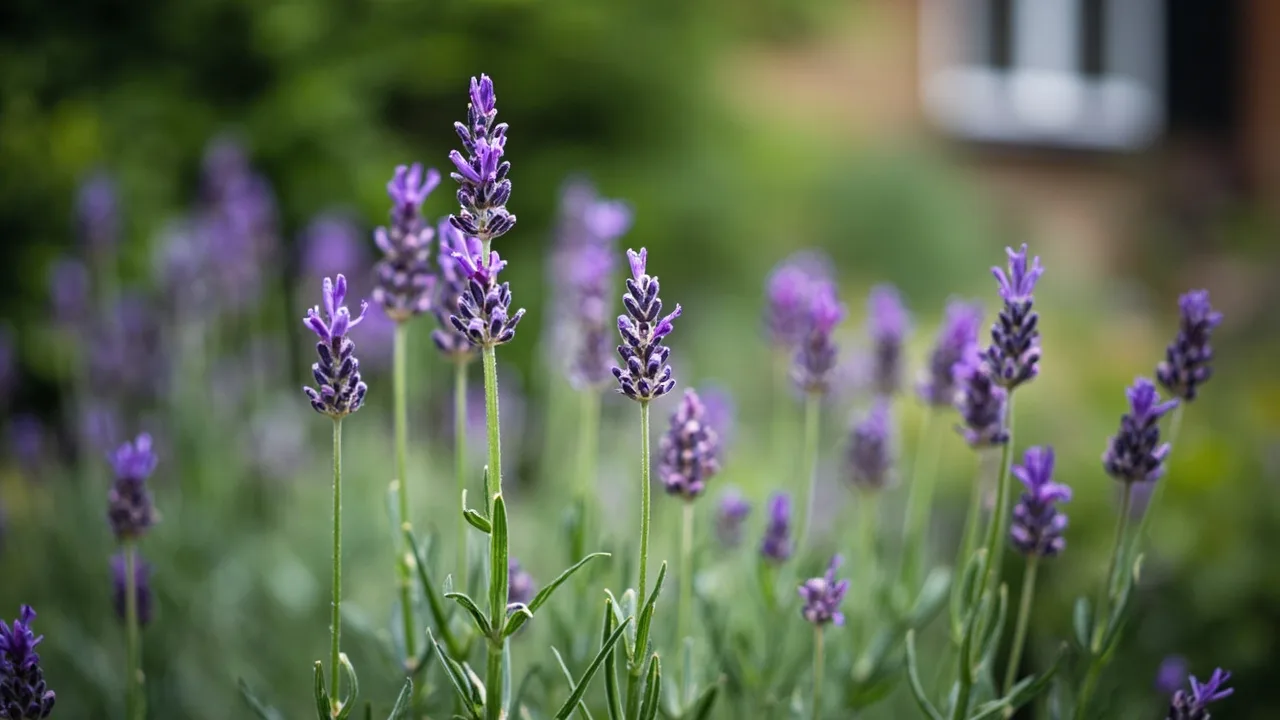
The flowers are borne in dense, interrupted whorls forming a terminal spike typically 4 to 8 cm long, held on a long, slender, square stem above the leafy body of the plant. Each flower is a small two-lipped corolla, pale to mid-violet in the species, shading to white at the throat. The bracts at the top of the spike are often a slightly different colour from the corollas, giving a two-tone effect in some cultivars. After flowering, the spikes dry on the plant and retain much of their colour and fragrance well into winter, which is one of the principal reasons lavender is valued as a structural plant in the off-season garden. The overall habit is rounded and mounded, broadening with age as the plant develops a short, gnarled framework of older wood at the base.
Growing Conditions
Lavender performs best in full sun, in poor to moderately fertile, free-draining soil with a near-neutral to slightly alkaline pH. Heavy, waterlogged or strongly acidic ground is the most common cause of failure: plants sitting in damp soil through winter are highly prone to root rot and will collapse in early spring. In the United Kingdom, this makes free-draining sites - raised beds, gravel gardens, the top of a wall, or a sunny south-facing border - far more reliable than retentive clay unless the clay is improved with sharp grit and organic matter.
Once established, the plant is notably drought-tolerant and copes well with the dry conditions often found against warm house walls and over paving. The RHS rates Lavandula angustifolia as hardy to H5, meaning it tolerates winter temperatures down to about -10 to -15 °C across most of the UK, including the colder parts of northern England and most lowland Scotland. In exposed or northern sites, young plants benefit from a light, free-draining mulch of coarse grit rather than bark or compost, which can hold moisture against the crown. Lavender is generally unsuitable for dense shade, for permanently wet ground, and for heavily fertilised borders where it produces lush soft growth that is then vulnerable to winter damage.
Planting and Care
Plant container-grown specimens in spring or early autumn, spacing them 45 to 60 cm apart for an informal drift, or 30 to 40 cm apart for a dense low hedge. Water in well after planting and keep the soil just moist for the first growing season; thereafter, additional watering is rarely needed except in prolonged drought on very free-draining soil.
Feeding should be light: a single application of a general-purpose fertiliser in early spring, or a top-dressing of garden compost, is sufficient, and overfeeding produces soft, leafy growth at the expense of flowers. Pruning is the single most important cultural task. Each year, immediately after flowering, trim the plant back to within 2 to 3 cm of the current season's leafy growth, taking care not to cut into the old, leafless wood, which usually does not regenerate. A second, lighter tidy in early spring removes any frost-damaged tips and shapes the mound. Plants allowed to grow unchecked become leggy, with bare woody centres and foliage only at the tips, and are difficult to restore; replacing them is often preferable to hard renovation.
Propagation is straightforward from semi-ripe cuttings taken in midsummer: 8 to 10 cm heel cuttings root readily in a gritty, free-draining compost under a cold frame or in a shaded corner, and established plants can also be layered by pegging a low shoot into the soil until it roots. Seed is slow and produces variable offspring, so it is used mainly for the species rather than cultivars.
Seasonal care in the UK follows a simple rhythm: light spring tidy (March to April), minimal summer watering, main prune straight after the last flowers fade in August, and a mulch of coarse grit rather than organic matter as winter sets in.
Common Problems
The most frequent problem is winter die-back caused by cold, wet conditions at the crown, particularly on heavy or poorly drained soils. Symptoms appear in late winter or early spring as the foliage turning grey-brown and the plant failing to break into new growth; affected specimens usually need to be replaced.
Lavender is largely free of serious pest problems in the UK, but it is occasionally attacked by the rosemary beetle (Chrysolina americana), a metallic green and purple beetle that feeds on the foliage of lavender and other Mediterranean shrubs from late summer into spring; hand-picking in spring and autumn is usually sufficient in a garden setting. The four-lined plant bug and various spittlebugs can cause minor spotting on the leaves in some seasons but rarely affect overall vigour. Fungal leaf spot and honey fungus (Armillaria) have been recorded on lavender but are uncommon.
Poor flowering is almost always a sign of one of three causes: insufficient sun, over-rich or over-watered soil, or pruning at the wrong time. A pale, sprawling plant with sparse flowers is usually telling the gardener that it is being grown in too much shade or that the previous year's pruning was missed.
On toxicity, lavender is generally non-toxic to humans, but the ASPCA lists it as mildly toxic to dogs, cats and horses (because of the compounds linalool and linalyl acetate); ingestion can cause mild stomach upset, vomiting or loss of appetite in pets. Gardeners with grazing pets may wish to confirm current advice with a vet for their specific animal.
Popular Varieties
Several cultivars of Lavandula angustifolia are widely available from UK nurseries and garden centres. The following are well-established, AGM-recognised forms where indicated, but stock and naming can vary between suppliers, so it is worth confirming the plant on the label at the point of purchase.
- 'Hidcote': a compact selection to about 60 cm tall with deep violet-blue flower spikes and silver-grey foliage. One of the most widely planted forms in the UK, often used for low hedging; AGM.
- 'Munstead': a slightly earlier-flowering cultivar of similar size, with paler blue-violet flowers and a slightly more open habit. Named after Gertrude Jekyll's garden at Munstead Wood; AGM.
- 'Melissa Lilac': a pale lilac-pink form, sometimes listed under the trade name 'Melissa', grown for its softer flower colour in mixed plantings.
- 'Imperial Gem': a compact, deep violet form with particularly uniform spikes, often used in formal edging schemes.
- 'Rosea': a pink-flowered cultivar of the species, with paler, less intensely coloured spikes; useful where a softer palette is wanted.
Cultivar names can be confused in the trade, and a number of seed-raised plants are sold under near-identical names. For the most reliable results, buy from a UK nursery that propagates by cuttings rather than by seed, and check the RHS Plant Finder for current availability.
Cultivars and Varieties
| Cultivar | Height | Flower | Notes | AGM |
|---|---|---|---|---|
| 'Alba' | 75 cm | White | Taller habit; good contrast planting | |
| 'Hidcote' | 60 cm | Deep violet, mid-summer | Compact; the classic dark hedge lavender | ✓ |
| 'Munstead' | 45 cm | Lavender-blue | Early flowering, very compact | ✓ |
| 'Rosea' | 60 cm | Soft pink | Unusual colour; slightly less vigorous |
Pests and Diseases
| Problem | Symptoms | Management |
|---|---|---|
| Rosemary beetle | Metallic green-and-purple striped beetles; notched leaves from late summer | Hand-pick adults and larvae; encourage birds and ground beetles; tolerate light damage |
| Froghopper (cuckoo spit) | Frothy white foam on stems in early summer | Harmless to established plants; dislodge with a jet of water if unsightly |
| Grey mould (Botrytis) | Fuzzy grey growth and dieback in wet, crowded conditions | Improve drainage and air flow; cut out affected growth; avoid overhead watering |
Or browse the full plant problem solver to diagnose an issue by symptom.
English Lavender in our guides
- Drip Irrigation Systems: Save Time and Water
- Gardening for Pollinators
- How to Take Plant Cuttings and Propagate for Free
- No-Dig Gardening Explained
- Watering Your Garden Wisely
- Creating a Herb Garden
Recommended Products
GardenWizz earns a commission from qualifying purchases made through affiliate links on this page (including links within the article) — as an Amazon Associate, and from Thompson & Morgan via the Awin network. This does not affect the price you pay. See our disclaimer for details.