Rosemary
Salvia rosmarinus
The Gardening Year
Best months in UK gardens · full planting calendar →
🖨 Printable care card (PDF)At a Glance
| Botanical name | Salvia rosmarinus |
|---|---|
| Common name(s) | rosemary |
| Family | Lamiaceae |
| Plant type | shrub (Evergreen; can live as long as 35 years.) |
| Height × Spread | 120–180 cm × 1.5–2.5 m |
| Position | Full sun |
| Soil | free-draining |
| Flowering | March–August |
| Toxicity | Skin allergen. Wear gloves and other protective equipment when handling |
| Native range | Mediterranean region |
Overview
Rosemary (Salvia rosmarinus, syn. Rosmarinus officinalis) is an evergreen aromatic shrub from the mint family (Lamiaceae), native to dry, rocky slopes of the Mediterranean basin and long naturalised in the United Kingdom. It is grown in British gardens for its narrow, needle-like leaves, its pale blue to violet flowers carried over a long season, and the strong resinous scent released whenever the foliage is brushed or crushed. The following quick-care table summarises the essentials for UK growers; the full article below covers each in detail.
Rosemary has been grown in British gardens since at least the medieval period, when it was used as a culinary and medicinal herb in monastery and cottage gardens. It remains one of the most widely planted evergreen shrubs in the UK, particularly in coastal, gravel and Mediterranean-style plantings, where its tolerance of dry, poor soil and exposed conditions is an asset. The plant forms a woody shrub of variable habit: upright and tall in the "Tuscan" and "Miss Jessopp's" groups, low and sprawling in the prostrate forms. Mature specimens develop a gnarled, fissured base with bark that peels in vertical strips, a feature that gives old plants a particular character in winter when the pale flowers stand out against the dark, evergreen foliage. The leaves are leathery, dark green above and grey- or silver-felted beneath, and produce the familiar resinous scent that is the principal reason the plant is grown. Rosemary is also an important nectar source for bees in early spring, and is widely used as a low informal hedge, as edging along paths and terraces, and as a specimen shrub in containers.
Appearance
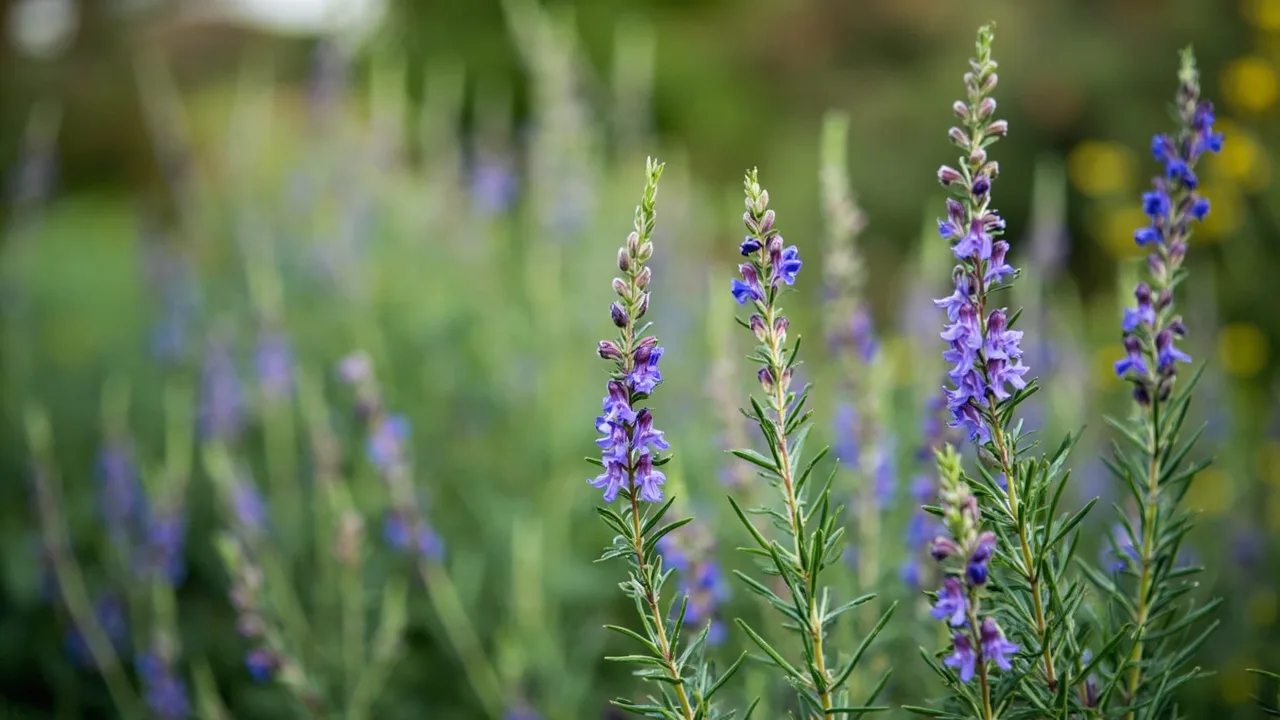
Salvia rosmarinus is a dense, woody shrub with a fibrous root system and a rounded or upright habit depending on cultivar. The leaves are opposite, narrow and linear, 1.5 to 4 cm long, dark glossy green on the upper surface and covered in fine white or grey hairs beneath, giving the underside a distinctly silvery look. When bruised, the foliage releases a strong, clean, slightly camphoraceous scent that is characteristic of the species. The flowers are borne in short axillary clusters along the previous year's growth, mainly from April to June but often with a second, lighter flush in late summer and a few blooms well into autumn in mild seasons. Each flower is a two-lipped corolla, typically 1 to 1.5 cm long, in shades of pale to mid violet-blue, with occasional white, pink or pale blue forms. The upper lip is hooded and the lower lip is spreading with a paler, often white-marked throat. The calyx is bell-shaped, finely hairy and flushed with purple, and persists on the plant after the corolla falls, giving the inflorescence a two-tone appearance. The fruit is a smooth, brown nutlet enclosed in the dry calyx, of little ornamental interest. Mature plants reach 60 cm to 2 m in height, with the upright cultivars forming narrow, almost columnar shapes and the prostrate forms making wide, low mounds that spill over walls and the edges of raised beds.
Growing Conditions
Rosemary performs best in full sun, in poor to moderately fertile, very free-draining soil with a near-neutral to slightly alkaline pH. It is well adapted to the dry, sunny sites typical of Mediterranean-style and gravel gardens, and to the lean, well-drained conditions found against warm south- or west-facing walls. Wet ground, particularly through winter, is by far the most common cause of failure: the plant is highly prone to root and crown rot in cold, saturated soil, and in heavy clay it is usually short-lived unless drainage is sharply improved with grit and organic matter, or the plant is grown on a raised bed, mound or in a large container. Once established, rosemary is notably drought-tolerant and copes well with the dry conditions often found against warm house walls, over paving, and on rock gardens. The RHS rates Salvia rosmarinus as H5, meaning it tolerates winter temperatures down to about -10 to -15 °C across most of the UK, including most of lowland England and Wales. In colder inland districts, in northern England, and across much of Scotland, hardiness can be marginal, particularly on heavy or wet soils: young plants benefit from a free-draining mulch of coarse grit rather than bark or compost, and a position sheltered from cold winter winds is advisable. The plant is unsuited to dense shade, to permanently wet ground, and to heavily enriched borders, where it produces soft, leafy growth that is then vulnerable to winter damage.
Planting and Care
Plant container-grown rosemary in spring or early autumn, ideally into soil that has been improved with coarse grit on heavy ground, and at the same depth as the plant was growing in its pot. For a low hedge, space plants 30 to 45 cm apart; for a free-standing shrub, allow 60 cm to 1 m depending on the cultivar's mature spread. Water in well after planting and keep the soil just moist for the first growing season; thereafter, additional watering is rarely needed except in containers during prolonged dry spells. Feeding should be light: a single application of a general-purpose fertiliser in early spring, or a modest top-dressing of garden compost, is sufficient, and overfeeding produces soft, leafy growth at the expense of flowers and scent. Pruning is straightforward. The main trim should be carried out immediately after the main flush of flowers in late spring or early summer, shortening the current season's growth by up to a third to keep the plant compact and to prevent the lower branches from becoming bare and woody. A lighter tidy in mid- to late summer removes any straggling shoots and encourages a small second flush of bloom. Hard pruning into old, leafless wood is unreliable: rosemary does not regenerate readily from old wood, and neglected plants are usually better replaced. Propagation is easy from semi-ripe cuttings taken in midsummer: 8 to 10 cm cuttings root readily in a gritty, free-draining compost under a cold frame, in a shaded corner, or in a propagator with bottom heat. Layering is also effective for low-growing forms: peg a flexible shoot into the soil in spring, sever it from the parent plant once rooted, usually the following spring. Seed is slow and produces variable offspring, so it is used mainly for the species rather than for named cultivars. Seasonal care in the UK follows a simple rhythm: light spring tidy once the hardest frosts have passed, minimal summer watering except in containers, main prune straight after the spring flowers fade, and a mulch of coarse grit rather than organic matter in late autumn on cold or wet sites.
Common Problems
The most frequent problem is winter die-back caused by cold, wet conditions at the crown, particularly on heavy or poorly drained soils. Symptoms appear in late winter or early spring as the foliage turning brown, the plant failing to break into new growth, and sections of the woody framework dying back to the base; affected specimens are often best replaced, as recovery from old wood is unreliable. Phytophthora root rot can develop in waterlogged soil, particularly in containers kept on saucers of standing water through winter. Rosemary is largely free of serious disease in the UK, but it is the principal host of the rosemary beetle (Chrysolina americana), a metallic green and purple-striped leaf beetle, about 7 to 8 mm long, that feeds on the foliage and growing tips from late summer through to the following spring. In heavy infestations the beetles can strip plants almost bare: hand-picking in spring and autumn, shaking the beetles from the foliage over a sheet, and encouraging natural predators is usually sufficient in a garden setting, and chemical control is rarely needed. Spittlebugs sometimes appear on the shoots in late spring, producing the familiar frothy "cuckoo spit", but the damage is cosmetic. Powdery mildew can affect plants grown in dry soil in a sheltered position with poor air movement, and honey fungus (Armillaria) has been recorded on mature specimens in old garden soil, though it is uncommon. Poor flowering, sparse foliage, and a leggy, open habit are almost always a sign of too much shade, over-rich or over-watered soil, or pruning at the wrong time. Rosemary is widely used as a culinary herb and is not generally regarded as toxic to humans, although the safety of large medicinal doses in pregnancy and the effect on domestic pets are not well documented in UK horticultural references; in case of suspected ingestion by a pet, a vet should be consulted.
Popular Varieties
'Tuscan Blue' is an upright, vigorous form originating in Italy, reaching 1.5 to 2 m tall, with broad, dark green leaves and deep violet-blue flowers carried over a long season; it is widely sold in UK garden centres and is among the most reliable for hedging and for use as a specimen shrub. 'Miss Jessopp's Upright' is a narrower, more columnar cultivar reaching 1 to 1.5 m, with pale blue flowers, often grown as a low formal hedge and the traditional choice for a tightly clipped rosemary edging. 'Sissinghurst Blue' is a compact, bushy form selected at Sissinghurst Castle Garden, with bright blue flowers and a tidy rounded habit to about 1 m, well suited to mixed borders and to containers. 'Severn Sea' is a lower, arching selection with particularly intense blue flowers and fine, slightly silvery foliage, reaching around 60 to 90 cm; it tolerates a hard prune well and is a good choice for the front of a sunny border or for trailing over a low wall. The prostrate rosemary group, sold as Rosmarinus officinalis Prostratus or more correctly as Salvia rosmarinus (Prostratus Group), includes low, spreading forms reaching only 30 to 50 cm tall but 1 to 1.5 m wide, with pale blue to violet flowers, and is the standard choice for walls, banks and the tops of terraced beds, though it is generally less hardy than the upright cultivars and benefits from a sheltered, well-drained site.
Cultivars and Varieties
| Cultivar | Height | Flower | Notes | AGM |
|---|---|---|---|---|
| 'Albus' | — | white flowers | — | |
| 'Arp' | — | lemon-scented and cold-hardy to 10° Fahrenheit | — | |
| 'Aureus' | — | — | leaves speckled yellow | |
| 'Benenden Blue' | — | — | narrow, dark green leaves | |
| 'Blue Boy' | — | — | dwarf, prostrate variety with small leaves | |
| 'Blue Rain' | — | pink flowers | — | |
| 'Gold Dust' | — | — | dark green leaves, with golden streaks but stronger than 'Golden Rain' | |
| 'Golden Rain' | — | — | leaves green, with yellow streaks | |
| 'Miss Jessopp' | — | — | RHS AGM (H4) | ✓ |
Pests and Diseases
| Problem | Symptoms | Management |
|---|---|---|
| Rosemary beetle | Small yellow larvae with black heads skeletonise leaves, leaving only the veins. | Hand-pick beetles and larvae or use a biological control like nematodes. |
| Powdery mildew | White, dusty fungal growth appears on leaves and stems, often in humid conditions. | Improve air circulation and spray with a fungicide if severe; avoid wetting foliage. |
| Root rot | Leaves turn yellow and drop, and the plant wilts despite moist soil due to waterlogged roots. | Ensure well-drained soil and avoid overwatering; do not plant in heavy clay without amendment. |
| Scale insects | Small, immobile, bump-like pests cluster on stems and undersides of leaves, causing yellowing. | Scrape off scales manually or treat with horticultural oil during the dormant season. |
| Honey fungus | Plant declines rapidly with wilting foliage and white fungal growth at the base of the stem. | Remove infected plants and surrounding soil; avoid replanting in the same spot for several years. |
For step-by-step help, read Treating Powdery Mildew. Or browse the full plant problem solver to diagnose an issue by symptom.
Rosemary in our guides
- Container Gardening for Beginners
- Container Gardening for Beginners: Pots, Compost and Care
- Drip Irrigation Systems: Save Time and Water
- How to Create a Windowsill Herb Garden
- How to Take Plant Cuttings and Propagate for Free
- No-Dig Gardening Explained
Recommended Products
GardenWizz earns a commission from qualifying purchases made through affiliate links on this page (including links within the article) — as an Amazon Associate, and from Thompson & Morgan via the Awin network. This does not affect the price you pay. See our disclaimer for details.