Youth And Old Age
Zinnia elegans Jacq. · common zinnia · elegant zinnia
The Gardening Year
Best months in UK gardens · full planting calendar →
🖨 Printable care card (PDF)At a Glance
| Botanical name | Zinnia elegans Jacq. |
|---|---|
| Common name(s) | youth and old age, common zinnia, elegant zinnia |
| Family | Asteraceae (Compositae) |
| Plant type | annual |
| Height × Spread | 100 cm × 50 cm |
| Position | Full sun |
| Soil | Well-drained; Fertile; Humus-rich; Warm |
| Flowering | June–October |
| Toxicity | — |
| Native range | Mexico to Nicaragua (Kew POWO); primarily the seasonally dry tropical biome. |
Overview
Zinnia (Zinnia elegans Jacq.) is a bushy, half-hardy annual in the daisy family Asteraceae (Compositae), native to Mexico and extending south through Central America to Nicaragua, where it grows as a warm-season species in the seasonally dry tropical biome. The accepted scientific name is Zinnia elegans Jacq.; the older synonym Zinnia violacea Cav. appears in older literature and is treated as the same plant by current authorities. In the United Kingdom it is grown as a long-flowering annual for beds, borders, cutting patches and container displays, where its strong upright stems and bright daisy-like flower heads earn it the common names "youth and old age", "common zinnia" and "elegant zinnia". The Royal Horticultural Society's species profile describes it as "a parent of many garden cultivars", confirming its central place in the modern Zinnia range, and Kew's Plants of the World Online treats Z. elegans as the accepted name for the species that anchors most garden zinnias. For other warm-season annuals in the same border, see our garden calendar for timing, and compare with Cosmos (Cosmos bipinnatus) and sunflower (Helianthus annuus), which share the full-sun, well-drained conditions below.
Appearance
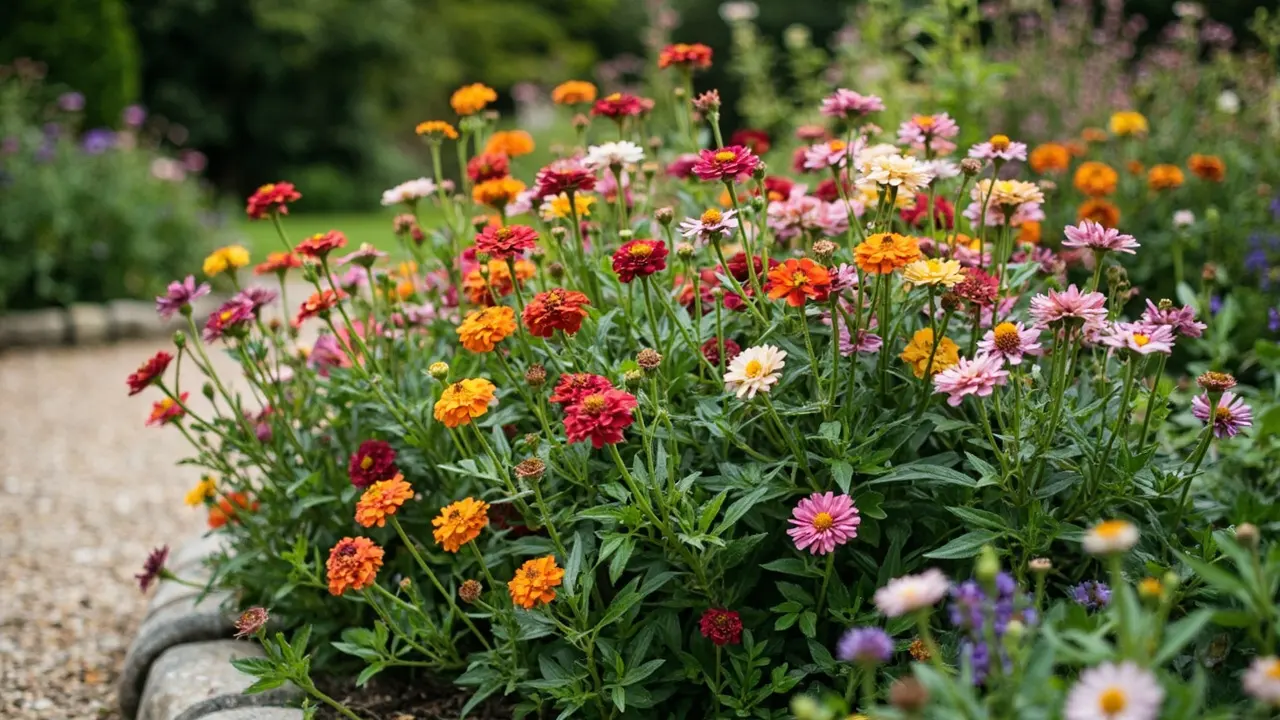
Zinnia elegans forms a stiffly upright, bushy annual clothed in opposite, broadly lance-shaped, mid-green leaves along stout stems that branch freely from the base. The Royal Horticultural Society records the species at 50–100 cm tall by 10–50 cm across (RHS Max Height 0.5–1 m, Max Spread 0.1–0.5 m), which is the height and spread range used throughout this article. The composite flower heads (capitula) are carried singly at the stem tips and measure roughly 5–12 cm across, depending on cultivar, with single, semi-double or double ray florets in red, orange, yellow, pink, rose, lavender, green or white arranged around a contrasting central disc. Flowering runs from June through October in UK conditions, and the common name "youth and old age" comes from the way fresh blooms continue to open alongside older, faded flowers on the same plant. The closely related narrowleaf zinnia (Zinnia angustifolia) is more compact with smaller single flowers, and the Mexican zinnia (Zinnia haageana) is smaller and bicoloured, so neither should be confused with Z. elegans; dahlia seedlings, cosmos and rudbeckia are also distinct in leaf and habit.
Growing Conditions
Zinnia elegans needs a warm, sunny, open position in well-drained, fertile, humus-rich soil. The Royal Horticultural Society specifies full sun in a south-facing or west-facing aspect with sheltered exposure, and describes the plant as a half-hardy annual that "can be grown outside in the summer" with a winter minimum of 5–10 °C — the UK H-system rating H1c, which the GardenWizz hardiness guide explains in more detail. Soil should be moisture-retentive yet free-draining; heavy clay is improved with grit and organic matter, while light, sandy soils benefit from garden compost to keep the root zone cool and moist through the hottest weeks. Because the species evolved in warm, sunny Mexico, it performs best where summers are reliably hot and the site is sheltered from cold, exposed wind. Zinnia elegans is a tender annual in the UK: it will not tolerate frost and should only be set out once night temperatures stay above about 5 °C. Use the May calendar to plan hardening off, the June calendar for the main planting-out window, and the July and August calendar entries to track flowering and feeding during peak summer.
Planting and Care
Sow seed under glass at about 13–18 °C in late winter or early spring, in modules or small pots of peat-free seed compost, and pot seedlings on as they develop. Harden the young plants off gradually through late spring and plant them out only after the last frost, usually late May or early June in southern England and one or two weeks later in colder parts of the UK. Space plants 20–30 cm apart in mass bedding, wider in mixed borders where they can develop their full 50–100 cm height, and water in well to settle the root ball. Once flowering begins, water deeply during dry spells rather than little and often, and apply a high-potash liquid feed every two weeks to keep new buds coming. Deadhead regularly to extend the display into October, and stake taller plants in exposed sites so the stiff stems do not snap in summer storms. Zinnia elegans is excellent as a cut flower: cut stems when the central disc is just opening, sear the stem ends in boiling water for ten seconds, and condition them in deep water overnight before arranging; regular cutting actually stimulates more blooms.
Common Problems
Powdery mildew is the principal disease reported on Zinnia elegans in UK gardens, and is the problem most consistently reported in the reviewed horticultural sources. The disease shows as a white, dusty coating on leaves and stems in warm, dry weather with cool nights, and is encouraged by overhead watering, crowded planting and plants that have finished their main flush. Improve airflow by spacing plants properly, water at the base of the plant in the morning, and remove badly affected foliage to slow the spread. Aphids can colonise soft shoot tips and flower buds in late summer; a strong jet of water or a suitable wildlife-friendly treatment will usually keep them in check. Slugs and snails may attack young seedlings soon after planting out, particularly in damp seasons, so protect new plants until they are growing away strongly. The GardenWizz common plant problems guide covers identification and organic-first treatment for each of these issues in more detail.
Popular Varieties
The Royal Horticultural Society describes Zinnia elegans as "a parent of many garden cultivars", and named cultivars from RHS plant pages include 'Desert Sun', the Oklahoma Series and 'Orange King' (d), all of which share the same 50–100 cm height, 10–50 cm spread and H1c hardiness as the species. This guide limits named recommendations to cultivars documented on RHS plant pages. In practice, garden zinnias fall into broad groups based on flower form: single-flowered types carry one ring of ray florets around an exposed disc and are excellent for pollinators; semi-double and double types pack the centre with extra petals for a more showy, longer-lasting display that suits cutting. Colour ranges within Z. elegans cultivars span red, orange, yellow, pink, rose, lavender, green and white, often with a contrasting central disc that intensifies the "youth and old age" effect as blooms age. Choosing mildew-resistant cultivars, providing full sun and well-drained soil, and following the GardenWizz seasonal calendar for sowing and planting will give the most reliable display from June until the first frosts.
Recommended Products
GardenWizz earns a commission from qualifying purchases made through affiliate links on this page (including links within the article) — as an Amazon Associate, and from Thompson & Morgan via the Awin network. This does not affect the price you pay. See our disclaimer for details.