Sunflower
Helianthus annuus
The Gardening Year
Best months in UK gardens · full planting calendar →
🖨 Printable care card (PDF)At a Glance
| Botanical name | Helianthus annuus |
|---|---|
| Common name(s) | Sunflower |
| Family | Asteraceae |
| Plant type | annual (Annuals are plants that complete their life cycle in one growing season.) |
| Height × Spread | 3–10.9 m × 50–100 cm |
| Position | Full sun |
| Soil | well drained |
| Flowering | June–August |
| Toxicity | No specific toxicity is listed by the RHS. This is not a guarantee of safety — check with a vet or the ASPCA before pets or children eat any plant. |
| Native range | central and western USA, southern Canada, and northern Mexico |
Overview
Sunflower (Helianthus annuus) is a fast-growing annual grown in British gardens for its large, single composite flower heads, edible seeds and value to pollinators. The quick-care table below summarises the essentials for UK growers; the full article covers each point in detail.
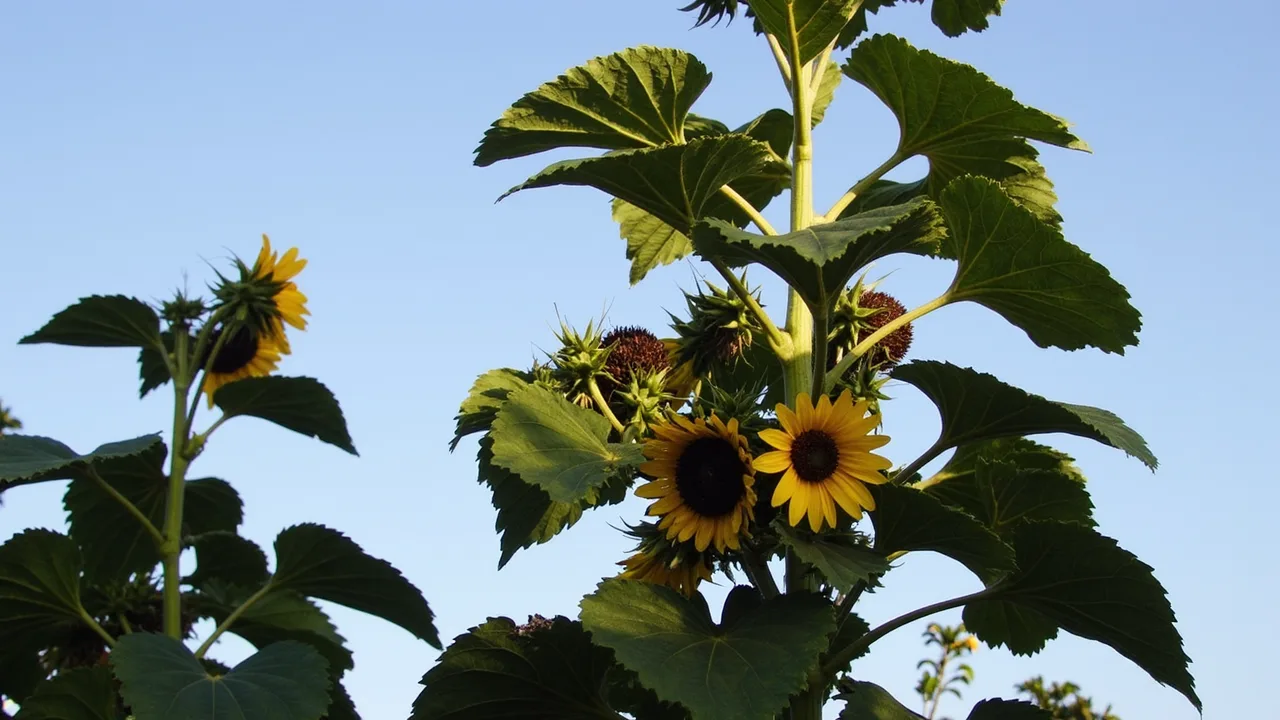
Helianthus annuus is a member of the daisy family (Asteraceae) and is native to North America, where it was first domesticated several thousand years ago for its seeds. It arrived in Europe in the sixteenth century and quickly became established in cottage gardens, allotment rows and children’s “grow-your-own” plots. The plant is grown for the showy single heads of large yellow ray florets surrounding a central disc of fertile, smaller flowers; for cut flowers; and for the edible seeds that ripen in late summer. It is a useful short-term screen at the back of a border, a stand-alone specimen on a lawn, and a late-summer nectar source for bees, hoverflies and butterflies. The grey-green stems are stout, often tinged with purple, and clad in large heart-shaped leaves. The flowers track the sun during the vegetative stage, a habit known as heliotropism, before the heads become fixed facing east as they mature. The RHS recognises several cultivars with the Award of Garden Merit, reflecting their reliable performance in typical British garden conditions.
Appearance
Helianthus annuus is a coarse but architecturally striking annual with a single, upright, pith-filled stem that can reach 3.5 m in the largest cultivars. The leaves are broadly heart-shaped to ovate, 10 to 30 cm long, dark green, rough-textured on both sides, and arranged spirally up the stem. The leaf margins are usually shallowly toothed. The plant is typically unbranched in the species grown for the largest single head, though branched cultivars produce several smaller heads from the leaf axils.
The flower is technically a composite inflorescence: a dense central disc of many small fertile florets, surrounded by a single ring of large sterile ray florets that give the impression of a single very large flower. Disc florets open from the outside in over a period of one to two weeks, and each ripens into a single grey or black-striped achene (the “seed” of commerce). Ray colour in the species is bright yellow, but cultivated forms range through pale lemon, deep gold, mahogany-red, bronze and creamy white. Disc colour is usually dark brown, though green- and yellow-centred forms exist. Heads of the giant single-stem types can reach 30 cm or more across; branched cultivars more typically bear heads 10 to 15 cm across.
At maturity, the heavy head often weighs down the upper stem, especially after rain, so taller plants in exposed sites benefit from staking. Once pollinated, the disc swells visibly as the seeds ripen, and the back of the head turns from green to yellow-brown. Ripe seeds are eaten by finches and other garden birds, which can strip a head in a few days once it begins to crack open.
Growing Conditions
Sunflowers need full sun for at least six hours a day and a sheltered site, particularly for the tall single-stem cultivars whose heavy heads catch the wind. Soil should be moderately fertile and moisture-retentive, but free-draining; very poor, dry soil produces stunted plants, while waterlogged soil rots the crown. A pH in the range 6.0 to 7.5 suits the plant well. In the United Kingdom, sunflowers are sown directly where they are to flower, after the last frost, which in most of lowland Britain means late April to mid-May; in colder parts of Scotland and at higher altitudes, sowing is more reliable in late May or early June.
The plant is a tender annual, completing its life cycle in a single season. The RHS rates tender annuals that tolerate a touch of frost as H3 and those that withstand several degrees of frost as H4; published RHS guidance for Helianthus annuus is limited, so the exact hardiness rating should be treated with some uncertainty. In practice, light frosts of about −1 to −2 °C blacken the leaves, and a hard late frost will kill young plants outright. Established plants tolerate brief cold snaps much better than seedlings.
In the south and east of England, on free-draining soils, sunflowers will often tolerate drier summers once their roots have run. In the wetter west, on heavy clay, growth can be lush but late-flowering; on thin soils over chalk, regular watering through July is essential if the heads are to reach full size. Coastal sites are generally suitable provided the plants are not exposed to salt-laden gales in their first few weeks.
Planting and Care
Sow seed directly in the flowering position from late April to early June, 2.5 cm deep and 30 to 45 cm apart for branched cultivars, or 45 to 60 cm apart for the giant single-stem types. For an earlier start, sow in 7 cm pots under glass in mid- to late April and plant out once the last frost has passed; sunflowers dislike root disturbance, so peat-free fibre or coir pots that go straight into the ground are preferable to plastic. Germination takes 7 to 14 days at 15 to 21 °C. Pinch out the growing tip of branched cultivars once they have four or five true leaves to encourage a stockier plant with more, if smaller, heads.
Watering is the single most important task through dry spells. Water deeply once or twice a week rather than little and often, and soak the root zone rather than the foliage to reduce the risk of fungal leaf disease. A 5 to 7 cm mulch of garden compost, applied once the plants are 30 cm tall, conserves moisture and keeps the roots cool.
Feeding should be light to moderate. A single application of a general-purpose organic fertiliser at planting, or a top-dressing of garden compost, is sufficient. Overfed plants on rich soil produce enormous leafy growth at the expense of flowers and are more prone to lodging.
Pruning is limited to the removal of dead or damaged leaves and, for the branched types, the regular cutting of flowers for the house, which encourages further side shoots. Cut flowers are best taken in the early morning just as the ray florets are opening; they last well in water for seven to ten days. Once the main head of a giant cultivar has finished, it can be left on the plant for the seeds, or the whole plant can be lifted and the head hung upside down in a dry, well-ventilated shed to ripen and dry.
Propagation is from seed every year, as the plant is an annual. Saved seed from open-pollinated cultivars comes true; F1 hybrid seed produces variable offspring and is best bought fresh each spring. Named cultivars are not stable from seed, so the giant single-stem types in particular should be raised from bought seed each year.
Seasonal care in the UK follows a simple rhythm. Sow under glass in April and plant out in late May; stake tall plants by the time they reach 1 m; deadhead branched types through July and August to keep the flowers coming; allow the final heads to ripen in September for the birds or for seed-saving; and clear the spent plants to the compost heap in October or November once the first hard frost has blackened them.
Common Problems
Slugs and snails are the principal problem on young seedlings, particularly in damp springs and on heavy soils. Young plants can be destroyed in a single night; protection with ferric phosphate pellets, copper rings, or night-time hand-picking is usually necessary until the stems have toughened. Rabbits and deer also browse young sunflowers in rural gardens, and pigeons will strip the leaves of seedlings in exposed sites.
Powdery mildew is the most common disease in late summer, producing a white, powdery coating on the leaves once nights turn cool and humid. It is largely cosmetic and rarely affects flowering, but badly affected plants can be cut back and the debris removed. Downy mildew, which causes yellow patches on the upper leaf and a pale grey mould below, is more serious in wet seasons and is best managed by improving air circulation and avoiding overhead watering.
Botrytis (grey mould) can affect the backs of the heads in cool, damp weather, particularly in shaded sites; affected heads should be removed before the spores spread. Sclerotinia head rot and stem rot are recorded but uncommon in garden settings.
The seeds are eaten in quantity by finches, tits and house sparrows once they begin to ripen in late August and September. In a wildlife garden this is welcome; in a seed-saving garden, net the ripening heads or cut them as soon as the back of the disc turns brown and finish drying indoors.
Failure to flower, or very late flowering, is almost always the result of a late sowing, an exposed cold site, or a shortage of water in July. Sunflowers are also prone to lodging in rich, over-watered soil or in exposed sites where they have not been staked; a stout 1.5 m cane inserted at planting and loosely tied to the stem at 60 cm intervals is usually sufficient. There is no serious evidence that Helianthus annuus is toxic to humans or domestic animals, though the rough hairy stem can cause mild skin irritation in sensitive individuals.
Popular Varieties
‘Russian Giant’ is the classic British-grown giant, a single-stem cultivar reaching 3 to 3.5 m with a single head often 30 cm or more across, each seed striped grey and black; it remains widely available from UK seed merchants and is the standard choice for county-show and school competitions.
‘Teddy Bear’ is a compact, double-flowered cultivar reaching about 60 cm, with shaggy, fully double heads of bright yellow on a stocky, branching plant. It is well suited to containers and the front of a border, and the flowers are long-lasting when cut.
‘Velvet Queen’ is a branching cultivar of 1.5 to 2 m with deep mahogany-red ray florets surrounding a dark disc, valuable in hot-coloured late-summer borders and as a cut flower.
‘Italian White’ is a tall, branching selection reaching 1.8 to 2.4 m, with pale lemon to creamy ivory ray florets and a dark brown disc, often used as a cut flower and a focal point in mixed annual borders.
‘Autumn Beauty’ is a branching mix reaching 1.5 to 2 m in shades of yellow, gold, bronze and mahogany, useful where a single colour would be too strident. Pollen-free, single-stem cultivars such as ‘Sunrich Orange’ are widely grown for cutting because the flowers do not shed pollen on to the table; their UK availability varies year to year and is not guaranteed.
Cultivars and Varieties
| Cultivar | Height | Flower | Notes | AGM |
|---|---|---|---|---|
| 'American Giant' | — | — | RHS AGM (H4) | ✓ |
| 'Buttercream' | — | — | RHS AGM (H4) | ✓ |
| 'Claret' | — | — | RHS AGM (H4) | ✓ |
| 'Munchkin' | — | — | RHS AGM (H4) | ✓ |
| 'Pastiche' | — | — | RHS AGM (H4) | ✓ |
| 'Solar Power' | — | — | RHS AGM (H4) | ✓ |
| 'Sunbright' | — | — | RHS AGM (H4) | ✓ |
| 'Teddy Bear' | — | — | RHS AGM (H4) | ✓ |
| 'Valentine' | — | — | RHS AGM (H4) | ✓ |
| 'Waooh!' | — | — | RHS AGM (H4) | ✓ |
Pests and Diseases
| Problem | Symptoms | Management |
|---|---|---|
| Fusarium | causes an increasing amount of damage and loss of sunflower crops | — |
| Downy mildew | susceptible to downy mildew due to shallow planting in moist soil | — |
| Broomrapes | parasitize the roots of various other plants, including sunflowers | — |
For step-by-step help, read Treating Powdery Mildew. Or browse the full plant problem solver to diagnose an issue by symptom.
Companion planting
✔ Grows well with: Courgette, Pea, Pumpkin, runner bean.
Full companion planting chart →
Sunflower in our guides
- How to Grow Sunflowers from Seed
- How to Attract Birds to Your Garden
- The Cut Flower Garden Revival
- June rain and sunshine set to boost flowering garden plants
Recommended Products
GardenWizz earns a commission from qualifying purchases made through affiliate links on this page (including links within the article) — as an Amazon Associate, and from Thompson & Morgan via the Awin network. This does not affect the price you pay. See our disclaimer for details.