Greater Masterwort
Astrantia major L. · masterwort · Hattie's pincushion
The Gardening Year
Best months in UK gardens · full planting calendar →
🖨 Printable care card (PDF)At a Glance
| Botanical name | Astrantia major L. |
|---|---|
| Common name(s) | greater masterwort, masterwort, Hattie's pincushion |
| Family | Apiaceae |
| Plant type | perennial |
| Height × Spread | 50–100 cm × 10–50 cm |
| Position | Full sun, Partial shade |
| Soil | chalk; clay; loam; sand |
| Flowering | June–August |
| Toxicity | — |
| Native range | Central & S. Europe to N. Caucasus (Kew POWO); naturalised in Great Britain |
Overview
Astrantia major L. — known to gardeners as greater masterwort, and sometimes sold as masterwort or Hattie's pincushion — is a clump-forming herbaceous perennial in the carrot family Apiaceae, native to central and southern Europe through to the northern Caucasus and long naturalised in Great Britain. The Royal Horticultural Society lists it as fully hardy across the UK, awarding it the highest hardiness rating of H7 — hardy in the severest European continental climates, below −20 °C. The accepted scientific name Astrantia major L. is confirmed by Kew Science's Plants of the World Online, with no current heterotypic synonym to note at species level. In a UK cottage-garden border it earns its place for the long-lasting, papery-bracted "pincushion" flower heads held well above the foliage from early summer into late summer, and for its tolerance of ordinary garden soils including damp clay. It should not be confused with Astrantia maxima Pall., a separate accepted species with larger, more spreading flower heads. For broader context on hardy cottage-garden partners, see our encyclopaedia entries for Geranium × oxonianum and Geranium magnificum.
Appearance
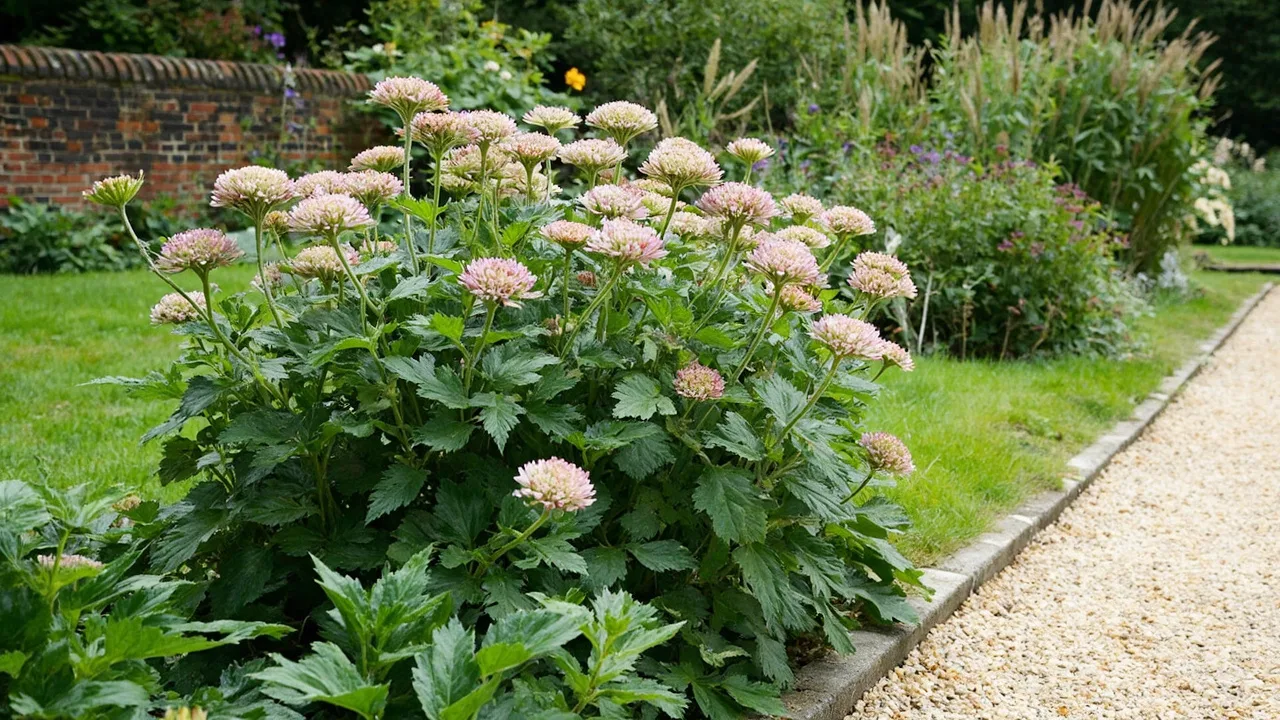
Astrantia major forms an erect, slowly expanding clump of palmate, scarcely 3–5-lobed basal leaves with toothed margins. From the clump it sends up wiry, branched flower stems typically reaching about 60 cm, each terminating in a small compound umbel of tiny flowers ringed by a ruff of papery bracts — usually pinkish or greenish-white in the species, and longer-lasting in colour than the true flowers they subtend. The species flowers from June to August, with named cultivars such as 'Roma' and 'Abbey Road' extending that window into September. This "pincushion" arrangement is the feature the folk name Hattie's pincushion refers to. The RHS gives an ultimate size band of 0.5–1 m tall by 0.1–0.5 m wide for the species, so a mature clump reads as a vertical accent rather than a bulky border filler. The bracts dry on the stem and remain ornamental well into late summer, which is why established clumps are useful both in the border and in cut-flower arrangements. Astrantia maxima has noticeably larger, more deeply coloured heads carried on a more spreading plant; this encyclopaedia entry does not cover that species, which has its own RHS plant page.
Growing Conditions
Astrantia major is happy in most ordinary garden soils — chalk, clay, loam or sand — provided the ground is moist but well-drained; it also tolerates damp or poorly-drained conditions that would defeat drier-medieval perennials, and accepts any pH from acid through neutral to alkaline. The RHS Astrantias plant guide recommends full sun or partial shade, and notes that the genus "does best in fertile soil that drains easily." In practice across most of the UK, a position that gets morning sun and afternoon shade in the hotter southern and eastern counties keeps both the foliage and the bract colours at their best, while in cooler northern and western gardens a fully open position produces stronger, more upright stems. The species reaches the lower end of its 0.5–1 m height band on thin or dry soils, and the upper end on deep, moisture-retentive loam. Because it tolerates damp ground, Astrantia major is one of the few true perennials that performs reliably at the edge of a bog garden or beside a regularly watered border, where it associates well with Cornus alba for foliage contrast.
Planting and Care
Plant container-grown Astrantia major at any time the soil is workable, though spring and early autumn are the most reliable windows for a UK garden; the plant needs two to five years to reach its full size band, so a first-year plant will read shorter and slimmer than the eventual 0.5–1 m × 0.1–0.5 m. Space plants roughly 30–45 cm apart so the clumps can grow into each other without competing in their first season, and water in well until established. After the first flush of flowers, cut back spent flower stems to the basal rosette to encourage a second show — particularly effective in long-season cultivars such as 'Roma' and 'Abbey Road'. Divide congested clumps in early spring or autumn; the crowns are shallow and lift easily, and divisions re-establish quickly in moist ground. If you are growing Astrantia from seed or bought plugs, follow our general guidance on how to harden off seedlings before planting out — Astrantia dislikes sudden exposure to cold, drying wind more than it dislikes cold itself. Seed-raised plants can be variable in flower colour, so named cultivars are best bought as potted plants for predictable results. The species is fully hardy at H7 (below −20 °C), so no winter protection is needed anywhere in the UK; in fact, the most common winter loss in UK gardens is from waterlogging in compacted clay rather than from cold.
Common Problems
Astrantias are generally trouble-free once established, and the RHS describes them as a low-maintenance genus. Powdery mildew can occur in dry conditions or where air movement is poor — a white, dusty coating on the leaves in mid- to late summer — and is controlled by the standard RHS powdery-mildew guidance: improve airflow, avoid overhead watering in dry spells, and remove affected foliage. Slugs and snails are not normally a problem on established clumps, though they may graze soft new growth in early spring on damp sites; the RHS does not list Astrantia among its slug- and snail-prone plants. Astrantia is not listed in the RHS poisonous-plant advice, and Kew's Plants of the World Online does not publish a toxicity statement for the species; on the available authoritative evidence, the species has no known toxicity, which is not the same as a positive non-toxicity claim, and gardeners handling cut material should still wash hands as a matter of routine. In very dry summers, lower leaves may brown early; this is a stress response rather than a disease and is corrected by deep watering and a mulch of garden compost. For a broader view of how to approach trouble in the UK perennial border, our guide to growing clematis covers the same triage logic for a different climber.
Popular Varieties
The species Astrantia major itself does not hold a species-level Award of Garden Merit — the AGM is held by individual cultivars, and the species record on the canonical case reflects that. Six RHS-listed cultivars are widely available in the UK trade and useful to UK gardeners, each with a source-grounded distinguishing feature:
- Astrantia 'Roma' (PBR) — soft pink, long-flowering, and a popular AGM cultivar for its extended season from early summer into September.
- Astrantia major 'Abbey Road' (PBR) — deep reddish-purple bracts carried on dark stems, to roughly 80 cm; the RHS plant page for 'Abbey Road' gives the same 0.1–0.5 m spread band as the species, so it is taller without being wider.
- Astrantia 'Buckland' — pink, an AGM cultivar, and a reliable mid-border choice; the RHS notes the same chalk/clay/loam/sand soil tolerance as the species.
- Astrantia major subsp. involucrata 'Shaggy' — distinguished by long, green-tipped bracts that give an unusually shaggy outline; the RHS lists it as an AGM cultivar.
- Astrantia major 'Rubra' — a red-flowered cultivar, deeper in colour than the species and a useful partner in hot colour schemes; RHS plant 99714.
- Astrantia major Gill Richardson Group — a group form listed by the RHS, encompassing red-pink selections named for the plantswoman Gill Richardson.
A few named cultivars sit at the edge of this list and are not invented into the article: 'Burgundy Manor' is an AGM cultivar but its details have not been added here; A. major subsp. involucrata 'Orlando' carries a different RHS hardiness rating from the species and is not transferred to the species record. The lookalike Astrantia maxima Pall. is a separate accepted species rather than a cultivar, and is out of scope for this encyclopaedia entry.
Recommended Products
GardenWizz earns a commission from qualifying purchases made through affiliate links on this page (including links within the article) — as an Amazon Associate, and from Thompson & Morgan via the Awin network. This does not affect the price you pay. See our disclaimer for details.