Wax Begonia
Begonia (Semperflorens Cultorum Group) · bedding begonia
The Gardening Year
Best months in UK gardens · full planting calendar →
🖨 Printable care card (PDF)At a Glance
| Botanical name | Begonia (Semperflorens Cultorum Group) |
|---|---|
| Common name(s) | wax begonia, bedding begonia |
| Family | Begoniaceae |
| Plant type | perennial |
| Height × Spread | 50 cm × 50 cm |
| Position | Partial shade, Full sun |
| Soil | fertile, moist but well-drained, neutral to slightly acid |
| Flowering | June–October |
| Toxicity | — |
| Native range | — |
Overview
Begonia (Begonia semperflorens) — most often sold to UK gardeners as wax begonia or bedding begonia — is the compact, mounded fibrous-rooted plant grown in huge volumes for summer bedding, mass plantings, edging, and containers. The plant you buy under the label "Begonia semperflorens" is, in horticultural trade terms, the Begonia Semperflorens Cultorum Group, a cultivated hybrid group registered with the RHS, with the synonym Begonia × semperflorens-cultorum hort. There is, however, an explicit and long-standing botanical ambiguity that this entry preserves: the bare binomial Begonia semperflorens Hook. (1829) and Begonia semperflorens Link & Otto are both treated by Kew Plants of the World Online as synonyms of varieties of Begonia cucullata Willd. (1805), which is the POWO-accepted species underlying the garden plant. UK gardeners may use any of these names interchangeably in conversation; the cultivated group name and the POWO-accepted species are not in conflict, but they are not interchangeable either, and the article keeps both visible. Botanically it is a tender evergreen perennial in the family Begoniaceae, native to South America; in UK conditions it sits at RHS hardiness H1c, which means it can be grown outside in the summer (5–10 °C); tender perennial, treated as half-hardy annual in most UK gardens. It reaches a maximum height of about 50 cm and a similar spread, and is grown almost entirely for its continuous, self-cleaning display of small waxy flowers through the warm months.
Appearance
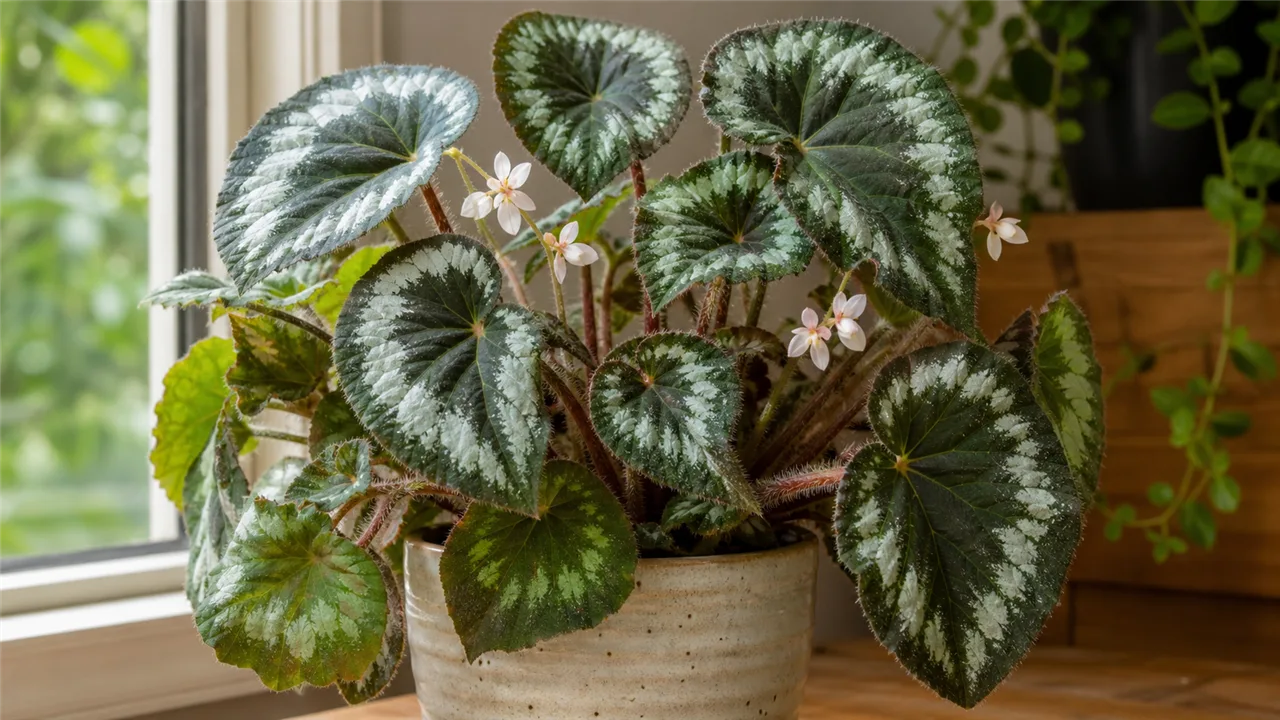
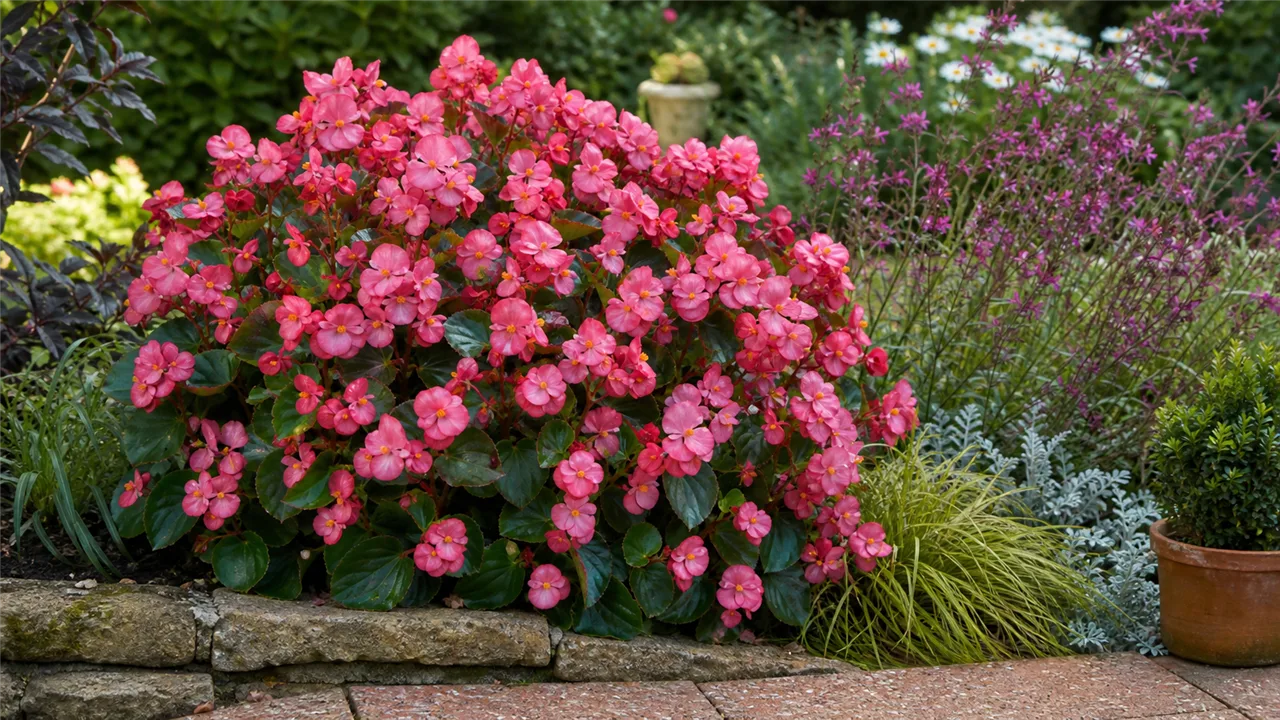
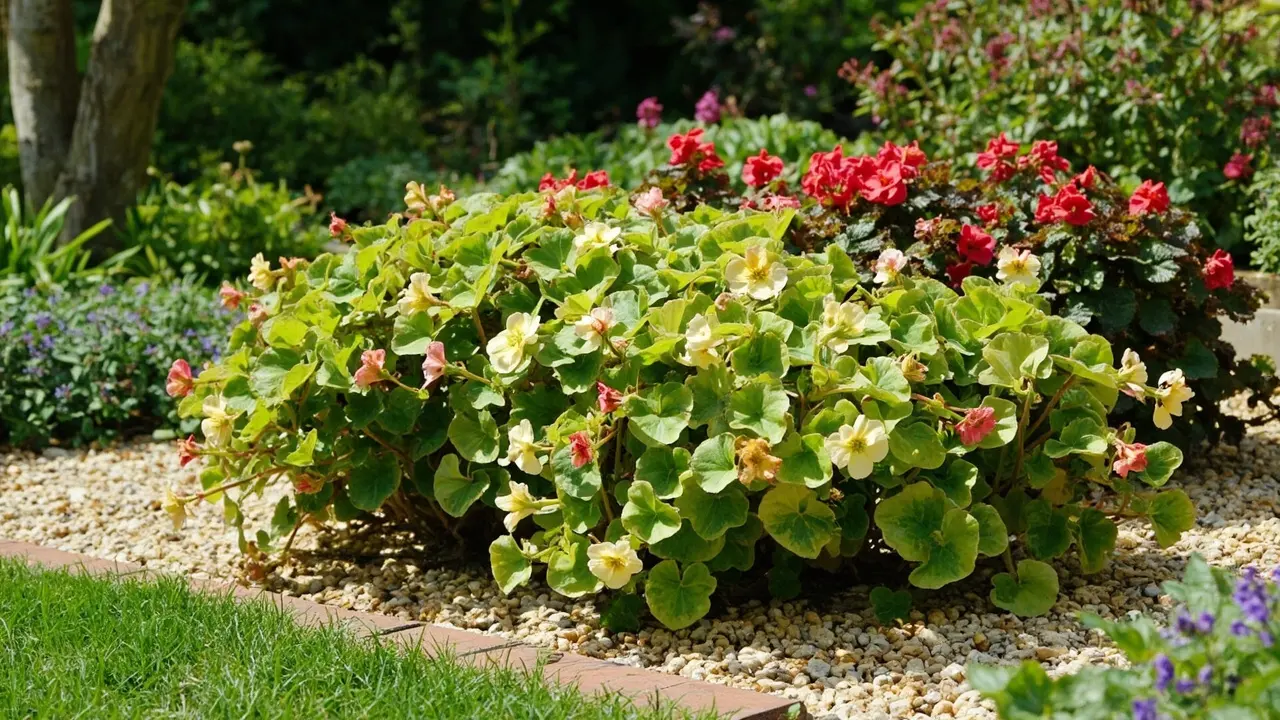
Begonia (Begonia semperflorens) makes a low, bushy, dome-shaped plant with a fibrous root system. Stems are succulent and fleshy, pale green to slightly reddish, and branch freely from the base so the plant fills out into a tight mound rather than a single stem. Leaves are the most reliable identification feature and the source of the common name: they are rounded to ovate, asymmetrical at the base as is typical of the family, smooth-edged or very faintly toothed, glossy, and distinctly waxy or polished to the touch. Two leaf-colour forms exist: the bright green-leaved type and the bronze-leaved type, in which the upper surface carries a coppery-bronze flush that deepens in strong light. Either form carries the same flowers. Flowers are small — typically 1–2 cm across — single or occasionally semi-double, and produced in loose clusters at the stem tips. They come in clear red, pink, and white, and modern F1 series reliably cover all three colours in the same seed packet. The waxy texture, the compact mounded habit, the small flower clusters, and the bright green or bronze foliage together separate wax begonia cleanly from the two plants UK gardeners most often confuse it with: the much larger-flowered tuberous begonia (Begonia × tuberhybrida), which is grown from a tuber, has large often double flowers and is lifted in autumn, and the rex begonia (Begonia rex), which is a rhizomatous foliage houseplant grown for its patterned leaves rather than its flowers and is not used as summer bedding at all. A third useful contrast is with Begonia grandis, the hardy begonia, which is genuinely UK-hardy, has soft pink flowers and a much taller, more open habit.
Growing Conditions
Begonia (Begonia semperflorens) wants a fertile, moist but well-drained, neutral to slightly acid soil and a position in partial shade, with full sun acceptable provided the soil stays reliably moist. In practice this means an east- or west-facing border, the dappled shade under an open shrub or small tree, a north-facing bed that catches morning light, or a container grouped with other summer bedding. In southern UK summers the waxy foliage will scorch in a hot south-facing border unless you are prepared to water daily through July and August; in cooler northern gardens and coastal districts full sun is more forgiving. Soil preparation is straightforward: dig in well-rotted garden compost or leaf mould a fortnight before planting so the bed holds moisture without waterlogging, and on heavy clay add a bucket of grit per square metre to improve drainage, because the fleshy stems and fibrous roots will rot in cold, saturated compost. In containers use a peat-free multi-purpose compost with about 10–15 % by volume of horticultural grit, and raise the pot on pot feet so excess winter and spring rain can drain freely. Begonia (Begonia semperflorens) is rated tender at RHS H1c — that is, it can be grown outside in the summer (5–10 °C); tender perennial, treated as half-hardy annual in most UK gardens — so it cannot be relied on to survive a British winter outdoors anywhere, and most UK gardeners treat it as a half-hardy annual replaced from new plugs or seed each spring. The plant reaches a maximum height of about 50 cm and a similar spread at maturity, and its main flowering window runs from June through July, August, September, and into October until the first hard autumn frost cuts it down.
Planting and Care
The realistic UK growing calendar for Begonia (Begonia semperflorens) is anchored on the last frost date. Sow seed indoors in January or February on the surface of a fine, moist seed compost at about 21–24 °C; do not cover, because the seed needs light to germinate, and prick out into individual cells once the seedlings are large enough to handle. Grow the young plants on at 18–21 °C in bright light, potting up as roots fill the cell. Harden them off thoroughly in late May by leaving trays outside by day and bringing them back under cover at night for seven to ten days, so the transition to outdoor conditions is gradual. Plant out in late May or early June once the last frost has passed — typically late May to early June in southern England, a week or two later further north and at altitude — into prepared beds at 15–20 cm spacing for mass planting, or 20–25 cm apart in mixed containers. The flowering season begins almost immediately and continues without pause through June, July, August, September, and into October. Through summer, water when the top 2–3 cm of compost are dry, ideally early morning or evening, and always at the base of the plant rather than over the foliage; wet leaves in still air are how botrytis gets in. Once the first flowers open, switch to a high-potash liquid feed (a tomato feed at half strength works well) every two weeks through the flowering season. Deadheading is largely unnecessary on modern F1 series such as 'Coco', 'Senator', 'Bada Bing' and 'Cocktail', which drop their spent flowers cleanly; older open-pollinated cultivars benefit from pinching off faded clusters with finger and thumb to keep the display tidy and reduce the risk of grey mould setting into damp petals. The simplest end-of-season decision in UK gardens is to compost the plants after the first hard frost and start again from new stock the following spring; the overwintering route is covered in the propagation section below.
Common Problems
The UK-specific problems that reliably affect Begonia (Begonia semperflorens) are five, and each has a realistic British response. Vine weevil (Otiorhynchus sulcatus) is the number-one issue in containers, especially on plants being overwintered indoors; the cream-coloured grubs chew notches out of the fibrous roots and the whole plant collapses without warning. The effective UK response is a drench of vine-weevil-eating nematodes (Steinernema kraussei or Heterorhabditis bacteriophora) applied in early autumn while the soil is still above 5 °C, plus a habit of tipping plants out of their pots in spring to check for grubs and replacing spent compost rather than reusing it. Botrytis (grey mould) appears in damp UK summers and again in cool, still autumns: grey, fuzzy mould on flowers and leaves, usually where air movement is poor. Improve airflow by holding the recommended spacing, water at the base only, remove infected material promptly, and avoid saving seed from any plant that has had botrytis. Powdery mildew is the opposite weather problem — dry, hot spells in southern UK midsummer, with a white dusty coating on the upper leaf surface. Give plants afternoon shade, water at the base, and treat severe outbreaks with potassium bicarbonate or sulphur. Slugs and snails target the young spring shoots once plants go outside and can shear a tray of plugs to the compost overnight; ferric phosphate pellets (pet-safe to wildlife), copper tape around pots, and hand-picking at dusk all work, and you can also see our slugs and snails guide and the general plant problem solver for the wider UK diagnosis. Root rot is the cold-wet-compost problem: yellowing leaves and a soft, blackened crown after a wet spell. Use a free-draining peat-free mix with added grit, raise containers on pot feet, and avoid overwatering in cool weather. Aphids occasionally colonise overwintered plants on UK windowsills in spring and respond to the same controls described in controlling aphids naturally. The RHS profile also lists glasshouse red spider mite and glasshouse whitefly as occasional problems on plants kept under cover, which is one more reason most UK gardeners simply treat Begonia (Begonia semperflorens) as a half-hardy annual rather than overwintering it.
Popular Varieties
Because Begonia (Begonia semperflorens) is sold as the Begonia Semperflorens Cultorum Group rather than as individual species, named varieties tend to come in two forms: green-leaved series and bronze-leaved series, each usually sold as a mixed-colour packet covering red, pink and white. The two named plants the RHS profile for the bronze-leaved subgroup specifically records are the bronze-leaved, red-flowered form and the bronze-leaved, white-flowered form — both clearly described on the RHS Plants pages and reproduced as trade names by UK growers. Beyond those, the modern F1 seed series that UK gardeners will encounter most often at the garden centre include 'Coco' (compact, mixed colours), 'Senator' (deep bronze foliage, mixed colours, heat-tolerant), 'Bada Bing' and 'Bada Boom' (green- and bronze-leaved respectively, very uniform), 'Cocktail' (bronze foliage, mixed colours, used widely in municipal bedding) and the larger 'Dragon Wing' type for hanging baskets. Two practical notes on choosing varieties. First, the F1 series do not come true from saved seed — saved seed produces variable, often muddy-coloured offspring, so if you want a uniform bedding display, buy fresh F1 seed each year rather than collecting from last year's plants. Second, none of the named varieties listed above have been recorded in the cited RHS evidence as carrying the RHS Award of Garden Merit (AGM), so this entry does not claim AGM status for any of them; that unknown is preserved rather than filled in. If you want a printable at-a-glance summary for the seed tray or potting bench, see our Begonia semperflorens printable care card and the wider Begonia printable care card, and for context on where wax begonias sit among the other begonias UK gardeners grow, see the Begonia (genus guide), the contrasting hardy Begonia grandis, and the half-hardy bedding companions Pelargonium, Fuchsia and Cosmos. For UK timing, the May planting calendar, June planting calendar and July planting calendar put the hardening-off, planting-out and peak-flowering windows in the wider gardening year, and the RHS hardiness ratings reference explains why wax begonias sit at H1c and are treated as annuals in most UK gardens. Related how-to guides worth pairing with this entry cover treating powdery mildew, dealing with slugs and snails and controlling aphids naturally.
---
Propagation in practice (UK realistic options). The two honest propagation routes for Begonia (Begonia semperflorens) in UK conditions are stem cuttings in late summer and seed in late winter. For cuttings, in late August or early September take 4–8 cm non-flowering side shoots, trim just below a node, and root them either in a glass of water on a bright windowsill (changing the water every few days) or in a 50:50 mix of peat-free compost and perlite kept just moist; pot on into 9 cm pots once a good root system has formed, and overwinter on a frost-free windowsill at 10–15 °C as a small houseplant, pinching out the tips to keep the plant bushy. Plant out after hardening off the following May. For seed, collect from open-pollinated plants in autumn, dry the tiny seeds thoroughly, and store cool and dry; in January or February, surface-sow on a fine moist seed compost at 21–24 °C, do not cover, and expect germination within two to three weeks. Again, do not expect F1 series such as 'Coco' or 'Senator' to come true from saved seed — that is the honest trade-off.
Pests and Diseases
| Problem | Symptoms | Management |
|---|---|---|
| Powdery mildew | A white, dusty fungal growth appears on leaves and stems, often causing distortion. | Improve air circulation and apply a fungicide if severe; avoid wetting foliage when watering. |
| Slugs and snails | Irregular holes in leaves and silvery slime trails on foliage and soil surface. | Use slug pellets, beer traps, or copper tape barriers to protect young plants. |
| Vine weevil | Notched leaf margins during the day and root damage causing wilting at night. | Apply nematodes to the soil in autumn or use systemic insecticides for potted plants. |
| Root rot (Phytophthora) | Plants wilt and collapse despite moist soil, with blackened, mushy roots. | Ensure well-drained compost and avoid overwatering; remove affected plants immediately. |
| Damping off | Young seedlings collapse at the base and die rapidly in damp conditions. | Use sterile, peat-free compost and ensure good ventilation for seed trays. |
For step-by-step help, read Dealing with Slugs and Snails and Treating Powdery Mildew. Or browse the full plant problem solver to diagnose an issue by symptom.
Recommended Products
GardenWizz earns a commission from qualifying purchases made through affiliate links on this page (including links within the article) — as an Amazon Associate, and from Thompson & Morgan via the Awin network. This does not affect the price you pay. See our disclaimer for details.