Chrysanthemum
Chrysanthemum × morifolium (Ramat.) Hemsl. · mums · chrysanths · florist's chrysanthemum · florist's daisy · hardy garden mum · garden mum · pot mum
The Gardening Year
Best months in UK gardens · full planting calendar →
🖨 Printable care card (PDF)At a Glance
| Botanical name | Chrysanthemum × morifolium (Ramat.) Hemsl. |
|---|---|
| Common name(s) | chrysanthemum, mums, chrysanths, florist's chrysanthemum, florist's daisy, hardy garden mum, garden mum, pot mum |
| Family | Asteraceae |
| Plant type | perennial (Perennial (POWO: 'a perennial and grows primarily in the subtropical biome'). In the UK, hardy garden chrysanthemums are clump-forming perennials that go dormant in winter and re-sprout in spring (RHS growing guide). Tender florist-grade 'pot mums' sold as seasonal indoor plants are a different market and are not the focus of this encyclopedia page.) |
| Height × Spread | 50–150 cm × 10–100 cm |
| Position | Full sun |
| Soil | Fertile, moist but well-drained peat-free compost or soil (RHS genus guide). In containers use peat-free John Innes No 2 in a pot at least 30 cm diameter (RHS growing guide). Mulch with well-rotted garden compost or manure. |
| Flowering | September–November |
| Toxicity | Toxic to dogs, cats and horses (ASPCA: https://www.aspca.org/pet-care/aspca-poison-control/toxic-and-non-toxic-plants/chrysanthemum). Toxic principles: sesquiterpene lactones, pyrethrins and other potential irritants. RHS does not publish a species-level toxicity statement. Keep cut flowers and garden plants out of reach of browsing pets; wash hands after handling cut flowers. |
| Native range | SE. China (POWO accepted hybrid); Chrysanthemum genus is Temp. Eurasia to N. Indo-China. Not native to GB / Ireland. |
Overview
Chrysanthemum (Chrysanthemum × morifolium (Ramat.) Hemsl.) is the long-cultivated florist's chrysanthemum of UK autumn gardens: an herbaceous perennial in the daisy family Asteraceae whose late-season flowerheads carry most UK borders from late summer into November. The accepted scientific name, with the hybrid cross preserved, is Chrysanthemum × morifolium (Ramat.) Hemsl., and Kew's Plants of the World Online records it as an accepted hybrid whose native range is south-east China. The Royal Horticultural Society genus guide lists its common names as "Mums, chrysanths"; the species is more widely known in UK and US horticulture as the florist's chrysanthemum, the florist's daisy, the hardy garden mum, the garden mum, or the pot mum. The plant you may have bought under the older name Dendranthema × grandiflora (Ramat.) Kitam. is the same species — that name is a POWO-recognised heterotypic synonym that was used for decades in UK trade and still appears on the RHS Dendranthema grandiflorum synonym page, so the page subject stays Chrysanthemum × morifolium and the slug stays `chrysanthemum-morifolium`. The species is not native to Great Britain or Ireland. For companion planting in the late-winter garden slot that follows chrysanthemums in the calendar, the GardenWizz encyclopaedia entry for cyclamen coum is a natural partner.
Appearance
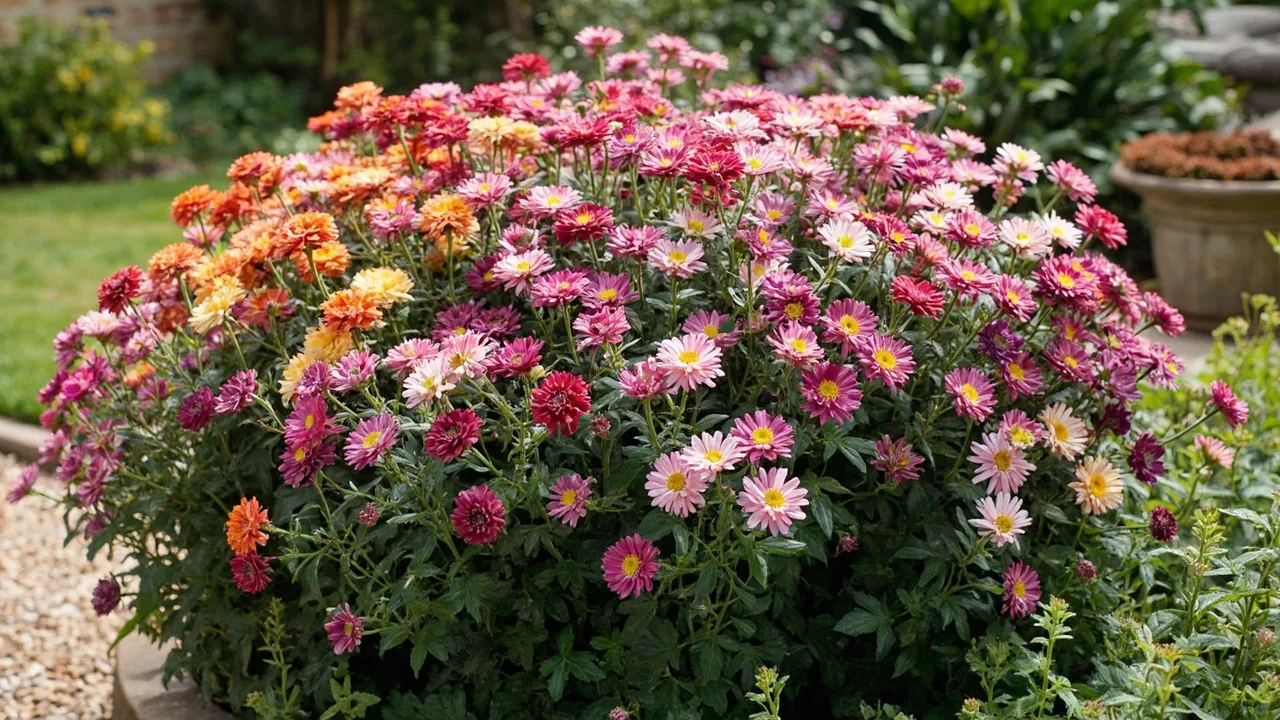
Chrysanthemum × morifolium is a clump-forming, sometimes bushy herbaceous perennial with a woody-based rootstock and aromatic, pinnately lobed leaves carried on upright stems; the RHS describes the genus as "erect woody-based perennials with aromatic, pinnately lobed leaves and flowerheads of diverse form, from late summer to late autumn." Mature plants reach the dimensions recorded for the RHS Award of Garden Merit cultivar set on the genus guide: 0.5–1.5 m tall by 0.1–1 m wide, depending on cultivar. The species is a hybrid complex whose individual cultivars vary considerably, so this article deliberately quotes dimensions as an envelope across the AGM cultivars rather than as a single species value. Flowerheads range from open single daisies through intermediate decorative forms to fully double pompoms, and the colour range covers pink, purple and red through orange, yellow and white. Leaves are deeply lobed, mid- to dark-green, and carry the distinctive aromatic scent that gives cut chrysanthemum stems their characteristic greenhouse smell. Flowering runs from late summer into November, with the RHS growing guide pinning the UK window as "in flower from September to November." This is the same plant sold in late summer as a flowering pot plant — those tender florist-grade "pot mums" are a different market and are not the focus of this hardy-garden-chrysanthemum entry.
Growing Conditions
Give chrysanthemums a warm, sunny and sheltered spot in fertile, moist but well-drained peat-free soil or compost; the RHS genus guide is explicit that they "enjoy a warm, sunny and sheltered spot" and "need fertile and moist but well-drained peat-free compost or soil", and that "most won't survive heavy frosts or waterlogged soil" and "don't perform well in dry conditions, poor soil or shade." In containers use a peat-free John Innes No 2 compost in a pot at least 30 cm (1 ft) in diameter, and mulch borders with well-rotted garden compost or manure to hold moisture and feed the roots. Water regularly through the growing season without ever letting the pot or border dry out completely, and avoid waterlogging at all costs — the RHS warns that chrysanthemums dislike waterlogged conditions as much as dry soil. Position is full sun in a sheltered border or south- to west-facing aspect; light afternoon shade is tolerated in hotter parts of southern England but reduces flower count. Chrysanthemums combine well with other autumn-flowering border plants such as salvias, sedums, asters and ornamental grasses, and they earn their place in a dedicated cut-flower border where sprays can be picked without spoiling the garden display.
Planting and Care
Plant out hardened-off young plants from mid-May to early June, once the last frost has passed in lowland Britain; the RHS growing guide says "plants that have been stored in a light frost-free place over winter can be planted outside in late spring, after the last frost (typically from mid May to early June)". Space plants 30–45 cm (12–18 in) apart in the border, add a stake to support taller cultivars, and pinch out the main growing point once stems reach about 20 cm (8 in) tall in early summer to encourage branching; continue pinching the tips of sideshoots through to mid-summer for stockier, more floriferous plants. Water regularly in dry spells, feed container-grown plants with an organic liquid seaweed fertiliser through the growing season, and switch to a high-potash feed such as tomato fertiliser once flowering starts. Deadhead spent blooms to extend the display into November, then cut the whole plant down to about 20 cm in late autumn once flowering is finished. In most of the UK the stools need to be lifted: cut stems to around 20 cm, lift the clump, shake off the soil, label the variety, and stand the stools in a shallow tray on 5 cm of damp compost in a cold but frost-free greenhouse, porch or conservatory. In mild, sheltered regions a thick autumn mulch over the crown is often enough to carry plants through. Propagate new plants by taking 5–7.5 cm basal softwood cuttings in spring, inserting them into a 50:50 mix of peat-free multipurpose compost and horticultural grit in a propagator at 10 °C or above in bright, indirect light; they should root in about three weeks. Established clumps can also be divided in spring once growth has restarted.
Common Problems
UK chrysanthemums face a defined set of pests and diseases that the RHS growing guide lists explicitly: slugs and snails (most damaging on young spring growth), aphids on soft shoot tips, leaf miners (serpentine pale tunnels in leaves), leaf and bud eelworms (angular brown-black areas between leaf veins with distorted buds), earwigs (notched petals on doubles in late summer), capsid bugs (distorted young leaves), and red spider mite under hot dry conditions — especially in greenhouses and indoor overwintering. The four significant diseases are chrysanthemum white rust ("can be very damaging and hard to control", with pale spots on the upper leaf surface and white pustules underneath), powdery mildew in dry conditions, grey mould (Botrytis) and other fungal rots in wet weather, and viruses that cause stunted growth and leaf markings. Manage them by improving air circulation, watering at the base rather than overhead, mulching to keep roots moist, removing and binning (not composting) badly affected material, encouraging natural predators outdoors, and sourcing new stock from clean suppliers. In confirmed outbreaks of chrysanthemum white rust, contact the RHS or Defra Plant Health for current UK statutory guidance. Common sense checks: don't plant out before the last frost, don't let borderline-hardy cultivars sit in cold wet clay over winter, and don't overwinter in a warm dry room where red spider mite takes hold. On toxicity, the ASPCA records chrysanthemum as toxic to dogs, cats and horses, with toxic principles of sesquiterpene lactones and pyrethrins — the same chemistry that underlies natural pyrethrin insecticide extracted from chrysanthemum flowers; the RHS does not publish a species-level toxicity statement for Chrysanthemum × morifolium, so keep cut flowers and border plants out of reach of browsing pets and wash hands after handling. On hardiness, the RHS growing guide states that "most hardy chrysanthemums can survive temperatures down to at least -5 °C (23 °F)" and that the broader H4 rating of -10 to -5 °C applies to most of the hardy garden chrysanthemum group; the RHS does not pin a single H-code to the species row, so the practical UK guidance remains: lift and store stools in most regions, mulch heavily in mild sheltered gardens, and bring containers indoors for winter.
Popular Varieties
The RHS genus guide lists eight current Award of Garden Merit cultivars of Chrysanthemum × morifolium — 'Ruby Enbee Wedding' (29d), 'Cream Talbot Parade' (29c), 'Myss Saffron' (29c), 'Yellow Pennine Oriel' (29a), 'Ruby Raynor' (21c), 'Max Riley' (23b), 'Allouise' (25b), and 'Gold Enbee Wedding' (29d) — each with its own height, width, classification code, and colour range. This species-level encyclopaedia page deliberately does not own a cultivar table: detailed profiles of 'Ruby Enbee Wedding', 'Cream Talbot Parade', 'Myss Saffron', 'Yellow Pennine Oriel', 'Ruby Raynor', 'Max Riley', 'Allouise' and 'Gold Enbee Wedding' belong at their own future GardenWizz cultivar slugs, and no separate page is created for the older synonym Dendranthema grandiflora since that name points to the same plant covered here. The National Chrysanthemum Society maintains the formal UK classification system reflected in those AGM cultivar codes (the trailing digits refer to the flower section and colour group), and specialist nurseries sell cultivars organised by flower form — sprays, decoratives, pompons, singles, spiders and spoons — and by flowering window from late August through November. When buying, look for plants labelled "hardy garden chrysanthemum" or "early-flowering outdoor chrysanthemum" rather than tender florist-grade pot mums; the latter are raised for indoor display and rarely survive a UK winter outdoors. For a broad informal planting, mixed collections of unnamed AGM cultivars in complementary autumn colours give the most reliable UK display.
Pests and Diseases
| Problem | Symptoms | Management |
|---|---|---|
| Chrysanthemum white rust | Pale spots on upper leaf surface with corresponding pustules of white spores on the underside; severe defoliation; RHS: 'can be very damaging and hard to control'. | Remove and bin affected leaves (do not compost). Improve air circulation. Avoid overhead watering. Choose resistant cultivars. In confirmed outbreaks, contact the RHS or Defra Plant Health for current UK statutory guidance. |
| Powdery mildew | White powdery fungal growth on leaves; prevalent in dry conditions (RHS). | Mulch to keep roots moist; water at the base rather than overhead; improve air circulation; remove badly affected leaves. |
| Grey mould and other fungal rots (Botrytis cinerea and allies) | Grey fuzzy sporulation on damaged or senescing tissue; thrive in wet weather (RHS). | Improve air flow; avoid overhead watering; remove affected material; do not overwinter in stagnant indoor conditions; lift and store stools in late autumn. |
| Viruses (Chrysanthemum mosaic virus and others) | Stunted growth and leaf markings (RHS); distorted flowers in some cultivars. | No cure. Remove and bin affected plants; control insect vectors (aphids); disinfect tools between plants; source new stock from clean suppliers. |
| Aphids | Clustering on soft shoot tips in spring and early summer; sticky honeydew; sooty mould. | Hand removal, soft soap spray, encourage natural predators (ladybirds, lacewings, hoverflies) outdoors. |
| Leaf miners | Serpentine pale tunnels in leaves. | Pinch out and bin affected leaves; encourage natural parasitoids; in severe cases use a systemic treatment approved for ornamentals. |
| Leaf and bud eelworms | Angular brown-black areas between leaf veins; distorted buds; stunting. | No chemical control available to gardeners. Remove and bin affected plants. Avoid propagating from infected stock. |
| Earwigs | Notched petals and leaves, especially on double-flowered cultivars in late summer. | Trap in upturned pots stuffed with straw on canes; empty daily; remove garden debris that harbours them. |
| Capsid bugs | Distorted, tattered young leaves and shoot tips. | Tolerate light damage; encourage natural predators; in severe cases treat in early summer. |
| Red spider mite (glasshouse / two-spotted) | Fine stippling and bronzing on leaves under hot dry conditions, especially in indoor overwinter or greenhouse. | Raise humidity, ventilate, introduce Phytoseiulus if severe; do not overwinter in a dry warm room. |
| Slugs and snails | Shoot damage on young plants in spring (RHS). | Standard UK slug and snail control — see /articles/dealing-with-slugs-and-snails. |
For step-by-step help, read Controlling Aphids Naturally, Dealing with Slugs and Snails and Treating Powdery Mildew. Or browse the full plant problem solver to diagnose an issue by symptom.
Recommended Products
GardenWizz earns a commission from qualifying purchases made through affiliate links on this page (including links within the article) — as an Amazon Associate, and from Thompson & Morgan via the Awin network. This does not affect the price you pay. See our disclaimer for details.