Hollyhock
Alcea rosea · common hollyhock
The Gardening Year
Best months in UK gardens · full planting calendar →
🖨 Printable care card (PDF)At a Glance
| Botanical name | Alcea rosea |
|---|---|
| Common name(s) | hollyhock, common hollyhock |
| Family | Malvaceae |
| Plant type | perennial |
| Height × Spread | 2.5 m × 100 cm |
| Position | Full sun |
| Soil | Well-drained; chalk, loam or sand; pH acid, alkaline or neutral (RHS genus guide: 'Hollyhocks will grow in most soils, including both heavy and dry soils, in full sun'). |
| Flowering | June–August |
| Toxicity | — |
| Native range | — |
Overview
Alcea rosea, the hollyhock, is a tall flowering plant in the mallow family (Malvaceae) that has been a fixture of British cottage gardens for generations. It is treated as a biennial or short-lived perennial in UK cultivation: most plants spend their first year as a basal rosette of large, rough-textured leaves, then send up a tall flowering spike in their second year, after which they commonly die back or are pulled out. The RHS places Alcea rosea in hardiness rating H5 ("hardy in most places throughout the UK even in severe winters; -15 to -10 °C"), and the accepted name Alcea rosea L. (1753) is confirmed by Kew's Plants of the World Online, with the older synonym Althaea rosea noted in the family. It is not native to Britain: Kew POWO lists Great Britain under "Introduced into" for the species, so it should be framed as a long-cultivated garden plant rather than a native wildflower. The common name "hollyhock" and the scientific name Alcea rosea are used together on the RHS taxon page, and both are accepted in UK horticultural reference. Hollyhocks carry the cottage-garden association for a reason — they suit informal plantings, sunny walls and the back of a mixed border, and they earn their place with months of summer colour on stems that other border plants cannot match.
Appearance
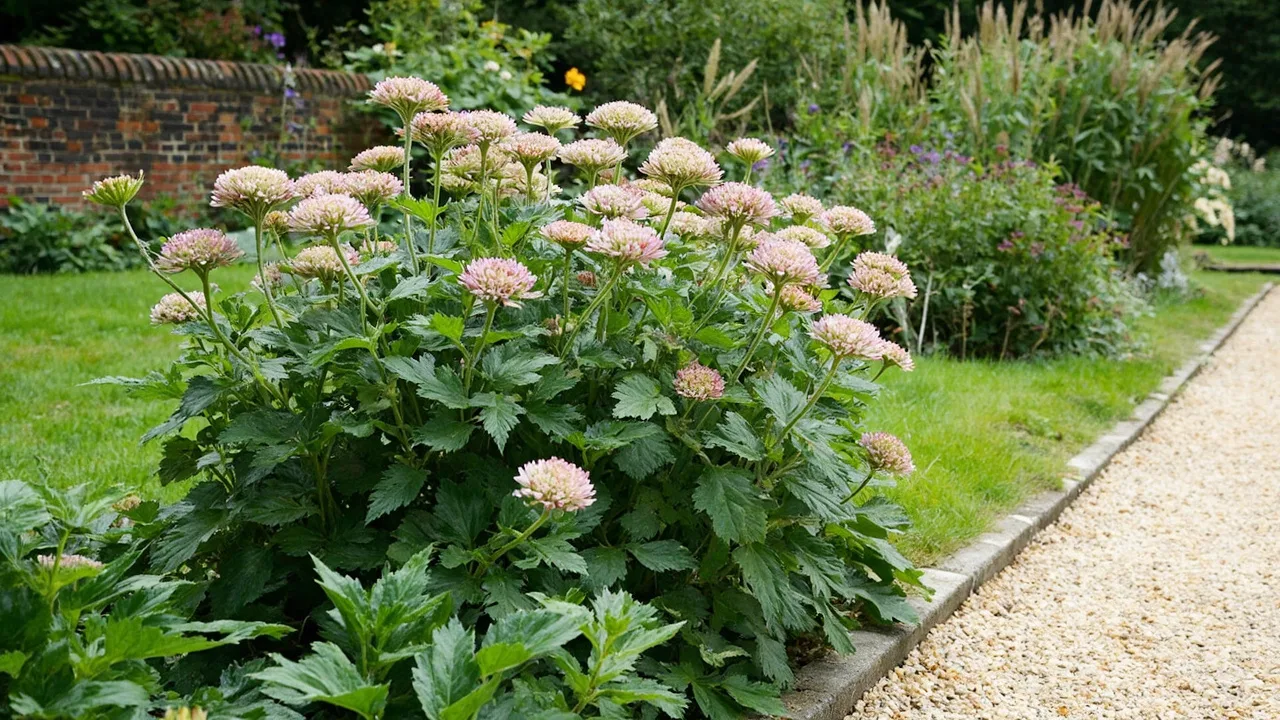
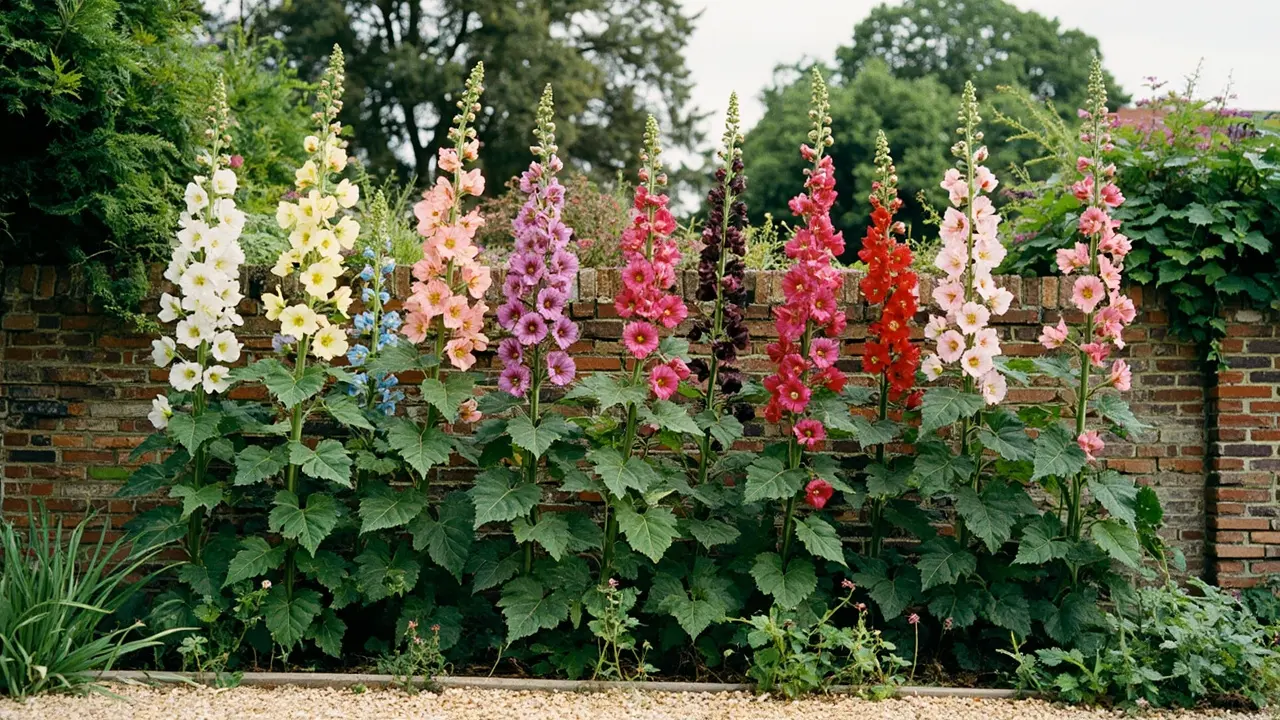
Alcea rosea has a robust, columnar upright habit: a single tall flower spike (sometimes branched at the base) carries a long erect raceme of large, open, funnel-shaped flowers roughly 10 cm across. The species-typical flower is single, with five broad petals, and many named cultivars offer semi-double or fully double forms. The colour range across the species and its cultivars is wide: white, cream, pink, apricot, yellow, red, dark dusky red, purple and very near-black maroon are all recorded, so a single planting can carry a surprising spread of hues. The leaves are deciduous, rounded, shallowly lobed to deeply palmately divided, and noticeably rough-textured to the touch; they are arranged alternately up the stem, with a low rosette in the first year. Mature plants reach 1.5 to 2.5 m in height — the RHS taxon profile notes "to 2 m or more", and well-grown specimens can exceed 2 m on a fertile site — with a spread of about 0.5 to 1 m. The flowers are not described as fragrant in the RHS sources reviewed, so do not expect a scented display. Hollyhocks are easy to confuse at a glance with other tall border plants; the upright single spike with flowers all the way up, the rough palmate leaves, and the size (taller than a typical delphinium, shorter only than a foxglove in full flight) together make identification straightforward in a mixed border.
Growing Conditions
Hollyhocks will grow in most soils and tolerate a wide pH range, which is one of the reasons they have stayed popular in British gardens for so long. The RHS genus guide is explicit: "Hollyhocks will grow in most soils, including both heavy and dry soils, in full sun." They are happy in chalk, loam or sand, and the pH can be acid, alkaline or neutral without trouble, provided the ground drains reasonably well. The site should be in full sun — south- or west-facing aspects are the usual choice — and the position can be exposed or sheltered, although tall stems may need staking on a windy site. The RHS-suggested planting locations for Alcea rosea are cottage and informal gardens, coastal sites, flower borders and beds, and wall-side borders, which together cover almost every situation in a typical British garden where a tall summer-flowering perennial is wanted. Drainage matters more than soil richness: a wet, heavy site in winter is the one combination that hollyhocks dislike, because it stresses the crown and encourages [hollyhock rust](#common-problems). In a normal British border with reasonable drainage and at least six hours of direct sun in midsummer, hollyhocks settle in readily and self-seed around the parent plant — a habit that gardeners can use to keep a colony going year after year without raising fresh stock. A short guide to planning a sunny border covers the wider site-preparation questions.
Planting and Care
Container-grown hollyhocks can be planted at any workable time from autumn through spring, when the soil is neither frozen nor waterlogged; autumn planting gives the roots a cool season to settle in before the first summer. Set the crown at the same depth it was growing in the pot, water in well, and mulch lightly with well-rotted compost to keep the roots cool through the first summer. Spacing should reflect the mature spread of about 0.5 to 1 m, so allow roughly that distance between plants in a group; against a wall, plant roughly 30 to 45 cm out so the roots are not entirely in the wall's rain shadow. Raise hollyhocks from seed, which is the usual home-garden method: sow under gentle heat in mid-winter, or in-situ in spring, and treat the seedlings as biennials — a rosette in year one, a flowering spike in year two. The plant self-seeds freely once established, and the RHS genus guide notes the well-known habit of hollyhocks finding cracks in paving and the base of walls; gardeners can either welcome the seedlings or hoe them out depending on the planting scheme.
Routine care is light. Water through dry spells in the first year to get the roots down; established plants cope with normal British summers without supplementary watering except on the very lightest soils. A single spring mulch of well-rotted compost is usually enough feeding; avoid high-nitrogen feeds, which produce soft leafy growth that flops and is more susceptible to rust. Staking is the practical task most often needed: tall spikes on exposed or windy sites can lean or snap under summer storms, so push a stout cane or a perennial stake in beside each plant in spring before the spike runs up, and tie in loosely as it extends. Deadhead spent flowers along the spike to encourage side shoots and extend the display, then cut back the whole plant after flowering. The RHS recommends either cutting back the dead foliage or pulling out and discarding the plant entirely; growing Alcea rosea as a biennial that is replaced from self-sown seedlings is the practical way to limit the build-up of [hollyhock rust](#common-problems) in the garden. The wider guide to designing a cottage garden covers mulching, feeding and border planning in more depth.
Common Problems
Hollyhock rust is the disease to know, and it is caused by the fungus Puccinia malvacearum. The RHS Advice page on hollyhock rust describes the symptoms clearly: bright yellow or orange spots appear on the upper leaf surface, with corresponding reddish-orange to brown, lumpy, spore-producing pustules on the underside; under high humidity those pustules turn ash-grey, and the same pustules also form on stems, calyces and occasionally the upper leaf surface. The disease typically spreads upwards from the lower leaves, and heavy attacks shrivel the foliage and stunt the plant. The fungus attacks other plants in the mallow family too — Althaea, Malva, Abutilon, Hibiscus, Lavatera, Malvastrum and Sidalcea — so an infected hollyhock can seed the disease to nearby mallows. Rust is worst in wet summers, which is one of the reasons it is so familiar to British gardeners. The RHS Advice is candid about chemical control: fungicides offer limited success because airborne spores travel long distances, so they should only be used minimally and in a highly targeted manner if at all. Non-chemical control is more useful and consists of regular checking, removing and disposing of affected leaves, disposing of heavily infected plants, not saving seed from infected specimens, and monitoring bought-in plants closely. Growing hollyhocks as biennials and discarding them after flowering — or hiding the worst leaf symptoms behind shorter front-of-border plants — both work to keep the disease from accumulating.
Aphids, capsid bugs and mallow flea beetles all colonise hollyhocks in summer, but the more damaging early-season pests are slugs and cutworms, which attack the young growth as the rosette or new spike emerges in spring. The standard dealing-with-slugs-and-snails and controlling-aphids-naturally approaches apply, and most healthy plants shrug off light pest pressure without treatment. It is worth knowing that no reliable toxicity statement was found for Alcea rosea in the RHS or Kew sources reviewed, so the plant should be treated as ornamental only and not characterised as edible or toxic on the strength of this reference alone. A wider overview of common garden problems is helpful if symptoms do not match any of the above.
Popular Varieties
Five verified Alcea rosea selections sit comfortably in a Popular Varieties section, all of them confirmed against the RHS Plant Guide carousel and the RHS taxon pages reviewed for this entry.
- Alcea rosea 'Nigra' is the dramatic near-black hollyhock: very dark maroon to reddish-purple flowers that read as black from a distance. Height 1.5 to 2.5 m, spread 0.5 to 1 m; a single-flowered heritage selection widely grown for its unusual colour.
- Alcea rosea 'Mars Magic' (Spotlight Series) is a vivid ruby-red, single-flowered form carrying the RHS Plants for Pollinators badge. The RHS taxon page describes "1.8 m tall spires of large, rich ruby-red flowers in summer"; rated H5; chalk, loam or sand in full sun.
- Alcea rosea 'Halo Blush' (Halo Series) is a soft blush-pink single with a contrasting darker eye; same height and spread range as the species. The Halo Series is bred for single flowers with a clear central eye and pollinator value.
- Alcea rosea 'Halo Apricot' (Halo Series) is the apricot counterpart of 'Halo Blush', with the same contrasting eye and single flower form.
- Alcea rosea 'Halo White' (Halo Series) is a clean white single with the same darker eye, useful in a white-and-green colour scheme at the back of a border.
Two further names — Alcea rosea 'Chater's Double' (mixed) and Alcea rosea 'Indian Spring' — are widely mentioned in seed-catalog and third-party sources but were not sighted in the RHS taxon or genus pages reviewed for this entry, so they are deliberately left out of the Popular Varieties list pending direct RHS verification. For cottage-garden neighbours with a similar upright habit, the lupin and snapdragon pages sit naturally alongside this entry, and the broader A-Z plants index lists the rest of the family.
Pests and Diseases
| Problem | Symptoms | Management |
|---|---|---|
| Hollyhock rust | Bright yellow or orange spots on the upper leaf surface; reddish-orange to brown, lumpy, spore-producing pustules on the corresponding lower surface; pustules turn ash-grey under high humidity; pustules also occur on stems, calyces and occasionally the upper leaf surface; spreads up from lower leaves; heavy attacks shrivel leaves and stunt the plant. | Non-chemical control: Check plants regularly and remove and dispose of affected leaves.; Dispose of heavily infected plants.; Do not use seed from affected plants.; Monitor bought-in plants closely.; Grow as a biennial and discard after flowering; alternatively hide leaf symptoms behind shorter front-of-border plants.. Chemical control: Difficult; fungicides offer limited success because airborne spores travel long distances. Should only be used minimally and in a highly targeted manner if at all. |
| Slugs | Slugs attack young growth as the rosette or new spike emerges in spring. | Use standard UK slug control (cultural barriers, hand-picking, biological controls as appropriate). |
| Cutworms | Cutworms attack young growth as the rosette or new spike emerges in spring. | Use standard UK cutworm control (collars, cultural controls as appropriate). |
| Aphids | Aphids colonise hollyhocks in summer. | Use standard UK aphid control (encourage predators, targeted treatment as appropriate). |
| Capsid bugs | Capsid bugs colonise hollyhocks in summer. | Monitor plants and remove affected growth; targeted treatment if severe. |
| Mallow flea beetles | Mallow flea beetles colonise hollyhocks in summer. | Monitor plants and use appropriate UK beetle controls as required. |
For step-by-step help, read Controlling Aphids Naturally and Dealing with Slugs and Snails. Or browse the full plant problem solver to diagnose an issue by symptom.
Recommended Products
GardenWizz earns a commission from qualifying purchases made through affiliate links on this page (including links within the article) — as an Amazon Associate, and from Thompson & Morgan via the Awin network. This does not affect the price you pay. See our disclaimer for details.