
Bulb Onion
Allium cepa · common onion
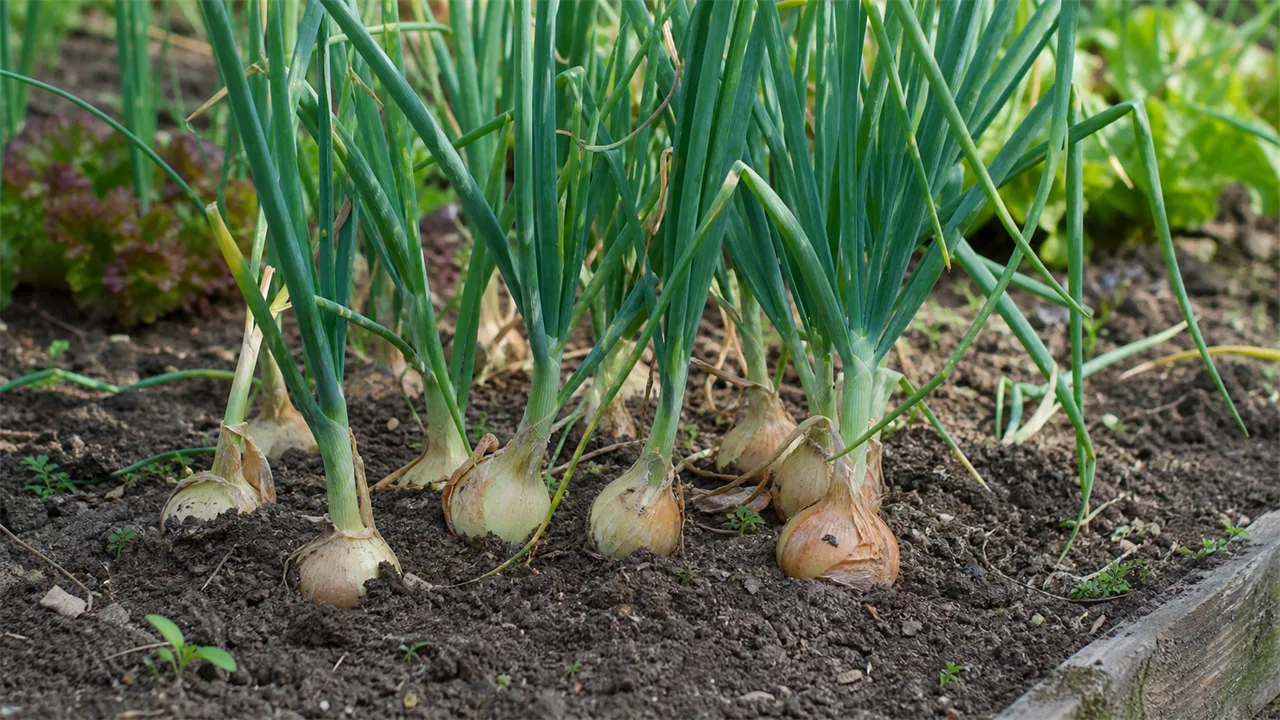
The Gardening Year
Best months in UK gardens · full planting calendar →
🖨 Printable care card (PDF)At a Glance
| Botanical name | Allium cepa |
|---|---|
| Common name(s) | bulb onion, common onion |
| Family | Amaryllidaceae |
| Plant type | biennial (usually treated as an annual and harvested in its first growing season) |
| Height × Spread | 15–45 cm × 10–50 cm |
| Position | Full sun |
| Soil | fertile, moisture retentive, but well-drained soil |
| Flowering | September |
| Toxicity | No specific toxicity is listed by the RHS. This is not a guarantee of safety — check with a vet or the ASPCA before pets or children eat any plant. |
| Native range | — |
Overview
Onions (Allium cepa) are one of the most rewarding crops for UK kitchen gardens. They're hardy, store brilliantly, and a single 3 m × 1.2 m bed can yield enough bulbs to see an average household through autumn, winter and well into the following spring. Almost every UK veg plot has space for at least one row, and the lifting day in late summer is one of the genuine milestones of the gardening year.
The common bulb onion is a biennial grown as an annual — it forms its bulb in year one from a leafy top, then would flower in year two if left in. The cultivated crop (Allium cepa) should not be confused with wild onion relatives or with ornamental alliums; it's a single species bred over centuries for swollen storage bulbs and a strong, pungent flavour. For UK growers there are three practical types to know: bulb onions (the main crop, brown, red and white), Japanese / overwintering onions sown the previous autumn, and shallots (a related Allium cepa aggregate, grown from sets). Spring onions and pickling onions are the same species harvested young.
Why bother growing your own? Supermarket onions are cheap, but a home-grown bulb has a sweetness and a depth of flavour, especially when used fresh, that shop-bought ones rarely match. Red varieties in particular keep their colour in salads. Storage is easy — a dry shed, a string bag, and they'll keep for six months or more. They're also a brilliant crop for beginners: sets (small immature bulbs) are almost foolproof, and even a failed sowing produces something useful in the kitchen.
Sowing
Onions are grown from either seed or sets (immature bulbs). Sets are the easier route and the one most UK gardeners start with; seed gives a wider choice of varieties and is cheaper, but needs a head start indoors.
From seed (most reliable for maincrop bulbs) Sow indoors in modules or small pots from January to February in the mild south and west, and from mid-February to mid-March further north and in Scotland. A windowsill or unheated greenhouse at 10–15 °C is ideal; seedlings don't need heat, just light and protection from the worst frost. Sow 5–8 seeds per module if you intend to plant as a cluster, or singly into cell trays if you want large individual bulbs. Germination takes 10–14 days. Harden off before planting out.
Plant seed-raised seedlings outside from late March in the south, through April into early May in the north. Space them 10–15 cm apart in rows 25–30 cm apart for medium bulbs; push to 20 cm apart if you're after show-bench size.
From sets (the easy option) Plant sets from mid-March to mid-April across most of England and Wales, and from early to mid-April in the north of England and Scotland. Sets can go in slightly earlier on light, well-drained soils in the south-west; on heavy clay in the north, hold off until the soil is warming and workable, otherwise the sets can rot. Push each set into the soil so the tip just shows, pointy end up, 10 cm apart in rows 25 cm apart. Birds love to flick sets out of the ground — fleece or bird netting for the first few weeks is worth it.
Overwintering (Japanese) onions These are the varieties that break the calendar by being sown in late summer and harvested in early summer the following year. Sow direct from mid-August to early September in the south, finishing by late August in colder areas and Scotland — they need to reach pencil-thickness before the worst of the winter. Alternatively, plant sets of overwintering varieties in September or October. They'll sit through frost, put on growth in early spring, and bulb up in June / July — a fortnight or two ahead of spring-sown crops.
Sowing depth: 1–2 cm for seed, sets just buried with the tip at soil level. Soil pH 6.5–7.0; onions dislike acid ground. If your soil is below 6.0, dust the bed with garden lime a few weeks before sowing.
Growing
Onions are shallow-rooted and don't compete well with weeds, so a clean bed is the single biggest contributor to a good crop. Hand-weed regularly — hoeing too close to the row can damage the roots and the bulb plate.
Watering. Keep the soil evenly moist from establishment until the bulbs start to swell in earnest, typically from early summer. Then ease back: drier conditions in the last 3–4 weeks before harvest help the bulbs ripen and cure properly. In a wet summer there's not much you can do; in a dry one, a soak every 7–10 days is far better than little-and-often.
Feeding. Onions want a steady supply of phosphorus and potassium rather than nitrogen. A light dressing of blood, fish and bone or a general-purpose fertiliser at planting, followed by a high-potash feed (tomato feed works well) every fortnight through May and June, gives reliable results. Stop feeding once the tops start to yellow and fall over.
Thinning. Spring-sown seed beds benefit from a thinning once the seedlings are 10 cm tall; use the thinnings as salad onions. Don't thin autumn-sown Japanese onions — they need the leaf area to get through winter.
Watch out for:
- Birds pulling up sets and seedlings — net until established.
- Onion fly: lays eggs at the base of plants; larvae tunnel into bulbs. Rotate your onion bed year to year, thin covers, and avoid transplanting damaged seedlings (the smell attracts the fly).
- Downy mildew: yellow patches on leaves in damp weather, especially in overcrowded crops. Improve airflow, water at the base, and don't overhead-water late in the day.
- White rot: a serious soil-borne fungus that persists for years. There's no cure once it's in the ground — avoid beds that have hosted onions, garlic or leeks in the past 7–8 years.
- Bolting: a flower stalk in year one, usually triggered by a cold spell or a check in growth. Snap the stalk off at the base and use the bulb first — it won't store well.
Harvesting
Onions are ready when the tops yellow, flop over and start to die back from the tip down. Lift the bulbs with a fork on a dry day, shake off loose soil, and lay them out on the bed (or on a sheet of cardboard) to dry in the sun for a day or two.
Timing by region:
- South / south-west England and the Midlands: maincrop bulbs ready from late July through August. Overwintering Japanese varieties lift in June to mid-July.
- North of England, north Wales: maincrop August into early September.
- Scotland, far north, upland areas: late August to mid-September is typical; in a cool year the tops may not fully fall over and you'll need to lift by date rather than appearance.
Once lifted, finish drying the bulbs somewhere warm, dry and airy — a greenhouse bench, a shed with the door open, or a covered porch — for two to three weeks until the skins are papery, the necks tight, and the roots shrivelled. Discard any with thick soft necks; they won't store.
Handle bulbs gently. Bruised onions don't keep, and they're more likely to go mouldy in store. Twist off the dead tops about 2–3 cm above the bulb, or plait them into a traditional onion string.
Eating
Home-grown onions are sweeter, juicier and more aromatic than shop-bought, especially when used within a few weeks of harvest. Brown maincrop varieties are the workhorses of the kitchen — long, slow cooking for soups, stews, casseroles, stocks, and the base of almost any savoury dish. Red onions are best used raw or lightly pickled: in salads, on burgers, or as quick-pickled rings with vinegar, a pinch of sugar and a bay leaf. White onions are typically milder and sweeter, sitting between the two and a good general-purpose choice.
Storage onions should be kept cool (0–5 °C is ideal), dry and dark — a frost-free shed, an unheated garage, or a well-ventilated cellar. String them in nets, or lay them in a single layer on a slatted tray. Stored well, brown maincrop onions will keep from harvest through to the following March or April; red varieties store less well, generally 2–3 months before they start to soften.
Beyond the bulb, don't waste the tops: young green tops can be chopped like spring onions, particularly from thinnings and from overwintering varieties going to seed.
Storing
Onions are one of the easiest UK crops to store, and a good harvest will keep the kitchen supplied long after the season has finished. The key is to cure the bulbs properly before storing — skins must be papery, necks tight, and any thick-necked or damaged bulbs used up first.
- Stringing. Plait the dried tops into a traditional onion rope and hang in a cool, dry, frost-free place with good airflow. Looks decorative in a kitchen or pantry and the bulbs are easy to inspect.
- Net bags or old tights. Knotted between bulbs and hung up — keeps them off the floor, lets air circulate, and individual bulbs can be cut free without disturbing the rest.
- Slatted trays. Lay bulbs in a single layer; rotate stock so the oldest are used first.
Check stored bulbs every few weeks and remove any that are going soft or sprouting — one bad onion can ruin a whole bag. Don't store near potatoes: both sprout faster together.
Beyond fresh storage, onions pickle beautifully, can be sliced and frozen for cooked dishes (they'll be soft when defrosted, fine for stews and curries), and form the basis of almost every preserve, chutney and relish. A single bed of brown maincrops gives you months of eating with very little extra effort.
---
Cultivars and Varieties
| Cultivar | Height | Flower | Notes | AGM |
|---|---|---|---|---|
| 'Bermuda' | — | — | sweet yellow onion | |
| 'Cévennes' | — | — | sweet yellow onion | |
| 'red or purple onions' | — | — | sharp pungent flavour | |
| 'Vidalia' | — | — | sweet yellow onion | |
| 'Walla Walla' | — | — | sweet yellow onion | |
| 'white onions' | — | — | mild in flavour |
Pests and Diseases
| Problem | Symptoms | Management |
|---|---|---|
| onion fly | — | — |
| onion eelworm | — | — |
| various fungi | rotting | — |
Or browse the full plant problem solver to diagnose an issue by symptom.
Companion planting
✔ Grows well with: beet, carrot, lettuce, strawberry.
✘ Keep apart from: Pea, runner bean.
Full companion planting chart →
GardenWizz earns a commission from qualifying purchases made through affiliate links on this page (including links within the article) — as an Amazon Associate, and from Thompson & Morgan via the Awin network. This does not affect the price you pay. See our disclaimer for details.