Allium
Allium hollandicum R.M.Fritsch · Dutch garlic (RHS-attested species common name, per RHS plant 104259 JSON-LD alternateName) · Persian onion (widely-used UK-trade synonym, shared in trade with A. jesdianum; not in RHS plant 104259 alternateName list, but recorded in Wikipedia and across UK horticultural media)
At a Glance
| Botanical name | Allium hollandicum R.M.Fritsch |
|---|---|
| Common name(s) | Dutch garlic (RHS-attested species common name, per RHS plant 104259 JSON-LD alternateName), Persian onion (widely-used UK-trade synonym, shared in trade with A. jesdianum; not in RHS plant 104259 alternateName list, but recorded in Wikipedia and across UK horticultural media) |
| Family | Amaryllidaceae |
| Plant type | perennial |
| Height × Spread | 50–100 cm × 10–50 cm |
| Position | Full sun |
| Soil | chalk; loam; sand |
| Flowering | — |
| Toxicity | — |
| Native range | Iran |
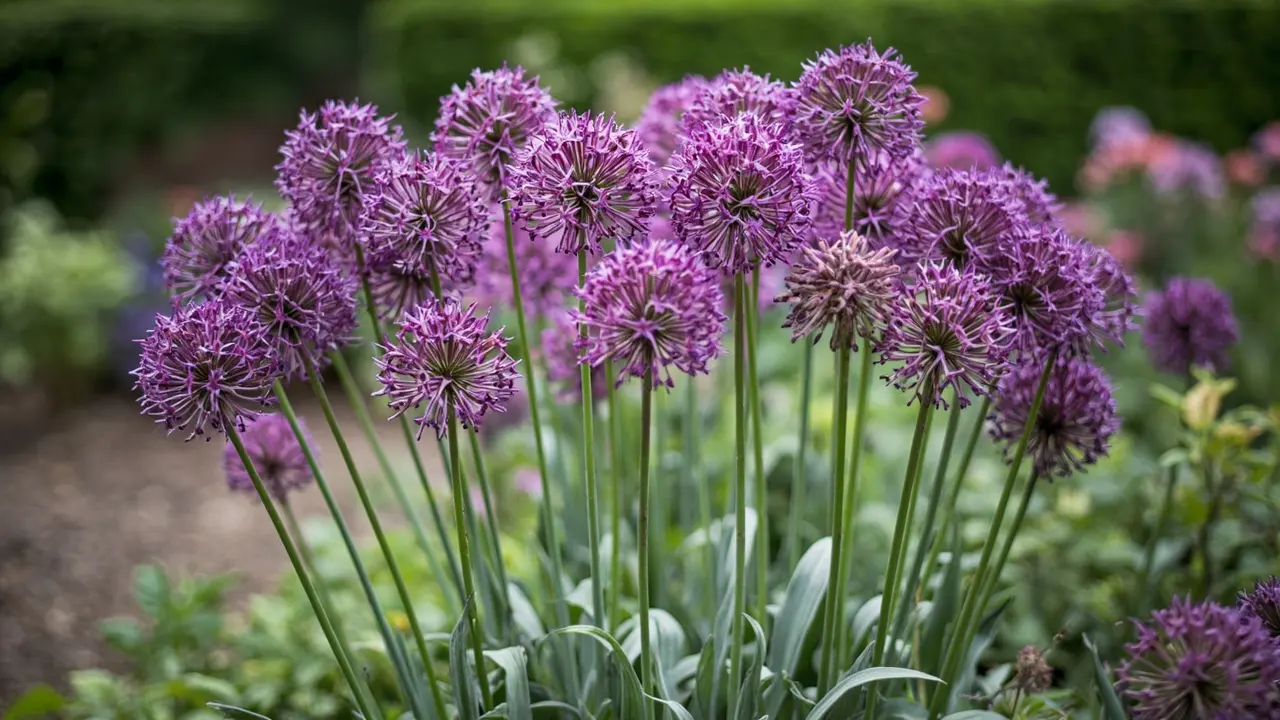
Allium hollandicum, the Dutch garlic or Persian onion, is one of the most widely planted ornamental onions in British gardens. Its most familiar form, 'Purple Sensation', dominates early-summer borders from Cornwall to the Hebrides with dense, violet globes held on stiff, straight stems. The species is native to Iran and Central Asia, but in the UK it is grown almost exclusively from autumn-planted bulbs lifted into garden centres each September. Whether naturalised informally through rough grass or staged in a formal parterre, the plant offers an architectural punctuation that few other bulbs can match.
A quick reference for the key facts appears below; full detail on cultivation, varieties, and problems follows in the rest of the entry.
Overview
Allium hollandicum is a bulbous perennial in the family Amaryllidaceae. It is sold in the UK almost entirely as dry bulbs in autumn, with named cultivars such as 'Purple Sensation' and 'Purple Rain' leading sales. The species itself is rarely listed, but the cultivar group defines what British gardeners mean when they say "allium". It is a reliable, low-maintenance plant for sunny borders and is widely used in both contemporary and traditional garden designs.
Appearance
The plant produces a tuft of strap-shaped, greyish-green basal leaves in early spring, typically 30–45 cm long, which often begin to yellow as the flower stem emerges. The leaf rosette is rather untidy by flowering time and is best hidden among emerging perennials.
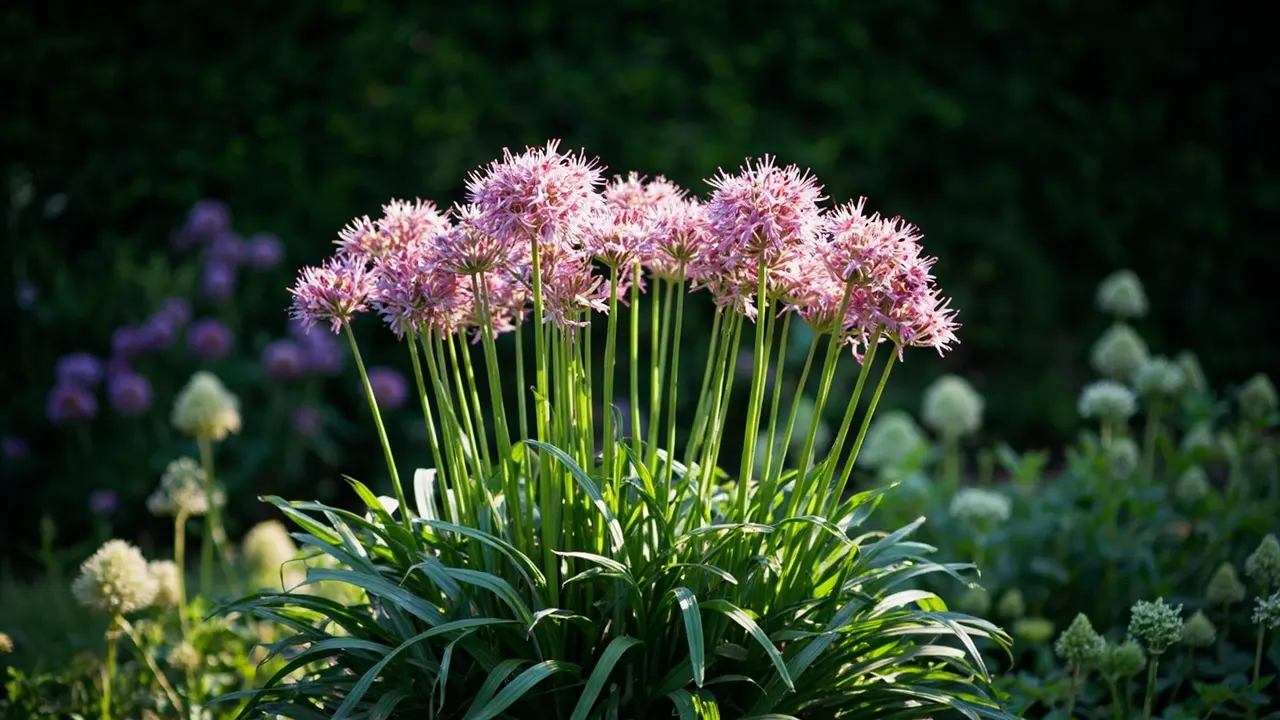
A single, smooth, leafless flower stem rises 70–100 cm above the foliage, carrying a dense, perfectly spherical umbel 7–10 cm across. Each umbel contains 50 or more small, star-shaped, six-tepalled flowers. In the species these are pale lilac to rosy-purple; in 'Purple Sensation' they are a vivid deep violet-purple, and in cultivars like 'Purple Rain' a slightly softer, more open, mauve form with looser florets.
After pollination the flowers fade but the seedheads remain highly ornamental, holding their shape well into late summer and looking striking when backlit by low sun or rimmed by frost.
Growing Conditions
Sunlight: Full sun is essential. A south- or west-facing border with at least six hours of direct light produces the stiffest stems and the most saturated flower colour. Plants in shade lean and produce markedly smaller umbels.
Soil: Moderately fertile, well-drained soil is ideal. The bulbs originate from steppe habitats and resent winter wet, so heavy clay must be improved with grit and well-rotted compost before planting. Soil pH is flexible, from slightly acidic to mildly alkaline; loam is preferred but the plant tolerates sandy and chalky ground well.
Hardiness: Allium hollandicum holds an RHS hardiness rating appropriate to most UK sites, including the colder gardens of northern England and Scotland. Bulbs left in the ground year-round generally perform reliably without lifting.
Position: Plant in groups of at least ten for visual impact, ideally among low perennials or ornamental grasses that disguise the fading foliage. Many designers place alliums in a dedicated bulb lawn, alongside late tulips and camassias, where the strappy leaves are accepted as part of the seasonal display.
Planting and Care
When to plant: Bulbs are sold from late August through November and should be in the ground by mid-October for the strongest establishment. October planting suits most of lowland Britain; in colder parts of Scotland and north-east England, late September planting gives roots time to develop before hard frost.
Depth and spacing: Plant bulbs 10–15 cm deep (roughly two to three times the bulb's height), pointed end up, and 10–20 cm apart. Deeper planting encourages perennial performance and reduces the need for staking.
Watering: Once planted in autumn, natural rainfall is sufficient through winter and spring. Container-grown alliums need watering from the moment growth appears in February until the foliage dies back in July; afterwards, keep the compost almost dry to mimic their native summer dormancy.
Feeding: A single application of slow-release bulb fertiliser or a top-dressing of bone meal at planting time, plus a light potash-rich feed (such as sulphate of potash) in early spring, sustains strong flowering for several years. Avoid high-nitrogen feeds, which produce lush leaves and weak stems.
Pruning: No pruning is required. The seedheads are a feature, not a fault; leave them in place through autumn for structural interest and winter food for birds. Cut foliage down only once it has fully yellowed, usually by mid-July.
Propagation: The most reliable method is by offsets. Lift congested clumps in late summer after the foliage has died back, separate the small bulblets from the mother bulb, and replant immediately at the recommended depth. Allium hollandicum can also be grown from seed, but seed-raised plants take three to four years to reach flowering size and cultivars will not come true.
Seasonal care: In summer-dry gardens, withhold supplementary watering once the leaves have died back. In damp gardens, especially on clay, consider lifting and storing bulbs in a cool, dry shed, or grow in raised beds where drainage is sharper. Mulching with garden compost in late autumn is beneficial; mulching in spring should be kept light so that emerging shoots are not smothered.
Common Problems
Onion fly (Delia antiqua): The principal pest of ornamental alliums in the UK. Female flies lay eggs at the base of plants in late spring; the maggots burrow into the bulb and roots, causing yellowing foliage, stunted growth, and sudden collapse. Damage is worst in consecutive dry springs and on light soils. Prevention: rotate planting sites, avoid growing near culinary onions or leeks, and cover emerging shoots with fine insect mesh from March until early June. Affected bulbs should be lifted and destroyed.
Leek moth (Acrolepiopsis assectella): More commonly seen in southern and eastern England, the caterpillars mine into leaves and stems, producing characteristic white "windows" and shredded tissue. Light infestations can be tolerated; heavier attacks are controlled by the same insect mesh used for onion fly.
White rot (Sclerotium cepivorum): A soil-borne fungus that produces fluffy white growth at the bulb base and small, poppy-seed-sized black sclerotia in the soil. There is no chemical control; affected ground should not be replanted with alliums (or onions, garlic, or leeks) for at least eight years.
Downy mildew (Peronospora destructor): Causes pale green to yellow leaf stripes and a downy grey-purple sporulation in damp weather. It is rarely fatal but weakens flowering in successive seasons. Improve air circulation, avoid overhead watering, and remove affected foliage.
Straggly or absent flowers: Usually a symptom of bulbs being too shallow, congested, or starved. Lift, divide, and replant at the correct depth every three to four years.
Popular Varieties
'Purple Sensation' (Allium hollandicum): The defining cultivar, with deep violet-purple, tightly packed umbels 7–8 cm across on stems to about 1 m. Holds the RHS Award of Garden Merit and is the variety most often pictured in British gardening books and shows.
'Purple Rain': A cross sometimes attributed to Allium hollandicum parentage (and sold under A. hollandicum labels in the UK), with slightly looser, more open umbels of soft mauve-purple and a fuller, more rounded flower head. Particularly effective in prairie-style plantings.
Allium hollandicum 'Album': A scarce white-flowered selection of the species, with creamy-white umbels on stems around 80 cm tall. Useful for cool colour schemes and moon gardens, though less widely stocked than its purple siblings.
'Mount Everest': Strictly a hybrid between Allium stipitatum and Allium hollandicum, but commonly grouped with A. hollandicum in UK plant-encyclopaedia entries. Tall (to 1.2 m), with bright white, slightly loose umbels 10–12 cm across on sturdy stems, providing height variation when planted in the same drift as 'Purple Sensation'.
'Cobalt Milenium' (note spelling): A 2010s American-bred sterile hybrid sometimes listed under A. hollandicum in nursery catalogues. Lower-growing (40–50 cm) with bright pinkish-purple flowers and broader, strappier leaves that stay green through summer. A useful front-of-border option but not a heritage UK form.
Sources & Further Reading
- RHS Plant Selector — Allium hollandicum 'Purple Sensation' profile, rhs.org.uk, accessed 2026-07-22.
- RHS — How to grow alliums, rhs.org.uk/plants/allium/growing-guide, accessed 2026-07-22.
- RHS — Onion fly: prevention and control, rhs.org.uk/biodiversity/onion-fly, accessed 2026-07-22.
- BBC Gardeners' World Magazine — Allium hollandicum 'Purple Sensation' plant profile, gardenersworld.com, accessed 2026-07-22.
- Beth Chatto Gardens — Allium hollandicum 'Purple Sensation' catalogue entry, bethchatto.co.uk, accessed 2026-07-22.
- Pacific Bulb Society — Allium 'Mount Everest' wiki entry, pacificbulbsociety.org, accessed 2026-07-22.
Cultivars and Varieties
| Cultivar | Height | Flower | Notes | AGM |
|---|---|---|---|---|
| 'Purple Sensation' | — | — | RHS AGM (H6) | ✓ |
Pests and Diseases
| Problem | Symptoms | Management |
|---|---|---|
| Allium leaf miner | Leaves develop white, winding trails or brown patches that cause them to wither and die prematurely. | Remove affected foliage immediately after flowering and burn it to break the pest's life cycle. |
| Onion fly | Young shoots turn yellow, wilt, and collapse while larvae feed on the bulb base underground. | Plant in autumn or early spring outside peak flight times and use insect-proof netting as a barrier. |
| Onion white rot | Bulbs become soft and rotten with distinctive white, cottony fungal growth on the base. | Avoid planting alliums in infected soil for at least 10 years and ensure excellent drainage. |
| Onion downy mildew | Foliage shows pale green to yellow streaks covered in a greyish-purple fuzzy mould. | Improve air circulation, avoid overhead watering, and remove severely infected leaves promptly. |
| Bulb rot | Bulbs become soft, mushy, and discoloured due to waterlogging in heavy or poorly drained soil. | Plant in well-drained soil or containers and avoid sites that remain wet during winter. |
For step-by-step help, read Treating Powdery Mildew. Or browse the full plant problem solver to diagnose an issue by symptom.
Allium in our guides
- Crop Rotation Explained for UK Vegetable Gardens
- How to Grow Onions in the UK: Sets and Seed
- How to Grow Shallots
Recommended Products
GardenWizz earns a commission from qualifying purchases made through affiliate links on this page (including links within the article) — as an Amazon Associate, and from Thompson & Morgan via the Awin network. This does not affect the price you pay. See our disclaimer for details.