Strawberry
Fragaria × ananassa
The Gardening Year
Best months in UK gardens · full planting calendar →
🖨 Printable care card (PDF)At a Glance
| Botanical name | Fragaria × ananassa |
|---|---|
| Common name(s) | strawberry |
| Family | Rosaceae |
| Plant type | perennial |
| Height × Spread | 30 cm × 50–100 cm |
| Position | Full sun, Partial shade |
| Soil | fertile, moist but well-drained soil; loam; pH Acid, Neutral |
| Flowering | April–June |
| Toxicity | No specific toxicity is listed by the RHS. This is not a guarantee of safety — check with a vet or the ASPCA before pets or children eat any plant. |
| Native range | — |
Overview
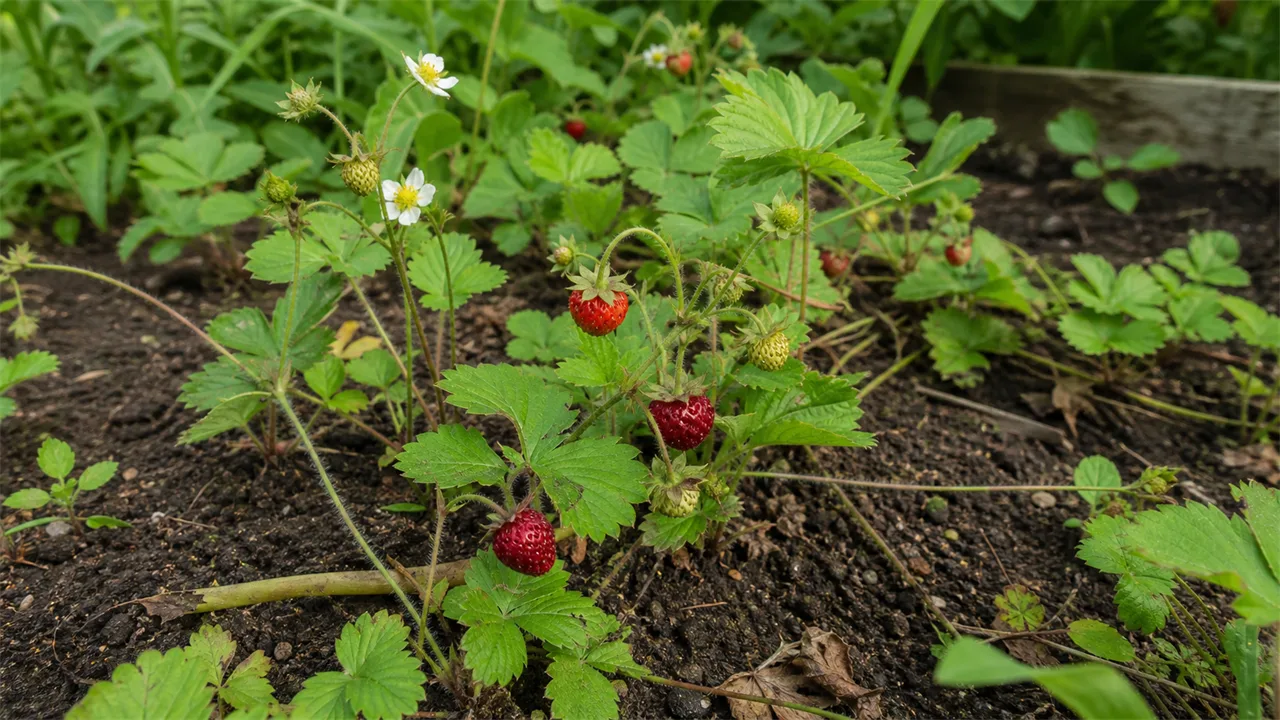
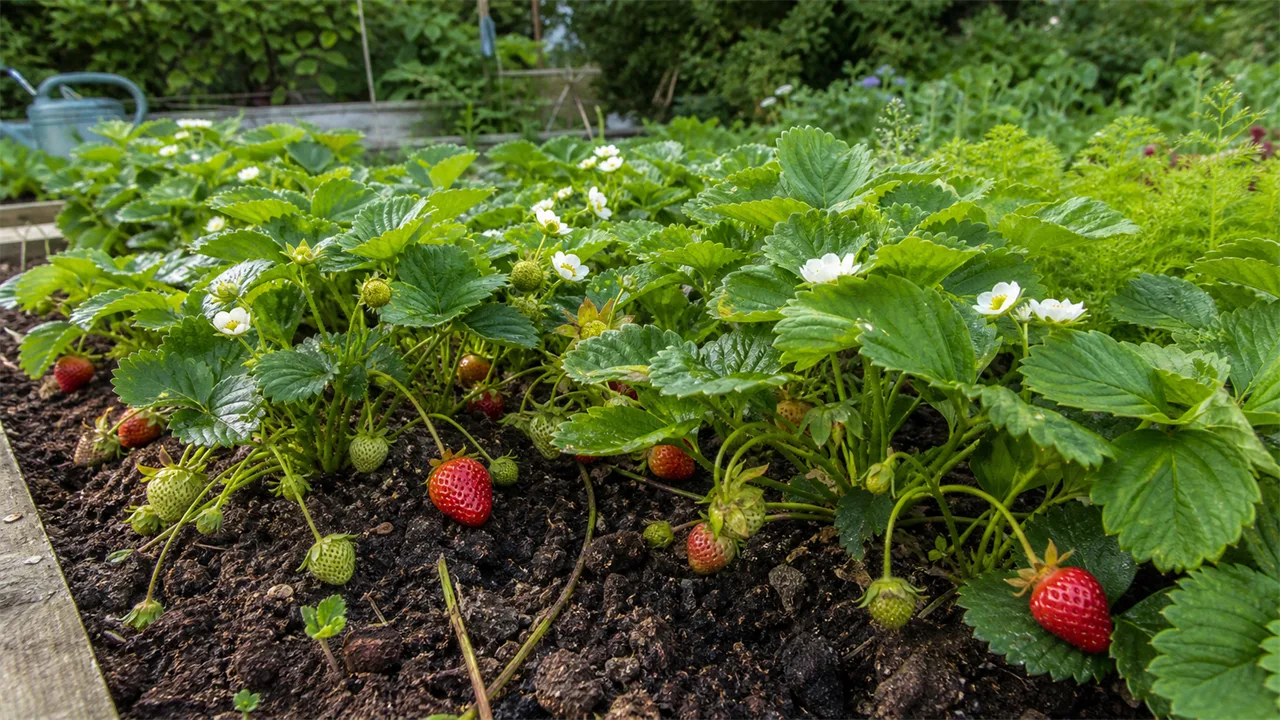
Strawberry (Fragaria × ananassa) is the cultivated garden strawberry — a hybrid of two American species, F. chiloensis and F. virginiana, that arose in 18th-century France and has since displaced the smaller-fruited wild strawberry (F. vesca) from commercial and allotment growing almost everywhere. It is a low, herbaceous perennial in the rose family (Rosaceae), grown for its aromatic, sweet-tart red fruits from late spring through high summer. Plants spread by runners, crop reliably from their first full year onwards, and lift or replace every three to four years when yields decline.
For UK growers, strawberries earn their place because the flavour of a sun-warmed, fully ripe berry off your own patch bears almost no resemblance to anything in a supermarket punnet. The plants tolerate a wide range of British conditions — a damp West Country summer or a dry East Anglian one — and crop heavily in beds, borders, pots, hanging baskets, grow-bags and even window boxes, making them one of the most versatile fruit crops for a small garden.
Sowing
Strawberries are not normally grown from seed at home — named cultivars come true only from runners, and seed-raised plants take a full year longer to crop. The two practical ways to start are bare-root runners (cold-stored plants sold by mail order from late autumn through early spring) and pot-grown plants (sold in garden centres from spring into summer).
Planting windows for UK runners:
- Mild south-west, south coast, London, lowland Wales: plant cold-stored bare-root runners from late November through February, provided the ground is workable and not frozen or waterlogged. Pot-grown plants can go in any time from March to September.
- Midlands, east and south-east England, lowland Scotland: aim for February into early April. Avoid planting in frozen soil; mulch newly planted runners with straw after a cold snap.
- North-east England, Cumbria, upland Scotland, north Wales: March to mid-April is the safer window. Late-autumn planting is risky in exposed districts because frost lift can heave shallow roots out of the ground.
Plant with the crown — the swollen point where leaves emerge — sitting exactly at soil level. Bury it deeper and it rots; leave it proud and the roots dry out. Space plants 30–45 cm (12–18 in) apart in rows 75 cm (30 in) apart, or 25–30 cm apart through the membrane in a strawberry bed. Runners sent out in the first summer are best snipped off so the mother plant channels energy into fruit the following year.
Recommended UK cultivars (not an exhaustive list, but a reliable starting set for different needs):
- 'Honeoye' — early, vigorous, hardy, a good northern and cold-site choice.
- 'Cambridge Favourite' — the long-standing UK allotment favourite; reliable, disease-tolerant, mid-season.
- 'Pegasus' — mid-to-late season, good disease resistance, well-suited to wetter western areas.
- 'Hapil' — mid-season, large fruit, performs well on lighter soils.
- 'Rhapsody' — late season, excellent disease resistance, extends the picking window.
- 'Symphony' — late, firm berries, good for jam and freezing.
- 'Mara des Bois' — a perpetual (remontant) French cultivar cropping in flushes from summer into autumn.
Growing
Strawberries like a sunny, sheltered spot with at least six hours of direct sun in summer — north-facing plots will give leaves but thin, sour fruit. Soil should be free-draining yet moisture-retentive, slightly acidic to neutral (pH 6.0–6.8 is ideal), and enriched with well-rotted manure or garden compost the autumn before planting. Avoid planting on ground that has grown potatoes, tomatoes or roses in the last three years, because of the risk of verticillium wilt.
Watering is the single biggest determinant of berry size. From flowering onwards, give plants about 25 mm (1 in) of water a week — more on light, sandy soils. Water at the base of the plant, ideally through a seep hose or trickle line, so the fruit stays dry and botrytis (grey mould) is kept in check. Pots and hanging baskets dry out fast and may need daily watering in a heatwave.
Feeding: in early spring, top-dress beds with a general-purpose fertiliser such as blood, fish and bone at 50 g per m², or use a high-potash feed (tomato feed) every 7–14 days from flowering until the last berries are picked. Avoid heavy nitrogen in summer — it makes soft, leafy growth that mildews and rots.
Mulching and fruit hygiene: once the first green fruits are swelling, tuck barley straw, dried bracken or strawberry mats under the trusses to lift berries off bare soil. This is the traditional British allotment technique and it pays for itself the first wet summer. Replace the straw each year.
Weeding and renewal: keep the bed hand-weeded — hoeing easily damages shallow roots. After fruiting, tidy plants by cutting off old leaves and any runners you don't want to root. The most productive strawberry beds are replaced every three to four years; the standard cycle is to bed 1, 2 and 3 cropping in successive years while bed 4 is being raised from rooted runners.
Pests and problems to expect in the UK: slugs and snails hollow out ripe fruit (use ferric phosphate pellets, beer traps or night-time hand-picking); birds take the berries just as they colour up (net the whole bed once flowering finishes — a walk-in fruit cage is the proper answer for larger patches); vine weevil grubs chew roots of container plants (use a nematode drench in September); botrytis rots fruit in damp weather (improve airflow, remove infected berries promptly).
Harvesting
Pick strawberries when they are fully coloured all over — including the white tip around the calyx — and come away from the plant with a gentle twist leaving the green hull and a short stalk on the fruit. Berries picked half-red will not ripen further once off the plant and will taste sharp.
UK harvest timing:
- South-west England, south coast, Channel Islands, lowland Wales: early cultivars ('Honeoye') from late May; main season June; late and perpetual types into October.
- South-east, Midlands, East Anglia: mid-June to mid-July is peak; earlies from early June, lates through July.
- North of England, lowland Scotland: mid-June through late July.
- Upland Scotland, north-east England, north Wales: late June through August is the realistic window.
Pick in the cool of the morning once dew has dried — berries hold better and bruise less. Move them straight into shallow trays or a single layer in a colander; deep buckets crush the bottom layer under the weight of those above. Eat, jam or chill within a couple of hours of picking for the best flavour; strawberries deteriorate faster than almost any other fruit.
In the first summer after planting, it is traditional to remove the flowers so the plant builds a strong crown for a full crop the following year. From year two onwards, let the plant crop freely. On perpetual (remontant) types like 'Mara des Bois' or 'Albion', pick through summer and well into autumn, removing the very late autumn flowers once October is half gone so the plant goes into winter with strong crowns.
Eating
Strawberries are at their best eaten within an hour or two of picking, still warm from the sun, with nothing more than a splash of double cream or a spoonful of clotted cream and a grinding of black pepper — the classic English Wimbledon combination for good reason. They are also excellent simply macerated with a little caster sugar and a squeeze of lemon juice, served with meringues and cream for an Eton mess, or layered with mascarpone and sponge for a trifle.
In the kitchen, strawberries hold their shape better than many soft fruits, which makes them useful for tarts, pavlovas, and fruit salads. They pair well with balsamic vinegar (a few drops over halved berries sharpens the flavour without making them savoury), with black pepper, with basil, and with elderflower cordial. A quick strawberry compote — berries simmered briefly with a splash of water and sugar — is the basis for fools, ice cream and yoghurt toppings.
Grow-your-own strawberries also earn their place in preserving. Classic British strawberry jam uses equal weight of fruit and sugar with lemon juice and is one of the easiest jams for a beginner to set. Strawberries also freeze well: hull, wash, dry thoroughly on a tea towel, then open-freeze on a tray before bagging so the berries stay separate. They soften on thawing so are best used for jam, compote, smoothies or coulis rather than as fresh fruit.
For growers wondering whether to bother: a 3 m × 1 m strawberry bed, well-tended, will yield 8–12 kg of fruit in a good year — more than enough for a household to eat their fill in June and still have a freezer full and a few jars of jam into winter.
Cultivars and Varieties
| Cultivar | Height | Flower | Notes | AGM |
|---|---|---|---|---|
| 'Cambridge Favourite' | — | — | — | ✓ |
| 'Hapil' | — | — | — | ✓ |
| 'Honeoye' | — | — | — | ✓ |
| 'Pegasus' | — | — | — | ✓ |
| 'Rhapsody' | — | — | — | ✓ |
| 'Symphony' | — | — | — | ✓ |
Pests and Diseases
| Problem | Symptoms | Management |
|---|---|---|
| pests and diseases | various, including moths, fruit flies, chafers, strawberry root weevils, strawberry thrips, strawberry sap beetles, strawberry crown moth, mites, aphids, slugs, powdery mildew, leaf spot, leaf blight, slime molds, red stele, verticillium wilt, black root rot, nematodes | — |
For step-by-step help, read Controlling Aphids Naturally, Dealing with Slugs and Snails and Treating Powdery Mildew. Or browse the full plant problem solver to diagnose an issue by symptom.
Companion planting
✔ Grows well with: Borage, bulb onion, lettuce, sage.
Full companion planting chart →
Strawberry in our guides
- How to Grow Strawberries in the UK: A Complete Guide
- Gardening Jobs for August in the UK
- Home & Garden News, Trends, and Seasonal Updates
Recommended Products
GardenWizz earns a commission from qualifying purchases made through affiliate links on this page (including links within the article) — as an Amazon Associate, and from Thompson & Morgan via the Awin network. This does not affect the price you pay. See our disclaimer for details.