Potato
Solanum tuberosum · spud
The Gardening Year
Best months in UK gardens · full planting calendar →
🖨 Printable care card (PDF)At a Glance
| Botanical name | Solanum tuberosum |
|---|---|
| Common name(s) | potato, spud |
| Family | Solanaceae |
| Plant type | perennial (Herbaceous perennial; grown from underground stem tubers.) |
| Height × Spread | 30–100 cm × 10–50 cm |
| Position | Full sun, Partial shade |
| Soil | Loose, fertile soil; well-manured. |
| Flowering | May–July |
| Toxicity | solanine |
| Native range | southern United States to southern Chile |
Overview
The potato is a herbaceous perennial in the nightshade family (Solanaceae), grown in the UK as an annual root crop for its swollen underground stem-tubers. The cultivated potato, Solanum tuberosum, is a tetraploid crop domesticated in the Andes around 8,000 years ago and brought to Europe in the late 16th century; it became a staple of British diets from the late 18th century onwards and remains the most widely grown vegetable in UK allotment and garden plots.
Potatoes are an exceptionally rewarding crop for the home grower. They are productive per square metre, store well through winter, and slot into a four-year rotation after legumes. They also tell you when they are ready — the foliage dies down on maincrops, and earlies can be lifted as soon as the plants flower. UK conditions suit them well: cool summers, reliable rainfall and free-draining soils in most regions make for high yields with relatively modest input. A 3 m × 1 m row can return 15–25 kg of maincrop tubers in a decent year.
Growers choose between three maturity groups — first earlies, second earlies and maincrops — which dictate planting date, harvest window and how the crop is used in the kitchen. First earlies are small, waxy new potatoes lifted from late June; maincrops are large, floury tubers harvested in late summer and stored through winter.
Sowing
Potatoes are not sown from seed in the usual garden sense; they are planted from seed potatoes (tubers saved or bought specifically for planting), which are sprouted ("chitted") before going in the ground.
Chitting. Start seed potatoes in late January in mild southern regions and through February further north. Stand them in egg boxes or seed trays with the end bearing the most eyes uppermost, in a cool, frost-free, brightly lit place (a porch or unheated greenhouse is ideal). Strong, stubby green sprouts about 2 cm long are the goal; leggy white sprouts indicate too warm or too dark a position.
Planting outdoors. The standard rule is to plant once the soil has warmed to about 7 °C and the risk of hard frost has passed. In practice this means:
- Mild south-west and south coast (Cornwall, Devon, Dorset, Hampshire, the Channel Islands): first earlies from mid-March, maincrops by mid-April.
- South-east, East Anglia, Midlands, lowland Wales: first earlies late March to early April, maincrops mid- to late April.
- Northern England, Yorkshire, North Wales, lowland Scotland: first earlies mid-April, maincrops late April to early May.
- Upland Scotland, the Pennines, the Lake District, the North Yorkshire Moors: first earlies late April to early May, maincrops early to mid-May.
If a hard frost is forecast after planting, draw a little soil over the emerging shoots or cover with horticultural fleece. Late frosts are the main cause of "frosted-off" potatoes in UK gardens.
Spacing and depth. Plant in trenches 12–15 cm deep, or in individual holes made with a trowel. Spacing depends on the group:
- First earlies: 30 cm apart in rows 45–50 cm apart.
- Second earlies: 37–40 cm apart in rows 55–60 cm apart.
- Maincrops: 40–45 cm apart in rows 65–75 cm apart.
Seed potatoes and quantity. Buy certified disease-free seed potatoes from a reputable supplier (Thompson & Morgan, Marshalls, Tamar Organics, the Potato Council's variety list, or local garden centres in late winter). Allow roughly 1.5–2 kg of seed potatoes per 10 m of row for earlies, 2.5–3 kg for maincrops. A 25 kg bag typically plants a 75–100 m row depending on spacing.
First-hand sowing dates for UK growers: chit from late January in the south; plant first earlies from late March (south) to early May (north). Sow/plant months in this guide: March, April, May (chitting: January, February).
Growing
Potatoes want an open, sunny site with fertile, free-draining soil that has had well-rotted manure or garden compost worked in the previous autumn. They are greedy feeders and respond well to additional nitrogen in the early stages, though too much late nitrogen promotes leafy growth at the expense of tubers.
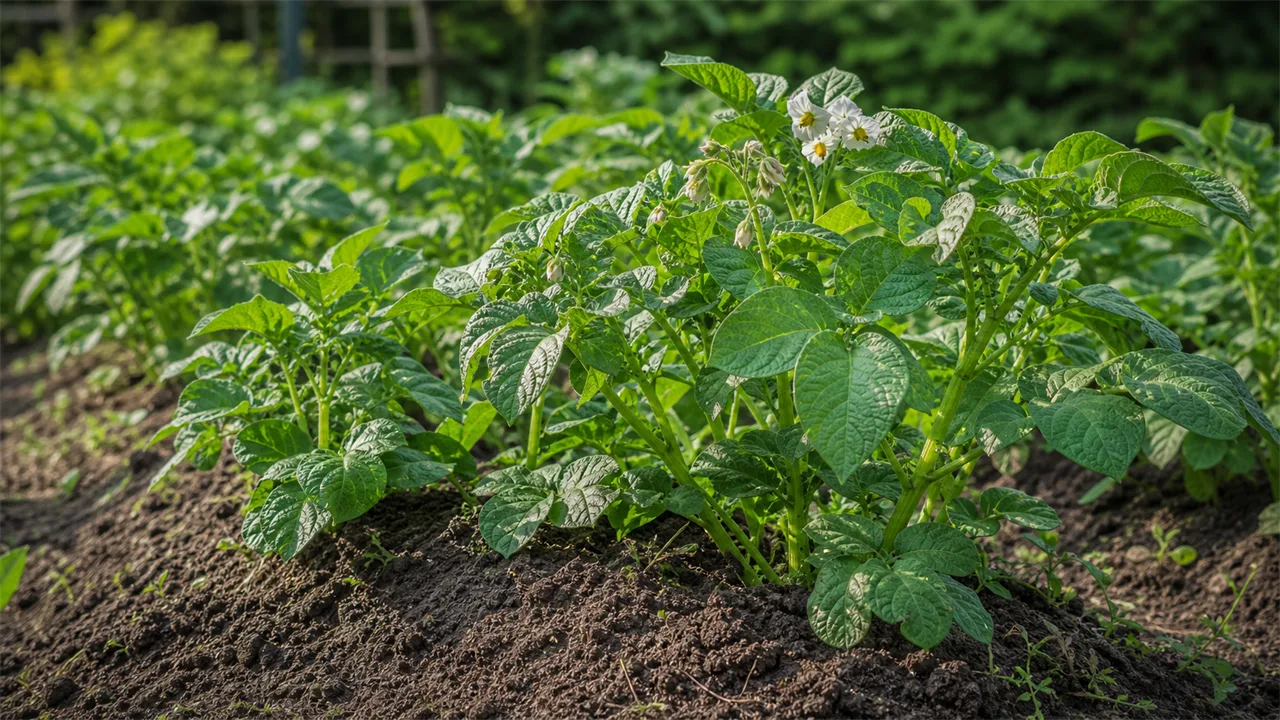
Earthing up. As shoots emerge and reach about 20 cm, draw soil from between the rows up around the stems to form a ridge, leaving the top few centimetres of foliage exposed. Repeat at two- to three-week intervals until the ridge is 20–30 cm high. Earthing up serves three purposes: it prevents light reaching developing tubers (which turns them green and produces toxic solanine), it suppresses weeds, and it gives the plant more stem from which to form tubers. Alternatively, grow through black polythene or in tall pots and containers, which removes the need to earth up.
Watering. Potatoes are sensitive to moisture stress, especially once tubers are swelling (typically from six weeks after planting). In dry spells — increasingly common in southern and eastern England — apply 20–25 litres per square metre per week, soaking rather than sprinkling. Erratic watering causes hollow heart, second growth and scab.
Feeding. Apply a general-purpose fertiliser such as blood, fish and bone at planting time (about 100 g per square metre). For maincrops, a second dressing of potash-rich fertiliser (or comfrey liquid) when the foliage meets across the rows helps tuber bulking. Avoid fresh manure immediately before planting — it encourages scab.
Weeding and pests. Hoe between rows carefully before the foliage closes over; once the canopy meets, hand-weed. The two main pests are potato cyst nematode (notifiable; rotate plots, buy resistant cultivars) and slugs (lift early if damage is severe, use nematode-based biological controls in late summer). Colorado beetle is a sporadic UK arrival; report sightings to the Animal and Plant Health Agency.
Blight. Late blight (Phytophthora infestans) is the most damaging UK potato disease and the same pathogen that caused the Irish Potato Famine. It thrives in warm, humid weather from July onwards and produces dark, water-soaked patches on leaves with white sporulation on the underside. First symptoms in the south often appear in late July or August; further north the risk peaks in August and September. Spray with copper-based or chlorothalonil fungicides (check current approvals) on susceptible maincrop varieties, or — for organic and low-input gardeners — grow resistant cultivars such as 'Sarpo Mira', 'Cara' or 'Toluca', and remove and burn infected foliage promptly.
Recommended UK cultivars.
- First earlies: 'Rocket' (very fast, waxy), 'Swift' (ready in ~7 weeks), 'Foremost' (classic flavour), 'Lady Christl' (buttery, salad use), 'Red Duke of York' (red-skinned heritage).
- Second earlies: 'Charlotte' (the benchmark salad potato), 'Maris Peer', 'Nicola' (waxy, stores well), 'Anya' (knobbly, salad type).
- Maincrops: 'Maris Piper' (the UK chip-shop standard), 'King Edward' (traditional baker, mid-late), 'Desiree' (red-skinned, drought-tolerant), 'Sarpo Mira' (blight-resistant, maincrop), 'Cara' (blight-tolerant, heavy yield), 'Pink Fir Apple' (heritage knobbly salad).
Mature plant size: 60 cm tall and 45–60 cm wide once foliage is fully developed.
Harvesting
Lift potatoes on a dry day when the soil is neither waterlogged nor bone-hard. Use a flat-tined garden fork pushed in well beyond the spread of the plant, then lever upwards and shake the soil off by hand. Avoid stabbing tubers — wounded potatoes do not store.
First earlies are ready from about 10–12 weeks after planting, generally as soon as the plants come into flower. In the south this is late June to mid-July; further north, July into early August. Earlies are eaten straight away and do not store well — lift only what you need for a meal.
Second earlies follow about 14–16 weeks after planting: July to August in most of England and Wales, August in Scotland.
Maincrops are ready 18–22 weeks after planting. Wait until the foliage has yellowed and died back, then cut it down and leave the tubers in the ground for a further 10–14 days to let the skins set — this dramatically improves storage. Lift from late August through October, depending on region and season: south and east earlier, north and west later. In heavy clay soils where slugs are a problem, lift maincrops by early October before slug damage worsens.
Signs of readiness. Earlies: flowers open, tubers the size of a hen's egg when rubbed open at the base of the plant. Maincrops: foliage senescing and dying down; skins firm rather than rubbing off when pressed with a thumb.
Yield expectations. A well-grown first-early plant yields 0.5–1 kg; a maincrop plant 1–2 kg. A 10 m row of maincrops typically returns 20–35 kg.
Eating
Potatoes grown at home outflavour anything from a supermarket. The sugars, starches and aromatic compounds degrade within days of lifting, so a potato eaten within an hour of being dug up has a freshness and depth that simply cannot be matched by tubers that have spent weeks in cold storage and distribution.
First earlies — small, waxy, low-starch — are best for boiling and serving whole with butter, mint, and a little sea salt. They need no more than 10–12 minutes in salted boiling water. Try 'Charlotte' or 'Maris Peer' as a side to grilled fish, cold salads with chive crème fraîche, or simply crushed with olive oil.
Second earlies occupy the middle ground: waxy enough to hold shape in salads, floury enough to roast. 'Nicola' and 'Anya' roast well in goose or duck fat; 'Charlotte' makes a classic French-style potato salad.
Maincrops are the floury, high-starch types: 'Maris Piper' for chips and crisps, 'King Edward' for roast potatoes and baking, 'Desiree' for mash. Cut chips thickly, double-fry at 140 °C then 180 °C for restaurant-style results. For mash, use a ricer or food mill rather than a blender — blenders release too much starch and turn mash gluey.
Storage notes. Cure lifted maincrops for a week or two in a single layer in a cool, dark, dry place to let minor scuffs heal, then store in hessian or paper sacks — never plastic, which traps moisture and rots the tubers. Store at 4–10 °C in the dark; light turns tubers green and develops toxic solanine, which must be cut away or the tuber discarded. A traditional method is to clamp maincrops outdoors under a thick layer of straw and soil in a well-drained spot, though this is less common in gardens today than in commercial and allotment sheds.
Storing
Maincrop potatoes store well from October to February or March if conditions are right. Ideal storage is dark, cool (4–10 °C), frost-free and slightly humid — an unheated garage, shed or cellar is ideal. Check stored tubers every two to three weeks and remove any that are soft, sprouting or rotting; one bad tuber can quickly spread through a sack. Do not store near apples, which release ethylene that encourages sprouting.
For longer storage, blanch diced or sliced potatoes for three minutes, cool in iced water, drain and freeze in airtight bags — though freezing changes the texture and is best for cooked mash or for chips cooked from frozen. New potatoes do not store well and should be eaten within a week of lifting.
First earlies do not store and should be lifted fresh; second earlies keep for two to three weeks in a cool shed. Maincrops, cured and properly stored, keep for four to six months.
Pests and Diseases
| Problem | Symptoms | Management |
|---|---|---|
| late blight | crop failures, plant disease | — |
Or browse the full plant problem solver to diagnose an issue by symptom.
Companion planting
✔ Grows well with: marigolds, Pea, Pot Marigold.
✘ Keep apart from: Courgette, Florence fennel, Pumpkin, tomato.
Full companion planting chart →
Potato in our guides
- Composting at Home: A Complete Beginner Guide for UK Gardens
- Containers for Growing Vegetables
- Crop Rotation Explained for UK Vegetable Gardens
- How to Grow Potatoes: From Chitting to Harvest
- How to Grow Sweetcorn
- Your First Vegetable Garden: A Beginners Guide
Recommended Products
GardenWizz earns a commission from qualifying purchases made through affiliate links on this page (including links within the article) — as an Amazon Associate, and from Thompson & Morgan via the Awin network. This does not affect the price you pay. See our disclaimer for details.