Apple
Malus domestica
The Gardening Year
Best months in UK gardens · full planting calendar →
🖨 Printable care card (PDF)At a Glance
| Botanical name | Malus domestica |
|---|---|
| Common name(s) | apple |
| Family | Rosaceae |
| Plant type | tree (Deciduous) |
| Height × Spread | 0.6–15 m × 8 m |
| Position | Full sun, Partial shade |
| Soil | Deep, fertile, moist but well-drained, neutral soil. Will not thrive on very acid soils or shallow chalk soils. |
| Flowering | March–May |
| Toxicity | No specific toxicity is listed by the RHS. This is not a guarantee of safety — check with a vet or the ASPCA before pets or children eat any plant. |
| Native range | Central Asia |
Overview
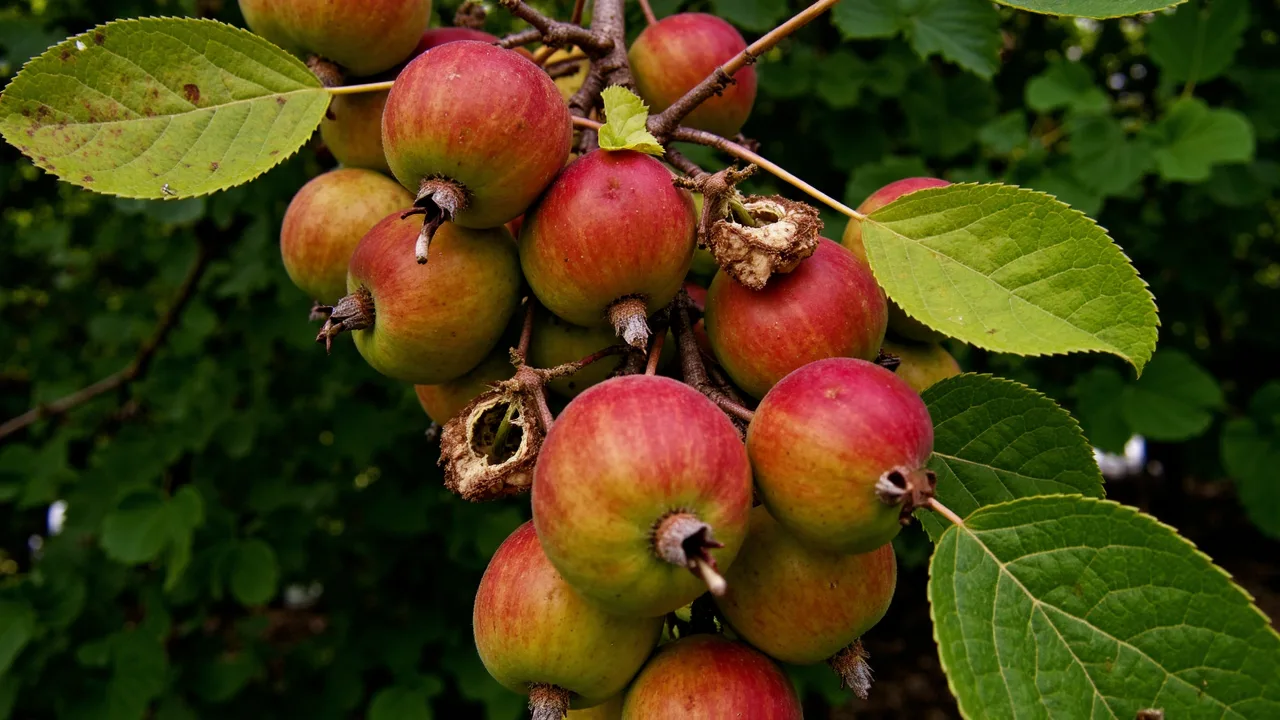
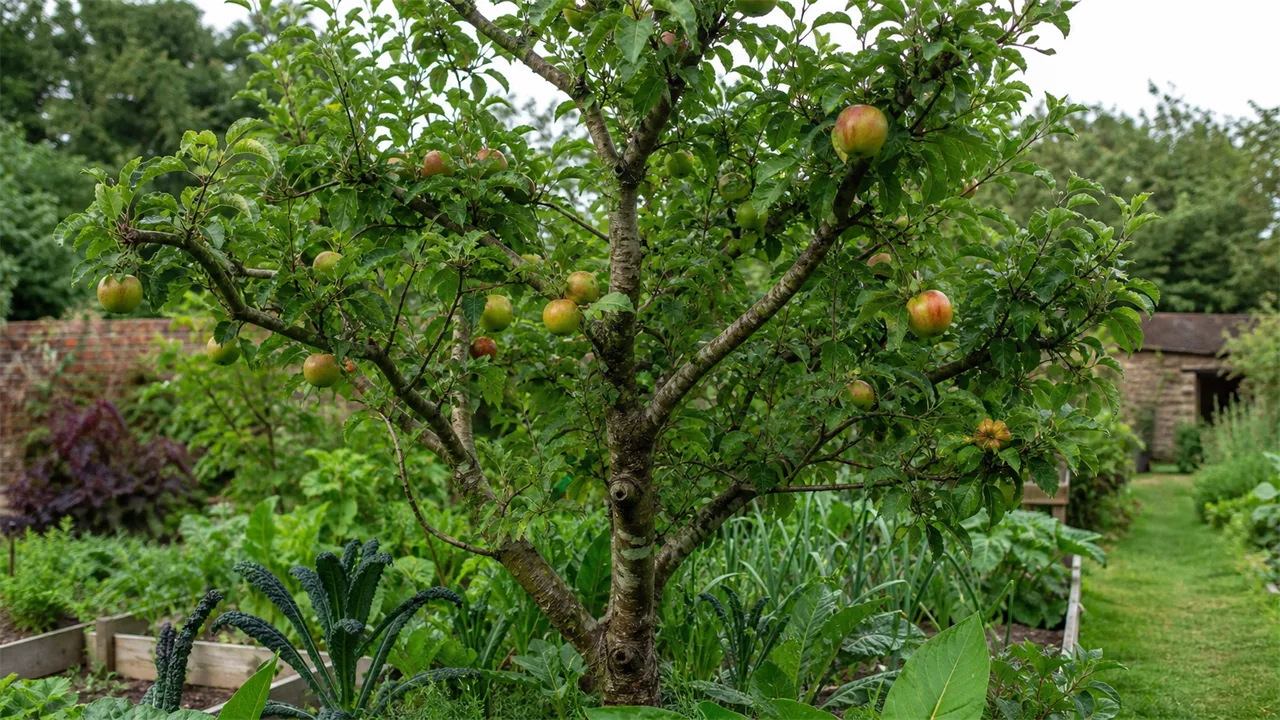
Apples (Malus domestica) are the cornerstone fruit of the British garden. Few crops repay a small investment of time so generously: a single established tree can produce 30–80 kg of fruit a year for two or three decades, and the range of flavours available from a home orchard dwarfs anything on a supermarket shelf. The UK sits firmly inside the apple's comfort zone — cool winters give the trees the chill hours they need, and the maritime climate suits both cookers and eaters.
Growing your own is worth it for three reasons. First, flavour: varieties such as 'Egremont Russet', 'Cox's Orange Pippin' and 'Ribston Pippin' are barely available to buy because they do not ship well. Second, reliability: apples crop in most British summers, even in poor ones, and a well-timed late frost is the only real threat in most regions. Third, choice of rootstock — the single biggest decision an apple grower makes — controls the eventual tree size, so there is an apple for every garden from a courtyard to a smallholding.
Sowing
Apples are not grown from seed for fruit production — seedlings take 6–10 years to crop and do not come true to type. Home growers plant either bare-root or container-grown whip or feathered maiden trees, bought from a specialist fruit nursery. The two genuine decisions are which variety and which rootstock.
When to plant. Bare-root trees are lifted and dispatched from late October to mid-March while fully dormant, and must be planted as soon as they arrive. Container-grown trees can go in at any time of year so long as the soil is workable and you can water them through any dry spell — autumn is still best because the roots establish over winter.
UK region-aware planting windows. In the mild south-west, south coast and London area plant any time from late October through to early March; the soil is workable for most of that window and trees establish quickly. In the Midlands and south-east, aim for November to late February and avoid planting into frozen or waterlogged ground. In the north of England, north Wales and the east of Scotland, delay planting until late November at the earliest and finish by mid-February — the shorter, colder dormant season leaves less margin. In upland Scotland and exposed northern sites, only plant in late autumn or wait until early spring once the worst frost has passed, and be prepared to stake firmly for wind.
Site preparation. Apples need a sunny, sheltered spot with at least half a day's direct sun in summer and free-draining soil — they will not tolerate waterlogged roots for more than a day or two. Dig out a hole wide enough to take the roots without bending them (about 60 cm across) and only as deep as the root collar. Fork the base, add a spadeful of well-rotted manure or garden compost to the spoil, and drive in a stake before you plant so the roots are not damaged later. Soak bare-root trees for an hour before planting.
Spacing. This is where the rootstock matters. On M27 (extremely dwarfing) allow 1.2–1.5 m between trees — suitable for a large pot or a small bed. On M9 (dwarfing) allow 2–2.5 m — the standard commercial orchard spacing and a good choice for a small garden. On MM106 (semi-vigorous) allow 3.5–4.5 m — the right choice for a larger garden, lawn specimen or small orchard. On MM111 or M25 (vigorous) allow 6 m or more — for a traditional orchard tree.
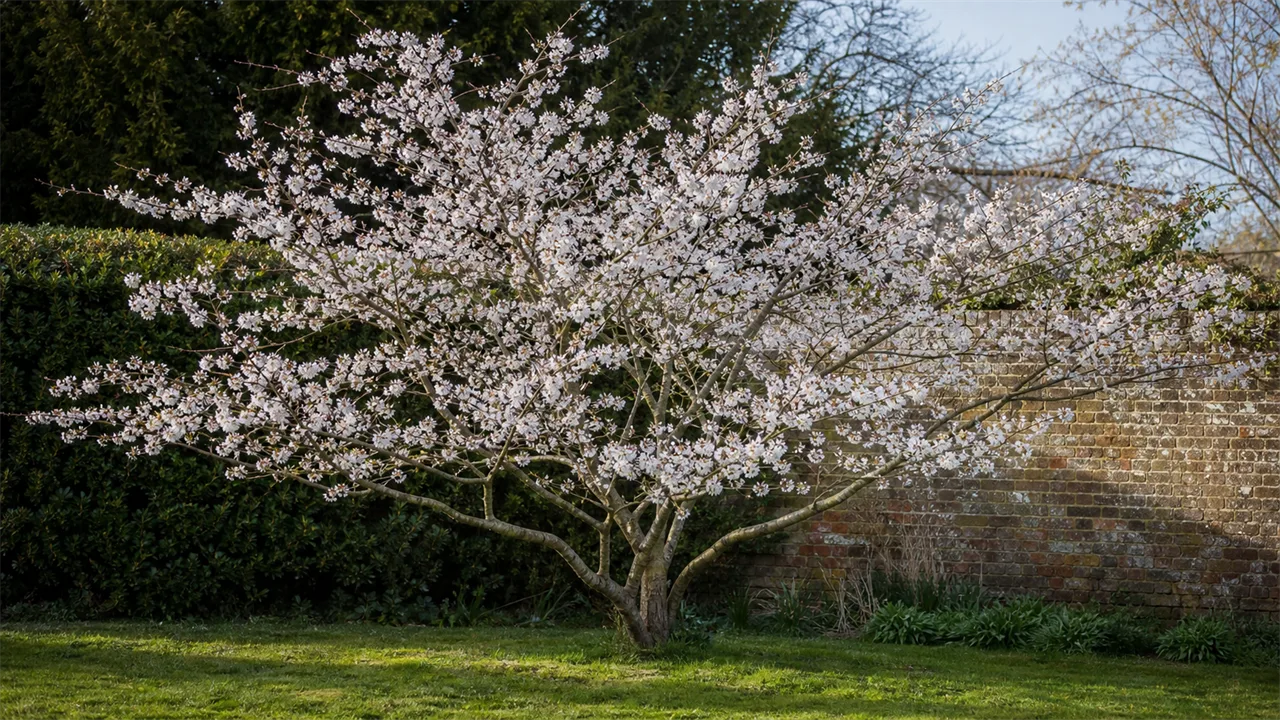
Pollination. Most apples are not self-fertile. You will need at least two varieties (or a crab apple nearby) that flower at the same time to get a reliable crop. Check the nursery's pollination group — apples are grouped 1 to 7 by flowering time, and any two in the same or adjacent group will cross-pollinate. Triploid varieties such as 'Bramley's Seedling' need two other pollinators, not one. If you only have room for one tree, choose a self-fertile variety such as 'Sunset', 'Scrumptious' or the family apple 'Cox self-fertile' strains.
Growing
Once planted, an apple tree wants little fuss but rewards the small amount of attention you give it.
Watering. For the first two summers, water a freshly planted tree thoroughly once a week during dry spells — a full watering can (around 10 litres) per tree, slowly, so it soaks in. Established trees on dwarfing rootstocks need watering in extended drought to keep fruit size up; a soak every 10–14 days is better than a daily sprinkle. Mulch in spring with a 5–7 cm layer of garden compost or well-rotted manure over the root area (but not touching the trunk) to conserve moisture and feed the tree slowly.
Feeding. A general-purpose fertiliser such as blood, fish and bone in early March, at roughly 50 g per square metre under the spread of the canopy, is enough for most trees. On poor sandy soils add sulphate of potash in summer to improve fruit flavour and storage life. Excessive nitrogen produces lush leaves and poor fruit — go easy on the feed if your tree is making lots of soft green growth at the expense of buds.
Weeding and grass. Grass directly under a young apple tree robs it of water and nutrients. Keep a clear circle at least as wide as the canopy for the first three to four years. In an orchard situation, mulching out to the dripline is more practical than bare soil.
Pruning. The two main windows are late summer (mid-August to mid-September) and winter dormancy (late November to mid-February). Winter pruning is for shape and renewal; summer pruning is for restricting vigour and letting light into the fruit. For a bush or half-standard apple — the commonest garden forms — aim for an open goblet shape with four or five main branches and a clear centre. Shorten the previous season's growth on each main branch by about a third, and remove any crossing, rubbing or dead wood. On cordon and espalier apples, summer pruning is the main event: cut each new side shoot back to five leaves in August.
Pests and diseases. The big four are apple scab (olive-green to black blotches on leaves and fruit — worst in wet summers; choose resistant varieties such as 'Saturn', 'Reverend W. Wilks' or the scab-immune 'Crispin' / 'White Transparent' family if you are in the wetter north-west), powdery mildew (white powdery shoot tips in dry springs — prune out affected growth), codling moth (the classic "worm in the apple"; pheromone traps from late May reduce damage significantly) and aphid colonies on young shoots, which a few blue tits will sort out if the tree is near a perch. Grease bands around the trunk from late October stop winter moth females climbing up to lay eggs.
Thinning. In late June, after the natural June drop, remove any damaged, misshapen or surplus fruits so the remainder are spaced roughly 10–15 cm apart. This gives bigger, better-flavoured apples and stops the tree slipping into biennial bearing (heavy crop one year, almost nothing the next).
Harvesting
When to pick. Picking time depends on variety and region. In the south-east, early apples such as 'Discovery' and 'Beauty of Bath' are ready from late July into August. Mid-season varieties like 'Cox's Orange Pippin' and 'Egremont Russet' ripen from mid-September to early October. Late keepers such as 'Braeburn', 'Ashmead's Kernel' and 'Spartan' are picked from mid-October into November in milder areas. In the north and Scotland, shift every window back by two to three weeks. Upland and exposed northern sites often find late October too cold for a clean harvest.
The standard test is to cup an apple in your hand and twist it upwards with a slight turn — a ripe apple parts cleanly from the tree with its stalk intact. If you have to pull, it isn't ready.
UK region-aware harvest windows. South-west and south coast: Discovery in late July, Cox mid-September, late keepers through late October. Midlands and south-east: Discovery from early August, Cox late September to early October, Braeburn into late October. North of England, north Wales, lowland Scotland: Discovery from mid-August, Cox early to mid-October, late keepers often not worth leaving past mid-October because of frost risk. Upland and exposed Scotland: concentrate on early and mid-season varieties; pick all fruit by mid-October at the latest.
How many pickings. Pick the same variety over two or three visits a week apart rather than stripping the tree in one go — apples on the sunny south side ripen first, and a single-pass harvest gives you a mixed lot of under-ripe and over-ripe fruit.
Eating
The reason to grow your own is flavour at its peak, which for most dessert apples is straight off the tree. Different varieties do different kitchen jobs:
- Dessert / eaters for the cheeseboard and lunchbox: 'Discovery' (sharp, juicy, doesn't keep), 'Cox's Orange Pippin' (the British benchmark flavour), 'Egremont Russet' (nutty, dry, classic with cheese), 'Worcester Pearmain' (strawberry notes, early), 'Sunset' (reliable Cox substitute).
- Cookers that hold their shape: 'Bramley's Seedling' (the only choice for proper apple crumble and sauce — breaks down to a fluffy purée), 'Reverend W. Wilks', 'Annie Elizabeth'.
- Dual-purpose: 'Howgate Wonder' (huge, good baked), 'Laxton's Superb' (desset flavour but cooks well), 'Peasgood's Nonsuch' (giant, excellent for baking whole).
Beyond the obvious, a surplus apple crop turns into apple crumble, apple cake, tarte tatin, apple chutney, dried apple rings, juice, and cider. A single mature tree usually produces far more than one household can eat fresh — plan from the start to share, store or process.
Storing
Apples are one of the few fruits that genuinely keep if you give them the right conditions. Late-ripening varieties such as 'Braeburn', 'Ashmead's Kernel', 'Cox's Orange Pippin' and 'Spartan' store best; early apples do not.
How to store. Pick firm, blemish-free fruit with the stalk intact on a dry day. Lay single layers on slatted wooden trays or in shallow cardboard trays, ideally in a dark, cool, frost-free shed or garage at 3–5 °C with high humidity. An old-fashioned apple loft or a north-facing outbuilding is ideal. Check weekly and remove any fruit showing signs of rot — one bad apple really does spoil the bunch, as the ethylene gas it releases accelerates ripening in its neighbours. Wrapping each apple in a single sheet of newspaper slows the spread further.
How long they last. Most late dessert varieties will keep in good condition from picking until Christmas; 'Ashmead's Kernel', 'Spartan' and some russets improve in storage and last well into February or March. Cookers such as 'Bramley's Seedling' stored in the same way keep shape and acidity for two to three months, which is why Victorian kitchen gardens had an apple loft as standard.
Freezing and drying. Apples freeze well for cooking: peel, core, slice into rings, dip in a little lemon juice to stop browning, open-freeze on a tray, then bag. Dried apple rings — sliced 5 mm thick, dipped in lemon water, dried slowly at 60 °C in an oven or dehydrator — store for six months in an airtight jar and are excellent for winter snacks and baking.
Supporting
Most garden apple trees need staking for at least the first three years until the roots anchor. Drive a short stake — about 5 cm square, 1.2 m tall — into the planting hole before you place the tree, so the roots lie against it rather than being speared. Tie the trunk to the stake with a proper tree tie (rubber or webbing with a spacer), loose enough to allow the trunk to thicken but firm enough to hold the tree upright in a winter gale. Check ties every spring as the trunk expands.
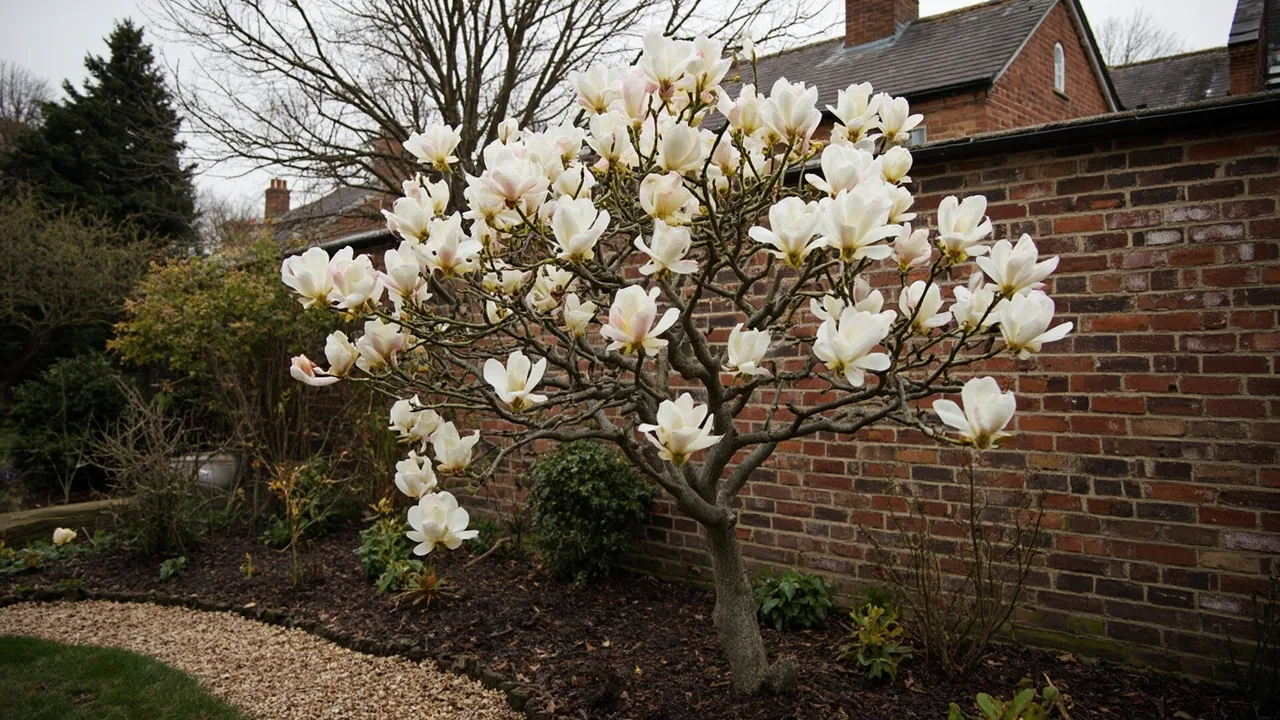
Cordon, espalier and step-over apples need permanent horizontal support wires against a wall or fence, with posts at 2 m intervals and wires at 60 cm, 90 cm and 120 cm above the ground for an espalier. Tie in new growth each summer as it extends. Bush and half-standard apples do not need permanent support once established; standard and half-standard trees on MM106 or MM111 in exposed sites benefit from a longer stake for the first five years, by which point the root system will hold them.
Pests and Diseases
| Problem | Symptoms | Management |
|---|---|---|
| Apple scab | Leaves develop greenish-black spots and blotches, often falling early, while fruit may also show dark lesions. | Collect fallen leaves in autumn to reduce overwintering spores and apply approved fungicides during wet springs. |
| Powdery mildew | A white powdery growth appears on young leaves, shoots, and sometimes fruit, potentially reducing tree vigour. | Prune to improve air circulation and apply sulphur-based treatments or resistant cultivars where possible. |
| Woolly aphid | Lumpy outgrowths on bark covered with a white, fluffy waxy substance secreted by the insects. | Scrape off infested areas in winter or use systemic insecticides; encourage natural predators like ladybirds. |
| Codling moth | Caterpillars bore into developing fruit, causing premature drop and leaving frass around the entry hole. | Use pheromone traps to monitor adults and apply targeted sprays or use trunk bands to catch crawling larvae. |
| Apple canker | Sunken, discoloured lesions on branches or trunk that may ooze sap and cause dieback of shoots. | Prune out infected wood well below the lesion during dry weather and disinfect tools between cuts. |
| Fireblight | Shoots and blossoms wilt suddenly, turning black and curling into a characteristic 'shepherd's crook' shape. | Prune out infected branches well below symptoms during dry weather and avoid excessive nitrogen fertiliser. |
For step-by-step help, read Controlling Aphids Naturally, Treating Powdery Mildew and Tackling Black Spot on Roses. Or browse the full plant problem solver to diagnose an issue by symptom.
Apple in our guides
- How to Grow Turnips in the UK: A Complete Guide
- Pruning Basics for UK Gardens
- Gardening Jobs for December in the UK
- Gardening Jobs for November in the UK
- Apple Scab: How to Identify and Treat It
- Codling Moth: How to Protect Apples and Pears
Recommended Products
GardenWizz earns a commission from qualifying purchases made through affiliate links on this page (including links within the article) — as an Amazon Associate, and from Thompson & Morgan via the Awin network. This does not affect the price you pay. See our disclaimer for details.