Austrian pine
Pinus nigra
The Gardening Year
Best months in UK gardens · full planting calendar →
🖨 Print-friendly care cardAt a Glance
| Botanical name | Pinus nigra |
|---|---|
| Common name(s) | Austrian pine |
| Family | Pinaceae |
| Plant type | tree |
| Height × Spread | 20–55 m × 6–12 m |
| Position | Full sun |
| Soil | well-drained; tolerates chalk, clay, loam, sand; acid, alkaline or neutral pH |
| Flowering | May–June |
| Toxicity | Not yet established. Do not assume this plant is safe for people or pets. |
| Native range | Southern Europe from the Iberian Peninsula and Lower Austria to the eastern Mediterranean, Anatolian peninsula of Turkey, Corsica, Cyprus, Crimea, high mountains of Northwest Africa |
Overview
Austrian pine is a large evergreen conifer valued for its dense, dark foliage and ability to grow on sites that can be challenging for less tolerant trees. The accepted species name is Pinus nigra J.F.Arnold, a member of the pine family, Pinaceae. Kew records the species as native across a broad area from the Mediterranean and eastern Austria to the north Caucasus, and as introduced in Great Britain.
The common name needs a little care. “Black pine” may refer to Pinus nigra as a whole, while “Austrian pine” most precisely refers to Pinus nigra subsp. nigra. Older horticultural sources and plant labels may use Pinus austriaca or Pinus nigra var. austriaca. These names are associated with Austrian pine, but the accepted species name should lead.
Austrian pine is not the same as Corsican pine, Pinus nigra subsp. laricio. The two belong to the same variable species, yet their form, foliage and performance differ. Forest Research describes the Austrian subspecies as more tolerant of chalk or limestone and exposure than Corsican pine, but generally poorer in vigour and form. That combination can make Austrian pine useful on particular exposed sites or in shelterbelts, but it does not make it the best large conifer for every garden.
This is a tree for space, not a compact ornamental to squeeze into a border. The RHS places it in its largest height and spread bands: more than 12 metres tall and more than 8 metres wide. Those bands are useful warnings rather than precise final dimensions. Ultimate size and form depend on age, site and growing conditions. Before planting, allow generously for the future crown and root zone, and consider nearby buildings, paths, overhead lines and neighbouring land. Check any relevant Tree Preservation Order, conservation-area controls and local planting constraints before work begins.
Appearance
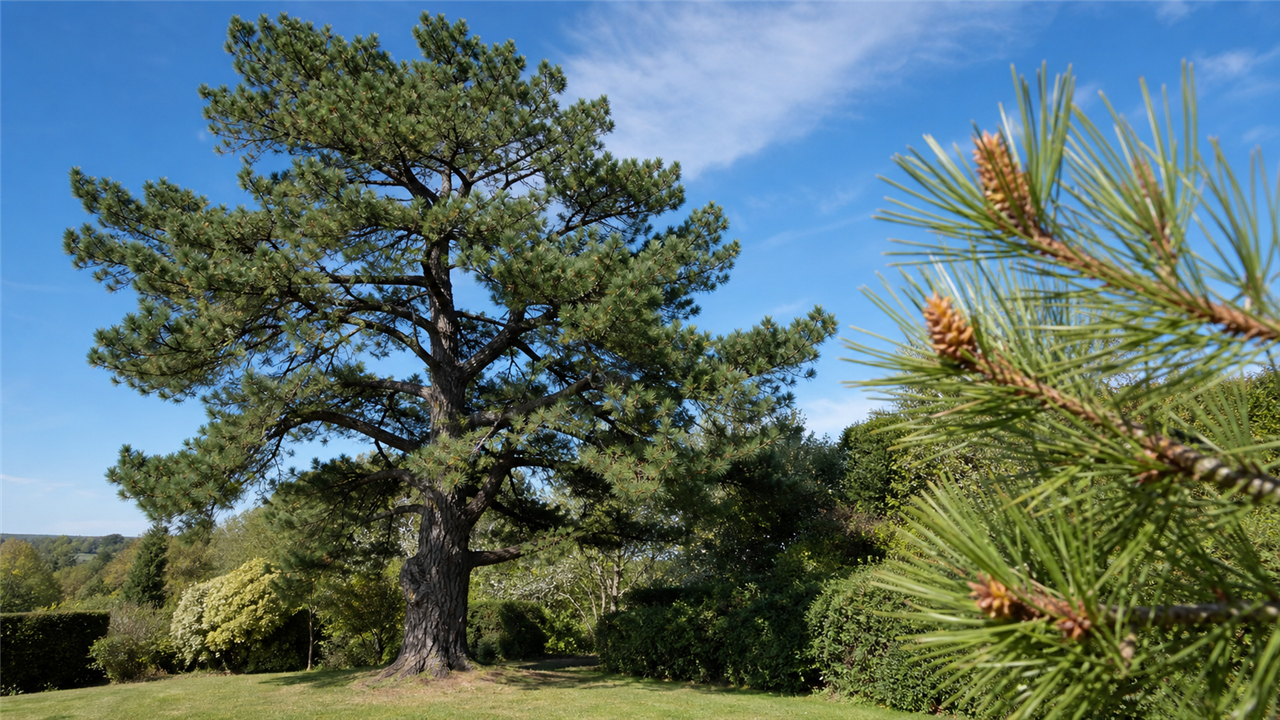
Young Austrian pines are typically pyramidal and clothed with branches low down the trunk. With age, the outline becomes broader and the lower trunk may become bare. Mature trees can develop a substantial, variable crown rather than retaining the neat cone associated with a young specimen.
The foliage is an important identifying feature. Needles are dark green, pointed, fairly stiff and carried in pairs. The paired needles have conspicuous sheaths at their bases. Compared with Corsican pine, Austrian pine generally has darker, denser-looking foliage. This is a useful comparison, but identification should use several features together because crown form within Pinus nigra can vary.
The bark becomes dark grey and deeply fissured as the tree matures, giving an older trunk a rugged texture. The cones are pointed and mature to light brown. Taken together, the paired stiff needles, dense dark foliage, fissured bark and cones help distinguish the tree, although a specialist opinion may be sensible where the precise subspecies matters.
Seasonal change is subtle because the tree is evergreen. Healthy older needles are eventually shed, while persistent or extensive browning deserves investigation. A photograph alone may not show whether symptoms reflect normal needle turnover, drought stress, site problems or disease.
Growing Conditions
Plant Austrian pine in full sun. It accepts an unusually broad range of soil textures: chalk, clay, loam and sand are all included in RHS guidance. It can also grow in acid, neutral or alkaline conditions, and in either exposed or sheltered positions. This breadth is one reason it has historically been used on chalklands, poor soils and exposed sites.
Tolerance does not mean indifference to drainage. Choose moist but well-drained or freely drained ground and avoid persistently waterlogged soil. Compaction can also restrict establishment, so prepare a realistic rooting area rather than improving only a small planting hole. On heavy ground, assess how water moves through the wider site before committing to a large, long-lived tree.
Austrian pine has a history of use where air pollution, poor soil or exposure made planting difficult. That record can guide site selection, but it should not be read as a promise that a tree will thrive without establishment care. A young tree still needs adequate water, protection from browsing and enough uncompacted soil for roots to extend.
Its tolerance of chalk, limestone and exposure is greater than that reported for Corsican pine. Conversely, Forest Research notes poorer vigour and form in forestry comparisons. Gardeners should therefore select Austrian pine for its own characteristics rather than treating it as an interchangeable replacement for Corsican pine.
Planting and Care
Plant preferably between October and April while the soil is workable. Avoid frozen or waterlogged ground. A container-grown tree can be planted at other times, but autumn or winter planting normally reduces the burden of watering. On an exposed site, consider whether staking or other establishment support is needed, and plan protection from mice, voles, rabbits or deer before damage occurs.
Set the tree at the same level at which it was growing in the nursery container or rootball. Planting too deeply can bury the root flare and create avoidable problems. Water thoroughly after planting, then monitor the root zone rather than relying on light rain or the appearance of the soil surface.
Water regularly during the first two years, particularly in dry or hot weather. The aim is to help roots establish into the surrounding ground, not to keep a small area permanently saturated. Once the tree is well established, supplementary water is generally needed only during prolonged drought or heatwaves. Conditions vary with soil and exposure, so use this as a practical guide rather than a fixed calendar.
Apply a mulch at least 5 centimetres deep from late autumn to late winter to help conserve moisture and reduce competition. Spread it over the rooting area, but keep it clear of direct contact with the trunk. Maintain a weed-free area while the tree establishes and renew protection if browsing animals remain a risk.
Most established conifers need little routine intervention. Prune Austrian pine only when necessary, between April and August. Remove appropriate green growth with a clear purpose, such as dealing with damage, but do not cut back into brown old wood: most conifers do not regenerate reliably from it. Do not plant a full-size Austrian pine with the expectation that repeated hard pruning will keep it small. The RHS advises that replacement is often the better answer when a conifer has outgrown its position.
Mature-tree pruning, structural concerns and work at height belong with a suitably qualified arborist. Early site choice is far safer and more effective than trying to correct a fundamental space conflict decades later.
Common Problems
Poor siting is one of the most preventable problems. Persistent waterlogging, compacted ground and inadequate room for the mature crown can all undermine a planting. A tree that conflicts with buildings, utilities or neighbours may become difficult to manage even if it remains healthy. Choose the location for the mature tree, not the convenient gap visible on planting day.
Drought stress is most likely to matter during establishment. Keep up regular watering through the first two growing seasons and pay particular attention during hot, dry spells. Mulch helps retain soil moisture, but mulch piled against the trunk should be avoided.
Dothistroma needle blight affects pines in Britain. Possible signs include browning and loss of older needles, with symptoms best assessed between June and August. Forest Research reports that Corsican pine and lodgepole pine have been particularly badly affected in Britain and lists other pine hosts. That evidence supports vigilance around Austrian pine, but it does not justify giving Austrian pine a specific UK risk ranking. If browning or needle loss is extensive, seek advice from a competent arborist or use current Forestry Commission and TreeAlert guidance instead of diagnosing from photographs alone.
Pine processionary moth is identified by Forest Research as a potential pest of pines. Its caterpillars can pose a health hazard to people and animals. Treat a suspected sighting as a reportable tree-health concern and follow official guidance; do not handle caterpillars or nests. This warning should not be confused with a general claim that the tree itself is poisonous. The available evidence does not support a categorical statement that Pinus nigra is either poisonous or safe for people or pets.
Young trees may also be damaged by mice, voles, rabbits and deer. Physical protection at planting is usually easier than responding after bark or shoots have been eaten. Check guards and ties regularly so that they remain effective without rubbing or constricting the tree.
Popular Varieties
This article covers the species Pinus nigra, with “Austrian pine” used most precisely for subsp. nigra. Corsican pine, subsp. laricio, should not be presented as an Austrian pine variety: it is a distinct subspecies with different foliage, form and forestry performance.
Older labels may show the names Pinus austriaca or Pinus nigra var. austriaca. These are historical botanical names associated with Austrian pine, not compact cultivars. They do not change the need to plan for a large species tree.
Named selections of Pinus nigra are sold in horticulture, but no cultivar-specific authoritative UK profiles were verified for this guide. It would therefore be misleading to provide a list or attach the species’ size and form to an individual cultivar. Nursery availability, habit and ultimate size can vary by selection.
If a named cultivar is being considered, check its exact botanical name against a current authoritative record and obtain a reliable estimate of its mature height, spread and habit. Confirm that the supplied plant matches the label, and choose it for documented characteristics rather than assuming that every selection behaves like full-size Austrian pine. Where a compact form is essential, cultivar-specific evidence matters more than the broad tolerances of the species.
Sources
- Kew Science, Plants of the World Online — Pinus nigra
- Royal Horticultural Society — Pinus austriaca
- Royal Horticultural Society — planting trees and shrubs
- Royal Horticultural Society — how to grow conifers
- Forest Research — Corsican pine species database
- Forestry Commission — Conifers booklet
- Forest Research TreeAlert — Dothistroma needle blight
- Forest Research — pathogens and hosts of Dothistroma needle blight
- Forest Research — pine processionary moth
Pests and Diseases
| Problem | Symptoms | Management |
|---|---|---|
| Pine shoot moth | New shoots wilt, turn brown, and die back in late spring or early summer. | Apply recommended insecticide sprays to young trees during the flight period of the moths. |
| Honey fungus | General decline, yellowing needles, and white fungal growth at the base in autumn. | Ensure well-drained soil conditions and remove infected root systems if detected. |
| Needle cast diseases | Older needles turn brown or grey and drop prematurely, thinning the foliage. | Improve air circulation around the tree and avoid overhead watering to reduce humidity. |
| Conifer aphids | Clusters of small insects on new growth with sticky honeydew residue on needles. | Wash off infestations with a strong jet of water or apply horticultural oil. |
| Pine sawflies | Caterpillar-like larvae skeletonize and defoliate the needles in summer. | Hand-pick larvae from small trees or use appropriate biological controls. |
Or browse the full plant problem solver to diagnose an issue by symptom.