Magnolia Denudata
Magnolia denudata
The Gardening Year
Best months in UK gardens · full planting calendar →
🖨 Printable care card (PDF)At a Glance
| Botanical name | Magnolia denudata |
|---|---|
| Common name(s) | Magnolia denudata |
| Family | Magnoliaceae |
| Plant type | tree (Deciduous) |
| Height × Spread | 9–12 m × 8 m |
| Position | Full sun, Partial shade |
| Soil | moist but well-drained neutral to acid soil |
| Flowering | March–May |
| Toxicity | — |
| Native range | central and eastern China |
--- slug: magnolia-denudata botanical_name: Magnolia denudata common_name: Yulan Magnolia category: shrubs-trees hardiness: H6 sunlight: Full sun or light dappled shade soil: Fertile, moisture-retentive, neutral to slightly acidic flowering_season: March to May mature_size: 8 to 12 m tall, spread wider than 8 m plant_type: Deciduous small tree or large shrub native_range: Central and eastern China ---
Yulan Magnolia (Magnolia denudata)
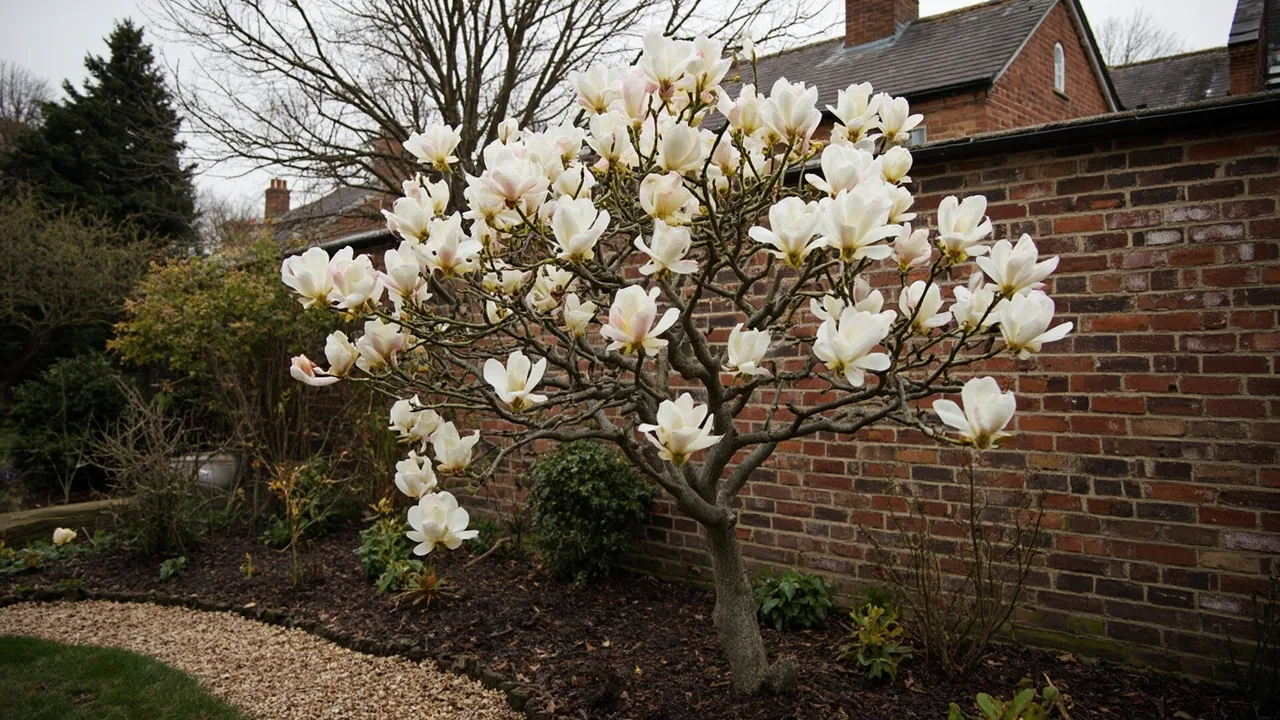
The Yulan Magnolia is one of the most spectacular early-flowering trees a UK garden can host, smothering its bare branches in large, fragrant, ivory-white goblet-shaped flowers from late March into early May. Known in cultivation for well over a century and revered in China for more than a thousand years, it is the legendary "yulan" or jade lily of Chinese gardens and one of the two parents of the widespread saucer magnolia, Magnolia × soulangeana. Give it a sheltered spot, neutral to slightly acid soil, and room to spread, and it will repay you with a display that few other spring-flowering trees can match.
Overview
Magnolia denudata is a deciduous member of the family Magnoliaceae, placed in section Yulania along with the other early-flowering "lily-flowered" magnolias. In UK gardens it typically grows as a large, spreading shrub or small tree reaching about 9 m, though the RHS records a maximum range of 8–12 m. It has held the Royal Horticultural Society's Award of Garden Merit for many years and is considered fully hardy across the UK. Its botanical name denudata — meaning "bare" or "naked" — refers to the flowers appearing on the leafless branches, before the new season's foliage expands. In a typical UK spring, the goblet-shaped white flowers open from late March through April, a few days to a fortnight ahead of the leaves.
The species is native to central and eastern China and has been cultivated there as an ornamental and temple-garden tree for at least a millennium. It entered European cultivation in the late eighteenth century and was crossed with M. liliiflora in the early nineteenth century to produce M. × soulangeana, the saucer magnolia widely seen in UK gardens today. UK trade names include yulan magnolia and lily tree.
Appearance
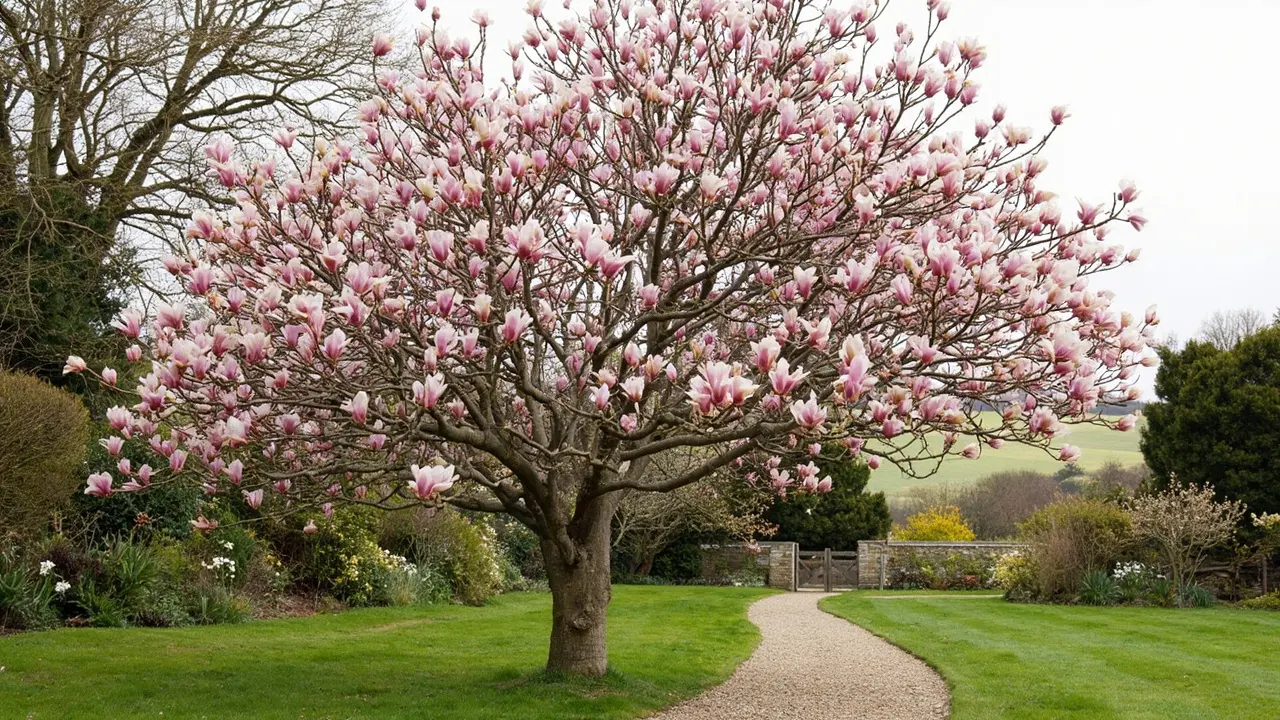
The Yulan Magnolia forms a broad, rounded crown on a short trunk, often wider than it is tall once mature — a habit that makes it as well suited to a lawn specimen as to the back of a large mixed border. The branches are smooth and grey-brown, becoming more rugged with age.
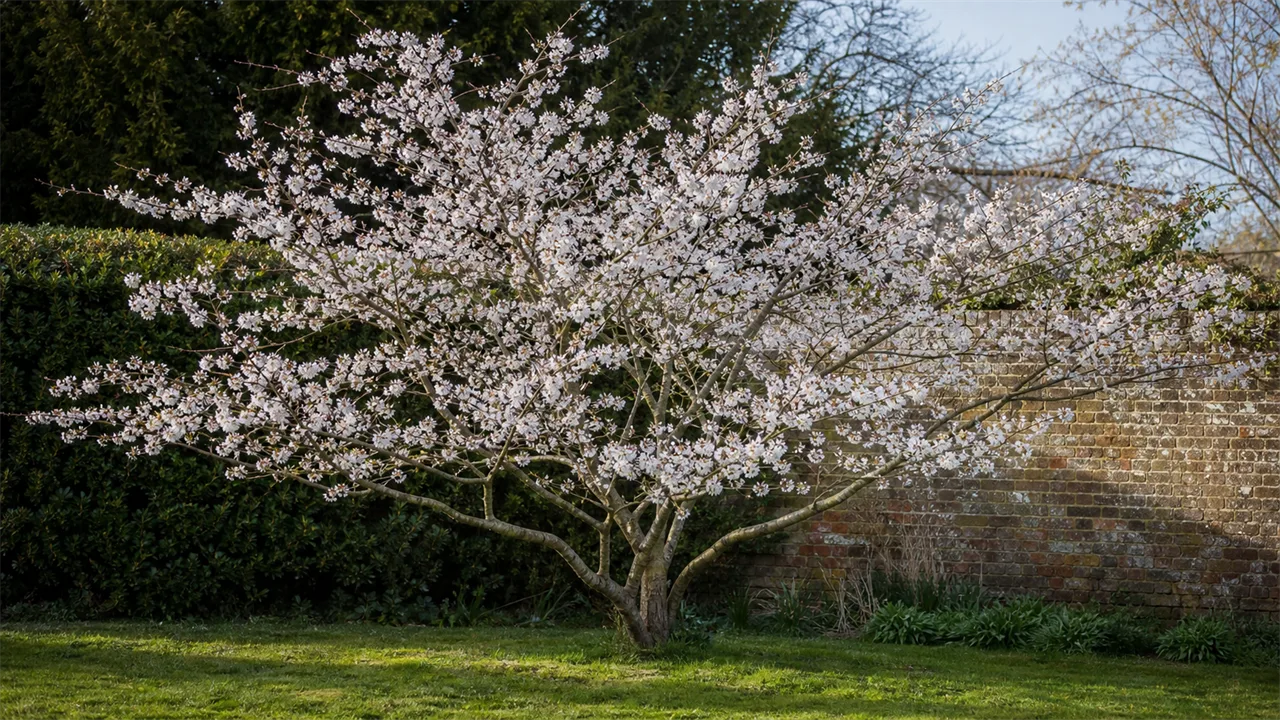
The defining feature is the flower. Each bloom is a thick, fleshy goblet up to about 15 cm across, composed of nine tepals (the petal-like segments that magnolias carry in place of true petals and sepals). In the typical species form these are pure creamy white, sometimes flushed with the faintest green at the base, and they carry a strong, sweet, slightly lemony fragrance that carries on a still spring morning. Forms in which the outside of the tepals carries a rosy-purple tint are sometimes sold as var. purpurascens.
The leaves emerge after flowering. They are broadly oval, mid-green, and around 10–17 cm long, arranged in a slightly drooping tier that gives the tree its characteristic horizontal silhouette. In autumn the foliage turns a muted gold to golden brown before falling — a quiet but reliable late-season display.
Growing Conditions
The Yulan Magnolia is not a demanding tree once established, but it does have a few firm preferences. The single most common reason a specimen fails to thrive is heavy, waterlogged ground or a sharply alkaline, shallow soil.
Soil: plant in deep, fertile, humus-rich loam that is moisture-retentive yet free-draining. A neutral to slightly acidic pH is ideal. Most established magnolias tolerate neutral to mildly alkaline soils provided the ground is deep and well conditioned, but very shallow chalk leads to chlorosis — yellowing leaves with green veins — and is best avoided or improved with generous amounts of organic matter and an ericaceous mulch.
Light: full sun gives the best flowering and the most compact habit. Light, dappled shade is acceptable, particularly in the south of England where a hot spring sun can bleach open blooms, but deep shade reduces flowering dramatically.
Shelter: this is the non-negotiable. M. denudata flowers very early, on bare wood, and a cold east wind or a late frost can ruin an open bloom in a single night. Choose a position out of the coldest winds — the south or west side of a house, a walled garden, or the sunny edge of a woodland works well. Avoid frost pockets at the bottom of slopes and exposed open lawns in cold counties.
Hardiness: the RHS rates the species H6, fully hardy across the UK and northern Europe. The tree itself is hardy; it is the flowers that are vulnerable to late spring frosts, so microclimate matters more than regional climate.
Planting and Care
When to plant: container-grown or balled-and-burlapped specimens establish best when planted in spring (March to early May) or early autumn (September to mid-October), when the soil is warm and moist but the tree is not in active leaf. Avoid planting in frozen, waterlogged, or parched soil. Most UK nurseries lift M. denudata as container stock, so year-round planting outside the extremes of midsummer and midwinter is possible if you can irrigate.
Planting technique: dig a hole two to three times the width of the rootball and only as deep. Magnolias have shallow, fleshy roots that resent being buried too deep — the root collar should sit exactly at the finished soil level, no lower. Backfill with the excavated soil improved with a generous bucket of well-rotted garden compost or leaf mould, and water in thoroughly to settle the soil around the roots. Stake only if the site is exposed; the trunk thickens faster if it can flex.
Watering: water deeply once a week during the first two growing seasons, and through any prolonged dry spell thereafter. Magnolias dislike drought at the root and will flag visibly if allowed to dry out.
Mulching and feeding: each spring, mulch over the rooting area with a 5–7 cm layer of leaf mould, bark, or well-rotted compost, keeping it clear of the trunk. On acid soils an ericaceous mulch is ideal; on neutral soils a general organic mulch is fine. A single spring application of a balanced slow-release fertiliser is usually enough for established plants.
Pruning: minimal. M. denudata forms a shapely crown without intervention and resents hard pruning, healing cuts slowly. Remove dead, damaged, crossing or wayward shoots in mid- to late summer, after flowering has finished and the next year's buds have set. Avoid winter pruning, which can encourage sap bleeding from the wounds. Overgrown specimens are best renovated gradually over several years rather than cut hard in one go.
Propagation: increase by semi-ripe cuttings in mid- to late summer, by layering a low branch in spring (pegging a notched shoot into the soil and leaving it 12–18 months), or by sowing fresh seed outdoors in autumn after cleaning off the fleshy red seed coat. Named cultivars must be propagated vegetatively to come true.
Seasonal care in the UK: in March and April keep an eye on overnight forecasts — a sheet of horticultural fleece thrown over a young specimen on a frosty night can save the year's display. In late summer check the canopy for dead wood and remove it cleanly. In November, after leaf fall, refresh the mulch.
Common Problems
Late frost damage to flowers: the most common UK issue. Open blooms turn brown and papery after a hard frost. There is no cure once it has happened; site selection and fleece on frost nights are the only defences.
Horse chestnut scale (Pulvinaria regalis): a soft scale insect that colonises the stems and undersides of branches, producing sticky honeydew and the sooty mould that grows on it. Light infestations can be tolerated; heavier ones respond to winter washes applied according to the label, or to encouragement of natural predators in a wildlife-friendly garden.
Coral spot (Nectria cinnabarina): bright orange-pink pustules on dead or dying wood. Cut affected shoots well back into clean, healthy growth and dispose of the prunings (do not compost). Improve air movement around congested specimens.
Phytophthora root rot: a fungal-like organism that attacks roots in cold, wet, poorly drained soils. Symptoms include general dieback, small pale leaves and a failure to flower. There is no cure; improve drainage for future plantings and avoid siting new magnolias in known wet ground.
Grey mould (Botrytis cinerea): a fuzzy grey mould on damp, crowded blooms in cool wet springs. Improve airflow by removing a few inner shoots and pick off badly affected flowers to reduce spread.
Honey fungus: on old or stressed trees, honey-coloured toadstools may appear at the base in autumn, with white mycelial fans beneath the bark. There is no cure; affected specimens should be removed along with the stump and roots.
Magnolias are not classed as toxic to humans, pets or livestock. The leaves, bark and flowers are considered non-hazardous, although the seed cones and individual seeds should not be eaten.
Popular Varieties
The typical species form, Magnolia denudata, remains the most widely planted and the one most gardeners mean when they say "yulan magnolia". A small number of cultivars are listed in UK nursery catalogues, mostly selected for flower colour or scent. The following are real and verifiable, all derived directly from M. denudata.
'Yellow River' ('Fei Huang'): a Chinese-raised cultivar with creamy to buttery-yellow, tulip-shaped, fragrant flowers held against the bare branches in early to mid-spring. Slower-growing and more compact than the species, reaching about 4–8 m in UK conditions, which makes it the better choice for smaller gardens. Awarded the RHS Award of Garden Merit.
'Festirose' ('Minfor'): selected for pink-flushed flowers, with the usual goblet shape and strong scent, but with a clear rose tint on the outside of the tepals that carries through to a soft blush as the blooms age.
'Fragrant Cloud' ('Dan Xin'): bred specifically for scent, with large white goblet flowers and a noticeably stronger, fruitier perfume than the typical species form.
Where M. denudata itself is too large or too early-flowering for a given site, Magnolia × soulangeana (the saucer magnolia) and its cultivars carry much of the same goblet-flower character in a more compact, slightly later-flowering package, and are worth considering as a complementary choice.
Sources & Further Reading
- Royal Horticultural Society, Magnolia denudata plant profile: https://www.rhs.org.uk/plants/10694/magnolia-denudata/details, accessed 2026-07-25
- Royal Horticultural Society, Magnolia growing guide: https://www.rhs.org.uk/plants/magnolia/growing-guide, accessed 2026-07-25
- Royal Horticultural Society, AGM ornamentals list (December 2024): https://www.rhs.org.uk/plants/pdfs/agm-lists/agm-ornamentals.pdf, accessed 2026-07-25
- Royal Horticultural Society, M. denudata 'Yellow River' ('Fei Huang') profile: https://www.rhs.org.uk/plants/143316/magnolia-denudata-yellow-river-fei-huang/details, accessed 2026-07-25
- Royal Horticultural Society, M. denudata 'Festirose' ('Minfor') profile: https://www.rhs.org.uk/plants/344244/magnolia-denudata-festirose-(-minfor-)/details, accessed 2026-07-25
- Trees and Shrubs Online, Magnolia denudata monograph: https://www.treesandshrubsonline.org/articles/magnolia/magnolia-denudata/, accessed 2026-07-25
- BBC Gardeners' World, "How to grow magnolias": https://www.gardenersworld.com/how-to/grow-plants/how-to-grow-magnolias/, accessed 2026-07-25
- Gardenia.net, Magnolia denudata (Yulan Magnolia): https://www.gardenia.net/plant/magnolia-denudata-yulan-magnolia, accessed 2026-07-25
Pests and Diseases
| Problem | Symptoms | Management |
|---|---|---|
| Late spring frost damage | Flower buds and open blooms turn brown, shrivel, and drop prematurely. | Plant in a sheltered location away from cold winds to delay bud burst. |
| Phytophthora root rot | General decline, yellowing foliage, and dieback of branches due to waterlogged soil. | Ensure planting in moist but well-drained soil; avoid heavy clay without drainage improvement. |
| Horse chestnut scale | Small, white, waxy scales on stems and leaves causing yellowing and leaf drop. | Apply horticultural oil spray in late winter or early spring before bud burst. |
| Coral spot fungus | Bright orange-red fungal spots appear on dead wood and pruning wounds. | Remove affected branches and seal large pruning cuts with wound paint. |
| Grey mould (Botrytis) | Flowers become covered in a fuzzy grey mould, particularly in damp, humid weather. | Improve air circulation around the tree and avoid overhead watering during flowering. |
Or browse the full plant problem solver to diagnose an issue by symptom.
Recommended Products
GardenWizz earns a commission from qualifying purchases made through affiliate links on this page (including links within the article) — as an Amazon Associate, and from Thompson & Morgan via the Awin network. This does not affect the price you pay. See our disclaimer for details.