Campbell's Magnolia
Magnolia campbellii
The Gardening Year
Best months in UK gardens · full planting calendar →
🖨 Printable care card (PDF)At a Glance
| Botanical name | Magnolia campbellii |
|---|---|
| Common name(s) | Campbell's magnolia |
| Family | Magnoliaceae |
| Plant type | tree (Deciduous) |
| Height × Spread | 30–45 m × — |
| Position | Full sun, Partial shade |
| Soil | Moist but well-drained neutral to acid soil |
| Flowering | February–April |
| Toxicity | — |
| Native range | Himalaya from eastern Nepal, Sikkim and Assam, India, east to southwestern China (southern Tibet, Yunnan, southern Sichuan) and south to northern Myanmar |
Magnolia campbellii rewards a sheltered, spacious UK garden with some of the largest and most dramatic magnolia flowers, but it needs careful siting and patience. Give this long-lived tree moist, well-drained neutral to acidic soil, protection from cold winds and room to reach mature proportions.
Overview
Campbell's magnolia, Magnolia campbellii, is a deciduous tree from the eastern Himalaya, where it grows in cool mountain forests from Nepal and Sikkim eastwards towards south-west China and northern Vietnam. Introduced to Britain in the 19th century, it has become an emblematic specimen tree in the mild, high-rainfall gardens of Cornwall and other western districts.
This is not a magnolia for a cramped border. A mature tree may reach around 15m in British cultivation and develop a broad, spreading crown, so it belongs in a large lawn, sheltered woodland garden or parkland setting. Its size and slow juvenile phase demand long-term planning: seed-raised trees can take 20-30 years to flower. A grafted named selection may bloom appreciably sooner, although buyers should still expect a tree rather than an instant floral display.
Many gardeners first encounter the species in an arboretum or historic West Country garden, where an established crown carrying hundreds of flowers makes a memorable late-winter spectacle. In colder or exposed districts, the wood can survive while the opening flowers are repeatedly spoiled by frost, making position more important than routine maintenance.
Appearance
The young tree is upright and conical, becoming broader and more spreading with age. Smooth grey bark and substantial limbs provide a quiet framework through winter. The large, oval to obovate leaves emerge after flowering, reaching up to about 25cm long; they are mid-green above and softly hairy beneath. Their dense summer canopy casts useful shade, before the foliage falls in autumn.
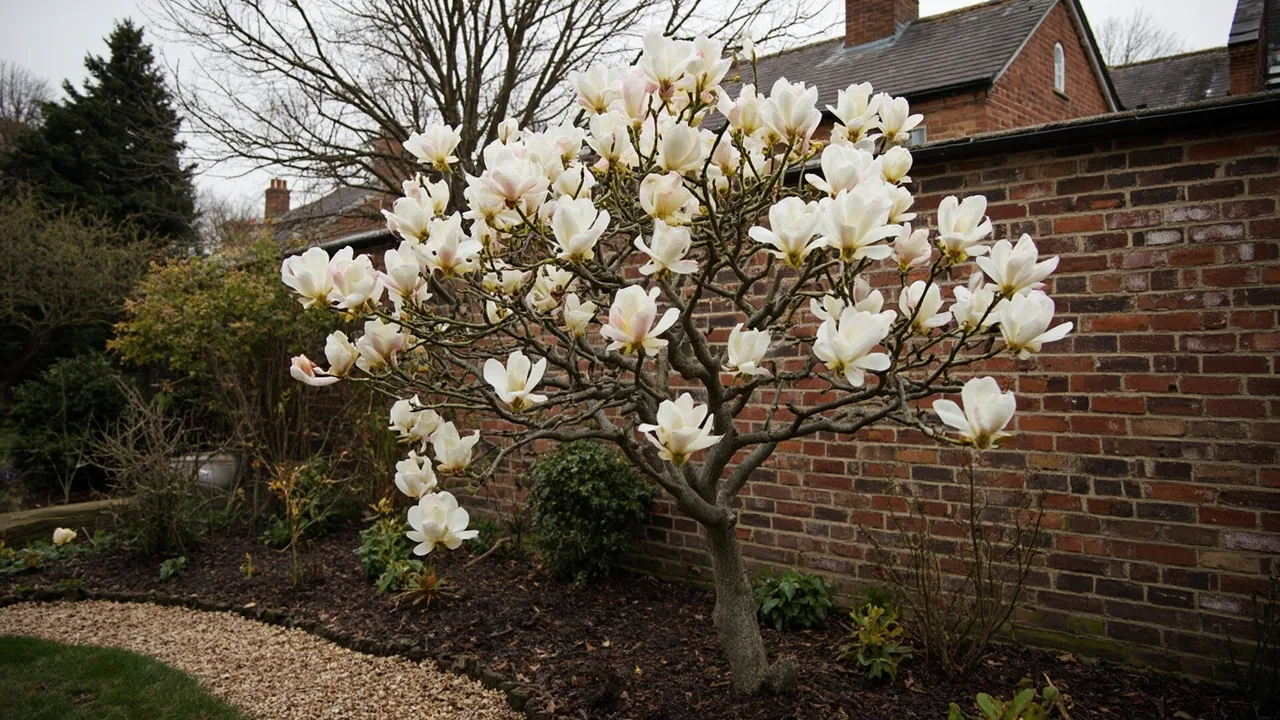
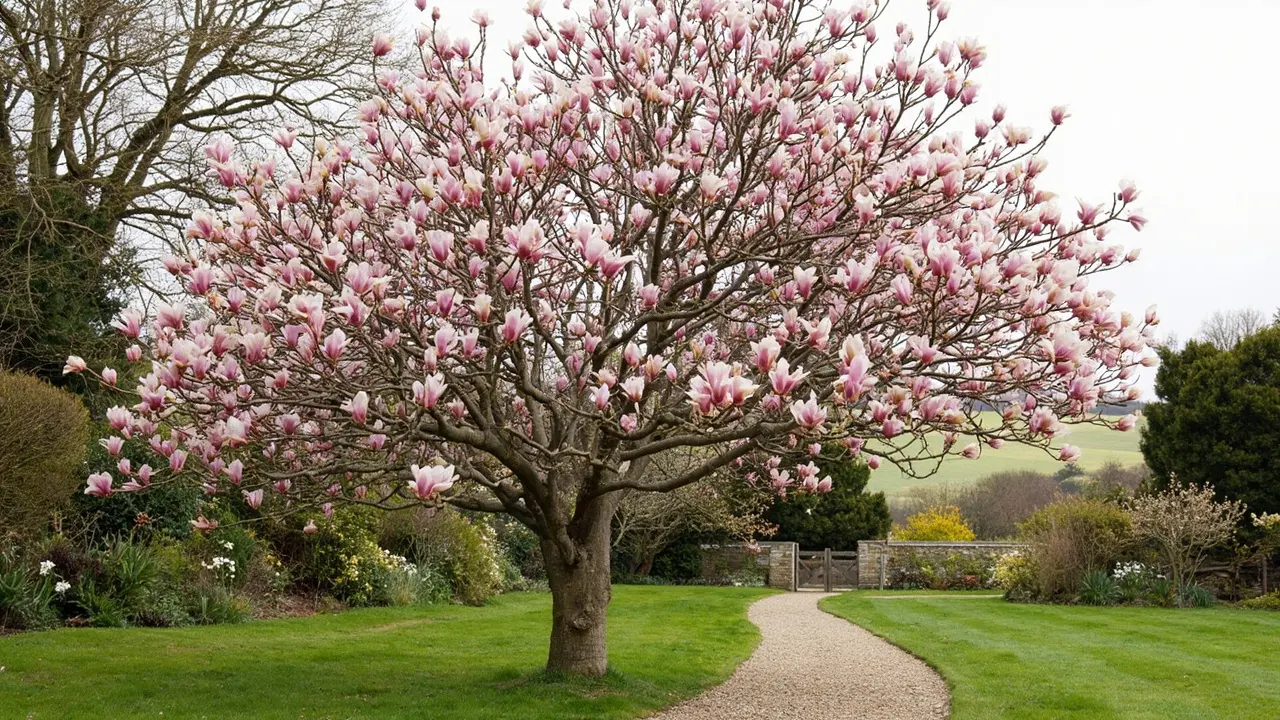
Flowers appear on bare branches, usually from late February into April in southern Britain. Each starts as a tall goblet and then opens into a broad, waterlily-like bloom, often 25-30cm across. Colour varies considerably between trees and selections, from white and pale blush through rose-pink to rich crimson-pink. The exposed flowers are magnificent but vulnerable: one sharp spring frost can brown the tepals overnight.
In my experience, the best viewpoint is far enough away to see the whole tiered crown, with a path or lawn allowing the fallen petals to form part of the display. After flowering, cone-like fruits may develop, eventually revealing red, fleshy-coated seeds, though fruiting is less important ornamentally than the immense early-season blooms.
Growing Conditions
Choose a south- or west-facing position with full sun or light partial shade. Shelter from cold north and east winds is essential, while a site protected from early-morning sun helps frozen buds thaw gradually rather than scorching. A warm wall may help a young tree, but the eventual crown needs open space, so avoid planting where buildings will constrict it later.
The ideal soil is deep, fertile, humus-rich and consistently moist yet well drained. Neutral to acidic loam suits it best. Avoid shallow chalk, strongly alkaline ground and any place that remains waterlogged after heavy rain. On sandy soil, generous organic matter and a broad mulch help retain moisture; on heavy clay, improve the wider planting area rather than creating a small compost-filled sump.
Rainy western counties and sheltered southern gardens generally offer the most reliable flowering. A common mistake is to judge the site only in summer: watch where frost settles and where easterly winds funnel during February and March. Inland and northern gardeners should seek the warmest protected microclimate available and consider a later-flowering selection.
Allow at least 8m of practical clearance from buildings, drains, paths and competing trees. Although the roots are not unusually aggressive, the crown and root system need room, and transplanting an established magnolia is difficult. Keep grass and vigorous ground cover away from the young root zone to reduce competition for water.
Planting and Care
Plant a container-grown or root-balled tree from October to March, avoiding frozen or waterlogged ground. Early autumn works well in mild areas because the soil remains warm; early spring is safer on cold or exposed sites. Magnolia roots are fleshy and brittle, so handle the rootball gently and never tease the roots apart aggressively.
Dig a hole wider than the rootball but no deeper. Set the tree at the same depth it grew in the container, backfill with the excavated soil and firm gently. Do not bury the stem or heap compost against it. Water thoroughly, then apply 5-8cm of leaf mould, composted bark or well-rotted organic matter over the root zone, leaving a clear collar around the trunk.
Stake only if needed, using a low stake and flexible tie, and check the tie twice each growing season. Remove the support once the tree is stable, generally after 2-3 years. Water deeply during dry spells for at least the first five summers; one thorough weekly soak is more useful than frequent surface sprinkling. Refresh the mulch each spring.
Feeding is seldom necessary in fertile loam. On poor or sandy ground, apply a modest slow-release fertiliser suitable for acid-loving plants in spring, following the label rather than doubling the dose. Excess nitrogen encourages soft growth at the expense of flowers.
Pruning should be minimal because magnolias recover slowly from large cuts. Remove dead, damaged or crossing growth and carry out any essential shaping between midsummer and early autumn, when the tree is in leaf. Use clean, sharp tools and avoid cutting into major limbs unless safety requires professional arboricultural work. Propagation is specialist work: softwood or semi-ripe cuttings may be attempted, while seed-raised plants are variable and exceptionally slow to flower.
Common Problems
Spring frost damage is the issue most owners notice. Brown, collapsed petals appearing after a cold night are weather damage, not disease. There is no useful spray: careful siting, wind shelter and selection of a later-flowering form provide the best defence. Do not remove lightly scorched shoots immediately; wait until growth resumes so live wood is easy to identify.
Scale insects, including horse chestnut scale, may form fixed waxy patches on stems and weaken congested growth. Capsid bugs can leave distorted young leaves with small holes. Most gardeners can tolerate light damage, support natural predators and prune out badly affected minor shoots at the correct season. Persistent or severe infestations should be identified accurately before treatment.
Phytophthora root rot is a greater concern in compacted or waterlogged soil. Warning signs include poor growth, sparse foliage, dieback and darkened roots or lower bark. Improve drainage and stop overwatering, but a badly affected tree may not recover. Honey fungus can also cause decline, often accompanied by white fungal sheets beneath bark or autumn mushrooms near the base.
Coral spot may colonise dead or weakened twigs, producing small pink-orange pustules. Grey mould and fungal leaf spots are more likely in damp, stagnant conditions. A useful trick is to remove dead material promptly, keep mulch clear of the trunk and preserve air movement without exposing the whole crown to cold winds. Avoid making unnecessary wounds and disinfect tools after cutting diseased wood.
Popular Varieties
Named forms vary in colour, flowering time and eventual size, but none turns this species into a small-garden tree. Check the current plant description and provenance with a specialist UK nursery, because labels and older group names can be confusing.
- Magnolia campbellii 'Darjeeling' produces very dark pink, cup-and-saucer-shaped flowers and forms a large tree. The RHS records a mature height around 15m, so it needs a genuinely substantial garden.
- Magnolia campbellii Raffillii Group 'Charles Raffill' has mid-pink flowers and vigorous growth. It is offered by specialist UK rhododendron and woodland-garden nurseries and is best reserved for a sheltered, generous site.
- Magnolia campbellii subsp. mollicomata 'Maharaja' is a very large, white-flowered selection. Its blooms can approach 28cm across, but its eventual scale means it is primarily an arboretum or parkland choice.
- Magnolia campbellii 'Lanarth' is an established pink-flowered selection listed by UK specialist nurseries, although stock may be intermittent. Confirm the exact clone when purchasing rather than relying on a generic use of the Lanarth name.
- Alba Group plants bear white flowers, offering a quieter alternative to the familiar deep pink forms. Individual named clones differ, so compare the nursery's mature dimensions and flowering notes before ordering.
Many gardeners should view this as a legacy tree: choose a healthy grafted plant, prepare the site carefully and expect its finest years to belong to the garden's future. Where space or frost exposure makes M. campbellii unrealistic, a smaller, later-flowering magnolia will usually give a more dependable display.
Sources & Further Reading
- RHS: Magnolia campbellii details, accessed 2026-07-23.
- RHS: How to grow magnolias, accessed 2026-07-23.
- RHS: Magnolia campbellii 'Darjeeling', accessed 2026-07-23.
- RHS: Magnolia campbellii subsp. mollicomata 'Maharaja', accessed 2026-07-23.
- Trees and Shrubs Online: Magnolia campbellii, accessed 2026-07-23.
- Bluebell Arboretum: Magnolia nursery listings, accessed 2026-07-23.
Pests and Diseases
| Problem | Symptoms | Management |
|---|---|---|
| Powdery mildew | White, dusty fungal growth appears on leaves and young shoots. | Improve air circulation and apply a systemic fungicide if severe. |
| Slugs and snails | Irregular holes in leaves and silvery slime trails on foliage. | Use iron phosphate pellets or beer traps around the base of the plant. |
| Vine weevil | Notched leaf margins above ground and root damage below. | Apply systemic insecticide drench to soil in early autumn. |
| Bud blast | Flower buds turn brown, shrivel, and fail to open after frost. | Plant in a sheltered location away from late spring frosts. |
| Leaf scorch | Brown, crispy edges on leaves due to wind or drought stress. | Mulch well and water deeply during dry spells. |
For step-by-step help, read Dealing with Slugs and Snails and Treating Powdery Mildew. Or browse the full plant problem solver to diagnose an issue by symptom.
Recommended Products
GardenWizz earns a commission from qualifying purchases made through affiliate links on this page (including links within the article) — as an Amazon Associate, and from Thompson & Morgan via the Awin network. This does not affect the price you pay. See our disclaimer for details.