Fuji cherry
Prunus incisa
The Gardening Year
Best months in UK gardens · full planting calendar →
🖨 Print-friendly care cardAt a Glance
| Botanical name | Prunus incisa |
|---|---|
| Common name(s) | Fuji cherry |
| Family | Rosaceae |
| Plant type | tree (Deciduous) |
| Height × Spread | 4–8 m × 4–8 m |
| Position | Full sun |
| Soil | moist but well-drained, moderately fertile soil; Chalk, Clay, Loam, Sand; Acid or Alkaline or Neutral pH |
| Flowering | March–May |
| Toxicity | Not yet established. Do not assume this plant is safe for people or pets. |
| Native range | Japan |
Overview
Fuji cherry, Prunus incisa, is a deciduous flowering tree from Japan, valued in UK gardens for its delicate early-spring blossom and vivid autumn foliage. The accepted botanical name is Prunus incisa Thunb.; Cerasus incisa is a synonym rather than a separate garden species. It belongs to the rose family, Rosaceae, and occurs naturally in the Kanto and Chubu regions of Honshu. Although established in cultivation here, it is not native to Great Britain or Ireland.
The species forms a spreading shrub or small tree, eventually reaching about 4–8 m in both height and width. That makes it a graceful choice for a lawn, mixed border or open courtyard where its branching outline can be appreciated, but it needs more room than the compact cultivars often sold under the same common name. Check the full botanical label when buying: a named selection such as ‘Kojo-no-mai’ has its own size and habit and should not be used as a guide to the dimensions of the species.
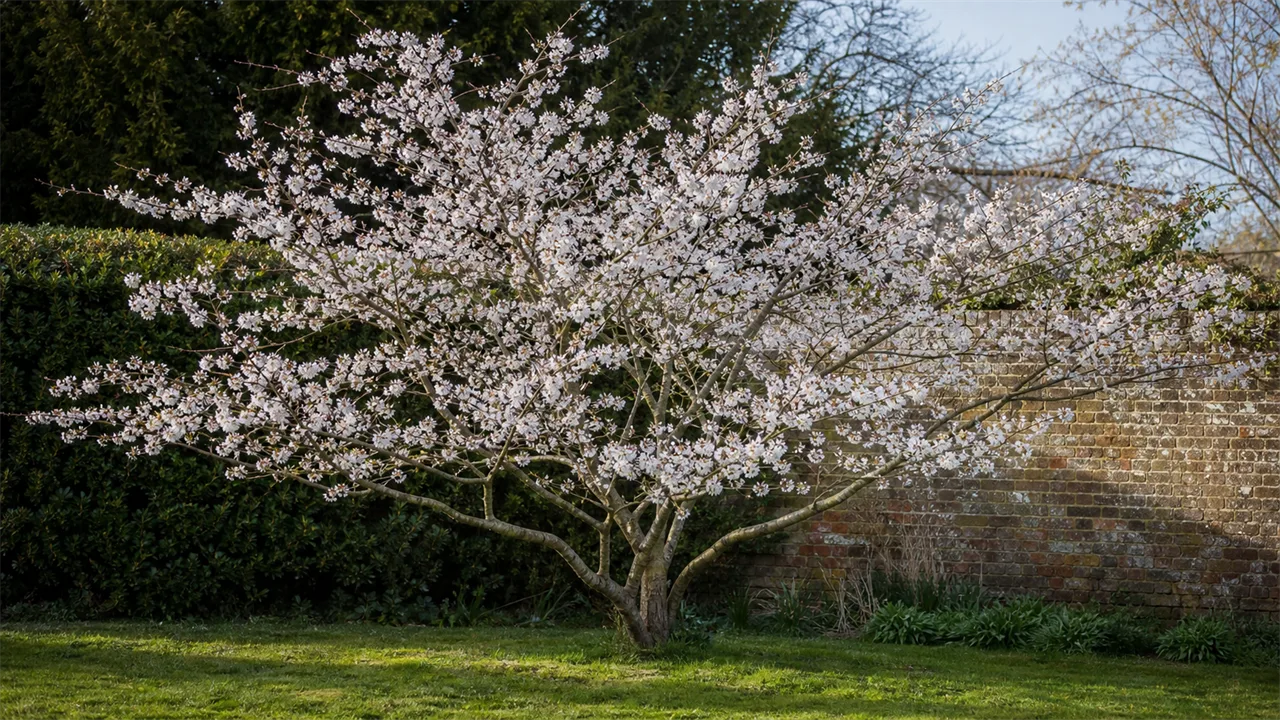
Its main display begins before the leaves emerge, when white or pale-pink flowers open along the branches. Fresh foliage follows, with warm bronze-red tones as the leaves unfold, then settles to dark green. In autumn, orange-red foliage gives the tree another distinct season of interest. Small purple-black, cherry-like fruits may develop after flowering, but the sources used for this guide do not establish whether they are suitable for people or pets to eat. Treat Fuji cherry as an ornamental plant and do not use this article as consumption or safety advice.
Fuji cherry is reliably hardy in Britain. The RHS gives it an H6 rating, corresponding to roughly -20 to -15°C and indicating hardiness throughout the UK and northern Europe. Its combination of hardiness, blossom and autumn colour makes it broadly useful, provided the site offers reasonable drainage and enough space for the mature tree.
Appearance
A mature Fuji cherry has a bushy, spreading outline rather than the strongly upright form of some ornamental cherries. Its naturally open shape allows the fine branches and early blossom to stand out, especially when the tree is viewed against an evergreen hedge, dark wall or open sky. Mature dimensions vary with conditions, but the species should be planned as a 4–8 m plant, not as a permanent patio shrub.
The oval leaves have toothed edges. They emerge bronze-red, become dark green through the growing season, and turn orange-red in autumn. This sequence gives the tree useful colour beyond its relatively brief flowering period. Seasonal timing varies with location and weather, so regard “early spring” as a guide rather than a fixed calendar date.
The saucer-shaped flowers are about 2 cm across and appear before the foliage. Their white to pale-pink colouring creates a light, airy display rather than a dense mass of large double blooms. The flowers are followed occasionally by small purple-black fruits described by the RHS as cherry-like. No inference about their edibility should be made from their appearance or from the plant’s common name.
When identifying the plant, look at the combination of its spreading small-tree habit, fine toothed leaves, blossom before leaf emergence and warm autumn colour. A compact, distinctly contorted specimen may instead be a cultivar, particularly ‘Kojo-no-mai’. Named selections remain Prunus incisa, but their individual characteristics cannot automatically be transferred to the species as a whole.
Growing Conditions
Choose a position in full sun where possible. Fuji cherry tolerates partial shade, but full sun is the preferred condition in the RHS guidance and is the sensible choice when an abundant flower display is the aim. The available evidence does not show that flowering will be equivalent in shade, so avoid promising the same performance in both situations.
The tree accepts a wide range of soil textures: chalk, clay, loam and sand can all be suitable. It also tolerates acid, neutral or alkaline soil. Structure and water movement matter more than matching a narrow pH range. Aim for moderately fertile soil that remains moist yet drains freely, rather than ground that stays waterlogged after rain or dries severely during establishment.
Allow enough room from buildings, paths and neighbouring plants for a potential spread of 4–8 m. This avoids relying on repeated hard pruning to confine a tree planted in too small a space. An exposed or frost-prone garden is not automatically unsuitable because the species is H6 hardy, but good establishment and sensible siting still matter. Avoid a persistent frost pocket or saturated hollow where cold, wet soil may place extra stress on the tree.
Before planting in heavy soil, examine drainage rather than simply adding a rich planting mix to a small hole. On very free-draining ground, prepare to monitor moisture carefully during dry spells while the roots establish. A broad mulch after planting can help conserve soil moisture, but it should sit clear of the trunk flare.
Planting and Care
Plant during the dormant season when the soil is workable and neither frozen nor waterlogged. Container-grown trees can be planted at other times if watering is reliable, but dormant-season planting usually reduces the immediate demand on a newly disturbed root system.
Set the tree without burying the trunk flare, then water it in thoroughly. The aim is to establish the tree in the site’s existing soil conditions, with enough surrounding space for the species’ mature dimensions.
Keep the root zone watered during dry periods while the tree establishes. The aim is evenly moist soil, not continuous saturation. Apply an organic mulch over the soil surface to reduce evaporation and weed competition, leaving a clear gap around the trunk. Renewing that surface mulch is generally more useful than repeatedly disturbing the soil beneath the canopy.
Once established, Fuji cherry should need little routine pruning. Remove dead, damaged or crossing growth and preserve the tree’s natural spreading form. If pruning is necessary, make restrained cuts in summer. This follows the Prunus risk-reduction principle that pruning in late July or August, when conditions are generally drier and the tree is active, lowers the risk from silver leaf and bacterial canker compared with unnecessary winter pruning. The timing comes from wider cherry guidance; it is not an instruction to wait for or harvest Fuji cherry fruit.
Do not prune simply to make the species fit a space chosen for a much smaller cultivar. If compact dimensions are essential, select a suitably sized named form from the outset. Clean, well-maintained tools and limited, purposeful cuts reduce avoidable wounds. Where a branch problem is extensive or the correct cut is uncertain, consult a qualified arborist rather than attempting major surgery.
Common Problems
Aphids and caterpillars may feed on Fuji cherry. Inspect young shoots and leaves periodically, especially if growth looks distorted or foliage is being eaten. A small amount of insect activity does not always require intervention; first assess whether damage is increasing and whether the tree remains otherwise healthy.
Possible diseases listed for the species include peach leaf curl, silver leaf, bacterial canker, blossom wilt and honey fungus. These names cover different causes and require different responses, so avoid diagnosing a tree from a single symptom. General resilience begins with a suitable site, correct planting depth, appropriate watering and avoiding unnecessary pruning wounds.
Bacterial canker can affect Prunus stems and leaves. Warning signs may include areas of sunken, dead bark and small holes in leaves, but those symptoms are not conclusive on their own. The RHS states that no fungicide sprays are available to amateur gardeners for controlling bacterial canker. If symptoms are widespread or the diagnosis is uncertain, seek expert advice rather than applying an unsupported chemical treatment.
Summer pruning is particularly relevant because it reduces risk from both bacterial canker and silver leaf. Remove only what is needed, make clean cuts, and avoid pruning in cool, wet winter conditions. Honey fungus can be a serious root and base problem, while blossom wilt affects flowers and shoots; neither should be assumed without considering the whole pattern of symptoms and the site history.
Prunus species are also classed by Defra as high-risk hosts for Xylella fastidiosa. This is plant-health and sourcing context, not a reason to assume that a Fuji cherry with poor growth has the disease. The RHS notes that UK-grown plants and established healthy plants present a very low risk, and laboratory testing is required for confirmation. Buy from a reputable supplier, retain the plant label, and follow current official reporting advice if a serious regulated pest or disease is suspected.
Popular Varieties
Named Fuji cherry cultivars offer different sizes and forms, but they should be kept distinct from the 4–8 m species. Always check the cultivar name and current nursery description rather than relying on “Fuji cherry” alone.
‘Kojo-no-mai’ is the best-defined selection in the evidence used here. It is a compact deciduous shrub or small tree, typically about 1.5–2.5 m high, with characteristic zig-zag branches. Its early flowers appear before the leaves, and it shares the species’ H6 hardiness. This makes it a more plausible choice than the species for a smaller border, although its eventual spread and site requirements must still be allowed for. Its compact dimensions and contorted form belong specifically to ‘Kojo-no-mai’ and do not describe every Fuji cherry.
The RHS Award of Garden Merit list also includes ‘Fujimae’, ‘Oshidori’ and ‘Pendula’ under Prunus incisa, alongside ‘Kojo-no-mai’. They are useful names to look for when comparing nursery stock, but this guide does not assign them individual flower colours, dimensions or habits because the approved source packet does not substantiate those details. Compare up-to-date, cultivar-specific information before choosing.
For a garden with room for a spreading ornamental tree, the species offers the clearest expression of Fuji cherry’s early blossom, fine foliage and autumn colour. For a tighter space, a documented compact cultivar may be the better fit. In either case, matching the exact plant to the available space is more reliable than trying to control a naturally larger tree through repeated pruning.
Pests and Diseases
| Problem | Symptoms | Management |
|---|---|---|
| Cherry leaf scorch | Leaves turn brown and shrivel, remaining attached to the branches throughout winter. | Improve air circulation by pruning and avoid wetting foliage when watering. |
| Cherry leaf spot | Leaves develop purple or yellow spots, often with white fungal growth underneath, and drop prematurely. | Rake and dispose of fallen leaves in autumn to reduce overwintering spores. |
| Silver leaf fungus | Leaves take on a silvery sheen when held up to the light, often accompanied by dieback. | Prune out and burn affected branches well below the visible symptoms. |
| Powdery mildew | A white, dusty fungal coating appears on young leaves and shoots in spring. | Ensure good air circulation and avoid overhead watering to keep foliage dry. |
| Slugs and snails | Irregular holes chewed into young leaves and seedlings, often with slimy trails. | Use beer traps, copper tape barriers, or iron phosphate-based pellets. |
Or browse the full plant problem solver to diagnose an issue by symptom.