Cappadocian Maple
Acer cappadocicum
The Gardening Year
Best months in UK gardens · full planting calendar →
🖨 Printable care card (PDF)At a Glance
| Botanical name | Acer cappadocicum |
|---|---|
| Common name(s) | Cappadocian maple |
| Family | Sapindaceae |
| Plant type | tree (Deciduous) |
| Height × Spread | 20–30 m × — |
| Position | Full sun, Partial shade |
| Soil | Moist but well-drained; Chalk, Clay, Loam, Sand; Acid, Alkaline, or Neutral pH |
| Flowering | March–May |
| Toxicity | — |
| Native range | Asia, from central Turkey (ancient Cappadocia) east along the Caucasus, the Himalayas, to southwestern China |
Acer cappadocicum Gled., the Cappadocian maple (also called the Caucasian maple), is a broad-crowned deciduous tree from the Caucasus and northern Iran whose truncate-based, five-lobed leaves and reliable butter-yellow autumn colour have earned it a quiet but consistent place in larger UK gardens since its introduction in 1838.
Overview
Acer cappadocicum is a vigorous, broadly columnar to rounded tree that, given space, develops into one of the most handsome of the larger garden maples. Native to the Caucasus — northeastern Turkey, Georgia, Armenia, Azerbaijan and into northern Iran, with related populations extending into the Himalayas — it was introduced to British cultivation in 1838 by the Veitch nursery, and has since been planted in parks, arboreta and larger private gardens across the country. Its tolerance of a wide range of UK soils, including chalk and clay, makes it more forgiving than many of its maple relatives, while its sustained yellow autumn colour gives it a clear ornamental role. The species is unusual among maples for producing abundant basal root sprouts, a habit that gardeners should site for rather than fight.
Appearance
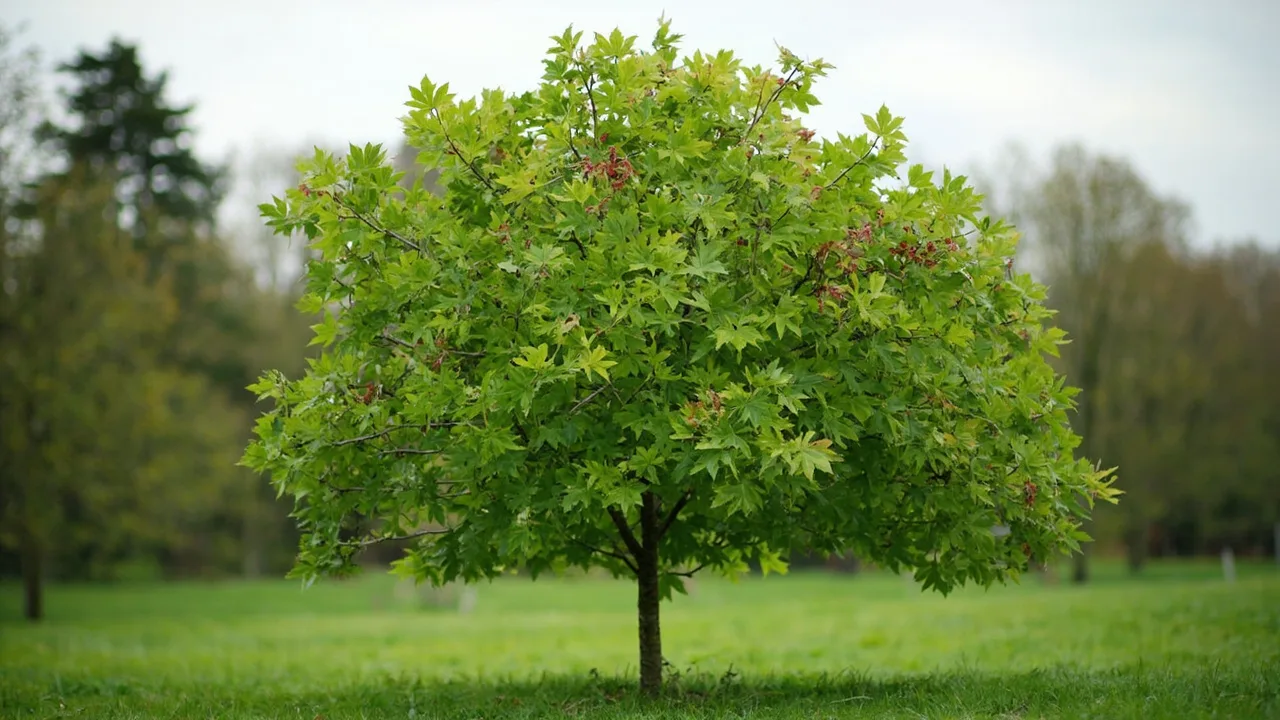
The leaves of Acer cappadocicum are opposite and palmate, typically five-lobed (occasionally seven on vigorous shoots), and 8–15 cm across. The lobes are triangular-ovate, entire or with only a few shallow teeth. The diagnostic field mark is the leaf base, which is characteristically truncate — appearing cut off straight across — to shallowly cordate. This separates the species cleanly from the Norway maple (Acer platanoides), which has a similar leaf shape but bleeds milky sap when cut, and from Acer heldreichii, which has more deeply divided lobes.
Leaf colour varies through the season and is the main ornamental feature. In the type, spring flush is fresh green, summer foliage is mid- to deep green and slightly glossy, and autumn colour is a clear, sustained butter-yellow. Cultivars shift this palette: 'Aureum' opens with reddish young foliage before settling into rich golden-yellow that holds through summer and finishes butter-yellow in autumn; 'Rubrum' flushes plum-red in spring, greens up for summer, and finishes in yellow to orange tones.
The flowers are small, yellow-green, and carried in upright corymbs in May as the leaves emerge. They are not ornamentally showy but are visited by pollinators. The fruits are paired samaras — the familiar "helicopter" seeds — with wings held at an acute to right angle, ripening in late summer.
Bark on young trees is smooth and grey-green, becoming grey and lightly fissured with age. It is not as decorative as that of the paperbark maples (Acer griseum, Acer capillipes) and should not be relied upon as a winter feature.
Growing Conditions
Cappadocian maple is fully hardy across the UK and tolerates a broad range of conditions. It performs best in full sun to light dappled shade, where the autumn colour develops most reliably; in deep shade the canopy becomes thinner and the autumn tint is duller. Soil should be moist but well-drained and ideally humus-rich, although established trees cope with chalk, clay and sandy soils. The species tolerates mildly acid to mildly alkaline pH. Waterlogged sites should be avoided, as prolonged saturation reduces root function and encourages decline.
Shelter from cold, drying east winds in spring reduces the risk of leaf scorch on emerging foliage; otherwise the tree is robust and tolerates exposed positions once established. Even soil moisture is the key — thin, dry ground during hot summers is the most common cause of marginal scorch on this species, rather than any disease.
A mature specimen needs space: allow at least 6–8 m of clearance from buildings, and avoid formal lawn edges, because the species' tendency to throw basal suckers will become a mowing nuisance if trunks are kept clean. The suckering habit, however, can be an asset in larger informal plantings and woodland edges, where it thickens up the canopy naturally.
Planting and Care
Plant bare-root stock between November and March, when dormant, and container-grown trees at any time the soil is workable and not frozen or drought-stressed. Prepare a wide planting pit, loosen the subsoil to break any compaction, and backfill with the native soil improved with well-rotted organic matter. Water in thoroughly and keep well irrigated through the first two growing seasons until the root system is established.
Apply a 5–8 cm organic mulch in early spring, kept clear of the trunk itself to prevent collar rot. On reasonable garden loam, feeding is rarely necessary; on thin or sandy soils a single application of a slow-release balanced fertiliser in spring is sufficient.
Pruning should be minimal. Carry out formative work in late summer to early autumn to remove crossing, damaged or dead wood, and to establish a clear leader on young trees. Avoid heavy winter pruning, which can lead to sap bleeding and weak regrowth. Acers respond best to light, infrequent shaping rather than hard cutting back.
If a clean single trunk is required for lawn or avenue planting, remove basal suckers in early summer by pulling or cutting them flush with the root collar; do not leave stubs, which resprout. Propagation of the species is by seed, which requires cold stratification. Cultivars are grafted onto Acer cappadocicum or Acer platanoides understock in late winter by specialist nurseries.
Common Problems
Tar spot (Rhytisma acerinum) is the most visible seasonal complaint: black, tar-like blotches develop on the leaves in late summer and persist into autumn. It is cosmetic rather than damaging, worse in damp seasons, and best managed by raking up and disposing of fallen leaves at the end of the season.
Verticillium wilt (Verticillium dahliae) can affect acers, including this species. Sudden branch dieback, often on one side of the tree, is the warning sign. There is no chemical cure; affected wood should be removed and destroyed, and susceptible species avoided in replanting the same ground.
Leaf scorch on the margins of leaves during summer is almost always physiological — drought stress, reflected heat from paving or walls, or cold drying winds — rather than disease. Mulching in spring and watering through prolonged dry spells prevents most cases.
Aphids colonise young shoots in late spring, producing honeydew and sometimes secondary sooty mould. Tolerate light infestations to feed natural predators; heavier outbreaks respond to a winter wash the following dormant season or soft soap during the growing period. Scale insects occasionally infest branches and are managed by similar cultural controls.
The species is not known to be toxic to people, pets or livestock.
Popular Varieties
'Aureum' — the Golden Cappadocian maple. Holds the RHS Award of Garden Merit. Young foliage is reddish, maturing to a rich golden-yellow that holds through summer and finishes butter-yellow in autumn. Typically reaches 12 m or more given time. Best in light shade to prevent scorch on the golden leaves.
'Rubrum' — the Red Cappadocian maple. Holds the RHS Award of Garden Merit. Spring growth is plum-red, summer foliage is green, and autumn colour is yellow to orange. A robust and widely planted cultivar, used in civic and parkland planting for its broad crown and reliable performance.
subsp. sinicum — listed by the RHS as a distinct subspecies (sometimes treated as a closely related taxon in its own right). Slightly larger and more vigorous in some sites, with leaves of similar form. Treated here as a subspecies rather than a cultivar, but worth seeking out where space allows.
Sources & Further Reading
- en.wikipedia.org/wiki/Acer_cappadocicum — species overview, native range, root-sprout habit, accessed 2026-07-23.
- rhs.org.uk/plants/95741/acer-cappadocicum-aureum/details — 'Aureum' AGM, mature size and soil tolerances, accessed 2026-07-23.
- rhs.org.uk/plants/89889/acer-cappadocicum-subsp-sinicum/details — RHS genus description and samara detail, accessed 2026-07-23.
- rhsplants.co.uk — 'Rubrum' AGM and hardiness note, accessed 2026-07-23.
- frankpmatthews.com — UK nursery catalogue entries for 'Aureum' and 'Rubrum', accessed 2026-07-23.
- deepdale-trees.co.uk — Acer cappadocicum 'Rubrum' fact sheet (PDF), accessed 2026-07-23.
- paramountplants.co.uk — UK plant pages for the species and 'Rubrum', accessed 2026-07-23.
- vdberk.com — tree profile with toxicity note, accessed 2026-07-23.
Pests and Diseases
| Problem | Symptoms | Management |
|---|---|---|
| Verticillium wilt | Sudden wilting, yellowing, and dieback of branches or entire sections of the canopy. | Avoid planting in infected soil; remove and destroy severely affected trees to prevent spread. |
| Acer gall mite | Small, greenish-pink blister-like galls form on the undersides of leaves. | Usually cosmetic; severe infestations can be treated with horticultural oil in early spring. |
| Honey fungus | General decline, dieback, and white fungal growth at the base of the trunk or on roots. | Ensure well-drained soil; remove infected material and avoid replanting maples in the same spot. |
| Aphids | Clusters of small soft-bodied insects on new growth, causing leaf curling and sticky honeydew. | Encourage natural predators like ladybirds; use insecticidal soap for heavy infestations. |
| Acer leaf scorch | Browning and drying of leaf margins, often following periods of drought or transplant shock. | Water deeply during dry spells and mulch to retain soil moisture; avoid root disturbance. |
For step-by-step help, read Controlling Aphids Naturally. Or browse the full plant problem solver to diagnose an issue by symptom.
Recommended Products
GardenWizz earns a commission from qualifying purchases made through affiliate links on this page (including links within the article) — as an Amazon Associate, and from Thompson & Morgan via the Awin network. This does not affect the price you pay. See our disclaimer for details.