Florence Fennel
Foeniculum vulgare · finocchio
The Gardening Year
Best months in UK gardens · full planting calendar →
🖨 Printable care card (PDF)At a Glance
| Botanical name | Foeniculum vulgare |
|---|---|
| Common name(s) | Florence fennel, finocchio |
| Family | Apiaceae |
| Plant type | perennial (Short-lived perennial; Florence fennel is grown as a tender annual vegetable.) |
| Height × Spread | 0.6–2.1 m × 10–50 cm |
| Position | Full sun, Partial shade |
| Soil | fertile, moist but well-drained soil; improved with organic matter |
| Flowering | May–August |
| Toxicity | Edible and non-toxic. Do not confuse with 'dog fennel', which is unrelated and not edible. |
| Native range | Mediterranean shores |
Overview
Florence fennel (Foeniculum vulgare var. azoricum) is a cultivated variety of common fennel grown as a vegetable for its swollen, bulbous leaf bases. Unlike its closely related herb form, which is harvested for feathery foliage and seed, Florence fennel is cultivated primarily for the crisp, aniseed-flavoured "bulb" that forms above the soil line where the leaf stalks converge. It is widely grown across southern and central Europe, with Italy historically the main centre of production, and it has been adopted by UK gardeners as a summer and autumn crop. The plant is an annual in cultivation, completing its life cycle in a single growing season, though botanically it is a short-lived perennial.
Florence fennel is a member of the Apiaceae family, alongside carrots, parsley, and celery, and it shares their characteristic umbel flowers and aromatic foliage. It is sometimes sold in the UK under the names "sweet fennel", "finocchio" (its Italian name), or simply "fennel bulb". The species is closely related to wild fennel, which has naturalised in parts of southern England, but cultivated Florence fennel has been selectively bred over centuries for enlarged, blanched leaf bases rather than for seed production.
The crop is moderately demanding in UK conditions, requiring steady moisture, fertile soil, and a long enough warm growing period to form a usable bulb before the plant bolts in response to stress or lengthening days. It rewards careful timing more than heavy inputs, and is well suited to the warmer, drier parts of England and to sheltered gardens further north.
Appearance
Florence fennel forms a rosette of upright, hollow, finely grooved stalks that arise from a basal plate just at or slightly below the soil surface. Where these stalks overlap, the lower portions swell and interlock to form the layered, pale "bulb" that is the edible portion. The bulb is composed of overlapping, sheathing leaf bases, not a true bulb in the botanical sense, and is topped by the growing crown of fresh stalks.
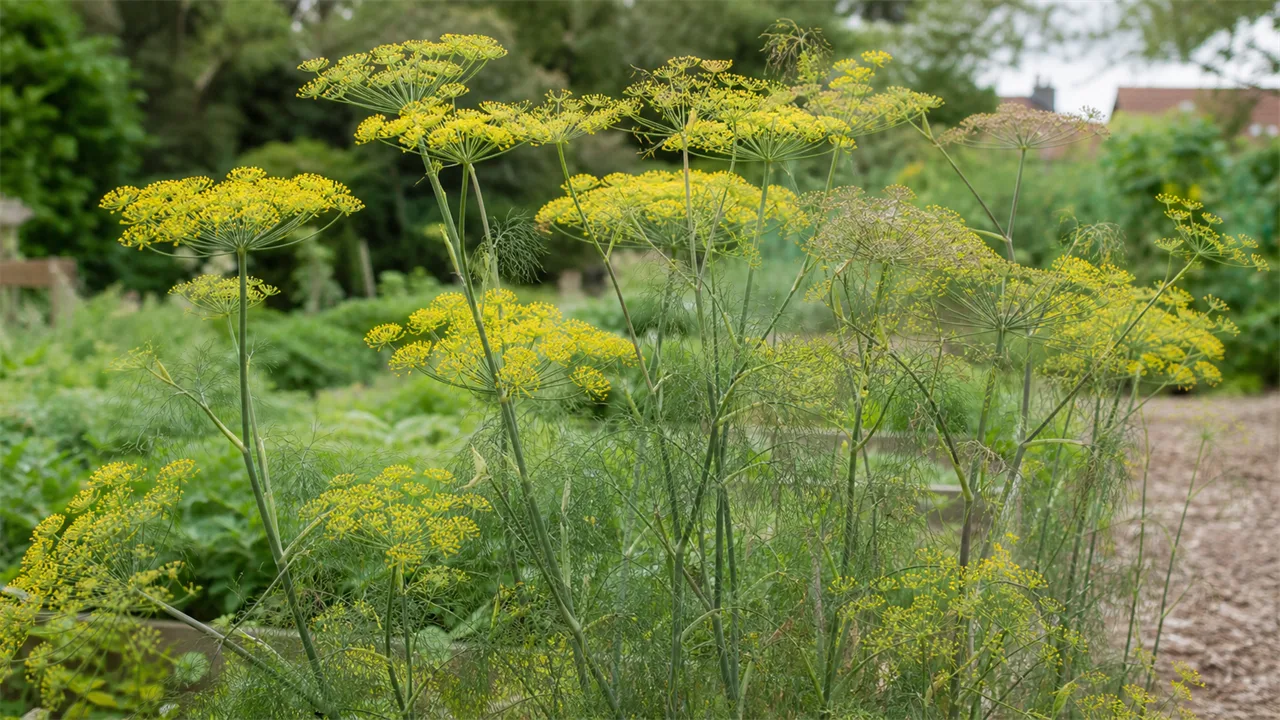
The foliage is the same feathery, thread-like, blue-green to mid-green leaves characteristic of common fennel, with a strong aniseed scent when bruised. Leaves can reach 40–50 cm long on mature plants. As the bulb matures, central stalks elongate and the plant eventually produces the tall, branching flower stems typical of the Apiaceae, topped with flat, compound umbels of small yellow flowers. The flowers are followed by ridged, aromatic seeds.
Bulbs of a well-grown plant are squat and rounded, white to pale green where blanched by soil or a collar, grading to deeper green where exposed to light. Cut in cross section, the bulb shows concentric arcs of tightly packed leaf bases. Flowering, if it occurs before harvest, ruins the texture and edibility of the bulb, which becomes stringy and tough.
Growing Conditions
Florence fennel needs a site in full sun with at least six to eight hours of direct light per day. The soil should be fertile, moisture-retentive yet free-draining, and ideally have a pH between about 6.5 and 7.5. Light, sandy soils dry out too quickly and tend to encourage premature bolting, while heavy clay soils that waterlog in winter can rot the developing bulb. Where the garden soil is poor, working in well-rotted manure or garden compost the autumn before sowing will improve both fertility and water-holding capacity.
Steady moisture is the single most important condition for successful bulb formation. Irregular watering, particularly a dry spell followed by heavy rain, is the most common trigger for bolting. A site with reliable summer rainfall or one that can be watered consistently is therefore preferable. Mulching with organic matter helps conserve soil moisture and keep the root run cool, which also reduces bolting risk.
Temperature matters: Florence fennel grows best at daytime temperatures of roughly 16–24 °C. In the UK, this generally means late spring through early autumn. It will tolerate cooler nights but is damaged by frost, so sowing and transplanting should be timed to avoid late frosts. The long-day response that causes bolting in mid-summer is partly temperature-driven and partly photoperiod-driven, which is why early and late sowings tend to be more successful than main-season sowings in the south of England.
Good air circulation helps reduce fungal disease, but very exposed sites increase the bolting risk. A sheltered but open position is ideal.
Planting and Care
Sowing. Florence fennel dislikes root disturbance, so direct sowing into a prepared seedbed is generally preferred. Sow from late April to early August in the south, and from late May to mid-July in cooler northern areas, in short successional batches two to three weeks apart to spread the harvest. Sow seed 1–2 cm deep in drills 30–45 cm apart, and thin seedlings to a final spacing of 20–30 cm once they have a few true leaves. Early sowings benefit from cloche or fleece protection until warmth returns.
Watering. Water consistently throughout the growing period, aiming to keep the soil evenly moist. A thorough soak once or twice a week is more effective than daily light sprinkling. Drought stress at any stage, but particularly as the bulb begins to swell, is the leading cause of premature flowering.
Feeding. A single application of a balanced general fertiliser at sowing, followed by a liquid feed such as a seaweed or comfrey solution every two to three weeks once bulbing begins, supports steady growth. Excessive nitrogen can produce lush leaves at the expense of the bulb, so feed moderately.
Pruning and blanching. The growing bulb can be blanched — that is, kept pale and tender — by drawing dry soil or a thick mulch up around the shoulders two to three weeks before harvest. Some gardeners also place a cardboard collar or an upturned pot with the base cut off over the bulb, excluding light from the sides. The feathery foliage does not require pruning, but removing any flower stems that appear as soon as they are spotted helps divert energy back to the bulb.
Propagation. Florence fennel is propagated exclusively from seed. Plants left to flower will set viable seed in UK summers, but in practice the crop is sown afresh each year. Because fennel cross-pollinates readily with common and wild fennel, seed saved from a Florence fennel plant grown near other fennels is unlikely to come true.
Seasonal care. Spring sowings crop in mid to late summer; later sowings crop from late summer into autumn. In mild regions of the UK, a late July sowing can be harvested in October or even November if protected with fleece. The crop is generally cleared before the first hard frosts, as mature plants will not survive prolonged cold. Cut the bulb at the base with a sharp knife; the stump can sometimes regrow a smaller, secondary bulb.
Common Problems
Bolting (premature flowering). The most frequent problem in UK cultivation. Causes include drought stress, root disturbance at transplanting, cold snaps after germination, and the long-day response of mid-summer. Choose bolt-resistant cultivars, sow at the right time, water consistently, and direct-sow where possible.
Aphids. Aphid colonies can build up on the umbels and tender shoots, particularly in dry weather. A strong jet of water or insecticidal soap is usually sufficient; encourage hoverflies and ladybirds as natural predators.
Slugs and snails. Young seedlings are vulnerable. Standard cultural controls (night-time collection, beer traps, ferric phosphate pellets) are effective.
Fungal leaf spots and downy mildew. Wet, humid conditions can favour Cercospora and downy mildew on foliage. Avoid overhead watering, space plants well, and clear crop debris at the end of the season. The bulb itself is rarely affected.
Root and bulb rot. Caused by Sclerotinia, Pythium, or waterlogging in heavy soils. Improve drainage, rotate crops, and avoid planting fennel after other Apiaceae such as carrots, parsnips, or celery.
Allelopathy. Fennel produces compounds that inhibit the growth of some neighbouring plants, particularly beans, tomatoes, and kohlrabi. Site fennel away from these crops, or grow it on its own.
Toxicity note. The bulbs, foliage, and seeds of Florence fennel are edible and widely consumed. There is no widely reported toxicity hazard to humans, but pets that ingest large quantities of any Apiaceae may experience mild gastric upset. Pregnant women are sometimes advised to avoid medicinal quantities of fennel seed, but culinary amounts in cooking are generally regarded as safe.
Popular Varieties
Several cultivars are reliably available in the UK through seed suppliers such as RHS Plant Finder listings, Suttons, Mr Fothergill's, and Marshalls. The following are well established.
'Romanesco' — an Italian-bred selection forming large, rounded bulbs with good flavour. Widely sold and regarded as a reliable maincrop in southern England.
'Zefa Fino' — a Swiss-bred, fast-maturing variety with some resistance to bolting. Often recommended for UK conditions and for succession sowings.
'Rondo' — an early F1 hybrid with a smooth, white bulb and good tolerance of variable weather. Frequently offered by larger UK seed merchants.
'Mantovano' — a traditional Italian landrace producing well-flavoured, slightly flatter bulbs. Available from specialist Italian vegetable seed suppliers shipping to the UK.
'Sweet Florence' — a long-established open-pollinated strain, common in older catalogues and still listed by several UK seed firms; a safe choice where F1 hybrids are not preferred.
Where a supplier lists a different named strain, treat its claims (bolting resistance, bulb size, days to maturity) as approximate unless verified against a horticultural authority such as the Royal Horticultural Society or a recognised seed trial.
Cultivars and Varieties
| Cultivar | Height | Flower | Notes | AGM |
|---|---|---|---|---|
| 'Bronze-leaved fennel (Foeniculum vulgare 'Purpureum' or 'Nig' | — | — | Decorative garden plant with bronze-colored leaves | |
| 'Florence fennel (Foeniculum vulgare Azoricum Group)' | 60 cm | — | Inflated leaf bases forming a bulb-like structure; mild anise-like flavor, sweeter and more aromatic than wild type |
Pests and Diseases
| Problem | Symptoms | Management |
|---|---|---|
| Invasive species and weed | Can drastically alter the composition and structure of many plant communities by outcompeting native species for light, nutrients, and water | — |
Or browse the full plant problem solver to diagnose an issue by symptom.
Companion planting
✘ Keep apart from: carrot, potato, tomato.
Full companion planting chart →
Florence Fennel in our guides
- How to Grow Dahlias: Tubers, Care and Cutting
- Creating a Herb Garden
- Gravel Gardens Explained
- Scale Insects: How to Spot and Control Them
- Whitefly: How to Control This Greenhouse and Garden Pest
Recommended Products
GardenWizz earns a commission from qualifying purchases made through affiliate links on this page (including links within the article) — as an Amazon Associate, and from Thompson & Morgan via the Awin network. This does not affect the price you pay. See our disclaimer for details.