Garden Parsley
Petroselinum crispum
The Gardening Year
Best months in UK gardens · full planting calendar →
🖨 Printable care card (PDF)At a Glance
| Botanical name | Petroselinum crispum |
|---|---|
| Common name(s) | garden parsley |
| Family | Apiaceae |
| Plant type | annual (Normally grown as an annual; biennial in temperate climates, annual in subtropical and tropical areas. Dies after seed maturation.) |
| Height × Spread | 10–50 cm × 10–50 cm |
| Position | Full sun, Partial shade |
| Soil | Fertile, moist but well-drained soil. pH Acid, Alkaline, Neutral. |
| Flowering | April–September |
| Toxicity | No specific toxicity is listed by the RHS. This is not a guarantee of safety — check with a vet or the ASPCA before pets or children eat any plant. |
| Native range | Greece, the Balkans, Algeria and Morocco |
Garden parsley is a biennial herb from the family Apiaceae, cultivated across the UK for its aromatic leaves, which are used fresh or dried in cooking. Native to the central and eastern Mediterranean, it has been grown in British kitchen gardens since at least the medieval period and remains one of the most familiar garnishes and pot herbs in the country. It is grown for its flavour, its high vitamin content, and its role as a host plant for the caterpillars of the swallowtail butterfly.
Overview
Petroselinum crispum is a hardy biennial, completing its life cycle in two seasons. In the first year it produces a dense rosette of divided, often curly or flat leaves. In the second year it sends up a tall flowering stem, sets seed, and then dies. Although it is technically biennial, most UK gardeners treat it as an annual, replacing plants each spring or autumn to keep a continuous supply of fresh leaves. The plant is closely related to cow parsley, celery, and carrots, and shares their tendency to attract beneficial insects when allowed to flower.
Parsley tolerates the cool, damp British climate well. It grows readily in most soils, prefers a position in sun or light shade, and is suitable for beds, borders, window boxes, and containers. It is widely available as seed from UK suppliers, and young plants are sold at garden centres from spring onwards. In mild regions it can survive winter outdoors, providing fresh leaves through the colder months, although growth slows sharply once temperatures drop below freezing.
Appearance
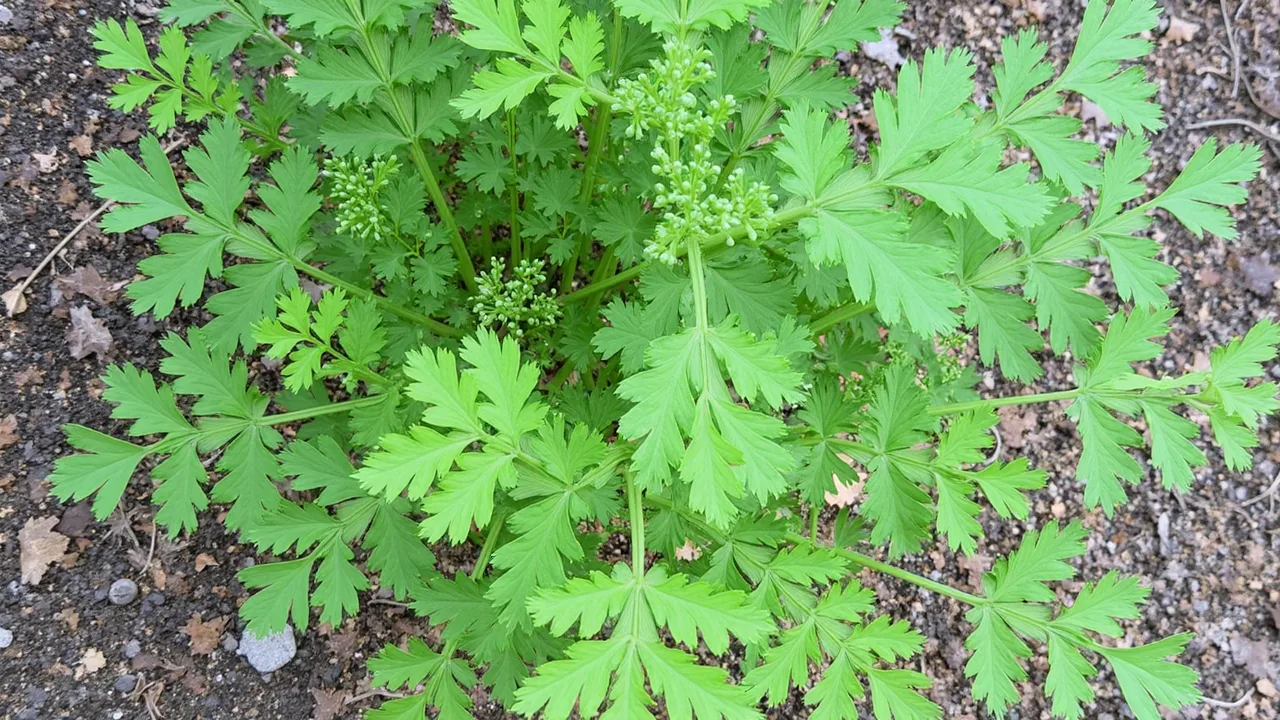
The first-year plant forms a low, bushy rosette of bright to mid-green leaves on slender, ribbed stalks. Leaves are pinnately divided, with three main lobes, each further subdivided into toothed or crinkled segments. The two main leaf forms are curly-leaved parsley, with tightly ruffled, decorative foliage, and flat-leaved or Italian parsley, with broader, smoother, more strongly flavoured leaves. A third type, sometimes sold as Hamburg or turnip-rooted parsley, is grown for its thick, parsnip-like tap root rather than its leaves.
The flower stem appears in the second year, reaching 60-100 cm tall, with a branching, slightly angular structure. Small yellow-green flowers are carried in flat-topped umbels typical of the carrot family, opening from June to August in the UK. These are followed by small, oval, grey-brown seeds with a characteristic parsley scent. Roots are pale, slender, and tapering, often with a faintly sweet, earthy flavour.
Growing Conditions
Parsley grows well throughout the UK and suits most garden situations. Soil should be reasonably fertile, moisture-retentive but free-draining, and ideally slightly acidic to neutral, around pH 6.0-7.0. Before sowing or planting, dig in well-rotted garden compost or manure to improve structure, especially on sandy or heavy clay soils. A sunny or lightly shaded spot suits it best; in deeper shade the plants become leggy and the flavour of the leaves is reduced.
RHS hardiness ratings for parsley vary by source. The species Petroselinum crispum is generally treated as hardy to around H5 (hardy in most of the UK, tolerating -10 °C to -15 °C in a sheltered site), with some growers reporting survival in colder conditions. Because ratings differ between references, gardeners in exposed northern or upland sites should be prepared to offer some winter protection, such as cloches or a cold frame.
Sowing season in the UK runs from late February under cover through to July for outdoor crops. Germination is slow, typically taking three to six weeks, so patience is needed. Soaking the seed overnight in warm water before sowing speeds germination. Sow thinly in drills 1 cm deep, with rows 25-30 cm apart, and thin seedlings to 20-25 cm once they are large enough to handle. Keep the seedbed moist until germination occurs.
Planting and Care
Watering is the most important part of parsley care. The plants dislike drying out, and water stress causes leaves to turn yellow, become bitter, and bolt prematurely. Water deeply once or twice a week in dry weather, and mulch lightly with compost or leaf mould to conserve moisture. Container-grown parsley needs daily watering in summer, as pots dry out quickly.
Feeding is modest. A single application of a general-purpose fertiliser in spring, or a top-dressing of garden compost, is usually sufficient for ground-grown plants. Container specimens benefit from a liquid feed such as seaweed extract every two to three weeks through the growing season to replace nutrients washed out by frequent watering.
Pruning is essentially a continuous harvesting process. Pick outer stems regularly, cutting at the base rather than just nipping the tips, to encourage fresh growth from the centre of the plant. Remove any yellowing or damaged leaves promptly. If flower stems appear in the first year — a sign the plant is bolting — cut them out at the base to prolong leaf production, though a plant that has bolted is best replaced.
Propagation is usually by seed, as parsley does not root readily from cuttings. Allow a healthy second-year plant to flower, then collect seed in late summer when the umbels turn brown and dry. Alternatively, let the plant self-seed; parsley will often naturalise in a corner of the garden and produce a fresh flush of seedlings each spring.
Seasonal care in the UK is straightforward. Sow under cover from late winter for early summer harvests, and again outdoors in late spring and early summer for autumn and winter crops. Overwintered plants benefit from a cloche or cold frame in colder districts, and dead leaves should be cleared away in autumn to reduce the risk of fungal disease. In very wet winters, watch for crown rot on poorly drained soils.
Common Problems
Slow or patchy germination is the most common complaint, caused by dry seedbeds, old seed, or cold soil. Always use fresh seed, keep the bed moist, and sow later in spring if the ground is still cold.
Aphids, particularly the willow-carrot aphid, can colonise the flower heads in the second year and sometimes the leaf rosettes. A strong jet of water, or insecticidal soap if infestations are heavy, generally controls them. Encourage hoverflies and ladybirds, which prey on aphids, by leaving a small area of umbelliferous flowers nearby.
Carrot fly (Psila rosae) can affect parsley, causing the foliage to turn reddish and the roots to be tunnelled. The same precautions used for carrots help: sow after the main egg-laying period, use fleece covers, and avoid crushing the foliage when brushing past, as the smell attracts the flies.
Crown rot and root rot may occur on heavy, waterlogged soils, especially in winter. Improve drainage with grit and organic matter, and avoid planting in low-lying spots. Powdery mildew can appear in dry summers on stressed plants; adequate watering and good spacing reduce the risk.
A note on toxicity: parsley leaves, stems, and seeds contain volatile compounds that, in very large quantities, may cause digestive upset in some individuals. The plant is widely used as a culinary herb without issue, and gardeners should follow normal food-handling practice. Specific toxicity claims for pets are not consistently documented in horticultural references and should be checked with a vet if there is concern.
Popular Varieties
'Curled' (also sold as 'Moss Curled') — a traditional British favourite with tightly curled, bright green leaves and a mild flavour. Reliable, hardy, and widely available from UK seed merchants. Suits garnishes and general kitchen use.
'Flat-Leaf' or 'Italian' parsley (Petroselinum crispum var. neapolitanum) — a stronger-flavoured, broad-leaved form preferred for Mediterranean cooking. Stands up better to cooking than curly types and is the standard parsley for tabbouleh, chimichurri, and similar dishes.
'Hamburg Turnip-Rooted' (Petroselinum crispum var. tuberosum) — grown for its swollen, parsnip-like root, which has a sweet, celery-like flavour. The leaves are also usable but coarser than leaf-types. Sow in spring for autumn and winter harvest of the roots.
'Bravour' — a modern, vigorous curly-leaved cultivar with good cold tolerance, often recommended for overwintering in the UK. Stands well into late autumn and produces dark, densely curled leaves.
'Plain-Leaved French' (also 'French' or 'Common') — a flat-leaved, hardy form widely grown in UK kitchen gardens, with the deep flavour associated with continental parsley.
Cultivars and Varieties
| Cultivar | Height | Flower | Notes | AGM |
|---|---|---|---|---|
| 'French (curly leaf) parsley' | — | — | preferred by some gardeners as it is easier to cultivate, being more tolerant of both rain and sunshine, and is said to have a stronger flavor—although this is disputed—while curly leaf parsley is preferred by others because of its more decorative appearance in garnishing | |
| 'Hamburg root parsley' | — | — | produces much thicker roots than types cultivated for their leaves. Although seldom used in Britain and the United States, root parsley is common in central and eastern European cuisine, where it is used in soups and stews, or simply eaten raw, as a snack (similar to carrots) | |
| 'Italian (flat leaf) parsley' | — | — | preferred by some gardeners as it is easier to cultivate, being more tolerant of both rain and sunshine, and is said to have a stronger flavor—although this is disputed—while curly leaf parsley is preferred by others because of its more decorative appearance in garnishing |
Pests and Diseases
| Problem | Symptoms | Management |
|---|---|---|
| Carrot fly | Roots become tunnelled with brown or black rotting channels, causing plants to wilt and die. | Use fine mesh netting as a physical barrier from April onwards and avoid planting near carrots. |
| Slugs and snails | Irregular holes chewed in leaves and silvery slime trails visible on foliage and soil. | Apply iron phosphate pellets or use beer traps and copper tape barriers to deter feeding. |
| Aphids | Clusters of small green or black insects on leaf undersides causing distorted, sticky growth. | Squash colonies by hand or spray with a strong jet of water; introduce ladybirds for biological control. |
| Celery leaf miner | White winding tunnels visible within the leaves, leading to yellowing and tissue death. | Remove and destroy heavily infested leaves immediately to break the life cycle. |
| Leaf spot | Small brown or black spots appear on leaves, potentially enlarging and causing foliage to wither. | Improve air circulation, avoid wetting foliage when watering, and remove affected leaves. |
For step-by-step help, read Controlling Aphids Naturally, Dealing with Slugs and Snails and Tackling Black Spot on Roses. Or browse the full plant problem solver to diagnose an issue by symptom.
Garden Parsley in our guides
- How to Create a Windowsill Herb Garden
- Creating a Herb Garden
- Carrot Fly: How to Protect Your Carrot Crop
Recommended Products
GardenWizz earns a commission from qualifying purchases made through affiliate links on this page (including links within the article) — as an Amazon Associate, and from Thompson & Morgan via the Awin network. This does not affect the price you pay. See our disclaimer for details.