Carrot
Daucus carota subsp. sativus · cultivated carrot
The Gardening Year
Best months in UK gardens · full planting calendar →
🖨 Printable care card (PDF)At a Glance
| Botanical name | Daucus carota subsp. sativus |
|---|---|
| Common name(s) | carrot, cultivated carrot |
| Family | Apiaceae |
| Plant type | biennial (herbaceous, biennial (although not always)) |
| Height × Spread | 10–50 cm × 10–50 cm |
| Position | Full sun |
| Soil | Chalk, Clay, Loam or Sand; moist but well-drained or well-drained; acid, neutral or alkaline |
| Flowering | May–September |
| Toxicity | Contact with leaves may cause skin irritation. |
| Native range | Temperate regions of the Old World |
Carrot is a biennial root vegetable usually grown as an annual for its swollen, edible taproot. It suits gardens across the UK and can provide harvests from early summer into winter when sowings, varieties and protection are chosen for the season.
Overview
The cultivated carrot belongs to the Apiaceae family, alongside parsnip, celery, parsley and fennel. Its wild relative is native across parts of Europe and western Asia, but centuries of selection produced roots that are larger, less fibrous and available in orange, yellow, white, red and purple forms. Orange carrots predominate in British cultivation, while differently coloured cultivars broaden the range of pigments, flavours and culinary uses.
The familiar root is an enlarged taproot and hypocotyl in which the plant stores energy during its first season. If left to overwinter, a carrot normally uses those reserves to send up branched flowering stems in its second year. For vegetable production, roots are harvested in year one, before they become woody. Premature flowering in the first year, known as bolting, is undesirable because it reduces root quality.
Carrots are particularly useful in UK gardens because succession sowing can spread the crop over many months. Early cultivars may be sown under cloches from February or March where soil is workable, maincrop sowings are commonly made from April to June, and carefully timed later sowings can yield small roots in autumn. Maincrop roots may remain in suitable ground for part of the winter or be lifted and stored. Heavy, stony or shallow soil need not exclude the crop: short, stump-rooted cultivars and containers are practical alternatives.
Appearance
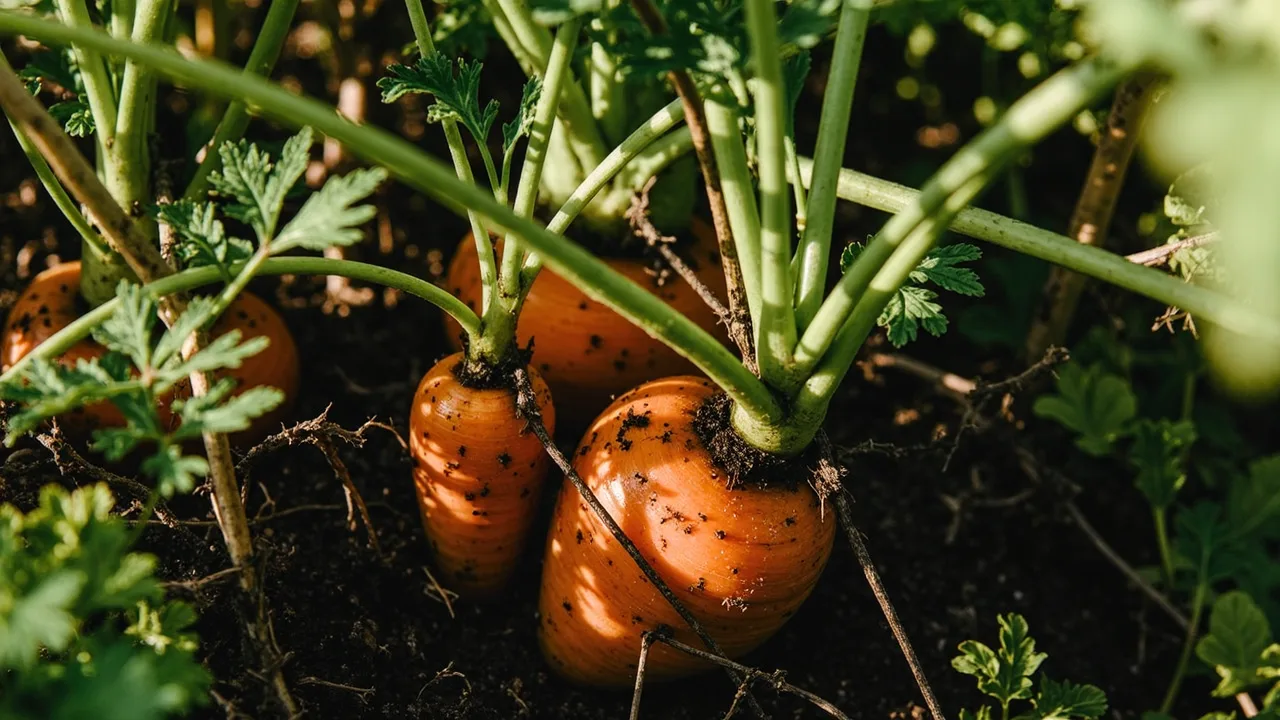
Seedlings first produce two narrow seed leaves, followed by finely divided true leaves. Mature foliage forms a low rosette of feathery, mid- to dark-green leaves. The leaf stalks arise from the root crown, which should remain near soil level. Green shoulders develop when the top of an orange root is exposed to light; a light covering of soil prevents this discolouration.
Root form depends strongly on cultivar and soil. Nantes types are cylindrical with blunt ends, Imperator types tend to be long and tapering, Chantenay types are broad and conical, and Amsterdam forcing types are relatively small and quick to mature. Root skin is usually smooth when growth has been even. Forking, multiple tips, deep cracking or a hairy surface indicate that soil conditions, water supply, nutrition or root disturbance have affected development.
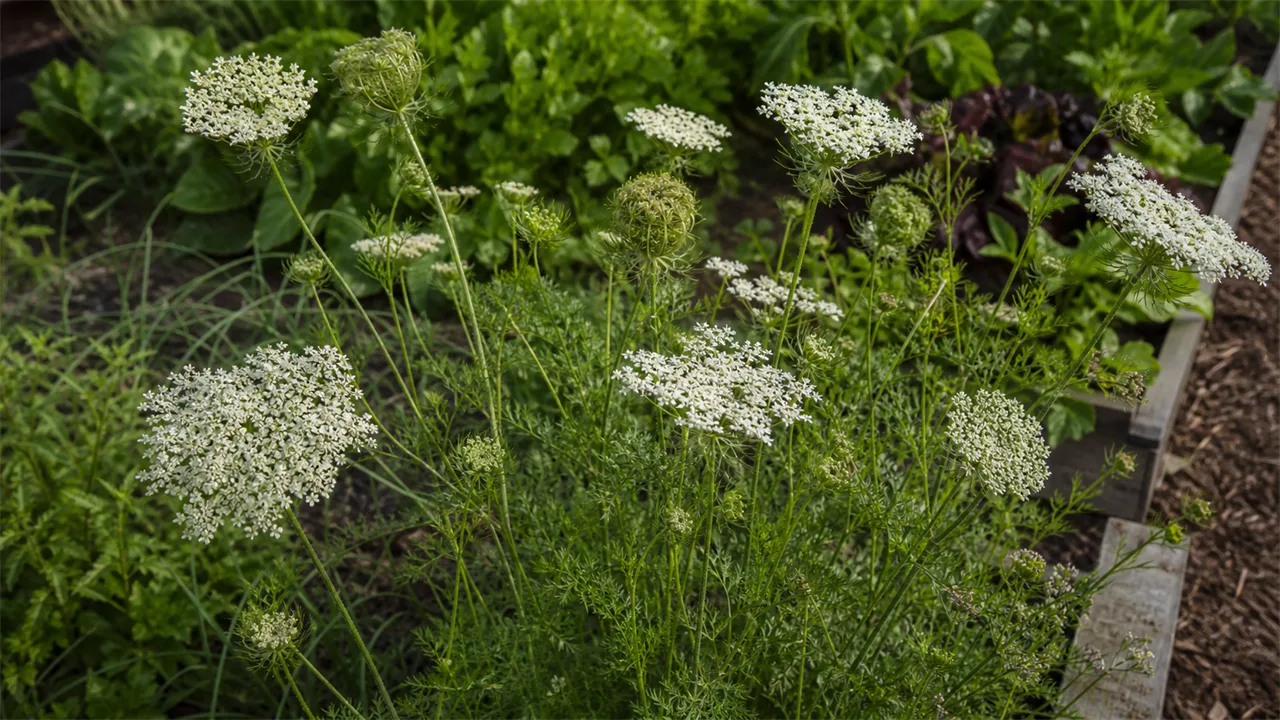
Carrots allowed to complete their life cycle produce tall, ridged, branched stems bearing compound umbels of many tiny white flowers, sometimes with a darker central floret. The umbels are attractive to numerous insects. Once pollinated, they develop dry, bristly seeds. Cultivated carrots cross readily with other flowering carrots and wild carrot, so seed saved in an ordinary garden may not reproduce the parent cultivar reliably.
Growing Conditions
An open position in full sun gives the strongest growth, although carrots tolerate a little shade, especially in hotter, drier gardens. Avoid sites immediately beside dense crops that compete for water. Exposed positions are usable, but fine seedlings dry quickly in spring winds and may need a light fleece covering while they establish.
The ideal soil is deep, loose and free of stones, with good drainage and steady moisture retention. Sandy loam allows roots to extend without obstruction and warms relatively early in spring. On compacted clay, double digging is unnecessary and can damage soil structure; instead, improve the bed over time with well-rotted organic matter applied for a previous crop, and choose shorter carrots. Deep containers or raised beds filled with a suitable peat-free growing medium are effective where garden soil is shallow or contaminated with rubble.
Do not add fresh manure immediately before sowing. Rich, recently manured ground commonly encourages forked or coarse roots and excessive foliage. A fertile soil left by a previous crop is usually sufficient. The crop prefers conditions around neutral to slightly acidic, while strongly acidic or waterlogged ground gives poor growth. Remove large stones and persistent weed roots, then rake the surface to a fine, level tilth without pulverising wet soil.
Moisture is most important during germination and when roots are swelling. Alternating prolonged dryness with heavy watering can split mature roots. Free drainage remains essential because saturated soil restricts growth and promotes rotting. Crop rotation reduces the build-up of soil problems: avoid repeatedly growing carrots and other Apiaceae in the same bed, and control related volunteer plants where practical.
Planting and Care
Propagation is directly from seed because transplanting disturbs the young taproot and usually causes misshapen roots. Make a shallow drill about 1 cm deep, water it if the soil is dry, and sow thinly. Space rows roughly 15–30 cm apart, using the closer spacing for small roots. Cover with fine soil and keep the seedbed evenly moist. Germination can be slow in cool ground, so mark rows clearly and remove weeds carefully before carrot seedlings are hidden by them.
For an early crop, sow a suitable fast-maturing cultivar under cloches from February or March, but wait if soil is cold and saturated. Regular small sowings from March or April to early summer usually give a steadier supply than one large batch. Maincrop carrots are commonly sown from April to June. Follow the seed packet for individual cultivars because sowing windows and time to maturity differ. In containers, use a vessel at least as deep as the expected roots, ensure drainage holes remain open and avoid overcrowding.
Thin seedlings when they are large enough to handle, aiming for about 3–5 cm between plants for ordinary roots and more space for large maincrops. Alternatively, sow sparingly enough to minimise thinning. Work in still, damp weather, firm the soil afterwards and remove thinnings promptly; damaged foliage releases a strong scent associated with carrot fly activity. Do not replant thinned seedlings. Keep the bed weed-free by hand or with very shallow hoeing, taking care not to cut the developing roots.
Water seedlings gently and frequently enough to stop the surface crusting. Established plants are better watered thoroughly at sensible intervals than sprinkled little and often. Once roots begin to size, maintain a reasonably even supply during dry spells. Container crops need closer attention because their compost dries rapidly. Avoid suddenly saturating a dry bed. Mulching between established rows can conserve moisture, but the material should not bury small seedlings or provide shelter for slugs.
Feeding should be restrained. On reasonably fertile soil, extra fertiliser may be unnecessary. If growth is weak, use a balanced or low-nitrogen vegetable feed according to its label; excessive nitrogen encourages lush leaves at the expense of well-shaped roots. Fresh manure and concentrated fertiliser must not contact seed or young roots.
Carrots require no routine pruning. Remove badly damaged foliage only when necessary, without stripping leaves needed to feed the root. Cut out a premature flower stem if the plant is being kept temporarily, although a bolted root is unlikely to regain good eating quality and is normally harvested or removed. Plants reserved for seed are left unpruned so their umbels can develop, but seed saving is most dependable from open-pollinated cultivars isolated from other flowering carrots.
Harvest small carrots as soon as they reach a useful size, often from June onwards after early sowing. Ease the soil with a fork beside long roots rather than pulling hard and snapping them. Maincrop roots are usually lifted from late summer through autumn. In well-drained soil they can be left temporarily and protected with straw or fleece, but heavy soil and areas troubled by slugs are better cleared before winter conditions deteriorate. For storage, lift sound roots in dry weather, twist off foliage near the crown and place them in layers of barely damp sand in a cool, dark, ventilated, frost-protected place. Check regularly and discard decaying roots.
Seasonal care therefore centres on protected early sowing in late winter or early spring, thinning and weeding in spring, steady watering and staged harvesting through summer, and lifting or protecting maincrops in autumn. Clear crop debris after harvest and move the following carrot crop to another part of the rotation.
Common Problems
Carrot fly is the principal pest in many UK gardens. Adult flies lay eggs near carrots, and the cream-coloured larvae tunnel through roots, leaving rusty-brown passages that may lead to secondary decay. Fine insect-proof mesh, supported so there are no gaps, should cover the crop from sowing until harvest. Barriers about 60 cm high can reduce attack because the flies generally remain near the ground, but complete mesh protection is more dependable. Thin carefully, remove damaged roots and avoid leaving foliage or thinnings beside the row. Resistant cultivars reduce damage but do not make protection unnecessary.
Willow-carrot aphid and other aphids may distort foliage and transmit virus disease. Small populations are often checked by natural predators; mesh can also limit access if fitted early. Remove severely stunted plants. Slugs and snails eat seedlings and exposed root shoulders, particularly in damp, weedy beds. Reduce hiding places, use appropriate barriers or controls, and harvest promptly where damage is persistent.
Forked roots result from stones, compacted ground, fresh manure or damage to the taproot. Hairy roots are associated with excessive fertility, irregular moisture or other root stress. Splitting follows abrupt water uptake after drought, while green shoulders are caused by exposure to light. These are physiological disorders rather than infectious diseases and are best prevented through careful site preparation, restrained feeding, even watering and lightly earthing up exposed crowns.
Cavity spot produces small sunken lesions on roots and is favoured by persistently wet conditions and unsuitable soil management. Parsnip canker and other rots may also affect damaged or poorly grown roots. Improve drainage, rotate crops, avoid injuring roots and remove affected material rather than storing it. Powdery mildew can coat older leaves in dry late-summer conditions; maintaining adequate root moisture and air movement usually limits its importance. Bolting is encouraged when young plants experience unsuitable cold conditions, so use cultivars and sowing dates appropriate to the season rather than forcing maincrop seed into very cold soil.
Popular Varieties
- ‘Amsterdam Forcing 3’ – an early, slender-rooted cultivar suited to early sowing under protection and to harvesting young.
- ‘Nantes 2’ – a widely grown, open-pollinated Nantes type producing cylindrical, blunt-ended orange roots for successional sowing.
- ‘Chantenay Red Cored 2’ – a short, broad-rooted cultivar useful on heavier or shallower soils where very long carrots are difficult to grow.
- ‘Autumn King 2’ – a traditional maincrop with long roots, generally selected for autumn harvest and storage.
- ‘Flyaway’ F1 – bred to offer resistance to carrot fly; protection and good hygiene are still advisable because resistance is not immunity.
Choice should reflect soil depth, intended harvest period and whether roots will be eaten young or stored. Seed catalogues sometimes group selections under type names, so the full cultivar name on the packet is the most reliable guide to its stated sowing window, root shape and maturity.
Cultivars and Varieties
| Cultivar | Height | Flower | Notes | AGM |
|---|---|---|---|---|
| 'Adelaide' | — | — | RHS AGM (H3) | ✓ |
| 'Amsterdam Forcing 3' | — | — | RHS AGM (H4) | ✓ |
| 'Artemis' | — | — | RHS AGM (H4) | ✓ |
| 'Bangor' | — | — | RHS AGM (H4) | ✓ |
| 'Deep Purple' | — | — | RHS AGM (H7) | ✓ |
| 'Eskimo' | — | — | RHS AGM (H4) | ✓ |
| 'Extremo' | — | — | RHS AGM (H7) | ✓ |
| 'Flyaway' | — | — | RHS AGM (H3) | ✓ |
| 'Ideal Red' | — | — | RHS AGM (H4) | ✓ |
| 'Maestro' | — | — | RHS AGM (H4) | ✓ |
| 'Marion' | — | — | RHS AGM (H3) | ✓ |
| 'Nairobi' | — | — | RHS AGM (H4) | ✓ |
| 'Romance' | — | — | RHS AGM (H4) | ✓ |
| 'Silvano' | — | — | RHS AGM (H3) | ✓ |
| 'Sugarsnax 54' | — | — | RHS AGM (H4) | ✓ |
| 'Sweet Candle' | — | — | RHS AGM (H4) | ✓ |
| 'Tozresis' | — | — | RHS AGM (H4) | ✓ |
Pests and Diseases
| Problem | Symptoms | Management |
|---|---|---|
| Carrot fly | — | Sow thinly to avoid thinning out which releases scent; handle carefully to avoid bruising. |
| Slugs and snails | — | — |
For step-by-step help, read Dealing with Slugs and Snails. Or browse the full plant problem solver to diagnose an issue by symptom.
Companion planting
✔ Grows well with: bulb onion, Chives, lettuce, Pea, runner bean, sage, tomato.
✘ Keep apart from: dill, Florence fennel.
Full companion planting chart →
Carrot in our guides
- Crop Rotation Explained for UK Vegetable Gardens
- How to Grow Carrots in the UK: A Complete Guide
- Five Reliable Plants to Sow in UK Gardens This June
Recommended Products
GardenWizz earns a commission from qualifying purchases made through affiliate links on this page (including links within the article) — as an Amazon Associate, and from Thompson & Morgan via the Awin network. This does not affect the price you pay. See our disclaimer for details.