Common Teasel
Dipsacus fullonum
The Gardening Year
Best months in UK gardens · full planting calendar →
🖨 Printable care card (PDF)At a Glance
| Botanical name | Dipsacus fullonum |
|---|---|
| Common name(s) | Common Teasel |
| Family | Caprifoliaceae |
| Plant type | biennial (Biennial; forms a rosette in its first year and flowers in its second before dying back. Rarely a short-lived perennial.) |
| Height × Spread | 1–2.5 m × 50–100 cm |
| Position | Full sun, Partial shade |
| Soil | Moderately fertile, moist, well-drained soil |
| Flowering | July–August |
| Toxicity | Not known to be toxic to humans, pets or livestock. |
| Native range | Eurasia and North Africa |
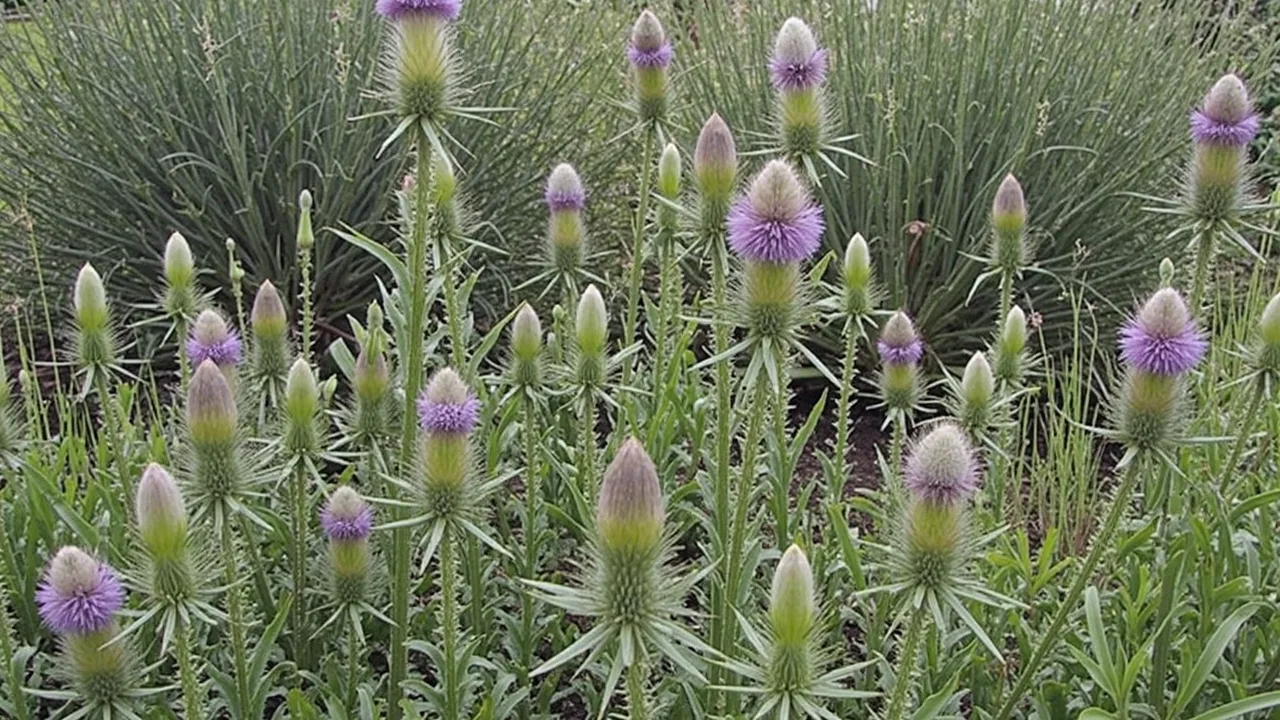
Common teasel is a robust, biennial wildflower native to the British Isles and much of temperate Europe. Once cultivated commercially for raising the nap on woollen cloth, it now grows freely along riverbanks, road verges, waste ground and damp pastures, where its tall flowering stems and sculptural seed heads are a familiar sight from midsummer into winter. Gardeners value it as an architectural perennial for wildlife plantings, wildflower meadows and dried-flower arrangements, although its vigorous self-seeding means it is best planted where its spread can be managed.
Overview
Dipsacus fullonum is a member of the caprifoliaceae family (formerly placed in Dipsacaceae), and is the type species for the genus. It completes its life cycle over two years: in the first it produces a low rosette of wrinkled, spiny leaves; in the second it sends up a stiff, branched stem topped by the characteristic prickly flower heads. After flowering and seed-set the parent plant dies, but a fresh cohort of seedlings usually replaces it.
In the UK, common teasel is fully hardy and is considered native rather than introduced, although it has spread along motorway corridors and disturbed ground well beyond its original range. It is listed as a species of "least concern" by botanical assessments and is not subject to any statutory control. Gardeners wanting wildlife value appreciate its prolific nectar production and its importance to goldfinches, which feed on the seeds through autumn and early winter.
Historically, fuller's teasel was grown as a commercial crop in the West Country, particularly in Somerset and Gloucestershire, where the curved bracts of Dipsacus sativus were used to tease the nap of woven woollen cloth before the adoption of metal cards. The trade persisted in a small way until the mid-twentieth century and is the origin of the English place-name Teaselwell and several "Fullers" field-names still found on ordnance survey maps.
Appearance
The first-year rosette consists of large, lance-shaped leaves up to 30 cm long, with a wrinkled surface, a pale central vein and scattered prickles along the midrib on the underside. Leaves are arranged in opposite pairs and sit flat against the soil.
In the second year the plant bolts, producing one or more stout, ridged stems that branch in the upper half. Stem leaves are narrower than the rosette leaves and clasp the stem with their fused bases, forming small cup-like structures that collect rainwater — a feature that has long attracted biological interest (see "Common Problems" below).
The flower heads are the plant's most distinctive feature. Each head is ovoid, 4–8 cm long, and ringed by a series of long, upward-curving, spine-tipped bracts. The flowers themselves are tiny, four-lobed, and pale lilac to deep purple, opening in a band around the middle of the head over a period of several weeks. Once pollinated, the spent flowers fade to brown and the head dries into a rigid, spiny cone packed with small four-sided seeds (achenes).
Growing Conditions
Common teasel is undemanding once established, but it performs best in conditions that mirror its native riverbank habitat.
Light: Full sun produces the strongest, straightest stems and the most prolific flowering. Light dappled shade is tolerated but leads to leggier growth and fewer flower heads per plant.
Soil: Moist but well-drained loam or clay-loam is ideal. The plant tolerates a wide pH range from mildly acid to mildly alkaline (roughly pH 6.0–8.0) and will grow on heavier clay provided the ground does not waterlog in winter. Very dry, thin soils lead to stunted plants that often fail to flower in their second year.
Moisture: Steady moisture through the growing season is important, particularly during the spring stem-extension phase. Established plants tolerate short periods of drought but prolonged dry spells reduce flower-head size.
Aspect and exposure: Stems are sturdy and rarely need staking in sheltered sites, but on very exposed sites a single cane per main stem is wise, as the seed heads become heavy when wet.
Climate: Hardy across the whole of the UK, including upland and exposed coastal districts. No special winter protection is required.
RHS hardiness rating: The Royal Horticultural Society does not publish a formal hardiness rating for Dipsacus fullonum. In practice it is reliably hardy to at least H6 (–15 °C to –20 °C) in British gardens.
Planting and Care
Sowing seed: The easiest and most reliable method. Seed can be sown direct in autumn (September–October) into a prepared, weed-free seedbed, or in spring (March–April) under cover in modules. Autumn-sown seed germinates the following spring once temperatures rise; spring-sown seed germinates within 2–3 weeks at 15–20 °C. Surface-sow or cover only very lightly, as the seed needs light to germinate. Fresh seed germinates more uniformly than old; if using home-collected seed, sow it the same autumn rather than storing it.
Transplanting: Module-raised seedlings can be planted out once they have formed a small rosette, typically in late spring or early summer of their first year. Space plants 60–80 cm apart; closer spacing leads to competition and slightly smaller flower heads. Handle the young plants by the leaves rather than the stems, as the taproot resents disturbance.
Watering: During establishment water young plants during dry spells to keep the soil evenly moist. Once the deep taproot has developed (usually by the end of the first summer) supplementary watering is rarely needed except in extended drought.
Feeding: Common teasel thrives on poor to moderately fertile soil and does not require routine feeding. On very rich soils plants can become over-tall and may flop. If growth is poor, a single spring application of a balanced general fertiliser at half the manufacturer's recommended rate is sufficient.
Companion planting: Teasel combines well with other robust meadow perennials such as knapweed (Centaurea nigra), musk mallow (Malva moschata), ox-eye daisy (Leucanthemum vulgare) and yellow rattle (Rhinanthus minor). Avoid planting it next to small or slow-growing alpines and rock-garden plants, which will be quickly smothered by its rosette.
Cut flowers and drying: The seed heads are widely used in dried-flower arrangements and last for years indoors if cut when fully mature (September–October) and hung upside down in a dry, airy place. For fresh-cut use, harvest stems just as the first flowers open at the base of the head.
Pruning and deadheading: Cut back the dead flowering stems in late winter (February–March), once seed has been shed and birds have finished feeding. If self-seeding is a concern, deadhead promptly after flowering, before the seed heads fully mature. Wear thick gloves when handling the spiny stems and heads.
Propagation: By seed, as above. Division of the first-year rosette is possible in autumn but is rarely practised, as seed-grown plants establish more reliably. Cuttings are not used.
Seasonal care in the UK: Sow in autumn or spring; transplant seedlings in May–June; expect flowering from July of the second year; cut back in February or March of the third year. Allowing at least one cohort of seedlings to establish each year gives a continuous flowering display from year two onwards.
Common Problems
Self-seeding and spread: The most common "problem" is the plant's enthusiasm for self-seeding. A single teasel can produce several hundred seeds per head, and seed remains viable in the soil for at least two years. In wildflower meadows this is an asset; in mixed borders it can crowd out less vigorous neighbours. Deadhead promptly if containment is required.
Powdery mildew: In dry late summers a white powdery coating can appear on the leaves. It is usually cosmetic and does not affect flowering. Improving air circulation and avoiding overhead watering reduce the risk.
Aphids: Blackfly and other aphids occasionally colonise the flower heads in midsummer. In most cases natural predators (ladybirds, hoverfly larvae) keep numbers in check; a strong jet of water dislodges heavier infestations.
Rabbits and deer: Young rosettes can be grazed by rabbits, and the flower stems are sometimes browsed by deer in rural areas. In known problem gardens, protect first-year plants with a low wire mesh until established.
Water-collecting leaf bases: The fused leaf bases of the stem leaves form small "wells" that collect rainwater. Historically this was thought to drown insect pests; in reality the trapped water supports a community of invertebrates (mosquito and midge larvae, rotifers) that is itself part of the garden food web. There is no need to empty them.
Non-toxic: Dipsacus fullonum is not listed as toxic to humans, pets or livestock. The spines are mechanical rather than chemical hazards, so handling with gloves is sufficient.
Ecological note: The dry seed heads persist well into winter and are an important food source for goldfinches (Carduelis carduelis), linnets and other small finches. Leaving stems uncut until late winter noticeably increases the number of small birds visiting a garden. Hollow dried stems also provide overwintering sites for solitary bees and other cavity-nesting insects.
Popular Varieties
True cultivars of common teasel are few, as the species is most often grown from wild-collected or commercially cleaned seed. The following selections are the most widely available in the UK trade:
- Dipsacus fullonum (species, wild form) — the standard type, with mid-purple flowers on 1.8–2.2 m stems. The form most commonly sold for wildlife and meadow plantings.
- White-flowered form — occasionally listed by specialist perennial nurseries under various names. Flowers are pale greenish-cream rather than purple, and plants are usually slightly shorter (around 1.5 m) than the wild type. Availability varies year to year; check with individual suppliers rather than relying on a fixed cultivar name.
- Dipsacus sativus (fuller's teasel) — closely related and historically cultivated for cloth-finishing; heads have hooked, downward-curving bracts rather than the upward-curving spines of D. fullonum. Sometimes sold alongside the wild form for dried-flower use.
Note: cultivar names are limited in this species and many nurseries list only the type. Gardeners wanting named selections should confirm availability direct with specialist wildflower or herbaceous perennial nurseries in the UK.
🌿 Wild species. Grown as the true native plant, not as named garden cultivars — so there is no cultivar list here by design, not for want of data.
Pests and Diseases
| Problem | Symptoms | Management |
|---|---|---|
| Aphids | Clusters of small green or black insects on new growth causing leaf curling and sticky honeydew. | Squash by hand, blast off with water, or apply a plant-based insecticide if infestations are severe. |
| Slugs and snails | Irregular holes chewed in young leaves and silvery slime trails on foliage and stems. | Use beer traps, copper tape barriers, or iron phosphate-based pellets to protect seedlings. |
| Stem rot | Lower stems become soft, brown, and mushy, causing the plant to collapse in wet conditions. | Ensure well-drained soil and avoid overwatering; remove affected plants to prevent spread. |
| Powdery mildew | White powdery fungal growth on leaves and stems, often in humid or stagnant air conditions. | Improve air circulation and spray with a bicarbonate of soda solution or approved fungicide. |
| Vine weevil | Notched edges on leaves during the day and root damage causing wilting in potted plants. | Apply nematodes to the soil in autumn or use systemic insecticides for severe infestations. |
For step-by-step help, read Controlling Aphids Naturally, Dealing with Slugs and Snails and Treating Powdery Mildew. Or browse the full plant problem solver to diagnose an issue by symptom.
Recommended Products
GardenWizz earns a commission from qualifying purchases made through affiliate links on this page (including links within the article) — as an Amazon Associate, and from Thompson & Morgan via the Awin network. This does not affect the price you pay. See our disclaimer for details.