Dill
Anethum graveolens
The Gardening Year
Best months in UK gardens · full planting calendar →
🖨 Printable care card (PDF)At a Glance
| Botanical name | Anethum graveolens |
|---|---|
| Common name(s) | dill |
| Family | Apiaceae |
| Plant type | annual |
| Height × Spread | 50–150 cm × 10–50 cm |
| Position | Full sun |
| Soil | fertile, moist but well-drained soil |
| Flowering | June–August |
| Toxicity | No specific toxicity is listed by the RHS. This is not a guarantee of safety — check with a vet or the ASPCA before pets or children eat any plant. |
| Native range | North Africa, Iran, Arabian Peninsula |
Dill (Anethum graveolens) is a single-species annual herb of the Apiaceae family, cultivated for its aromatic foliage, seed heads and umbels of yellow flowers. Native to the eastern Mediterranean and western Asia, it has naturalised widely across temperate regions and is grown throughout the United Kingdom in kitchen gardens, allotments and containers. Both the leaves (commonly called "dill weed") and the seeds are used in cookery, and the plant is a useful nectar source for hoverflies, parasitic wasps and other beneficial insects.
Overview
Dill is a fast-growing umbellifer that completes its life cycle in a single season. In the UK it is sown in spring once the soil has warmed, with successional sowings made every three to four weeks through to early summer to maintain a continuous supply of fresh leaves. The plant readily runs to flower in hot, dry weather and in long-day conditions, so timing of sowings is the principal method used to extend the leaf harvest.
Dill is closely related to fennel, caraway and coriander, and will cross-pollinate with other Anethum material; isolated seed crops are therefore difficult to maintain on a small scale. The species is self-sows freely where conditions suit, and volunteer seedlings are common in cultivated ground.
In British gardens dill is generally grown as a culinary herb, but it also has a long history of use in herbal tradition. Its taproot makes it a useful soil-loosener when grown in rotation, and its open umbels are attractive to pollinators and to predatory insects that assist in apid control on neighbouring crops. The plant pairs well with brassicas, cucurbits and tomatoes in intercropping schemes.
Appearance
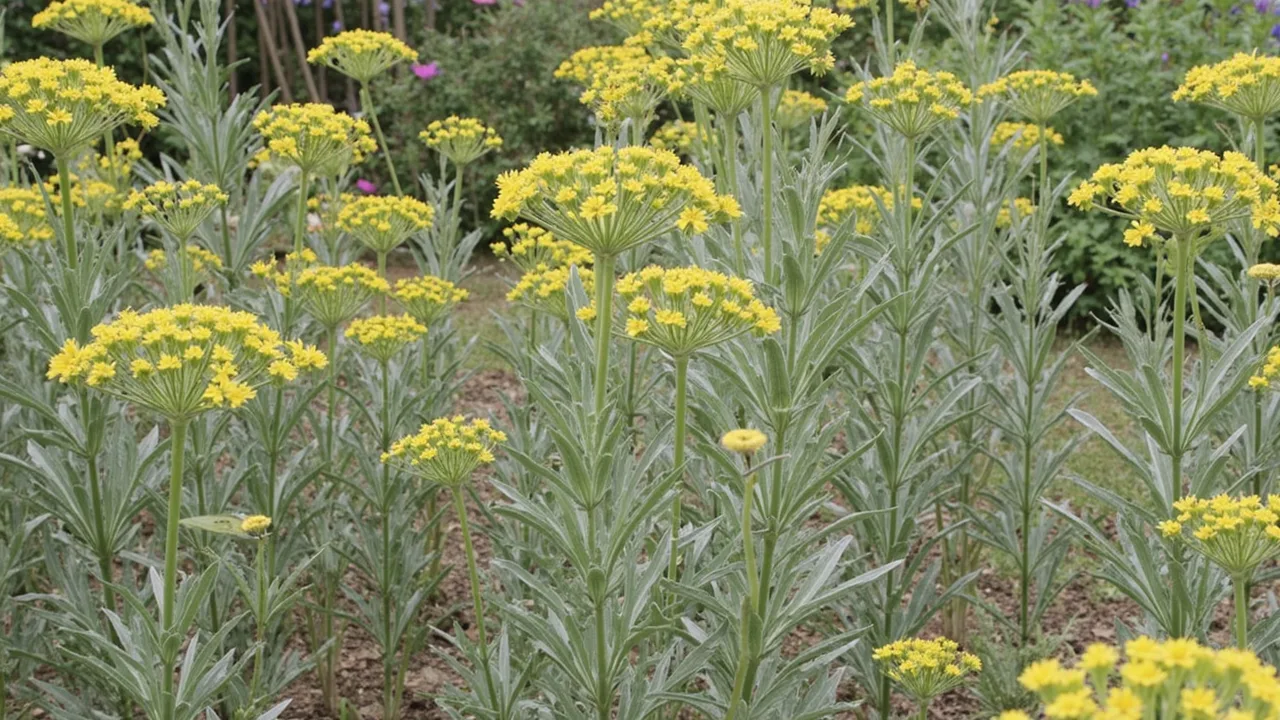
Dill forms a single, hollow, finely ridged stem that emerges from a slender taproot. The stem is glaucous green, often faintly striped, and branches in the upper portion when the plant begins to flower. Left unchecked, the stem reaches 1–1.5 m in height, although garden cultivars bred for leaf production are typically more compact at 45–90 cm.
The leaves are feathery and tripinnate, divided into very fine, thread-like segments of a soft blue-green or grey-green colour. Foliage has a strong, slightly aniseed aroma when bruised. Lower leaves are larger and more openly divided; upper leaves become progressively smaller and sit closer to the stem.
The inflorescence is a compound umbel, 10–15 cm across, composed of numerous smaller umbellets of tiny five-petalled yellow flowers. A single plant may carry several umbels at successive heights. Pollination is largely by insects, and seed sets readily in most UK summers. The seeds (mericarps) are flat, oval, around 4–5 mm long, and ripen from green through tan to a pale brown.
Growing Conditions
Dill grows best in an open, sunny position sheltered from the strongest winds, which can flatten the tall flowering stems. It prefers a fertile, well-drained loam that retains some moisture through the summer, although established plants tolerate short dry periods. Soil pH in the range 6.0–7.0 suits the crop; very acid or waterlogged ground should be improved before sowing.
Sowings are made in situ, as dill resents root disturbance and transplants often bolt prematurely. Choose a bed that has been weeded and raked to a fine tilth. Direct sowing under cloches from mid-April in the south of England, and from late April to early May further north, gives the strongest plants. A second sowing in late May or early June extends the harvest into late summer, and a third in early August can provide a useful late flush of leaves in mild districts before the first frosts.
Hardiness ratings for Anethum graveolens are not consistently published in the RHS Hardiness system: the plant is usually treated as a half-hardy annual that tolerates light frost down to roughly −5 °C but is killed by prolonged freezing. Growers in colder parts of Scotland and exposed northern sites should treat dill as a tender annual and avoid autumn sowings outdoors.
Planting and Care
Sowing and spacing. Sow seed in shallow drills 1–1.5 cm deep, thinning established seedlings to 20–30 cm apart for leaf production and to 30–40 cm apart where large seed heads are wanted. Rows are typically 30–45 cm apart. Germination takes 10–21 days at 12–18 °C.
Watering. Water regularly during dry spells, particularly in the three to four weeks after germination and again as the flower heads are forming. Irregular moisture encourages premature bolting and reduces leaf quality. A straw or compost mulch laid after thinning helps to conserve soil moisture and to keep the lower foliage clean.
Feeding. Dill responds to moderate fertility but is sensitive to excess nitrogen, which produces lush, leafy growth with reduced aroma and a tendency to collapse. Incorporating well-rotted garden compost or manure into the bed before sowing is normally sufficient. A light top-dressing of a general-purpose fertiliser at thinning may be applied on very poor soils, but additional feeding is rarely necessary.
Pruning and harvesting. Regular harvesting of the outer leaves delays flowering and prolongs the productive period. Cut leaves with scissors in the morning, before the heat of the day has released the volatile oils. Whole stems can be cut at the base once a plant is well established; new growth will not regenerate from the cut stem, so succession sowings remain the principal means of keeping a continuous supply.
Propagation. Dill is propagated by seed only. To save seed, leave the strongest plants uncut and allow the umbels to ripen on the plant. Cut the heads when the seeds have turned tan but before they begin to shed, and dry them further on paper indoors. Stored seed remains viable for two to three years in cool, dry conditions.
Seasonal care. In the UK, spring sowings are the mainstay. June sowings are the most useful for late summer leaf production. Plants left to flower in August provide nectar for beneficial insects and seed for the kitchen in September and October. At the end of the season, the stems can be cut and composted, and the bed cleared; volunteer seedlings often appear the following spring where seed has shed.
Common Problems
Dill is generally a trouble-free crop, but a few recurring issues are worth noting.
Bolting. Sudden flowering, particularly in young plants, is the most frequent complaint. It is usually caused by checks to growth: cold soil at sowing, root disturbance at transplanting, drought, or sudden heat. Sow in warm soil, water steadily, and avoid moving seedlings.
Aphids. Greenfly and blackfly colonise the soft growing tips and the flower heads in mid- to late summer. They are rarely damaging in numbers that warrant treatment and are usually held in check by hoverfly and lacewing larvae. A strong jet of water dislodges light infestations.
Powdery mildew. In hot, dry late summers a white bloom can develop on the foliage, particularly on crowded plants. Improve airflow by wider spacing and water at the base of the plant rather than overhead.
Carrot root fly. Dill belongs to the same family as carrot and parsnip, and can act as a host for carrot root fly larvae in the taproot. Where this pest is a known problem, sow dill away from main carrot beds and avoid leaving roots in the ground late into autumn.
Slug damage. Young seedlings are vulnerable to slugs and snails in damp springs. Standard controls (night picking, ferric phosphate pellets, beer traps) are effective.
Toxicity and safety: dill leaves, seeds and seed oil are widely used in food, and the plant is not considered hazardous. As with many Apiaceae, individual sensitivities can occur, particularly with concentrated seed oil; culinary quantities of the fresh or dried herb present no concern. Pet owners occasionally ask about cats and dogs: dill is not listed as toxic to either species by major veterinary references, but it should still be offered only in small amounts as a food plant.
Popular Varieties
Several named cultivars of Anethum graveolens are available from UK seed suppliers. The following are widely listed and correspond to distinct, real selections rather than generic seed packets.
- 'Bouquet' — a traditional, tall-growing selection (around 90–120 cm) with abundant foliage and large seed heads; commonly used for both leaf and seed production, and a frequent choice for cut-flower use of the umbels.
- 'Fernleaf' — a compact, dwarf cultivar reaching about 45 cm, bred for container growing and for a slower bolting habit; leaf production is good relative to plant size.
- 'Mammoth' ('Long Island Mammoth') — a tall, vigorous American-bred selection reaching 1.2–1.5 m, with strong flavour and large seed heads; widely offered in the UK and suited to pickling seed production.
- 'Tetra' ('Tetra Leaf') — a vigorous, leaf-oriented selection with thick, dark green foliage and a slower bolting tendency than taller types; sometimes listed under the name 'Dukat' by European suppliers, although the two are distinct in some catalogues.
- 'Herkules' — a modern, high-yielding Dutch-bred selection with strong, dark green leaves and good resistance to bolting; offered by several UK wholesalers.
A note on toxicity and ornamental relatives: Anethum graveolens is distinct from Anethum spp. sometimes sold as ornamental "dill" substitutes (such as bronze fennel, Foeniculum vulgare 'Purpureum'), and confusion with these should be avoided. The real Anethum graveolens has not been subject to an official RHS Award of Garden Merit at the cultivar level in the most recent published RHS trials available to this writer; the omission is noted here rather than back-filled with an unverified claim.
Pests and Diseases
| Problem | Symptoms | Management |
|---|---|---|
| black swallowtail caterpillars | plants are eaten by black swallowtail caterpillars | — |
| wind damage | — | support with bamboo canes or twiggy sticks |
Or browse the full plant problem solver to diagnose an issue by symptom.
Companion planting
✘ Keep apart from: carrot.
Full companion planting chart →
Dill in our guides
Recommended Products
GardenWizz earns a commission from qualifying purchases made through affiliate links on this page (including links within the article) — as an Amazon Associate, and from Thompson & Morgan via the Awin network. This does not affect the price you pay. See our disclaimer for details.