Coriander
Coriandrum sativum · cilantro
The Gardening Year
Best months in UK gardens · full planting calendar →
🖨 Printable care card (PDF)At a Glance
| Botanical name | Coriandrum sativum |
|---|---|
| Common name(s) | coriander, cilantro |
| Family | Apiaceae |
| Plant type | annual |
| Height × Spread | 50 cm × 10–50 cm |
| Position | Full sun, Partial shade |
| Soil | well-drained |
| Flowering | June–July |
| Toxicity | No specific toxicity is listed by the RHS. This is not a guarantee of safety — check with a vet or the ASPCA before pets or children eat any plant. |
| Native range | Mediterranean Basin |
Coriander (Coriandrum sativum) is a fast-growing annual herb from the Apiaceae family, cultivated in the UK both for its aromatic leaves (commonly called cilantro in North American usage) and for its round seeds, which are used as a spice. Native to regions spanning southern Europe and southwestern Asia, it has naturalised in many temperate areas and grows readily in British gardens, allotments and containers during the warmer months. It is one of the shortest-lived culinary herbs in common UK cultivation, with most plants completing their life cycle from sowing to seed in a single season.
Overview
Coriander is grown in the UK primarily for its sharply flavoured, bright green lower leaves, which are used fresh in salads, salsas, curries and garnishes. The same plant produces clusters of small white or pale pink flowers followed by spherical seeds that are dried and used whole or ground in baking, pickling, stews and spice blends. Both forms of the plant are widely available in British supermarkets, and home cultivation is popular because the cut leaf is highly perishable and loses flavour quickly after harvest.
The species is a true annual and has a strong tendency to "bolt" — running to flower and seed prematurely — under stress, particularly in hot, dry weather or when the root system is disturbed. For UK growers this means successional sowing through the season is more important than for many other culinary herbs. Coriander is not long-lived in the garden, but a well-timed programme of sowings can supply fresh leaves from late spring until the first hard frosts of autumn, and a later sowing can be left to set seed for harvesting and for natural self-seeding the following year.
The plant has a long history of cultivation. Seed has been found in Egyptian tombs, and it is mentioned in early Sanskrit, Greek and Roman texts. It was widely grown in medieval English gardens as both a culinary and medicinal herb.
Appearance
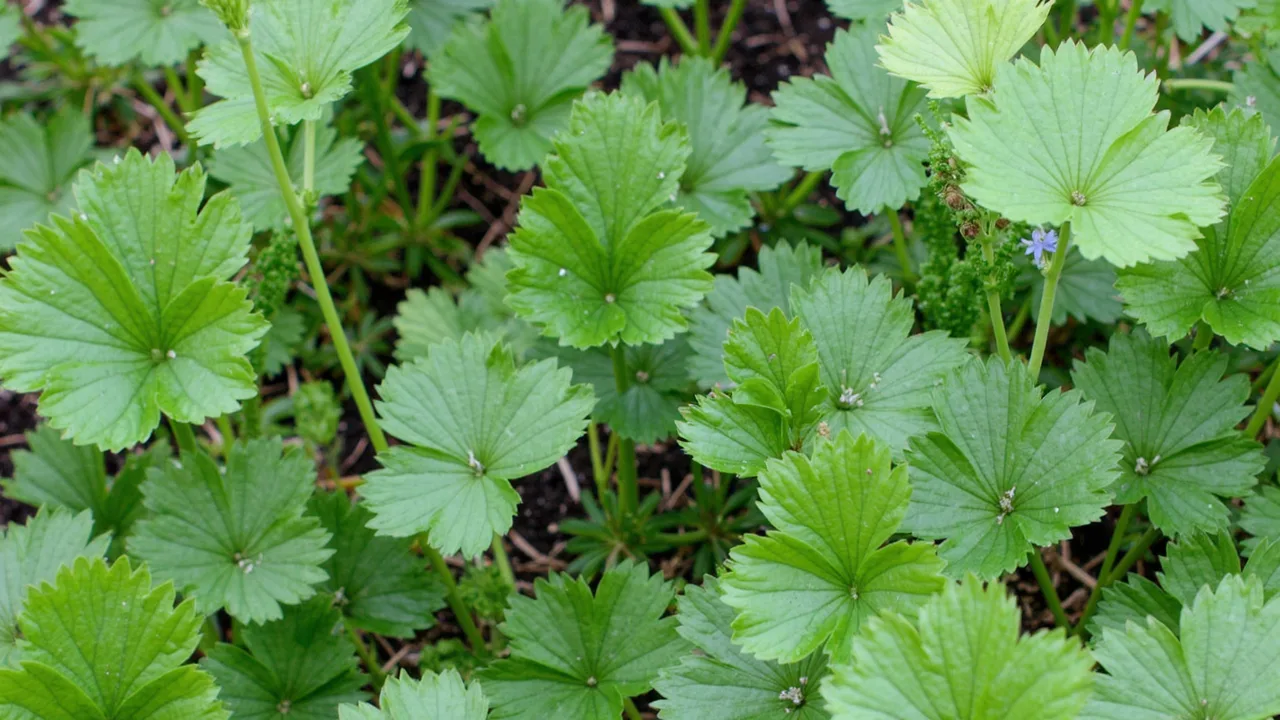
Coriander forms a rosette of long-stalked, broadly lobed lower leaves at the base of the plant, each leaflet being roughly fan-shaped with scalloped or toothed edges. These basal leaves are the form most recognisable from the kitchen and are the "coriander leaf" of cookery. Leaves higher on the stem become progressively more finely divided and feathery, resembling those of flat-leaved parsley or fennel.
The flowering stem is slender, upright and branched, reaching 30–60 cm in height under typical UK conditions. The inflorescence is a compound umbel typical of the Apiaceae family, carrying small white, pink or lilac five-petalled flowers that are attractive to hoverflies, bees and other pollinators. Each flower can set a pair of the round, ribbed, straw-coloured seeds (technically schizocarps) that are the spice coriander.
Mature plants have a distinctive, somewhat divisive aroma caused by aldehyde compounds, particularly (E)-2-decenal and (E)-2-dodecenal. The fresh leaves, unripe seeds and roots carry this aroma most strongly; dried ripe seed has a warmer, citrusy, slightly nutty fragrance that is quite different.
Growing Conditions
Coriander prefers a sunny, sheltered position but will tolerate light dappled shade, particularly in midsummer when strong sun combined with dry soil encourages premature bolting. In southern and central England a site with morning sun and afternoon shade often produces the best leaf quality through July and August; further north a fully open, south-facing spot is usually preferable.
Soil should be reasonably fertile, moisture-retentive yet well drained. Coriander grows well on most garden loams and on improved clay, and it tolerates a pH from roughly 5.5 to 7.5. Soils that dry out rapidly in summer, or that waterlog in winter, both shorten the productive life of the crop. A bed enriched with well-rotted garden compost in the previous autumn or winter is ideal; freshly manured ground tends to produce lush, soft growth that bolts readily.
Coriander is a half-hardy annual. It will survive light frosts down to about −3 °C, particularly as a young plant or as a near-mature plant approaching the end of its life, but a prolonged hard frost will kill it. It is therefore grown as a spring- and summer-sown annual across the UK rather than overwintered outdoors, except in very mild coastal or urban microclimates.
Planting and Care
Sowing. Direct sowing in the final growing position is strongly preferable, as coriander resents root disturbance and transplanted specimens bolt earlier. Sow from late March under cloches or fleece in southern England, from mid-April onwards in the open, and continue successionally every three to four weeks until late August. Autumn sowings made in September in a cold frame or unheated polytunnel can provide leaves through winter in mild areas. Sow seed 1 cm deep in drills 20–30 cm apart, and thin seedlings to 15–20 cm apart once the first true leaves are well developed.
Watering. Consistent moisture is the single most important factor in delaying bolting. Water thoroughly during dry spells, aiming to keep the soil evenly moist rather than alternating between bone-dry and saturated. Mulching with compost or straw helps conserve moisture and keeps the root run cool. Container-grown plants dry out rapidly and usually need watering daily in summer.
Feeding. Coriander is not a heavy feeder. On reasonably fertile garden soil additional fertiliser is rarely necessary, and excessive nitrogen produces soft growth that bolts readily. Plants in poor soil or in containers benefit from a single light application of a balanced liquid feed, such as a seaweed-based or general-purpose feed at half strength, applied once the seedlings are established and again only if growth noticeably slows.
Pruning and harvesting. Leaves can be picked as soon as the plant is well established, normally five to six weeks after sowing. Pick the outer, lower leaves first and leave the central growing point intact so the plant continues to produce new foliage. Cut whole stems just above ground level rather than stripping individual leaflets, and use the cut material quickly, as flavour fades within a few days even when refrigerated. Flower stems should be removed promptly on plants being grown for leaf, unless seed is wanted.
Propagation. Coriander is propagated exclusively from seed. Plants left to flower will self-seed readily in undisturbed ground, and a self-sown seedling crop often appears the following spring, providing some of the earliest usable leaves of the year.
Seasonal care. Main-crop sowings made between April and June provide leaves from June to September, with later sowings extending harvest into November. September sowings under protection can crop through winter. Allowing one late sowing to run to seed in late summer provides both a seed harvest and, in most gardens, a self-sown flush of seedlings the following year.
Common Problems
Bolting. The most frequent complaint. Triggered by hot weather, drought, root disturbance, sudden cold snaps, or day length, it sends the plant into premature flower. It cannot be prevented entirely, but it is reduced by steady moisture, light shade in midsummer, successional sowing, and avoiding transplanting.
Aphids. Greenfly and the related willow-carrot aphid cluster on the flowering stems and on the undersides of leaves in early summer. They rarely kill the plant but taint harvested leaf. Encouraging predators and, if necessary, washing off with a strong jet of water is usually sufficient.
Powdery mildew. A white, dusty fungal coating on the leaves in warm, dry late-summer weather, particularly on plants that are already under stress. Good spacing, watering at the base rather than overhead, and removing affected material limit its spread.
Fungal leaf spot and damping-off. Seedlings raised in cold, wet conditions can collapse from Pythium or Rhizoctonia. Sowing into warm, free-draining compost and avoiding overwatering reduce losses.
Pest damage to seedlings. Young plants are attractive to slugs and snails, particularly in damp spring weather. Standard slug controls (nematode applications, ferric phosphate pellets, or hand-picking) are effective.
Popular Varieties
UK seed catalogues offer a small but well-established set of named varieties, mostly selected for leaf production, slow bolting, or seed yield.
- 'Calypso' — a British-bred, slow-bolting selection widely sold for leaf production; forms a compact, leafy plant that holds well into midsummer.
- 'Leisure' — a Dutch-bred leaf type noted for being slower to bolt than common coriander and producing a generous harvest of well-flavoured foliage.
- 'Confetti' — distinguished by very finely divided, fern-like leaves; grown for its decorative appearance as well as its milder flavour.
- 'Moroccan' — a seed type, taller and later-flowering than the leaf varieties, traditionally cultivated for its larger, more aromatic seed crop.
- 'Vietnamese' (Polygonum odoratum, sometimes sold as "Vietnamese coriander") — botanically unrelated to true coriander and noted here only because it is sometimes confused with it in retail listings. It is a tender perennial and is not a substitute for Coriandrum sativum in cooking.
Pests and Diseases
| Problem | Symptoms | Management |
|---|---|---|
| allergies | similar to other food allergies | — |
Or browse the full plant problem solver to diagnose an issue by symptom.
Recommended Products
GardenWizz earns a commission from qualifying purchases made through affiliate links on this page (including links within the article) — as an Amazon Associate, and from Thompson & Morgan via the Awin network. This does not affect the price you pay. See our disclaimer for details.