Garden Nasturtium
Tropaeolum majus
The Gardening Year
Best months in UK gardens · full planting calendar →
🖨 Printable care card (PDF)At a Glance
| Botanical name | Tropaeolum majus |
|---|---|
| Common name(s) | garden nasturtium |
| Family | Tropaeolaceae |
| Plant type | annual |
| Height × Spread | 1.5–2.5 m × 1.5–2.5 m |
| Position | Full sun, Partial shade |
| Soil | poor to moderately fertile, well-drained |
| Flowering | June–October |
| Toxicity | — |
| Native range | — |
Overview
Garden nasturtium (Tropaeolum majus L.) is a fast-growing, half-hardy annual in the family Tropaeolaceae, native to the Andes of South America and now grown across UK gardens for its bold, long-flowering display and its peppery edible leaves and flowers. The accepted scientific name is Tropaeolum majus L. and the current Royal Horticultural Society species profile and Kew's Plants of the World Online both treat it as an annual climbing or scrambling plant, with the common name "garden nasturtium". It must not be confused with the unrelated watercress-family plants that also use the common name "nasturtium": Nasturtium is a separate botanical genus in Brassicaceae and refers to watercress and its relatives. The plant is grown in the UK for beds, borders, trailing container displays, and as a productive companion in the vegetable garden; for general timing across the growing year, the GardenWizz May calendar and September calendar give sowing and end-of-season reminders.
Appearance
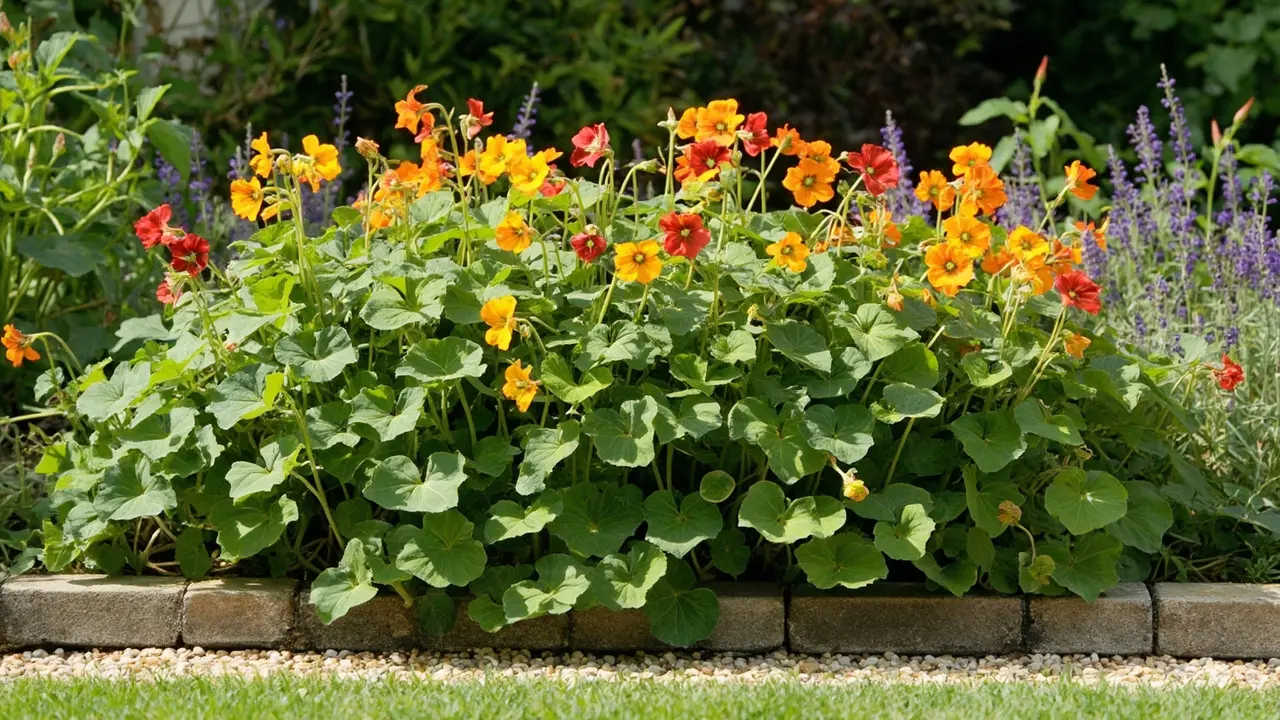
Garden nasturtium is a soft-stemmed, trailing or scrambling annual that uses its long leaf stalks to clamber through taller neighbours or sprawl across bare ground, reaching a broad spread rather than a strict upright height; the species is recorded by the RHS as a climbing or scrambling plant without a specific maximum height or spread. The leaves are almost circular, smooth-edged, and pale to mid-green, with the leaf stalk attached to the underside of the blade in the characteristic peltate fashion of Tropaeolum, and they grow alternately along the stem. Flowers are carried singly in the leaf axils from early summer until the first frosts, with five unequal petals, a long backward-projecting spur, and colours that range from cream and yellow through orange and red to deep mahogany; the orange shades are the most familiar and have given the plant its "nasturtium" associations with flame and embers. Seed is set in clusters of three roughly hemispherical nutlets, and ripe seed falls readily to the soil and self-sows in mild UK gardens.
Growing Conditions
Garden nasturtium grows best in full sun, where it flowers most freely, but it tolerates light partial shade, especially in hotter parts of southern England; deep shade produces leafy growth with very few flowers. The current RHS profile records the plant as an annual, so it completes its life cycle in a single UK season and will not survive a cold winter outdoors. Soil should be poor to moderately fertile and well-drained: this is one of the few ornamentals that genuinely prefers lean ground, because rich soil and high-nitrogen feeds promote lush leaves at the expense of flowers. Moisture should be moderate rather than generous, and the plant resents being overfed; for general watering and feeding guidance, the GardenWizz problems guide covers how to recognise over-fertile growth. For container and small-space use, see the raised bed guide for construction and the plant encyclopaedia entry for marigolds as a comparison sun-loving annual.
Planting and Care
Sow seed directly where it is to flower once the soil has warmed in late spring, or start it indoors in small pots a few weeks earlier to get an earlier display; nasturtium has a delicate root system and resents being transplanted once established, so direct sowing is often the simplest option. In a container, use a free-draining peat-free compost with a modest amount of loam, and place the pot in a warm, sunny spot; one of the more useful companions in a mixed patio display is the tomato plant, which shares the same preference for full sun and free-draining compost. Once plants are growing away strongly, water moderately during dry spells rather than little and often, feed only sparingly if at all, and deadhead spent blooms to keep the display coming into early autumn; if you want a small amount of self-seeding for next year, leave a few of the last flowers to set seed. The plant's natural habit is to sprawl and scramble, so allow it room to run, or let it climb into a low support such as a wigwam of pea sticks; the GardenWizz entry for pea gives a useful comparison for the kind of light support structure that suits climbing annuals.
Common Problems
Black aphids are the single most familiar pest of garden nasturtium in the UK, and the species is widely used as a sacrificial or "trap" plant in the vegetable garden to draw aphids away from broad beans and potatoes; for organic-first treatment options, see the GardenWizz guide to controlling aphids naturally. Slugs and snails can also damage young plants, particularly in damp spring weather and on soft new growth, and the GardenWizz guide to dealing with slugs and snails gives current treatment options. In hot, dry summers, plants in very poor soil may wilt quickly and benefit from an occasional deep soak; in rich, moisture-retentive soil, the same plants may produce excessive leaf at the expense of flower, which is why the GardenWizz common plant problems guide treats feeding and watering levels as a balance rather than a fixed rule. Frost will cut plants down in autumn, at which point they can be cleared to the compost heap, leaving any ripe seed to self-sow for the following year.
Popular Varieties
The species Tropaeolum majus itself is a variable plant, and most UK gardeners grow it from mixed-colour seed packets labelled simply "Tropaeolum majus" or "garden nasturtium" rather than named cultivars; current authoritative evidence at PM coordination level does not record a specific named cultivar list for this species, so any further named forms should be left to specialist seed-catalog evidence rather than invented here. By colour and habit, the familiar forms include trailing types for hanging baskets and walls, compact or "dwarf" types for edging and container use, and the strongly climbing types that will run several metres up a support through the season; in each group the colour range typically covers cream, yellow, orange, scarlet and mahogany, often with darker markings at the throat of the flower. Semi-double and dark-leaved forms exist in seed-catalog listings, but the evidence packet for this case does not record specific named forms, so this section deliberately stops at the broad groups rather than naming particular cultivars. For a comparison sun-loving annual that shares the same warm-season growing window, see the GardenWizz entry for cosmos and the GardenWizz entry for pelargonium, both of which pair well with nasturtium in a mixed border.
Pests and Diseases
| Problem | Symptoms | Management |
|---|---|---|
| Aphids (Blackfly) | Clusters of small black or green insects on stems and buds causing sticky honeydew. | Squash by hand, blast off with water, or use a plant-based insecticide if severe. |
| Whitefly | Tiny white flying insects that swarm when the plant is disturbed. | Use yellow sticky traps and spray with horticultural oil or insecticidal soap. |
| Red spider mite | Fine webbing on leaves and stippled, yellowing foliage in hot, dry conditions. | Keep plants well-watered and spray with a miticide or horticultural oil. |
| Viral infection | Mottled, distorted leaves and stunted growth with no specific cure. | Remove and destroy infected plants immediately to prevent spread via aphids. |
| Slugs and snails | Irregular holes chewed in young leaves and seedlings, often with slime trails. | Use beer traps, copper tape barriers, or iron phosphate-based pellets. |
For step-by-step help, read Controlling Aphids Naturally and Dealing with Slugs and Snails. Or browse the full plant problem solver to diagnose an issue by symptom.
Recommended Products
GardenWizz earns a commission from qualifying purchases made through affiliate links on this page (including links within the article) — as an Amazon Associate, and from Thompson & Morgan via the Awin network. This does not affect the price you pay. See our disclaimer for details.