Giant Herb Robert
Geranium maderense
The Gardening Year
Best months in UK gardens · full planting calendar →
🖨 Printable care card (PDF)At a Glance
| Botanical name | Geranium maderense |
|---|---|
| Common name(s) | Giant herb robert |
| Family | Geraniaceae |
| Plant type | biennial (evergreen biennial or triennial) |
| Height × Spread | 120–150 cm × 120–150 cm |
| Position | Full sun, Partial shade |
| Soil | well-draining but moisture retentive soils, rich in humus |
| Flowering | June–August |
| Toxicity | — |
| Native range | Madeira |
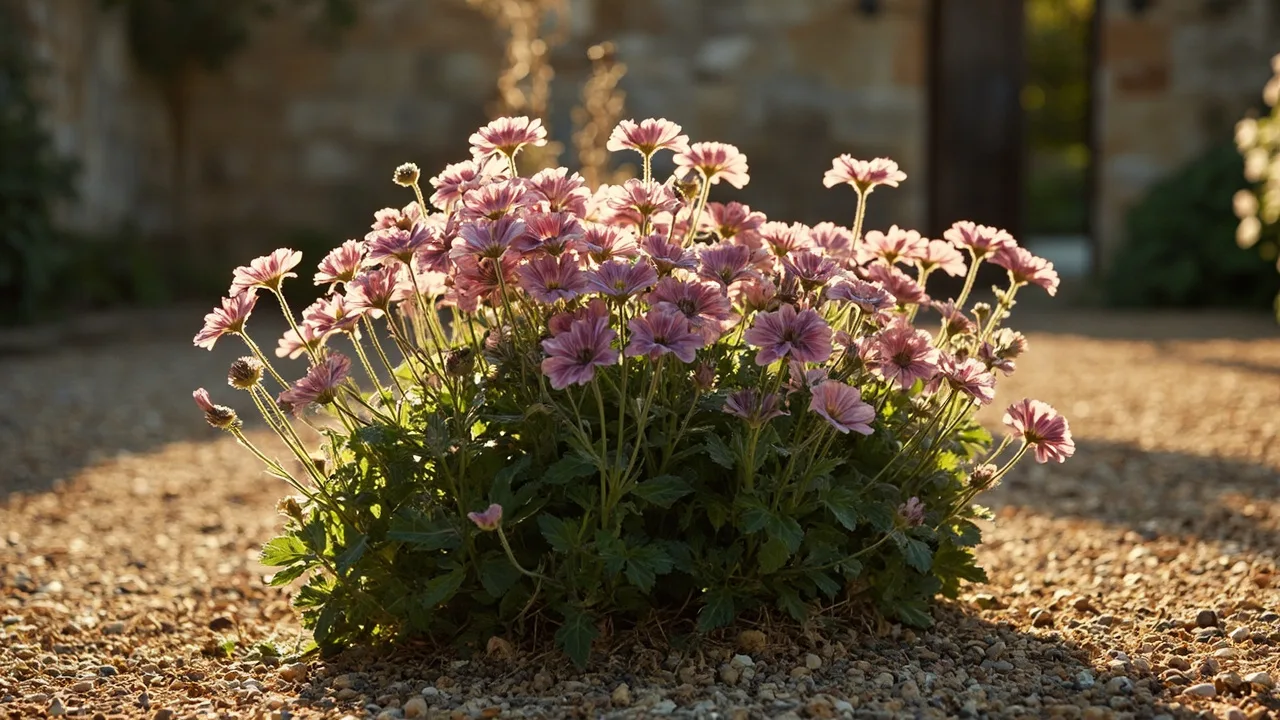
Geranium maderense is the largest of the true hardy geraniums commonly grown in the UK: a short-lived evergreen perennial that throws a single dome of pinkish-mauve flowers in its second year before the parent plant dies. Native to the laurel forests of Madeira and now widely planted in mild corners of British and Irish gardens, it has become a familiar sight on Cornish walls, in London courtyards and along the south coast. The following page sets out what UK gardeners should expect from this striking but essentially biennial plant, from its form and flowers to its liking for sharp drainage and its habit of seeding itself freely into walls and pavements.
Overview
Geranium maderense is a member of the family Geraniaceae and the only species in UK trade that develops a true trunk-like stem. In the wild it grows on north-facing rocks and stream banks in Madeira at roughly 600–1,200 m, where mild damp winters and dry summers shape its growth cycle. In British gardens it is treated as a half-hardy evergreen perennial or, more accurately, as a monocarpic biennial that flowers once and dies, leaving a scatter of self-sown seedlings in its wake. A well-grown specimen reaches 1.0–1.5 m across and shoulder-high in bloom, several times the size of G. himalayense or G. phaeum. Gardeners in coastal Cornwall, the Isles of Scilly, the Channel Islands, the Hebrides and parts of west Scotland can leave it outdoors year-round; elsewhere in the UK it usually needs a sheltered south- or west-facing wall, a cold greenhouse, or a large container that can be moved under cover for the worst winter weather.
Appearance
The plant builds up over its first year as a single rosette of large, deeply lobed, fern-like leaves on long fleshy stalks. Mature leaves reach 20–60 cm across with seven to nine primary lobes, each further divided, giving the foliage a feathery, almost papyrus-like texture. In spring and early summer a stout central stem elongates from the centre of the rosette and lifts the foliage clear of the ground; older plants develop a woody caudex up to 30–60 cm tall, the trait that distinguishes G. maderense from every other cranesbill commonly grown in the UK.
The inflorescence is a broad, slightly rounded panicle that emerges above the leaves in late spring or early summer, typically May to July in southern England. Individual flowers are roughly 4 cm across, with five rounded petals in soft mauve-pink and a darker network of veins from a pale centre. The buds are noticeably hairy and reddish. Mature panicles carry 50–100+ flowers and have a domed, almost hydrangea-like outline from a distance. Seed heads follow quickly: long, pointed, beak-like fruits characteristic of the genus, which split open to flick seeds a short distance from the parent.
After flowering the parent rosette declines through summer and autumn and usually dies by the following winter. A reliable stand depends on replacements, which is why most gardeners treat this species as part of a self-seeding colony rather than a permanent individual.
Growing Conditions
Site selection matters more than feeding. The plant tolerates a range of soils but rewards sharp drainage; a sandy or gritty loam in sun or part shade suits it best, and a constantly damp root run through winter is the most common cause of failure inland. In coastal Cornwall and the Channel Islands it grows in thin soil over rock with no protection; inland it appreciates a south- or west-facing wall that radiates stored heat, and a slightly raised planting pocket so its crown sits above the wettest part of the bed.
Aspect is best as full sun to light dappled shade. Avoid deep shade under evergreen trees, where the rosette stays wet for long periods. Against a wall that catches afternoon sun the caudex builds up faster and the plant overwinters more reliably through an average British winter.
Soil can be any reasonable garden soil that drains. Adding coarse grit or horticultural sand at roughly 1:4 by volume, plus a mulch of coarse bark or leaf mould, replicates the loose, humus-rich but free-draining substrate of its native Madeira. pH is not critical — slightly acid to neutral (6.0–7.5) suits it well.
Water should be moderate in the growing season and sparse in winter. Established plants in the open ground tolerate several weeks of summer drought with little harm; containerised plants need watering roughly twice a week in summer and far less, if at all, between November and March. Hardiness is shown on the plant's badge; do not rely on a single quoted figure, as microclimate and drainage shift the practical limit by a full zone in either direction.
Climate suitability: G. maderense performs best in the mild maritime regions of the UK — the south-west, the Isles of Scilly, the Channel Islands, the south coast of England, parts of western Scotland and favoured pockets in central London and East Anglia. It can be grown as a foliage plant under cold glass almost anywhere, but flowers reliably only where winter cold and damp stay just short of the damaging threshold.
Planting and Care
Planting. The best window is spring, once the soil has warmed and the worst of the wet is past — typically April to early May in most of lowland Britain, or March in the far south. Container-grown plants can be planted whenever the ground is workable, but autumn plantings in cold inland gardens frequently fail because wet, cold soil rots the crown. Set the crown slightly above the surrounding soil level so winter wet does not settle into the rosette, and firm the backfill gently.
Watering in the first season should be steady until new growth pushes through, then reduced. In a typical UK summer an established plant in the open ground needs little or no supplementary watering. Container plants are thirstier and should be soaked thoroughly, then allowed almost to dry out before the next drink.
Feeding is light. An annual mulch of garden compost in spring, plus a handful of slow-release organic fertiliser, supports the strong growth that produces a flowering-size rosette in a single season. Overfeeding produces soft lush growth that is more vulnerable to winter damage and less likely to flower well the next year.
Pruning and tidying are minimal. Remove faded flower stems after the main display finishes in mid- to late summer if seed is not wanted; otherwise leave them to ripen and self-sow. Cut away old outer leaves from the rosette in late winter or early spring, taking care not to damage the emerging central growth. Established plants resent hard cutting back into old wood.
Propagation is normally from seed. Seed is widely available from UK and European suppliers, and home-saved seed germinates readily when sown fresh in late summer. Surface-sow on a damp seed compost and cover with a thin layer of grit; keep at a steady room temperature and germination typically takes two to four weeks. Prick out seedlings once they have two true leaves and grow on in individual pots for a season before planting out. Cuttings from basal shoots are possible but slow to root, so seed-raised plants are the norm in British nurseries.
Seasonal care: in spring, top-dress with compost and renew the grit mulch around the crown; in summer, water container plants freely and enjoy the flowers; in autumn, remove the spent flowering stem once seed has set or been collected; in winter, protect any plant grown outside its favoured regions with a dry mulch of straw or bracken during prolonged frost.
Common Problems
Winter rots
Symptom: blackening of the crown and lower leaf stalks through winter; collapse of the central growing point in spring. Cause: prolonged cold and wet around the rosette, especially in heavy clay or in gardens north of a line from the Wash to the Bristol Channel. Fix: improve drainage with grit at planting; raise the crown on a small mound; protect with a dry winter mulch; in cold inland gardens, treat as a container plant and move under cover for the worst weeks.
Vine weevil
Symptom: notched leaf margins on the rosette in summer; sudden wilting of containerised plants in late summer or autumn when you lift the pot. Cause: larvae of Otiorhynchus sulcatus feeding on the thick fleshy roots; the adults clip neat arcs out of leaf edges. Fix: drench containers with a biological nematode (Steinernema kraussei or Heterorhabditis bacteriophora) in late summer; inspect roots of any wilting plant and pick out the cream-coloured grubs by hand; in open ground, encourage ground beetles and birds which take a heavy toll.
Slugs and snails
Symptom: ragged holes in young leaves in spring, slime trails across the crown. Cause: soft new growth is attractive to common slugs and snails in mild, damp weather. Fix: use pet-safe ferric phosphate pellets, thin out dense ground cover that shelters slugs, and pick off offenders after dark. G. maderense usually grows through minor damage with no lasting effect.
Powdery mildew
Symptom: a dusty white coating on the upper surface of leaves in warm, dry late summers, especially on plants in pots or against a hot wall. Cause: the same mildew that affects many Geraniaceae under stress; poor air movement and drought at the root make it worse. Fix: water more consistently, mulch to keep the root run cool, and remove badly affected leaves. The plant is generally vigorous enough to recover from a light infection without spraying.
Lack of flowers
Symptom: a large, healthy-looking rosette that fails to bloom in its second or third year. Cause: usually a cold snap that killed the developing flower stem, or excess nitrogen-rich feed that produces leaves at the expense of flowers. Fix: choose a warmer, more sheltered spot in future plantings; switch to a high-potash, low-nitrogen feed in spring; let self-sown seedlings establish in different microclimates and keep those that flower best.
Popular Varieties
The species itself is the mainstay of UK cultivation, and named selections are few. Because G. maderense hybridises only with reluctance and seed-raised plants vary modestly, most nurseries stock the straight species rather than cultivars. The following are real entries in UK trade today.
- Geranium maderense — the species itself, seed-raised and the default plant in Cornish and Channel Island gardens. Flower colour is consistently mauve-pink.
- Geranium maderense 'Album' — a white-flowered selection that has been in cultivation since the early twenty-first century. Plants offered under this name tend to be slightly smaller and less vigorous than the type, with pure white petals and the same darker veining.
- Geranium maderense 'Guernsey White' — a robust white form selected on the Channel Islands, valued for its clearer white flowers and a slightly more upright caudex in older specimens.
- Geranium maderense 'Crugs Big Pink' — a vigorous large-flowered pink selection raised from seed collected on Tenerife by Crûg Farm Plants in Gwynedd and widely available from UK specialist nurseries.
Gardeners are sometimes offered Geranium × maderense hybrids under names such as G. 'Patricia' or G. 'Joy', which derive from G. endressii and other European species rather than from true G. maderense. These are lovely garden plants in their own right but should not be confused with the species and do not reach the same scale. Any cultivar name not appearing in at least two current UK nursery catalogues should be treated with caution.
---
Pests and Diseases
| Problem | Symptoms | Management |
|---|---|---|
| Powdery mildew | White, dusty fungal growth appears on leaves and stems, potentially causing distortion. | Improve air circulation and apply a suitable fungicide if infection is severe. |
| Downy mildew | Yellowing patches on upper leaf surfaces with fuzzy grey growth underneath in humid conditions. | Avoid wetting foliage when watering and remove affected leaves promptly. |
| Root rot | Stems become soft and brown, often following overwatering or poor drainage. | Ensure well-drained compost and allow the surface to dry out between waterings. |
| Vine weevil | Notched edges on leaves above ground and damaged, slimy roots below. | Apply a systemic insecticide drench or use biological nematodes in the soil. |
| Slugs and snails | Irregular holes chewed into young leaves and silky trails left on foliage. | Use slug pellets, beer traps, or copper tape barriers to deter feeding. |
For step-by-step help, read Dealing with Slugs and Snails and Treating Powdery Mildew. Or browse the full plant problem solver to diagnose an issue by symptom.
Recommended Products
GardenWizz earns a commission from qualifying purchases made through affiliate links on this page (including links within the article) — as an Amazon Associate, and from Thompson & Morgan via the Awin network. This does not affect the price you pay. See our disclaimer for details.