Runner Bean
Phaseolus coccineus · scarlet runner bean · multiflora bean · butter bean
The Gardening Year
Best months in UK gardens · full planting calendar →
🖨 Printable care card (PDF)At a Glance
| Botanical name | Phaseolus coccineus |
|---|---|
| Common name(s) | runner bean, scarlet runner bean, multiflora bean, butter bean |
| Family | Fabaceae |
| Plant type | climber (differs from the common bean (P. vulgaris) in several respects: the cotyledons stay in the ground during germination, and the plant is a perennial vine with tuberous roots (though it is frequently treated as an annual in colder climates)) |
| Height × Spread | 2.5–4 m × 100–150 cm |
| Position | Full sun |
| Soil | Fertile, moisture-retentive soil with plenty of well-rotted compost or manure. |
| Flowering | April–September |
| Toxicity | phytohaemagglutinin |
| Native range | Central America |
Overview
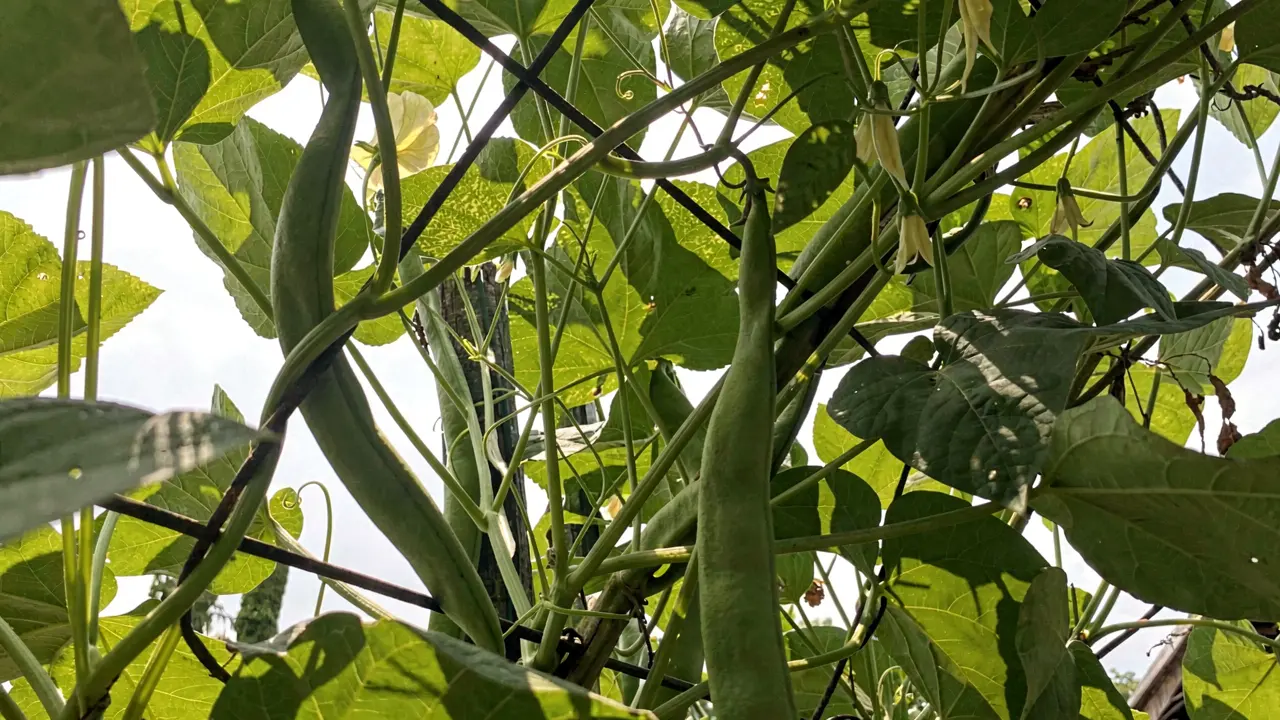
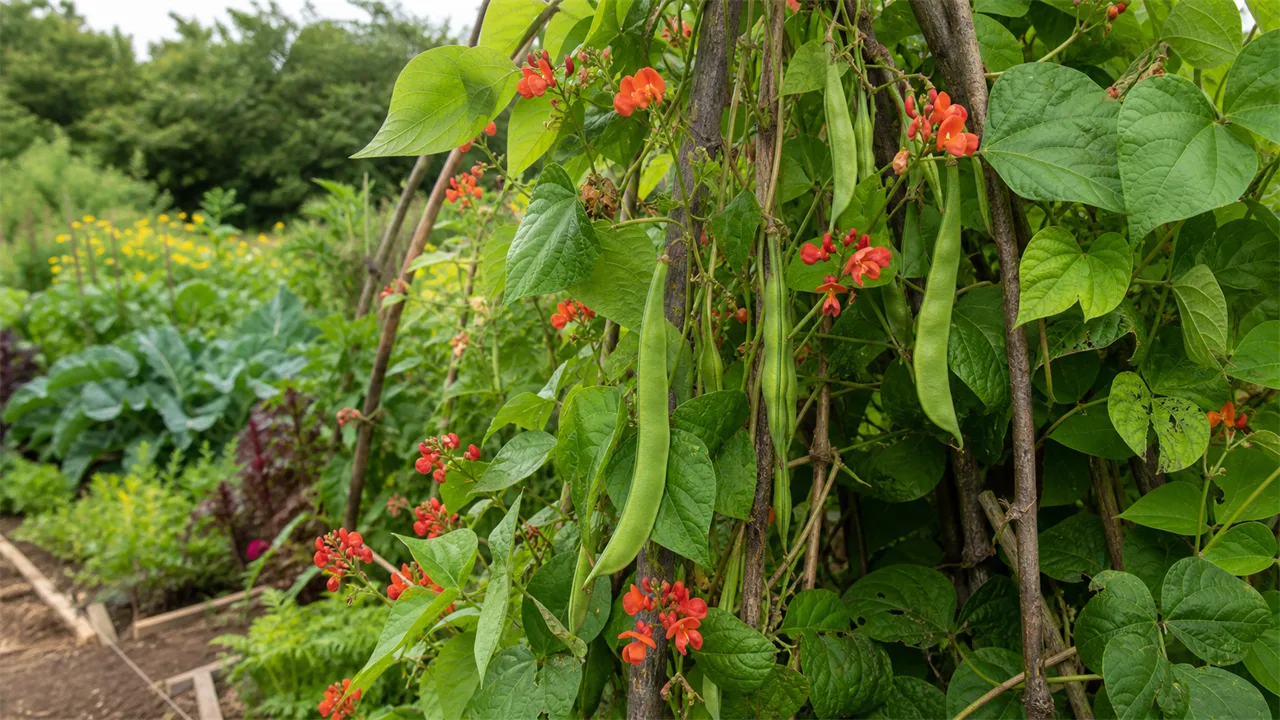
The runner bean, Phaseolus coccineus, is a half-hardy climbing perennial grown as an annual across most of the UK, and one of the most productive crops a British gardener can fit into a small patch of ground. A single 3 m row, given reasonable soil and a cane support, can yield 10–15 kg of pods between July and the first frosts of October. Few vegetables repay the effort so generously, and none is more recognisably British: the scarlet-flowered wigwam in an allotment, dripping with long, fleshy pods, is a defining image of the high summer kitchen garden.
Phaseolus coccineus is not a true bean in the same sense as the French bean (Phaseolus vulgaris) — it is a different species, native to the cool highlands of Central America (Mexico and Guatemala), where it was grown for its large, edible, often brightly marked seeds. Spanish and Portuguese traders carried it into Europe in the 16th century; it reached England around 1633, initially as an ornamental curiosity for its showy flowers, before becoming a kitchen-garden staple in the 19th century. The plant was once classified as Phaseolus multiflorus, a name still found in older books; modern UK horticulture has standardised on P. coccineus.
There are two good reasons to grow runner beans rather than buy them. First, supermarket runner beans are almost always old and stringy by the time they reach the shelf — picked for shipping life rather than tenderness. A home-grown pod, picked at 15–20 cm while the beans inside are still small, has a sweetness and a snap no shop-bought bean can match. Second, the flowers are spectacular: most cultivars have brilliant scarlet blooms, but there are white-, pink- and bicoloured forms, and bumblebees love them. A double row of canes against a sunny fence will produce a wall of flower and foliage that earns its keep as an ornamental feature even before the first pod is picked.
Sowing
Runner beans are frost-tender. They will not tolerate any temperature below freezing, and germination is poor below about 12 °C. UK sowings are therefore timed around the last frost date, which ranges from late March in the far south-west and the Channel Islands to mid-May in upland Scotland. Because the plants grow fast once established, almost all UK sowings are made in spring, with no autumn or overwintered crop.
Indoor sowing (the standard UK method). Sow into 9 cm pots of peat-free multipurpose compost, two seeds per pot, 5 cm deep, from late April to mid-May. Pinch out the weaker seedling after germination. Keep pots at 15–18 °C on a bright windowsill or in an unheated greenhouse; germination takes 7–14 days. Hardening off is essential — a week of putting pots outside during the day and bringing them in at night, before planting out after the last frost.
Direct sowing (the traditional method). In mild districts — south-west England, the south coast, London, East Anglia, the Midlands and most of lowland Wales — direct sowing is reliable from mid- to late May, once the soil has warmed to 12 °C and the risk of frost has passed (a rough rule of thumb is "wait a fortnight after the last predicted frost"). Push two seeds 5 cm deep at each station, then thin to the stronger seedling. In northern England, north Wales, Yorkshire, Lancashire and the central belt of Scotland, delay direct sowing until late May or even early June; in upland Scotland and the north-east, early-to-mid June is safer.
UK sowing windows by region.
- South-west England, Channel Islands, south coast, London, East Anglia: indoor mid-April to early May; direct mid-May.
- Midlands, central southern England, south Wales: indoor late April to mid-May; direct late May.
- Northern England, north Wales, Yorkshire, Lancashire: indoor early to mid-May; direct late May to early June.
- Scotland (lowland and central belt): indoor mid-May; direct early June.
- Scotland (upland, north-east, west Highlands): indoor mid- to late May; direct mid-June, after the last frost.
- Northern Ireland: indoor early to mid-May; direct late May.
Site and soil. Choose the sunniest, most sheltered spot available — runner beans are tall, easily wind-thrashed plants, and a windy site will reduce both flower-set and pollination. Soil should be deeply dug in autumn or early spring with a generous barrow-load of well-rotted manure or garden compost per square metre worked in; runner beans are hungry and will reward rich ground. They dislike cold, wet feet, so avoid sites prone to waterlogging. Soil pH 6.0–7.0 is ideal; liming is unnecessary in most UK soils.
Building the support (canes or wigwam). Set up the support before sowing or planting out — working around established canes is awkward and risks damaging the plants. The traditional structure is a double row of 2.4 m bamboo canes, set 15 cm apart within the row, with rows 60 cm apart, the canes tied to a horizontal cross-cane at the top to form an A-frame (the "X" or "tent" rig). For a more compact alternative, push 4–6 canes into the ground in a circle 60–75 cm across and tie them at the apex to make a wigwam — ideal for a single planting pocket in a small garden or border. Canes should be pushed at least 20 cm into the ground so they carry the weight of a mature crop in wind.
Spacing. Along a cane row: one plant per cane, 15 cm apart in a double row, 60 cm between rows. On a wigwam: one plant per cane, 4–8 canes per structure.
Growing
Planting out. Set indoor-raised plants out once all risk of frost has passed and the plants are 15–20 cm tall — typically late May in the south, early to mid-June further north. Water the pots an hour before planting, then plant through the soil at the base of each cane, firming well and watering in. If rabbits, pigeons or slugs are a problem in your area, fit a 60 cm-high ring of fine mesh around each plant for the first two weeks until it has grown away.
Watering. Runner beans are thirsty. A mature row in July may use 10 litres per square metre per week, and any check to growth (especially a dry spell at flowering time) will reduce pod-set. Soak the ground thoroughly once or twice a week rather than sprinkling lightly every day — light watering encourages surface roots and leaves the plants vulnerable in hot weather. A 5 cm mulch of garden compost or straw over the bed, kept clear of the stems, will cut water loss sharply and suppress weeds.
Feeding. On well-prepared ground, additional feeding is usually unnecessary until flowering. Once the first flowers open, switch to a high-potash liquid feed (tomato feed is ideal) every 10–14 days through July and August. Avoid high-nitrogen feeds, which produce lush leafy growth at the expense of pods.
Pinching out. When the leading shoots reach the top of the canes, pinch them out to encourage side-shoots lower down and to stop the plants blowing over. Continue to tie in loose growth as the season progresses; runner beans climb by twining, but a heavy crop can pull the stems away from the cane.
Pollination and flower-set. Runner beans set best in warm, settled weather. In cold, wet or windy spells, bees may not visit the flowers and pods fail to form. The traditional remedy is to mist the flowers with water in the early morning (this raises humidity and helps pollen germinate), and to grow a bicoloured cultivar such as 'Painted Lady' or a self-fertile form such as 'Firestorm' or 'Snowstorm' in cold districts where set is consistently poor. In exposed gardens, erecting a low windbreak of debris netting along the row will markedly improve cropping.
Common problems.
- Blackfly (black bean aphid): the most frequent pest. Colonies build on the shoot tips in June and July; pinch off badly infested tips, or spray with a soft soap solution. Encourage ladybirds and hoverflies by leaving a margin of flowering herbs nearby.
- Slugs and snails: serious only on young seedlings. Use ferric phosphate pellets, beer traps, or night-time hand-picking.
- Halo blight: a bacterial disease causing yellow-ringed spots on leaves; avoid overhead watering, do not work among wet plants, and remove infected material. There is no cure — destroy badly affected plants and do not save seed.
- Red spider mite: a hot, dry-summer problem in greenhouses; outdoors, fine-spray the foliage in the evening during heatwaves.
Harvesting
The first pods are ready about 12–14 weeks after sowing — typically mid-July in the south, late July to early August further north. Pick while pods are young and tender, before the beans inside swell visibly and the pods become stringy. The ideal picking size is 15–20 cm long, with pods that snap cleanly when bent.
Pick little and often — every two to three days is ideal. A pod left on the plant slows production of further flowers and pods, and within a week an unpicked pod can become tough and inedible. Hold the stem with one hand and the pod with the other to avoid tearing the plant off the cane.
Harvesting continues until the first hard frost of autumn kills the top growth. In the south, picking may run from mid-July to late October; in the north and Scotland, late July to late September or early October is more typical. A light frost blackens the leaves but the pods lower down are often still usable; a hard frost (-2 °C or below) ends the crop.
UK harvest windows by region.
- South-west England, south coast, London: mid-July to late October.
- Midlands, central southern England, south Wales: late July to mid-October.
- Northern England, north Wales, Yorkshire, Lancashire: late July to early October.
- Scotland (lowland): late July to early October.
- Scotland (upland, north-east): late July to late September.
- Northern Ireland: late July to early October.
End-of-season seed saving. If you wish to save seed for next year, leave a few pods on the strongest plants until they turn brown and dry on the plant in late September or October. Pick before the first hard frost, finish drying indoors on newspaper, shell, and store in a paper envelope in a cool, dry place. Saved seed is viable for 3–4 years; bear in mind that runner beans cross-pollinate, so saved seed will not necessarily come true to type unless only one cultivar is grown.
Eating
Runner beans are best eaten the day they are picked. Their flavour is at its peak in the hours after harvest, before the sugars begin converting to starch; within 24 hours of picking, a runner bean is already noticeably less sweet than at the moment of harvest. Pick what you intend to cook that evening, and either cook immediately or keep in the fridge in a damp tea-towel for no more than two days.
The classic preparation is simple: top and tail the pods, slice them diagonally into 2–3 cm lengths, then boil in lightly salted water for 3–4 minutes until just tender, and drain. Toss with butter, sea salt and a grind of black pepper, or finish with a knob of butter and a handful of flaked almonds. A squeeze of lemon brings out the sweetness. Runner beans take well to garlic, to bacon, and to cream-based sauces — a runner bean and bacon gratin is a strong British autumn dish.
Younger pods (under 15 cm) need only the tips trimmed; older pods (over 20 cm) should have the fibrous side strings pulled away and may need to be sliced thinly. Very large pods in which the beans have swollen can be opened and the fresh beans inside cooked separately as a flageolet-style pulse — about 20 minutes simmering in salted water.
Beyond boiling, runner beans can be stir-fried (cut on the diagonal, 2–3 minutes in a hot wok), pickled in spiced vinegar, or made into chutney with shallots and apples. Cold, blanched runner beans dressed with olive oil, shallots and mustard are a good addition to a summer salad.
Supporting
Climbing beans are one of the crops where a support structure is essential, not optional. A mature runner bean plant in full production carries 2–3 kg of pods, leaves and stems — the equivalent of a heavy sack hanging from a 2.4 m pole — and an unsupported plant will collapse within weeks. The cane support is therefore built first, before sowing or planting, and the plant is tied in as it climbs.
The two common support forms are:
- Double row (A-frame / tent rig): two rows of 2.4 m canes 60 cm apart, with 15 cm between canes within each row. Tie pairs of canes together at the top to form a stable A-frame, with a horizontal cross-cane lashed across the apex. Best for larger allotments and main-crop rows; gives the heaviest yield per square metre.
- Wigwam (teepee): 4–8 canes pushed into the ground in a 60–90 cm circle, tied at the top. Best for small gardens, square beds, and growing among flowers; ornamental as well as productive.
Netting (pea-and-bean netting stretched between upright posts) is a workable alternative to canes, but it is harder to harvest from and tends to sag under weight. Galvanised or plastic-coated steel obelisks are increasingly popular in flower borders and work well for one or two wigwam-style plantings.
Tie in young plants loosely with soft twine once they have produced their first pair of true leaves and start to twine; after that, the plants will generally climb themselves, but check weekly during July and August and re-tie any stems that have come away from their cane in wind. Pinch out the growing tip once it reaches the top of the support, to redirect energy into side-shoots lower on the plant.
Storing
Runner beans do not store well fresh. They keep in the fridge for 2–3 days at most before losing sweetness and becoming limp. For longer keeping, the reliable options are:
- Freezing: top, tail and slice the pods, blanch in boiling water for 2 minutes, drain, cool in iced water, pack in freezer bags or boxes, and freeze. Frozen runner beans keep for 9–12 months and cook from frozen in about 4 minutes.
- Salting: layer sliced raw pods in a jar with coarse salt (50 g salt per 500 g beans), cover, and store in the fridge. The beans keep for 2–3 months and are rinsed and soaked before cooking.
- Pickling: blanched pods can be pickled in spiced vinegar and stored in sterilised jars for 6–9 months.
- Drying: leave pods to mature and dry on the plant in late summer, then shell the dried beans inside. Dried runner beans need soaking overnight and long, slow cooking (1.5–2 hours) before eating; in the UK kitchen they are less commonly used than dried French beans, but they make a substantial winter pulse. A heavy harvest of dried beans can be stored in airtight jars for a year or more.
Cultivars and Varieties
| Cultivar | Height | Flower | Notes | AGM |
|---|---|---|---|---|
| 'Aeron Purple Star' | — | purple pods | not available commercially | |
| 'Black Runner' | — | — | — | |
| 'Butler' | — | — | — | |
| 'Case Knife' | — | — | — | |
| 'Fasolia gigantes' | — | — | white bean which originated in Greece | |
| 'Hammond's Dwarf' | — | — | — | |
| 'Japanese Runner' | — | — | sold in Canada and USA under the names of 'Akahana' or 'Shinshu runner' | |
| 'Painted Lady' | — | — | — |
Pests and Diseases
| Problem | Symptoms | Management |
|---|---|---|
| Runner and French bean rust | Pale spots on upper leaves develop into brown or black pustules on the undersides, causing leaves to shrivel and die. | Thin out dense growth to improve air circulation and reduce humidity around the foliage. |
| Black bean aphid (blackfly) | Dense colonies of small black insects cluster on stems, leaves, and growing tips, causing distortion and stunted growth. | Encourage natural predators like ladybirds or use a strong jet of water to dislodge them; avoid spraying when flowers are open. |
| Slugs and snails | Irregular holes chewed in young leaves and seedlings, often accompanied by silvery slime trails. | Use physical barriers like copper tape or beer traps, and apply iron phosphate-based pellets if necessary. |
| Failure to set pods | Plants produce abundant flowers but few or no beans, often dropping petals without forming fruit. | Ensure consistent watering during dry spells and plant in a sheltered site to encourage bee pollination. |
| Bird damage | Pecked or missing flowers and young pods, particularly noticeable in varieties with brightly coloured blooms. | Net the plants once flowering begins or switch to a variety with different flower colours to deter birds. |
For step-by-step help, read Controlling Aphids Naturally and Dealing with Slugs and Snails. Or browse the full plant problem solver to diagnose an issue by symptom.
Companion planting
✔ Grows well with: carrot, Courgette, lettuce, Sunflower.
✘ Keep apart from: beet, bulb onion, Chives.
Full companion planting chart →
Runner Bean in our guides
- How to Grow Runner Beans in the UK
- Rust on Plants: How to Identify and Treat Garden Rust
- Charles Dowding: Why Mid-June Is the UK's Busiest Sowing Fortnight
- June rain and sunshine set to boost flowering garden plants
Recommended Products
GardenWizz earns a commission from qualifying purchases made through affiliate links on this page (including links within the article) — as an Amazon Associate, and from Thompson & Morgan via the Awin network. This does not affect the price you pay. See our disclaimer for details.