Catalonian Jasmine
Jasminum grandiflorum
The Gardening Year
Best months in UK gardens · full planting calendar →
🖨 Printable care card (PDF)At a Glance
| Botanical name | Jasminum grandiflorum |
|---|---|
| Common name(s) | Catalonian jasmine |
| Family | Oleaceae |
| Plant type | climber (semi-evergreen to deciduous) |
| Height × Spread | 2–4 m × 2.5–4 m |
| Position | Full sun, Partial shade |
| Soil | moist, well-drained fertile soil |
| Flowering | June–November |
| Toxicity | — |
| Native range | South Asia, the Arabian peninsula, East and Northeast Africa and the Yunnan and Sichuan regions of China |
Overview
Jasminum grandiflorum is a vigorous, scrambling woody shrub in the olive family (Oleaceae), grown in the UK almost exclusively for its intensely fragrant, star-shaped white flowers. Of the forty or so jasmine species recognised worldwide, this is the one behind most of the high-grade perfumery jasmine extracts, and the one most often confused with the hardier garden jasmine, Jasminum officinale. In British gardens it is best treated as a tender conservatory or patio plant, brought under cover for the winter outside the mildest coastal or city microclimates. The Royal Horticultural Society treats it as a conservatory shrub requiring frost-free winter protection, and that position is the dependable starting point for UK growers.
Appearance
The plant builds up a tangle of slender, scrambling stems clothed with opposite, pinnate leaves. Each leaf carries several oval to lance-shaped leaflets with a slightly darker, glossier upper surface than the underside; the overall impression is of a lustrous, dark green screen once the plant is established. The stems are not true twiners, which is why they need to be tied in regularly rather than simply wrapped around a support.
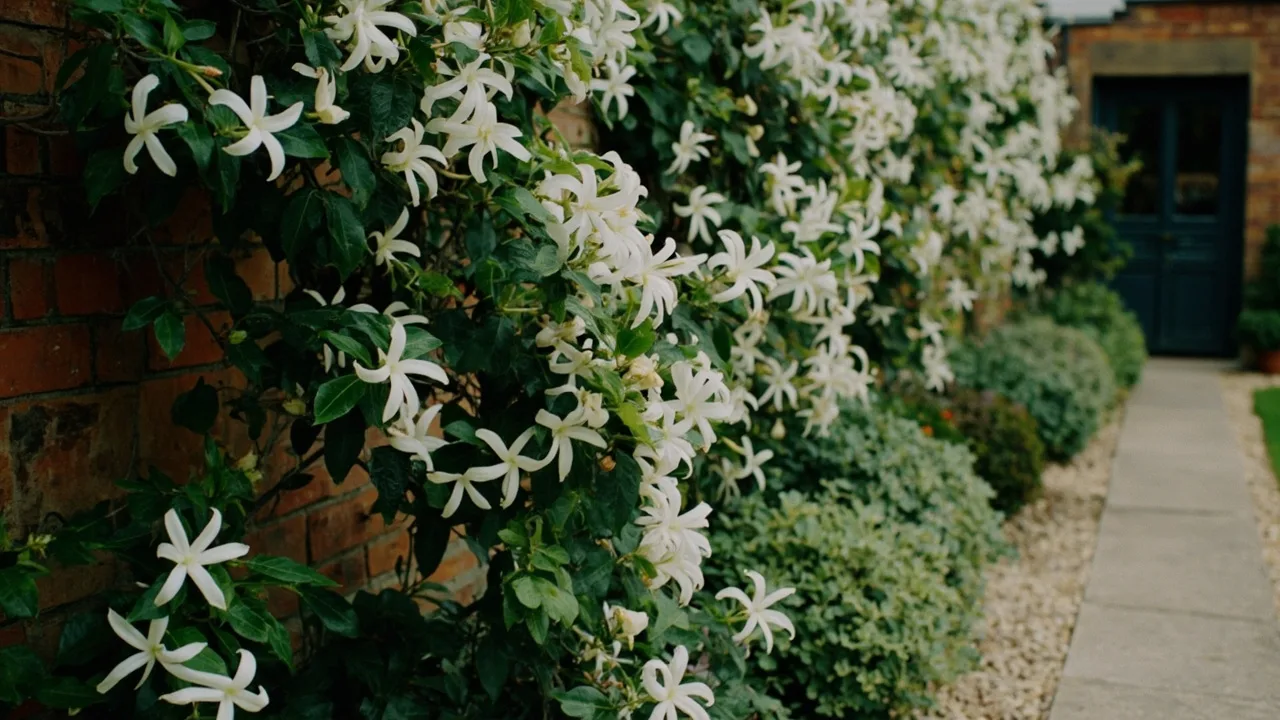
Borne in loose clusters at the tips of the current season's growth, the flowers are the whole point of growing this species. Smooth, pink-flushed buds open into flat, white, star-shaped blooms, each with five broad petals around a small central eye. The fragrance is heavy, sweet and slightly fruity, and carries on still summer evenings. Flowering begins in mid- to late summer and continues, sometimes in flushes, into early autumn. The Royal Horticultural Society notes that the cultivar 'De Grasse' produces flowers to about 3.5 cm across on a plant that can reach 4 m in good conditions; treat that size as a useful size hint for the species in a warm, well-grown UK conservatory, not as a fixed species maximum.
Growing Conditions
Jasminum grandiflorum wants the warmest, brightest spot a UK garden can offer. A south- or south-west-facing wall in full sun, with the roots shaded by a paving slab, a low neighbour or another shorter plant, is the textbook position. Light dappled shade is tolerated, but deep shade produces leggy growth and very little flower. Shelter from cold, drying winds matters as much as the aspect, because the foliage is evergreen and the stems are vulnerable to wind scorch in winter.
Soil should be fertile and reliably moist but sharply drained; this jasmine resents waterlogging around the crown and roots far more than it resents the occasional dry spell. A loam improved with well-rotted garden compost or leafmould, with a generous mulch each spring, suits it well. In containers, use a peat-free, loam-based potting compost with added grit for drainage, and choose a pot that comfortably accommodates the rootball with a thumb's width of compost around the sides. The plant is tender in UK winters and needs frost-free protection across most of the country; outside the mildest coastal locations, expect to grow it as a conservatory, glasshouse or movable patio specimen.
Planting and Care
Plant in late spring, once the risk of hard frost has passed and the soil is warming up. Dig a hole at least twice the width of the rootball, fork the base, and backfill with the improved soil so the plant sits at the same depth it sat in its nursery pot. Water in thoroughly, then fit a sturdy trellis, wires on a wall, or an arch before the new stems start to wander; training is easier when the framework is already in place. Space plants about 1.5–2 m apart if you are using more than one to cover a wall.
During the growing season keep the compost evenly moist: in practice, that means a deep soak two or three times a week in dry spells for ground-planted specimens, and daily checking for container plants in summer. From the first flower buds, switch to a high-potash liquid feed (tomato feed is the standard kitchen-cupboard choice) every ten to fourteen days; revert to a balanced general fertiliser after the main flowering has finished. In autumn, ease off the watering and stop feeding altogether so the wood can ripen before winter.
Pruning is light and immediate. As soon as the last flowers fade, shorten the stems that have flowered back to a strong sideshoot or a healthy pair of buds, and remove any dead, damaged, diseased, overcrowded or wayward growth at the same time. Hard renovation is rarely necessary and is best done in one go, in early spring, on an established plant that has outgrown its space. Propagation is straightforward: take semi-ripe cuttings in mid- to late summer and root them in a 50:50 mix of peat-free compost and perlite under a propagator lid, or layer a low flexible stem into a pot of compost pegged alongside the parent plant.
Overwintering is the make-or-break task in the UK. Move container plants into a frost-free greenhouse, conservatory or cool porch before the first frost, and reduce watering to just enough to keep the compost from drying out completely. For wall-trained specimens, wrap the framework in horticultural fleece during cold snaps and insulate the root zone with a thick autumn mulch of bark or straw.
Common Problems
The two problems the Royal Horticultural Society specifically flags for Jasminum grandiflorum are spider mites and honey fungus, and both are worth taking seriously.
Spider mites are the more common indoor and conservatory pest. Fine webbing across the leaf undersides and a fine pale speckling or bronzing of the foliage are the tell-tale signs. The cause is usually a warm, dry, sheltered atmosphere with poor air circulation. The fix is to raise humidity (a gravel tray beneath the pot, or grouping plants together), improve ventilation without creating cold drafts, and treat with a horticultural soap or a specific miticide if the infestation takes hold.
Honey fungus is a soil-borne root disease that can attack a wide range of garden plants, including this jasmine. The symptom is a steady, unexplained decline of the plant, often with white fungal sheets beneath the bark at the base and honey-coloured toadstools on or near the roots in autumn. There is no chemical cure; the practical response is to remove and destroy affected specimens, avoid replanting susceptible subjects in the same spot, and check that the border is not harbouring old, dead roots from previous shrubby plantings.
A few non-pest problems are common in UK cultivation. Poor flowering is usually down to insufficient light, prolonged drought, low summer temperatures, over-generous nitrogen feeding (lots of leafy growth, few buds), or pruning at the wrong time. Yellowing leaves and sudden dieback in winter are almost always a cold or waterlogging issue rather than a true disease. Failure to flower the year after pruning is more often than not a sign that the plant was cut back too late in the year and the new flower-bearing wood did not have time to ripen.
Popular Varieties
Cultivar names within Jasminum grandiflorum are sparsely listed in UK nursery catalogues, and care should be taken not to invent or borrow names from other species. The two forms that can be verified through UK-facing sources are:
- Jasminum grandiflorum L. — the species itself, widely sold as seed and as young plants by UK herb and specialist nurseries. This is the plant to grow for the classic perfumery-style flower.
- Jasminum grandiflorum 'De Grasse' — recorded by the Royal Horticultural Society as a floriferous selection reaching about 4 m, with flowers to roughly 3.5 cm across. The name references the historic perfume-growing region around Grasse in southern France, and several suppliers list it as a cutting-grown form.
For most UK gardeners the choice is less about named cultivars and more about where to buy a healthy, propagated-by-cutting plant from a reputable supplier. The closely related Jasminum officinale (common white jasmine) is far more cold-tolerant and is the better choice for a permanent outdoor wall in most of the UK; if in doubt, check the botanical name on the label before buying.
Sources & Further Reading
- Royal Horticultural Society — Jasminum grandiflorum L. plant profile: https://www.rhs.org.uk/plants/118949/jasminum-grandiflorum-l/details, accessed 2026-07-23
- Royal Horticultural Society — Jasminum grandiflorum L. (De Grasse) plant profile: https://www.rhs.org.uk/plants/86012/jasminum-grandiflorum-l-de-grasse/details, accessed 2026-07-23
- Royal Horticultural Society — Jasmine growing guide: https://www.rhs.org.uk/plants/jasmine/growing-guide, accessed 2026-07-23
- Royal Botanic Gardens Kew — Plants of the World Online, Jasminum grandiflorum L.: https://powo.science.kew.org/taxon/urn:lsid:ipni.org:names:328130-2, accessed 2026-07-23
- BBC Gardeners' World — How to grow jasmine: https://www.gardenersworld.com/how-to/grow-plants/how-to-grow-jasmine/, accessed 2026-07-23
Pests and Diseases
| Problem | Symptoms | Management |
|---|---|---|
| Aphids | Clusters of small green or black insects on new growth causing distorted leaves and sticky honeydew. | Squash by hand, spray with a strong jet of water, or apply insecticidal soap if infestations are severe. |
| Spider mites | Fine webbing on leaves and stippled yellowing foliage, particularly in dry, warm conditions. | Increase humidity around the plant and treat with horticultural oil or a miticide if necessary. |
| Scale insects | Small, immobile, bump-like pests attached to stems and leaves, often accompanied by sooty mould. | Scrape off small infestations manually or use systemic insecticides for larger outbreaks. |
| Mealybugs | White, cottony wax secretions at leaf axils and on stems, often found in sheltered areas. | Wipe away with a cloth dampened in methylated spirit or apply insecticidal spray. |
| Honey fungus | General decline, wilting, and dieback of shoots, sometimes with white fungal growth at the base. | Improve drainage and remove infected roots; severe cases may require removing the plant. |
For step-by-step help, read Controlling Aphids Naturally. Or browse the full plant problem solver to diagnose an issue by symptom.
Recommended Products
GardenWizz earns a commission from qualifying purchases made through affiliate links on this page (including links within the article) — as an Amazon Associate, and from Thompson & Morgan via the Awin network. This does not affect the price you pay. See our disclaimer for details.