Etruscan Honeysuckle
Lonicera etrusca
The Gardening Year
Best months in UK gardens · full planting calendar →
🖨 Printable care card (PDF)At a Glance
| Botanical name | Lonicera etrusca |
|---|---|
| Common name(s) | Etruscan honeysuckle |
| Family | Caprifoliaceae |
| Plant type | climber (deciduous perennial climber) |
| Height × Spread | 6 m × 2–4 m |
| Position | — |
| Soil | moisture-retentive, well-drained |
| Flowering | June–September |
| Toxicity | The berries are poisonous |
| Native range | Southern Europe, Western Asia and North Africa |
Etruscan Honeysuckle (Lonicera etrusca)
Overview
Etruscan honeysuckle, Lonicera etrusca, is a fragrant climbing plant for gardeners who can offer it sun, warmth and a firm structure to twine around. It is a vigorous woody climber, usually deciduous but sometimes semi-evergreen where conditions allow. In a UK garden it can reach about 2.5–4 m high and spread 1.5–2.5 m, making it suitable for covering a sunny wall, fence or robust trellis without requiring the scale of a very large climber.
The accepted botanical name is Lonicera etrusca Santi, in the honeysuckle family, Caprifoliaceae. Plants of the World Online records its native range from southern Central Europe through the Mediterranean region to the western Caucasus. That origin helps explain its preference for a sunny, sheltered position in British gardens, but it should not be mistaken for a tender plant: the Royal Horticultural Society plant profile gives it an H5 hardiness rating, meaning it is hardy in most parts of the UK, including through severe winters.
This is a twining climber rather than a self-clinging one. Its stems need wires, trellis or another durable framework around which they can wind. It is therefore best planted where its support can be installed before vigorous growth begins. Once established in a suitable position, the combination of scented summer flowers, changing flower colour and later red berries gives it a long period of visual interest.
The plant’s winter appearance depends on conditions. The description “deciduous or semi-evergreen” should not be read as a promise that leaves will remain through every UK winter. Exposure, local climate and the severity of cold weather may all affect how much foliage is retained.
Appearance
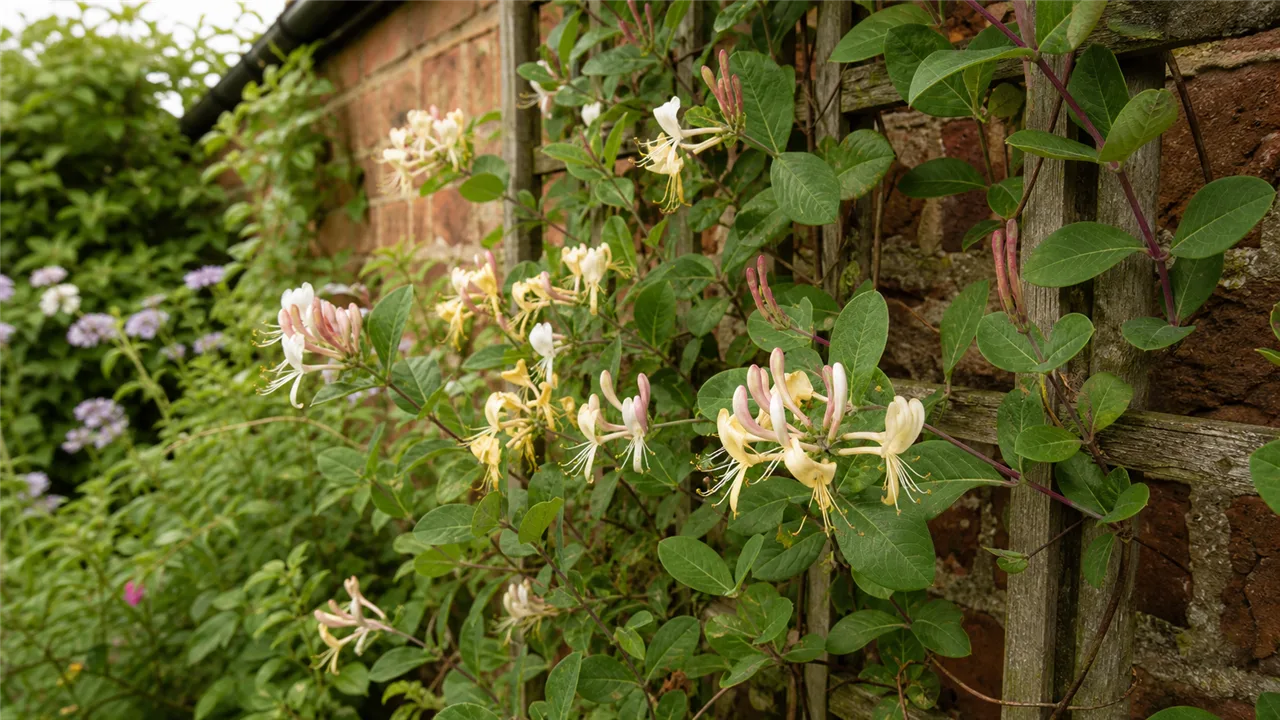
Young shoots are purplish, providing a useful identifying feature before the plant flowers. The leaves are oval, mid- to grey-green and downy rather than glossy. Together, the softly coloured foliage and slender, twining stems give the climber a less formal appearance than a closely clipped wall shrub.
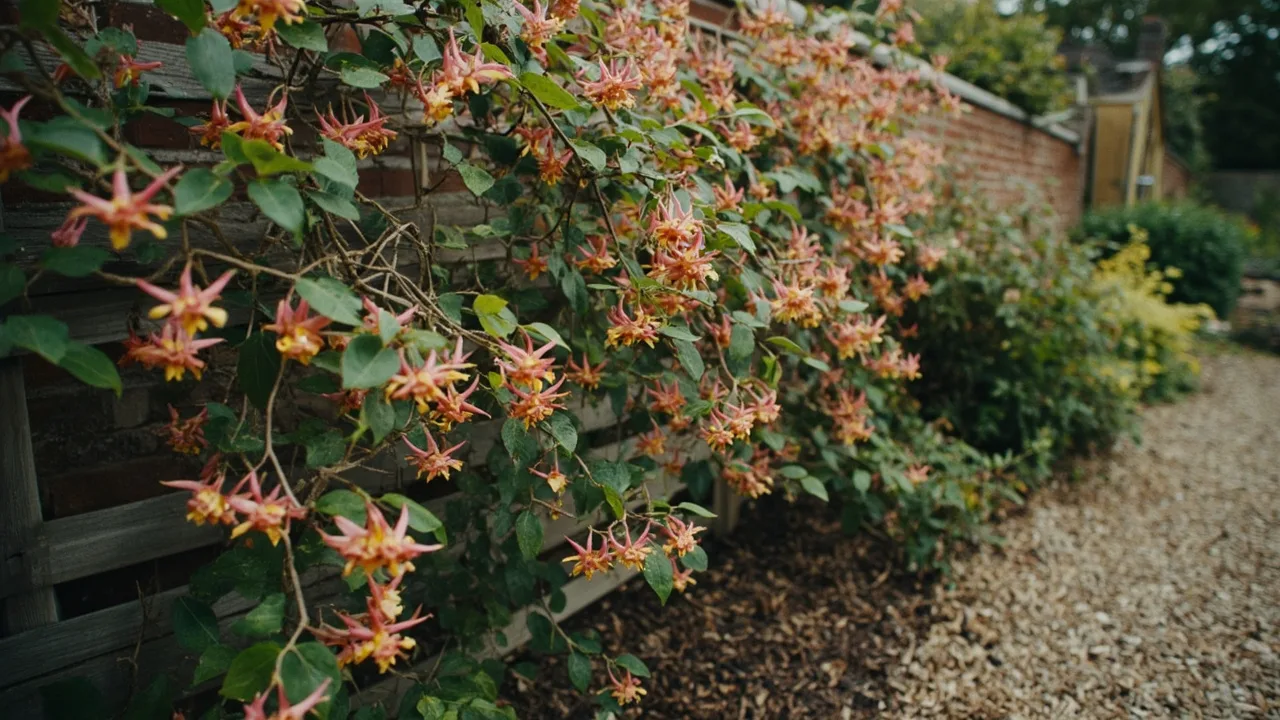
The flowers are the main attraction. They are fragrant, tubular and two-lipped, each about 5 cm long. When they open, the flowers are creamy with a red flush; as they age, they become yellow. Several stages of colour can be present at once, so an established plant may show cream, red-flushed and yellow flowers together. The straight species flowers in early to midsummer. Claims of flowering later into summer relate to the named selection ‘Superba’ and should not automatically be applied to every Lonicera etrusca plant.
Red berries follow the flowers. These are ornamental only and must not be eaten. The RHS advises using gloves or other protective equipment when handling the plant and warns that the fruit may be harmful if eaten, including by pets. Gardeners should position or manage the climber with children and animals in mind and should never assume that its berries are edible because some other plants have edible fruit.
At maturity, the plant’s vigorous growth can produce a substantial screen, but the overall density will depend on training and pruning. Guiding new stems across the available support, rather than allowing all growth to rise in one narrow column, is a practical way to develop more even coverage.
Growing Conditions
Choose a position in full sun, ideally against a sheltered south- or west-facing wall or fence. These aspects provide the warmth and light that suit the species while reducing exposure to cold winds. A durable free-standing structure in a similarly sunny, protected position can also work, provided it is strong enough to carry the mature stems.
Etruscan honeysuckle accepts chalk, loam or sandy soil and can grow in acid, neutral or alkaline conditions. Drainage matters: the soil should be moist but well drained, or reliably well drained. “Moist” does not mean waterlogged. If water remains around the roots for long periods, improve the site or choose another position rather than relying on the climber’s hardiness rating to compensate for unsuitable soil.
Walls and fences can create a rain shadow, leaving the soil at their base drier than the rest of the garden. It is therefore sensible to check moisture by hand rather than judging from rainfall alone. A yearly mulch can help the root zone retain moisture, particularly during establishment and in warm weather. Keep the mulch around the plant rather than piling it tightly against the stems.
For practical siting, aim to combine sunny top growth with a root zone that does not repeatedly dry out. This is an interpretation of the plant’s preference for full sun and moist, well-drained soil, not a requirement to place the roots in deep shade. The important point is to avoid both extremes: a cold, poorly lit position is unlikely to give the best floral display, while persistently parched soil can place the plant under stress.
‘Superba’ is particularly associated with warmer gardens and a warm south- or west-facing wall. Its reported heat tolerance belongs to that named selection; it should not be used as evidence that every plant of the species will perform identically in the hottest, driest position available.
Planting and Care
Install the support first. Use trellis or tensioned wires that are securely fixed and able to carry a mature woody climber. Leave enough space for air to move between the foliage and a wall, and make sure there are horizontal as well as vertical routes along which young shoots can be trained.
Deciduous climbing honeysuckles are best planted during winter, provided the ground is neither frozen nor waterlogged. Container-grown plants can be handled at other suitable times, but planting during hot or dry weather creates a greater watering burden. Set the plant where its stems can readily reach the support, firm it in and water thoroughly.
During the first spring and summer, water regularly while the root system establishes. Do not give frequent token splashes: check the soil and water sufficiently to reach the root zone. Once established, the plant should still be soaked during hot, dry spells. Soil beside a wall may need attention even when other borders remain moist.
Apply an organic mulch each year to help conserve moisture. At the same time, inspect ties, wires and trellis. Replace any tie that is cutting into an expanding stem and redirect vigorous shoots before they become tangled. Training a few strong stems across the support is easier than trying to reorganise a dense mature mass.
Prune after flowering, in line with RHS pruning group 11. Start by removing dead, damaged or badly placed growth. Shorten flowered shoots as needed to keep the climber within its allotted space and tie in useful replacement growth. Pruning at the recommended time retains a clear connection between flowering and maintenance and avoids unsupported assumptions about the plant flowering on a particular age of wood.
For propagation, the RHS lists layering and several forms of cuttings: softwood, semi-ripe, leaf-bud and hardwood. These options suit gardeners with different facilities and levels of experience. Layering can be a straightforward choice where a flexible shoot can be brought down to the soil while remaining attached to the parent plant; cuttings require closer control of material and growing conditions.
Care is mainly about maintaining the balance the plant prefers: strong light above ground, sufficient moisture without waterlogging, and good support for its twining stems. Gloves are a sensible part of routine pruning and handling, and all cut fruiting material should be kept away from children and pets.
Common Problems
Etruscan honeysuckle may be affected by honeysuckle aphids, thrips and glasshouse whitefly. Aphids are particularly likely to be noticed on tender young shoots in spring. Inspect new growth regularly so that a developing infestation is found early. A strong jet of water can sometimes dislodge small aphid colonies, but any further control should be chosen for the specific pest and used according to its instructions.
Powdery mildew is a common concern for climbing honeysuckles, especially in hot, dry weather. It appears as a powdery coating on foliage and is often associated with plant stress. Keeping the root zone adequately moist, applying mulch and avoiding an unnecessarily congested tangle of stems are practical ways to support the plant. These measures reduce stress and improve growing conditions; they do not make the plant resistant to mildew.
Fungal leaf spot and silver leaf are also listed risks, while honey fungus is described as rare. If leaves develop unexplained spotting, distortion or dieback, do not assume every symptom has the same cause. Examine the pattern and extent of damage, check recent watering and weather, and obtain a reliable diagnosis before choosing a treatment. Removing clearly dead material and keeping tools clean are sensible general measures, but a serious or spreading problem may require specialist advice.
Poor performance is not always caused by a pest or disease. Sparse flowering may reflect insufficient sun, while wilting or scorched-looking foliage can accompany dry soil, especially at the base of a wall. Conversely, consistently wet ground conflicts with the plant’s need for drainage. Checking the position, soil moisture and support should be part of any diagnosis.
The berries present a separate safety problem rather than a plant-health issue. They are not for eating and may be harmful to people and pets. Remove fallen or cut fruit where it could be investigated by a child or animal, wear gloves when handling the plant, and do not use the berries in food or home remedies.
Popular Varieties
The best-supported named garden selection is Lonicera etrusca ‘Superba’. The RHS describes it as a vigorous deciduous or semi-evergreen climber reaching about 4 m. It has red-tinged shoots, downy grey-green leaves and fragrant flowers that change from red with a pale throat through cream to orange-yellow. Red berries follow. It prefers full sun, a warm south- or west-facing wall and well-drained soil, and it shares the species’ H5 hardiness rating.
‘Superba’ is useful where a gardener wants the character of Etruscan honeysuckle in a particularly warm position. Its bloom can extend later into summer than the early- to midsummer period given for the species profile. That longer season and the selection’s heat tolerance should remain attached to ‘Superba’, rather than being presented as universal characteristics of Lonicera etrusca.
No other named cultivar is sufficiently supported by the approved evidence for recommendation here. This is important because botanical ranks and garden selections are not interchangeable. Plants of the World Online recognises two accepted infraspecific taxa, Lonicera etrusca var. etrusca and var. hispidula, but botanical varieties are not automatically retail cultivars or named selections.
Similarly, ‘Superba’ should not be described here as a current RHS Award of Garden Merit holder without checking the current award record directly. Its inclusion is based on the RHS evidence for the plant’s garden characteristics, not on an unsupported award claim. When buying, use the full botanical label, check whether the nursery is offering the straight species or ‘Superba’, and choose according to the conditions and flowering character actually described for that plant.
Pests and Diseases
| Problem | Symptoms | Management |
|---|---|---|
| Powdery mildew | White, dusty fungal growth appears on leaves and stems, often causing distortion. | Improve air circulation and apply a suitable fungicide if severe; avoid overhead watering. |
| Vine weevil | Notched edges on leaves above ground and root damage below, leading to wilting. | Apply nematodes to the soil in autumn or use systemic insecticides for potted plants. |
| Slugs and snails | Irregular holes chewed in leaves and silvery slime trails on foliage. | Use iron phosphate pellets, beer traps, or copper tape barriers around the base. |
| Aphids | Clusters of small soft-bodied insects on new growth, often accompanied by sticky honeydew. | Spray off with a strong jet of water or treat with insecticidal soap or natural predators. |
| Leaf spot | Circular brown or black spots develop on leaves, sometimes leading to premature leaf drop. | Remove affected leaves and avoid wetting foliage when watering to reduce fungal spread. |
For step-by-step help, read Controlling Aphids Naturally, Dealing with Slugs and Snails, Treating Powdery Mildew and Tackling Black Spot on Roses. Or browse the full plant problem solver to diagnose an issue by symptom.
Recommended Products
GardenWizz earns a commission from qualifying purchases made through affiliate links on this page (including links within the article) — as an Amazon Associate, and from Thompson & Morgan via the Awin network. This does not affect the price you pay. See our disclaimer for details.