Hybrid Honeysuckle
Lonicera × heckrottii
The Gardening Year
Best months in UK gardens · full planting calendar →
🖨 Printable care card (PDF)At a Glance
| Botanical name | Lonicera × heckrottii |
|---|---|
| Common name(s) | Hybrid honeysuckle |
| Family | Caprifoliaceae |
| Plant type | climber |
| Height × Spread | 8 m × — |
| Position | Full sun, Partial shade |
| Soil | Fertile, humus-rich, moist but well-drained (clay or loam) |
| Flowering | June–August |
| Toxicity | — |
| Native range | — |
Quick Answer: Hybrid honeysuckle (Lonicera × heckrottii) is a fragrant, deciduous or semi-evergreen climber for a sunny or lightly shaded UK wall, fence or pergola. Give it fertile, well-drained soil, a sturdy support and an annual tidy rather than severe routine pruning.
Overview
Hybrid honeysuckle is a garden hybrid in the Caprifoliaceae family, valued for richly scented flowers and a long summer display. Kew records Lonicera × heckrottii as an artificial cross involving L. caprifolium, L. etrusca and L. sempervirens, rather than a naturally occurring species. That parentage helps explain its mixture of European garden toughness, showy tubular flowers and vigorous twining growth.
It suits UK gardens where a climber is needed quickly but an invasive spreader is not wanted. Train it over a trellis, arch or pergola, and keep the roots cool with mulch. In a small garden, remember that a plant capable of reaching around 5m needs a support planned before planting, not added as an afterthought.
For nearby planting ideas, compare it with the common honeysuckle, climbing plants and perennial climbers.
Appearance
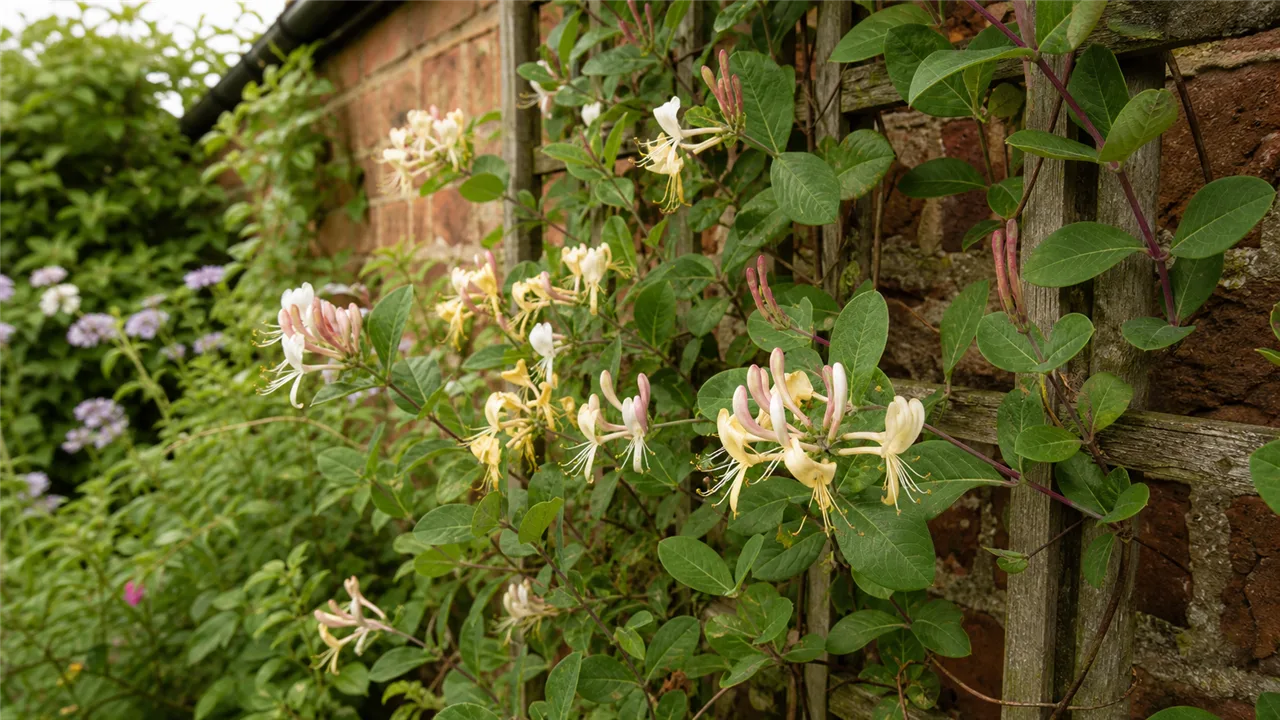
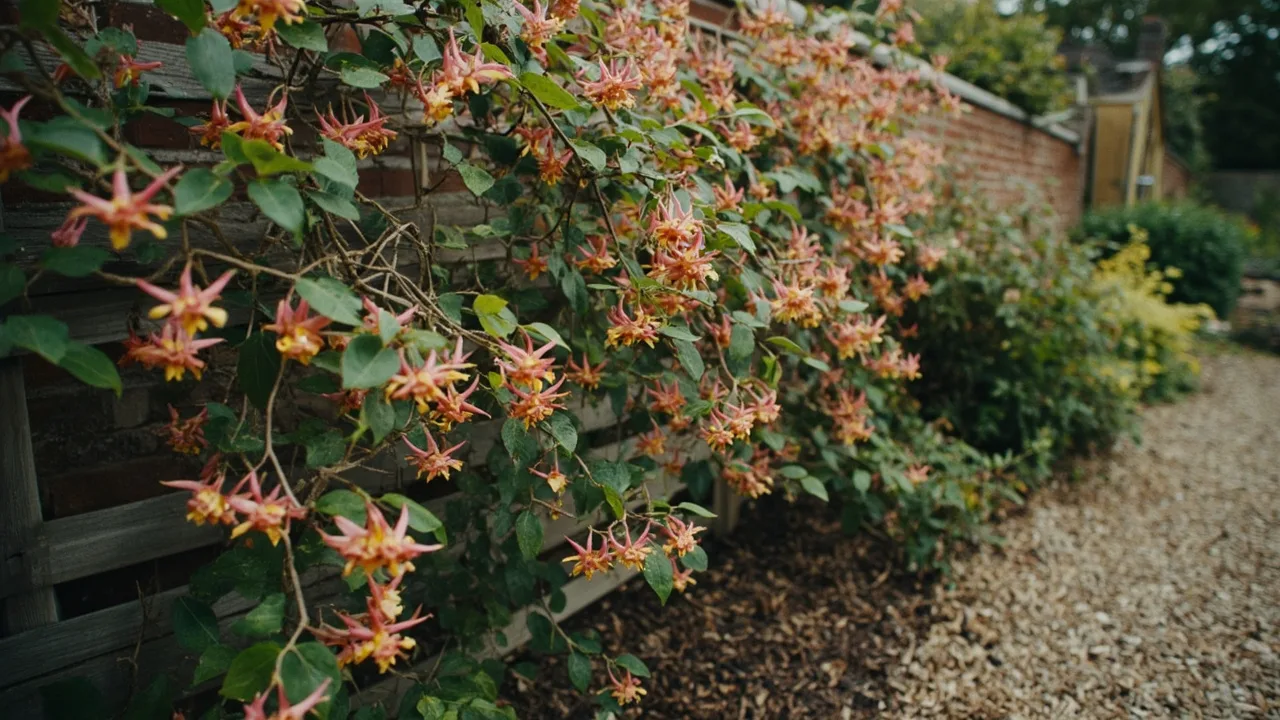
Many gardeners choose this honeysuckle for the contrast between pink or carmine outer petals and orange-yellow throats. The flowers are narrow, tubular and arranged in clusters around the ends of leafy shoots. Their fragrance is strongest in warm weather and is particularly noticeable beside a path, seating area or open window.
The paired leaves are oval and dark green, becoming blue-green as the season advances. Depending on the site and winter, the plant may be deciduous or retain some foliage. Its stems twine around slender supports, but they do not attach themselves to a wall like ivy; use soft ties to guide young growth through a trellis.
After flowering, red berries can form, especially after a warm summer. Fruit production is not guaranteed and should not be confused with the berries of native honeysuckle. The overall effect is a loose, floriferous climber rather than a dense evergreen screen, so underplanting or a second structural climber may be useful where year-round cover is required.
A useful trick is to place the flowers where their scent can be enjoyed at dusk, while allowing the foliage to shade the root area. This balances the plant's preference for light above ground with cooler, evenly moist soil below.
Growing Conditions
A south-, west- or east-facing position is suitable, provided the roots do not bake beside a heat-reflecting wall. Full sun encourages the heaviest flowering, while partial shade is acceptable and can be helpful in hot, dry gardens. Dense shade produces fewer flowers and weaker, more stretched shoots.
The best soil is fertile, moisture-retentive and free-draining. Improve thin or sandy ground with well-rotted garden compost before planting; on heavy clay, incorporate organic matter and check that water does not sit around the root ball in winter. A 5cm mulch of compost or leaf mould each spring helps maintain even moisture, but keep it clear of the stem.
New plants need regular watering during their first two growing seasons, particularly from May to September and during prolonged dry spells. Established plants tolerate short dry periods once rooted, but drought can reduce flowering and encourage pests. Water at the base rather than wetting the foliage repeatedly.
Provide a robust support: galvanised wires, a substantial trellis, arch or pergola. Fix the support securely to the wall or posts before the climber becomes heavy. Leave a small gap between a wall and trellis so air can circulate and stems can be tied in without trapping damp foliage.
One common mistake is choosing a site solely for the flowers and forgetting the roots. Keep the crown at the same level as it was in the pot, protect the base from strimmer damage and avoid planting where gutters discharge water onto the soil.
Planting and Care
October to March is the usual UK planting window when the soil is workable, although container-grown plants can be planted at other times if watered carefully. Dig a hole wider than the root ball, mix compost into the excavated soil, and set the plant at its original depth. Water thoroughly and tie the strongest shoots loosely to the support.
Water deeply rather than little and often. During the first summer, check the soil twice a week in dry weather; a newly planted climber may need more frequent attention on sandy soil or beside paving. Once established, water during drought while the plant is in active growth, then allow the surface to dry slightly between applications.
Feed in March with a balanced, slow-release fertiliser or a generous mulch of well-rotted compost. Avoid excessive nitrogen, which encourages soft leafy growth at the expense of flowers. A second light feed is rarely necessary in fertile ground.
Prune according to the plant's performance and the space available. In late winter or early spring, remove dead, damaged or crossing stems and tie in useful new growth. After the main flush of flowers, trim wayward shoots and thin congested growth. Avoid cutting the whole framework hard every year: this can remove flowering wood and leave a bare base.
Newly planted specimens benefit from formative pruning in early spring of their first full year, when weak or badly placed stems can be shortened and the framework established. Older plants that have become woody can be renovated gradually over two or three seasons, removing a proportion of the oldest stems at their base rather than exposing the plant in one operation.
Propagation is possible from semi-ripe cuttings taken in summer. Select healthy non-flowering shoots, cut below a leaf joint, remove the lower leaves and insert the cuttings into a gritty, free-draining mixture. Keep them covered in a bright, sheltered place until rooted. Layering a flexible stem into the soil is another practical method, though rooted plants may take a season to become independent.
Seasonal care is straightforward. Tie in fresh shoots during spring and early summer, water through dry June and July weather, and check ties before winter storms. In autumn, clear fallen leaves from the base if they remain wet, but retain a mulch to protect the root zone. Berries may be left for wildlife where they occur, unless self-seeding or a particular garden design makes removal preferable.
A handy tip is to train several stems horizontally before allowing them upwards. More flowering shoots develop along a spread framework than on one vertical stem, giving better coverage over a fence or pergola.
Common Problems
Aphids
I have found aphids most noticeable on soft shoot tips in spring, where they cause curling leaves and sticky honeydew. Inspect new growth regularly and squash small colonies or wash them off with a strong jet of water. Encourage ladybirds, hoverflies and other natural enemies; chemical treatment is seldom needed on a healthy established plant.
Powdery mildew
A white powdery coating on leaves usually follows dry roots, restricted air movement or crowded growth. Mulch and water the soil during dry periods, thin congested stems after flowering and avoid overhead irrigation. Remove badly affected leaves and improve ventilation rather than applying repeated feeds that drive soft growth.
Honeysuckle aphid and leaf distortion
Some honeysuckles develop distorted, puckered or discoloured young leaves after sap-feeding insects attack. Most gardeners see the worst symptoms early in the season, followed by useful natural control. Cut off badly affected tips if necessary, dispose of them with household waste and avoid broad-spectrum sprays that harm beneficial insects.
Scale insects
Brown or white scale on stems may weaken shoots and produce honeydew. A small infestation can be brushed off or treated with a suitable horticultural oil when the label permits. Prune out heavily infested twigs, improve plant vigour and inspect new plants before adding them to the garden.
Winter and wind damage
One common mistake is assuming a large climber needs no tying once established. Strong winds can tear stems from a trellis or rub them against supports. Check ties in autumn, replace tight ones with soft adjustable ties and remove broken wood back to healthy tissue in spring.
Popular Varieties
‘Gold Flame’ is the best-known name associated with this hybrid and is also sold in the UK under the synonym ‘American Beauty’. RHS Plants describes it as a free-flowering climber with fragrant pink-flushed, orange-yellow tubular flowers and a mature height of about 5m. Nursery listings and the RHS both use the two names, so check the botanical label when buying.
‘American Beauty’ is not a separate invented selection here: it is a widely used name for ‘Gold Flame’. This naming overlap is worth noting because plants labelled with either name may be offered in UK garden centres and catalogues.
Beyond ‘Gold Flame’/‘American Beauty’, reliable UK listings of distinct Lonicera × heckrottii cultivars are limited. Do not assume that every pink-and-orange honeysuckle is this hybrid; compare the full botanical name and supplier description. Where a nursery offers another selection, verify its identity and current availability before planting, as names and stock can change.
The RHS profile for ‘American Beauty’ is the safest reference for identification, while Kew's Plants of the World Online record confirms the hybrid name and parentage. A plant bought without a cultivar label can still be a worthwhile hybrid honeysuckle, but it should be described as Lonicera × heckrottii rather than given an invented variety name.
Sources & Further Reading
- Royal Horticultural Society, Lonicera × heckrottii ‘American Beauty’, accessed 25 July 2026.
- Royal Horticultural Society, How to grow climbing honeysuckle, accessed 25 July 2026.
- Royal Horticultural Society, Lonicera × heckrottii ‘Gold Flame hort.’, accessed 25 July 2026.
- Royal Botanic Gardens, Kew, Plants of the World Online: Lonicera × heckrottii, accessed 25 July 2026.
- BBC Gardeners' World, How to grow and care for honeysuckle, accessed 25 July 2026.
Pests and Diseases
| Problem | Symptoms | Management |
|---|---|---|
| Honeysuckle aphids | Clusters of small green or black insects on new shoots causing leaf curling and sticky honeydew. | Encourage natural predators like ladybirds or spray with a horticultural oil in early spring. |
| Powdery mildew | A white, dusty fungal growth appears on leaves and stems, potentially causing distortion. | Improve air circulation by thinning dense growth and avoid wetting foliage when watering. |
| Thrips | Tiny insects cause silvering or bronzing of leaves and may leave black specks of excrement. | Use blue sticky traps to monitor populations and spray with insecticidal soap if infestations are severe. |
| Fungal leaf spot | Distinct dark or brown spots develop on leaves, which may yellow and drop prematurely. | Remove and dispose of affected leaves to reduce spore load and avoid overhead watering. |
| Silver leaf | Leaves take on a silvery sheen when held up to the light, often accompanied by dieback. | Prune out infected branches well below the visible symptoms and burn them to prevent spread. |
For step-by-step help, read Controlling Aphids Naturally and Treating Powdery Mildew. Or browse the full plant problem solver to diagnose an issue by symptom.
Recommended Products
GardenWizz earns a commission from qualifying purchases made through affiliate links on this page (including links within the article) — as an Amazon Associate, and from Thompson & Morgan via the Awin network. This does not affect the price you pay. See our disclaimer for details.