Honeysuckle
Lonicera periclymenum · common honeysuckle · European honeysuckle · woodbine
The Gardening Year
Best months in UK gardens · full planting calendar →
🖨 Printable care card (PDF)At a Glance
| Botanical name | Lonicera periclymenum |
|---|---|
| Common name(s) | honeysuckle, common honeysuckle, European honeysuckle, woodbine |
| Family | Caprifoliaceae |
| Plant type | climber (deciduous twining climber, occasionally keeping its old leaves over winter) |
| Height × Spread | 2.3–7 m × 2.5–4 m |
| Position | Partial shade, Full sun |
| Soil | fertile, moist but well-drained soil |
| Flowering | June–November |
| Toxicity | Fruit are ornamental - not to be eaten |
| Native range | much of Europe, North Africa, Turkey and the Caucasus |
Lonicera periclymenum, commonly known as common honeysuckle or woodbine, is a twining deciduous climber native to much of the United Kingdom and across temperate Europe. It is widely grown in British gardens for its heavily scented, tubular flowers, its value to pollinating insects, and its tolerance of a range of conditions including partial shade. Unlike the Japanese honeysuckle (Lonicera japonica), it is generally considered well-behaved in the UK, though it can still climb vigorously given favourable conditions.
Overview
Honeysuckle is a vigorous, woody-stemmed climber that reaches for the light by twining its stems around supports rather than by clinging with tendrils or aerial roots. In the wild it is found scrambling over hedgerows, woodland edges, scrub and old trees, and it is this natural habit that makes it so useful for covering fences, pergolas, arches and unsightly garden structures. It is one of the most strongly scented of all hardy garden climbers, with the perfume typically strongest in the still, warm air of early evening, attracting pollinating moths as well as bees.
The species has received an Award of Garden Merit from the Royal Horticultural Society, and the RHS hardiness rating commonly cited for Lonicera periclymenum is H6 (hardy throughout the UK, tolerating temperatures down to around -20°C). The RHS classification scheme has been revised over the years, and growers checking the most current assessment should consult the RHS website directly.
All parts of the plant are considered mildly toxic if ingested, and the foliage can cause skin irritation in sensitive individuals. The berries in particular are not edible and should be kept away from young children. Gardeners handling large amounts of cut material may wish to wear gloves.
Appearance
Lonicera periclymenum is a twining, woody climber with paired, oval to oblong leaves arranged opposite one another along the stem. The leaves are typically 4–8 cm long, mid-green on the upper surface and slightly paler beneath, and they are usually deciduous, though in mild coastal or sheltered sites some leaves may persist into winter. The stems are woody at the base when the plant is mature, with newer growth remaining soft and flexible in the current season.
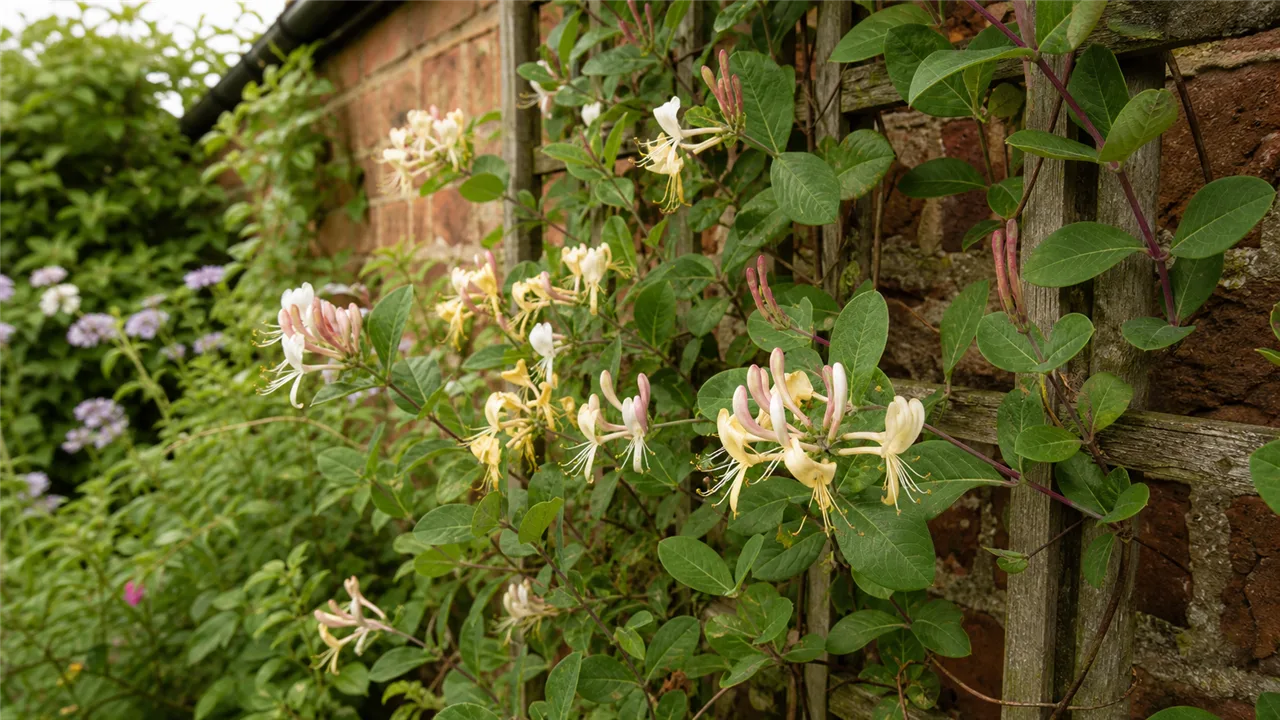
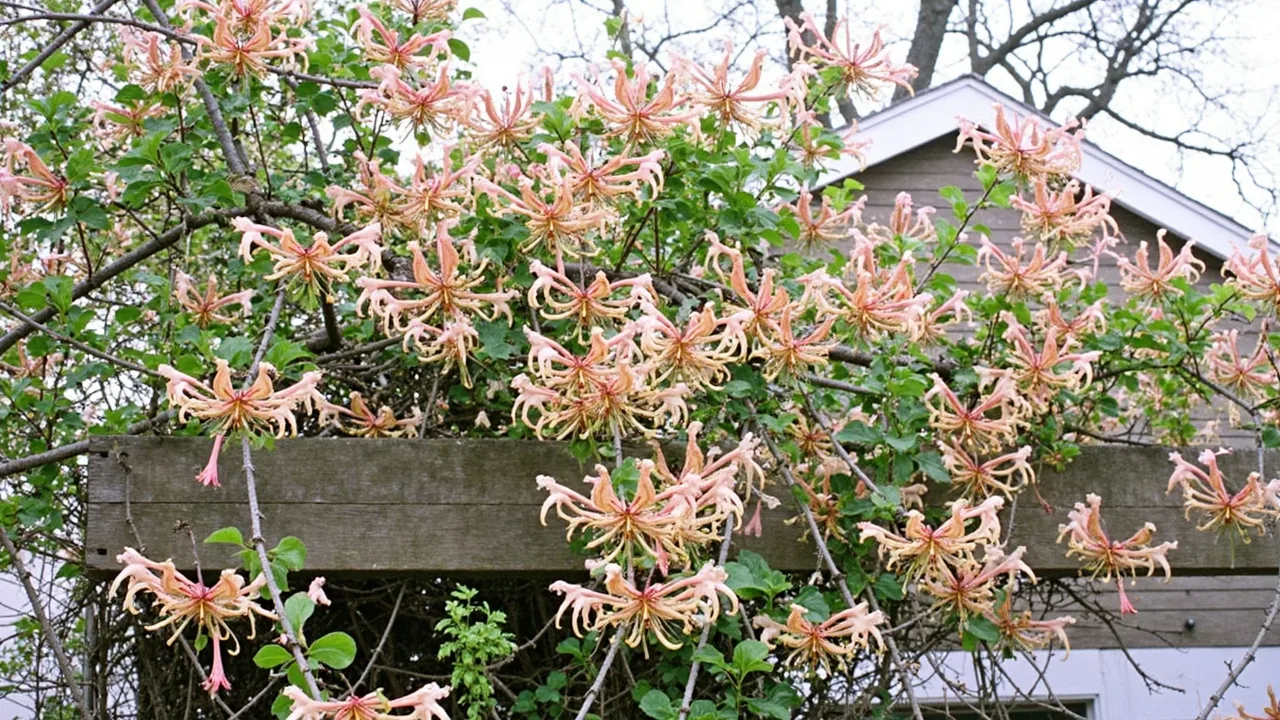
The flowers are carried in whorled clusters (technically cymose inflorescences) at the ends of the current year's shoots. Each flower is tubular, around 4–5 cm long, with a long slender tube and four recurved lips at the mouth. In the wild type, the buds are often flushed reddish-purple and open to a creamy-yellow interior, but the exact colouring varies. The flowers are followed in late summer and autumn by small, glossy red berries that are attractive to birds.
Flowering in the wild type is concentrated in mid to late summer, typically June to August, with cultivars varying in their precise season. The flowers give way to inedible red berries in late summer and autumn.
Growing Conditions
Common honeysuckle grows well throughout the UK, including in cooler northern regions and in most of Scotland given a reasonably sheltered site. It is tolerant of a wide pH range but performs best in soil that is moisture-retentive yet well-drained, ideally enriched with organic matter such as well-rotted garden compost or leaf mould. Once established, mature plants tolerate short dry spells, but they grow and flower far better where the roots are kept cool and the top growth is in sun or light dappled shade.
The classic advice for honeysuckle is to plant it with its roots in shade and its head in sun, a condition often met by training it up a north- or east-facing fence that then arches over into brighter light, or by placing it against a wall with shade at the base. While the plant tolerates denser shade than many climbers, flowering is noticeably reduced in heavy shade, and a position with at least half a day of direct sun gives the best floral display.
In coastal and exposed gardens, honeysuckle generally performs reasonably well, though very cold, drying easterly winds can scorch the foliage in spring, particularly on evergreens and on plants growing in thin, free-draining soils. Mulching in early spring helps conserve moisture and keeps the root run cool.
Planting and Care
Plant container-grown specimens at any time of year when the soil is workable and not frozen, although autumn and early spring are generally considered ideal as they allow the roots to establish before the main growing season. Dig a hole at least twice the width of the rootball and to the same depth, fork over the base, and incorporate organic matter into the backfill. Water in well and apply a 5–8 cm mulch of compost or bark, keeping the mulch clear of the stems.
Watering. Newly planted honeysuckles need regular watering through their first full growing season, particularly in dry spells. Once established, plants in ordinary garden soil usually only need supplementary water during prolonged drought, especially if they are growing in light or sandy ground.
Feeding. A general-purpose fertiliser, or a top-dressing of garden compost or well-rotted manure in early spring, is usually sufficient. Overfeeding with high-nitrogen feeds can produce lush foliage at the expense of flowers.
Pruning. Honeysuckles can be left largely to their own devices, but they flower best on relatively young, well-ripened wood. A light annual tidy after flowering, removing weak, congested or damaged growth and shortening the oldest stems to a strong sideshoot, is usually adequate. Neglected plants can be hard-pruned almost to the base in late winter; they will regrow but may flower less the following summer.
Propagation. Semi-ripe cuttings taken in mid to late summer root readily in a cold frame or propagator. Layering of low stems in autumn is also reliable. Seed is slower, often takes two years to germinate, and will not come true to type on named cultivars.
Seasonal care. Mulch in spring, water in dry spells during summer, check ties and supports as the new growth lengthens, and prune lightly after flowering. In late winter, cut out any dead or frost-damaged wood before the new buds break.
Common Problems
Honeysuckle is generally a healthy, trouble-free plant in most British gardens, but a few issues are worth watching for.
Aphids. Colonies of greenfly or blackfly may build up on the soft shoot tips in late spring and early summer, causing distorted growth and sticky foliage. They are usually kept in check by natural predators; a strong jet of water or a soap-based spray will deal with heavier infestations.
Powdery mildew. In hot, dry summers, particularly on plants in dry soil, the leaves may develop a white powdery coating. Mulching, watering during drought, and avoiding overly congested growth all help to reduce the problem.
Leaf spot. Fungal leaf spots can disfigure foliage late in the season but rarely threaten the plant's long-term health. Clearing up fallen leaves in autumn reduces carry-over of infection.
Suckering. Some honeysuckles can produce suckers from the base, which can be an advantage where ground cover is wanted but a nuisance in confined plantings. Suckers are easily removed by severing them at the root.
Possible decline of wild plants. Lonicera periclymenum and other native honeysuckles are among the species sometimes discussed in the context of declining pollinator populations, though the picture is complex. Gardeners planting for wildlife are generally advised to favour a mix of native plants over single, non-native species.
Popular Varieties
Several named cultivars of Lonicera periclymenum are widely available from UK nurseries, including from specialist climbers growers and the larger garden centres. The list below is given for guidance only; specific availability varies from year to year.
'Graham Thomas' – one of the most popular white- and yellow-flowered forms, with particularly long blooming period and good scent. Holds an RHS Award of Garden Merit.
'Serotina' – also widely sold as 'Late Dutch', with deep reddish-purple buds opening to creamy-yellow flowers, flowering later than many forms, often into September.
'Belgica' ('Early Dutch') – flowers earlier than the wild type, typically from late spring or early summer, with reddish-purple buds.
'Heaven Scent' ('Inov 42') – a more compact form with a particularly long flowering season and strong perfume; useful where space is limited.
Note that cultivar names and availability do change, and a small number of the cultivars historically sold in the UK have been subject to renaming or confusion in the trade. Where precise naming matters — for example, when ordering a specific colour form for a design scheme — confirmation from the supplier is recommended. Many of the above are also stocked grafted onto a stem to form a small weeping standard, popular for patio planting.
Cultivars and Varieties
| Cultivar | Height | Flower | Notes | AGM |
|---|---|---|---|---|
| 'Graham Thomas' | — | — | — | ✓ |
| 'Serotina' | — | — | — | ✓ |
Pests and Diseases
| Problem | Symptoms | Management |
|---|---|---|
| Honeysuckle aphids | Clusters of small green or black insects on new growth causing leaf curling and sticky honeydew. | Encourage natural predators like ladybirds or use a strong jet of water to dislodge them. |
| Powdery mildew | White, dusty fungal growth on leaves and stems, often appearing in dry, sunny conditions. | Improve air circulation by pruning and mulch in spring to maintain consistent soil moisture. |
| Slugs and snails | Irregular holes chewed into young leaves and stems, often accompanied by slimy trails. | Use physical barriers like copper tape or apply organic slug pellets around the base. |
| Vine weevil | Notched edges on leaves above ground and root damage below, leading to wilting in potted plants. | Apply biological nematodes to the soil in late summer or use systemic insecticides. |
| Leaf spot | Small brown or black spots on leaves that may enlarge and cause premature leaf drop. | Remove affected leaves and avoid wetting foliage when watering to reduce humidity. |
For step-by-step help, read Controlling Aphids Naturally, Dealing with Slugs and Snails, Treating Powdery Mildew and Tackling Black Spot on Roses. Or browse the full plant problem solver to diagnose an issue by symptom.
Honeysuckle in our guides
- Gardening for Pollinators
- Best Climbing Plants for UK Walls and Fences
- Designing a Cottage Garden
- Treating Powdery Mildew
Recommended Products
GardenWizz earns a commission from qualifying purchases made through affiliate links on this page (including links within the article) — as an Amazon Associate, and from Thompson & Morgan via the Awin network. This does not affect the price you pay. See our disclaimer for details.