Beet
Beta vulgaris
The Gardening Year
Best months in UK gardens · full planting calendar →
🖨 Printable care card (PDF)At a Glance
| Botanical name | Beta vulgaris |
|---|---|
| Common name(s) | beet |
| Family | Amaranthaceae |
| Plant type | perennial (rarely, biennial) |
| Height × Spread | 1.2–2 m × 10–50 cm |
| Position | Full sun, Partial shade |
| Soil | Moist but well-drained; fairly rich. |
| Flowering | — |
| Toxicity | No specific toxicity is listed by the RHS. This is not a guarantee of safety — check with a vet or the ASPCA before pets or children eat any plant. |
| Native range | southwestern, northern and Southeast Europe along the Atlantic coasts and the Mediterranean Sea, in North Africa, Macaronesia, to Western Asia |
Overview
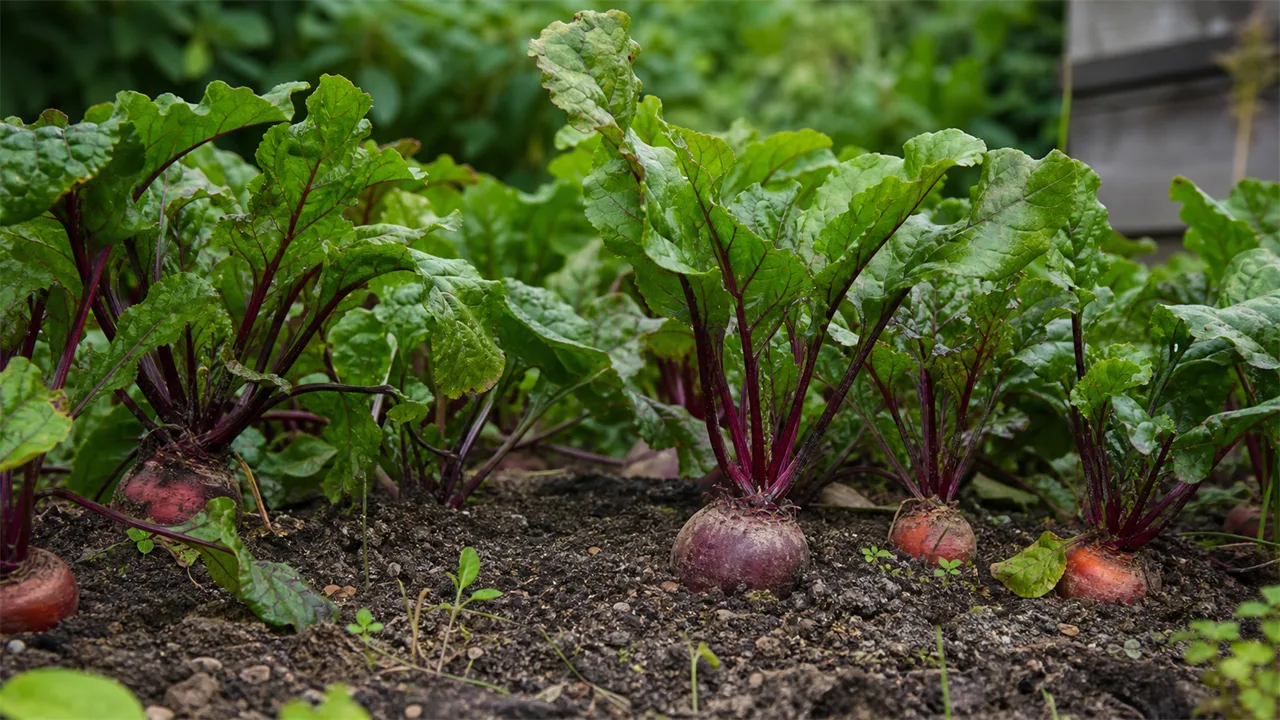
Beetroot (Beta vulgaris) is one of the most underrated crops on the British vegetable plot. It is reliable, fast, generous with its yield, and stores better than almost any other home-grown root. The swollen storage root and the leaves are both edible, and the same plant gives you a harvest from baby golf-ball beets in summer to fist-sized maincrop roots that keep in a clamp through winter. A member of the Amaranthaceae (formerly Chenopodiaceae), beetroot is closely related to chard, spinach and sea beet (B. vulgaris subsp. maritima) — the cultivated root form was developed from sea beet over centuries of selection for sugar and pigment.
It is a crop genuinely suited to the UK climate. Beetroot is a cool-season biennial grown as an annual, prefers 15–21 °C, and stands light frost without damage. It is one of the first crops you can sow in spring and one of the last you lift in autumn, with a long midsummer succession in between. Fresh beetroot has a sweetness and juiciness shop-bought roots rarely match — especially lifted young and cooked within an hour or two.
Sowing
Beetroot is a straightforward crop to sow but rewards attention to three details: temperature, seed type and spacing.
Seed — and why it matters. What looks like a beetroot seed is actually a small, corky, irregular cluster containing two to four true seeds. This means every "seed" you sow gives you a clump of seedlings that must be thinned — the single most common mistake beginners make. Monogerm varieties (where each cluster has been bred to contain a single seedling, or the seed is processed to rub it apart) are widely available and save thinning. If you are growing in modules or cells for transplanting, choose a monogerm or primed variety; if you are sowing direct in rows, either thin or use a monogerm type.
UK region-aware sowing windows. Beetroot needs a soil temperature of at least 7 °C to germinate reliably — sow into cold wet ground and the seed rots, or the seedlings bolt later. In the mild south-west, south coast, London and the south-east, the first sowing can go in from mid-March under cloches or fleece, with the main succession starting in early April. In the Midlands and the south-west inland, wait until the soil has warmed in early to mid-April. In the north of England, north Wales, lowland Scotland and the east, delay the first sowing until mid- to late April, and rely on a later succession for the main harvest. In upland and northern Scotland and exposed northern sites, sow from late April or even early May — pushing beetroot into cold ground is the surest way to get a crop of bolted, inedible plants.
Successional sowing. Beetroot is at its best lifted small — golf-ball to tennis-ball size — and a single sowing matures in a short window, so sow little and often. A useful pattern is to sow a short row every two to three weeks from your region's first safe date through to the end of June, or to mid-July in the south for a late autumn harvest. The last sowing should give you roots of usable size before the first hard frost in your area: that means finishing by early July in Scotland and the north, mid-July in the Midlands, and late July in the south-west and south coast.
Indoor vs direct. For the earliest crops in the north and Scotland, sow one or two seeds per module in a 24-cell tray in a cold greenhouse or cold frame from late March, then transplant the clusters (or thinned singles) when they have two true leaves and the soil outside has warmed. Direct sowing is more straightforward in milder regions and is the standard method for maincrop and succession sowings.
How to sow. Prepare a fine, firm, stone-free seedbed — a raked tilth the depth of a trowel blade. Mark out rows 30 cm apart for round varieties or 35–40 cm for long-rooted types such as 'Cylindra'. Draw a drill 2 cm deep with the corner of a hoe, water it well if the soil is dry, then space seeds (or seed clusters) 5 cm apart in the row. Cover, firm the soil back over the drill with the back of the rake, and water again. Germination takes 10–14 days in cool soil and 7–10 days once it warms. Cover the row with fleece or fine mesh until the seedlings are established to deter birds and flea beetle.
Spacing after thinning. Thin the seedlings to 10 cm apart for normal maincrop roots, or to 7–8 cm for smaller baby beets. The thinnings are tender and good in salads — don't waste them. For long varieties like 'Cylindra', thin to 8–10 cm in the row. The mature plant is roughly 25–30 cm tall and the same across at full leaf.
Growing
Beetroot is a forgiving crop once established but does benefit from steady, even growth — sudden checks from drought or poor nutrition produce woody, badly flavoured roots and trigger bolting.
Watering. The single biggest cause of poor beetroot is irregular watering. Soak the bed thoroughly once a week in dry spells rather than a daily sprinkle — a light shower wets only the surface and encourages shallow roots. From sowing until the roots are 2–3 cm across is the critical window; afterwards the plant's tap root can find its own moisture in all but the worst drought. Mulching between rows with 5 cm of garden compost in early summer cuts evaporation and keeps the soil cool, which in turn reduces bolting.
Feeding. Beetroot is not a hungry crop. A light dressing of blood, fish and bone raked into the seedbed a fortnight before sowing, plus a mulch of garden compost mid-season, is enough for most soils. Avoid high-nitrogen feeds — they push leaf at the expense of root, and a leafy canopy shades out the weeds for you. On light, alkaline or recently limed soils beetroot can show boron deficiency (internal brown corky rings in the root, black spots in the flesh). If your patch is known to be short on boron, a single pinch of borax (about 1 g per square metre) raked into the seedbed prevents the problem; do not exceed this, as boron is toxic in excess.
Weeding. Keep the rows weed-free while the canopy is small — beetroot does not compete well in its first six weeks. Once the leaves meet across the rows, the canopy smothers most weed growth itself.
Conditions. Beetroot prefers full sun and a light, well-drained soil with a pH of 6.5–7.5. It will tolerate heavier ground as long as it is not waterlogged, and will happily grow in raised beds and large containers (at least 25 cm deep). Avoid freshly manured ground — too much nitrogen produces forked, leafy roots with poor flavour. A bed that was manured for the previous crop is ideal.
Common problems. Bolting (running to seed in the first year) is caused by cold check at germination, drought stress, or sowing too early — choose a bolt-resistant variety such as 'Boltardy' for early sowings. Leaf miner (white trails in the leaves, worst May to July) is the most damaging pest — cover the crop with fleece from sowing through to mid-summer, or pick off affected leaves. Downy mildew (yellow patches on the upper leaf surface, grey-purple fungus underneath) thrives in damp, crowded crops — improve airflow by correct thinning and avoid overhead watering. Cercospora leaf spot (small grey-brown spots with reddish margins) is becoming more common in warm, wet summers — remove affected leaves and rotate the crop. Birds, especially pigeons, will strip a young row overnight — fleece or bird netting is essential until the leaves toughen up.
Harvesting
When to lift. Most round beetroot varieties are ready 8–10 weeks from sowing; long-rooted types such as 'Cylindra' take 10–12 weeks. Start pulling alternate roots from the row when the remainder are the size of a golf ball, leaving the others to swell. A beetroot left to grow past cricket-ball size becomes woody, loses its sweetness and is harder to cook evenly — but a row of large roots lifted in autumn for storage is a different proposition from a row for fresh summer eating, and both are worth growing.
UK region-aware harvest windows. In the south and south-west, the first sowings are ready from late May, with the main succession running from late June through October. In the Midlands, expect first harvests from mid-June, peaking in July and August. In the north of England, north Wales and lowland Scotland, first sowings come ready from early July, with the bulk of the harvest from late July through September. In upland Scotland and exposed northern sites, concentrate sowings so the crop finishes by mid- to late September before the first hard frost.
How to lift. Ease the roots out with a fork pushed in well away from the row so the tap root is not stabbed — a damaged root bleeds, loses flavour in storage and will not keep. Twist off the leaves an inch or two above the crown rather than cutting them flush; a cut flush invites rot. For baby beets, simply pull by hand after loosening with a hand fork.
Signs of readiness. Lift one to check. The crown should sit at or just above soil level and feel firm; oversize roots push up out of the ground and the crown turns rough and purple. If the root is finger-thick, it is a baby — leave it another two to three weeks; if it is fist-sized and you want it for storage, lift now before the ground gets cold.
Eating
Fresh beetroot cooks in a fraction of the time the supermarket version takes — small tender roots boil in 25–35 minutes, or roast in 45 minutes wrapped in foil, and can be grated raw into salads. The classic British preparation is pickled beetroot — boiled, sliced and covered in malt vinegar — and a row of maincrop roots will see you through a winter of sandwiches. Equally good: roasted whole with olive oil and thyme and served with goats' cheese and walnuts; grated raw with apple, horseradish and soured cream; or blended into borscht.
The leaves are a bonus crop. Young beetroot leaves, picked at 5–10 cm tall and treated like spinach, are excellent wilted with butter and garlic. Older leaves work in cooked dishes as a substitute for chard. There is no waste.
Beetroot is also one of the most forgiving vegetables to preserve. Pickled roots in sterilised jars keep for a year. Cooked and vacuum-packed beetroot freezes for six months and goes straight from the freezer into soups and purées. The pigment — betalain — holds its colour through cooking, which is why beetroot keeps its hue so well in pickles and chutneys.
Storing
Maincrop beetroot stores better than almost any other home-grown root.
Lifting for storage. Lift in October, before the first hard frost. Choose a dry day. Twist off the leaves an inch above the crown, brush off loose soil (do not wash), and set aside any damaged or very small roots for immediate use.
Clamping and boxing. Layer roots in a wooden box or potato clamp, alternating with damp (not wet) sand or old potting compost, with the crowns uppermost. A standard potato-style clamp — a 60 cm layer of roots on a dry base, covered with 15–20 cm of straw and 15 cm of soil — works well outside the very north. The ideal temperature is 3–5 °C with high humidity: an unheated shed, garage or north-facing outbuilding. Do not store in the kitchen — warmth shrivels the roots within weeks.
In good conditions, clamped beetroot keeps in usable condition from October to March. Check once a month and remove any roots showing rot; one bad root spreads quickly.
Recommended cultivars for UK growers. 'Boltardy' (the reliable UK benchmark — bolt-resistant, round, deep red; the variety to grow if you only grow one). 'Detroit 2' (classic round, smooth-skinned, good flavour). 'Bona' (monogerm — no thinning needed). 'Chioggia' (Italian heirloom with concentric pink-and-white rings when sliced raw; loses the rings when cooked). 'Cylindra' (long cylindrical roots — slice evenly, ideal for pickling). 'Pablo' F1 (deep red, smooth, holds quality well). 'Action' F1 and 'Alto' F1 (reliable maincrop and storage types). Late-sown, large-rooted types store best; baby and round summer beetroot are not worth storing — eat them fresh.
Cultivars and Varieties
| Cultivar | Height | Flower | Notes | AGM |
|---|---|---|---|---|
| 'Altissima Group' | — | — | sugar beet | |
| 'Cicla Group' | — | — | spinach beet or chard | |
| 'Conditiva Group' | — | — | beetroot or garden beet | |
| 'Crassa Group' | — | — | mangelwurzel | |
| 'Flavescens Group' | — | — | swiss chard |
Pests and Diseases
| Problem | Symptoms | Management |
|---|---|---|
| lack of boron | meristem and the shoot to languish, eventually leading to heart rot | — |
Or browse the full plant problem solver to diagnose an issue by symptom.
Companion planting
✔ Grows well with: bulb onion, lettuce.
✘ Keep apart from: Pea, runner bean.
Full companion planting chart →
Beet in our guides
Recommended Products
GardenWizz earns a commission from qualifying purchases made through affiliate links on this page (including links within the article) — as an Amazon Associate, and from Thompson & Morgan via the Awin network. This does not affect the price you pay. See our disclaimer for details.