Common Thyme
Thymus vulgaris · German thyme · garden thyme · thyme
The Gardening Year
Best months in UK gardens · full planting calendar →
🖨 Printable care card (PDF)At a Glance
| Botanical name | Thymus vulgaris |
|---|---|
| Common name(s) | common thyme, German thyme, garden thyme, thyme |
| Family | Lamiaceae |
| Plant type | shrub (evergreen subshrub; can be short-lived in garden use as groundcover) |
| Height × Spread | 15–30 cm × 40 cm |
| Position | Full sun |
| Soil | well-drained, alkaline to neutral soils |
| Flowering | June–August |
| Toxicity | No specific toxicity is listed by the RHS. This is not a guarantee of safety — check with a vet or the ASPCA before pets or children eat any plant. |
| Native range | southern Europe from the western Mediterranean to southern Italy |
Overview
Common thyme (Thymus vulgaris) is a small, evergreen subshrub from the family Lamiaceae, grown in British gardens for its aromatic foliage, its value as a culinary herb, and its importance to pollinating insects. The quick-care table below summarises the essentials for UK growers; the full article expands on each point.
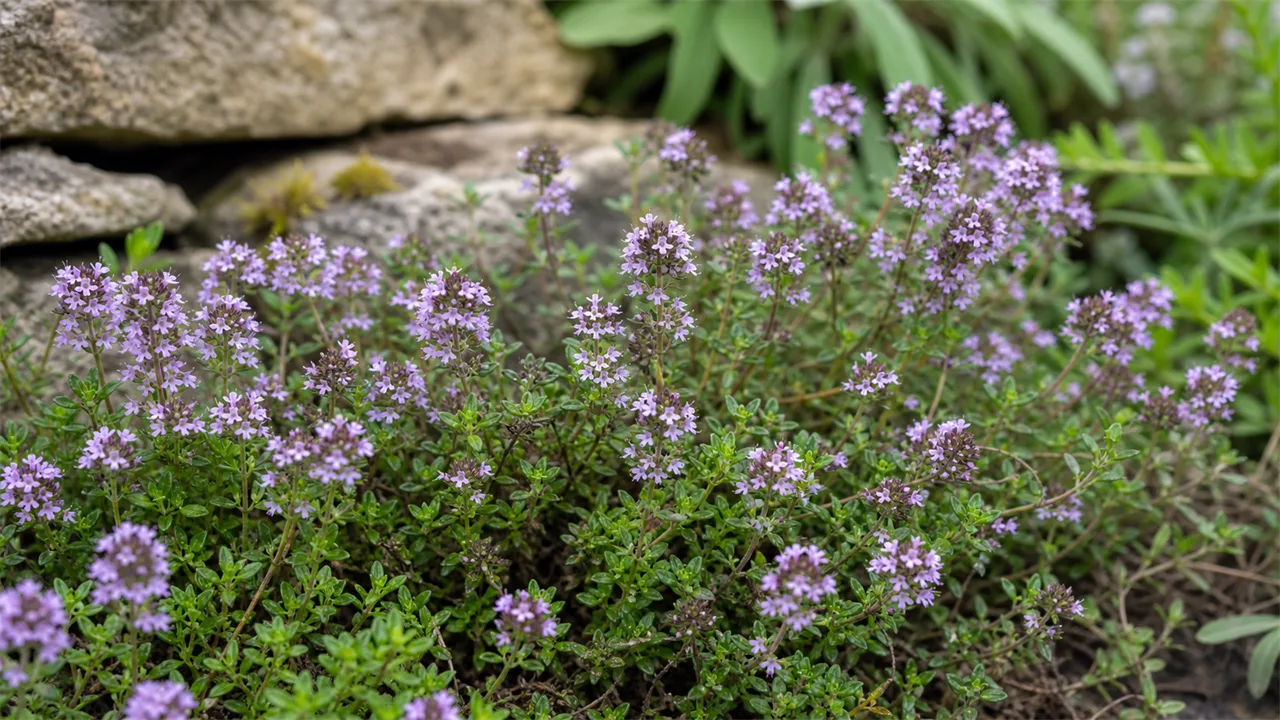
Thymus vulgaris is a small, woody-based subshrub native to dry, rocky slopes of the western and central Mediterranean, where it grows on stony, sun-baked ground among other low, aromatic herbs. It has been grown in British herb gardens since at least the sixteenth century and is today one of the most widely planted culinary herbs in the country, equally at home in a dedicated herb bed, at the front of a sunny border, in a gravel garden, or in a terracotta pot on a sunny patio. The plant forms a low, dense mound of fine, wiry stems clothed in small grey-green leaves, the whole plant strongly aromatic when bruised. In early to midsummer it produces whorled clusters of tiny two-lipped flowers, usually pale lilac to pinkish-mauve, that are exceptionally attractive to honey bees, bumblebees and hoverflies. It is reliably hardy across most of lowland Britain, tolerates drought once established, and is a useful structural plant at the front of sunny borders and along the edges of paths, where its scent is released as visitors brush past. It is also grown commercially in the United Kingdom for the fresh and dried herb market, with production concentrated in the southern and eastern counties.
Appearance
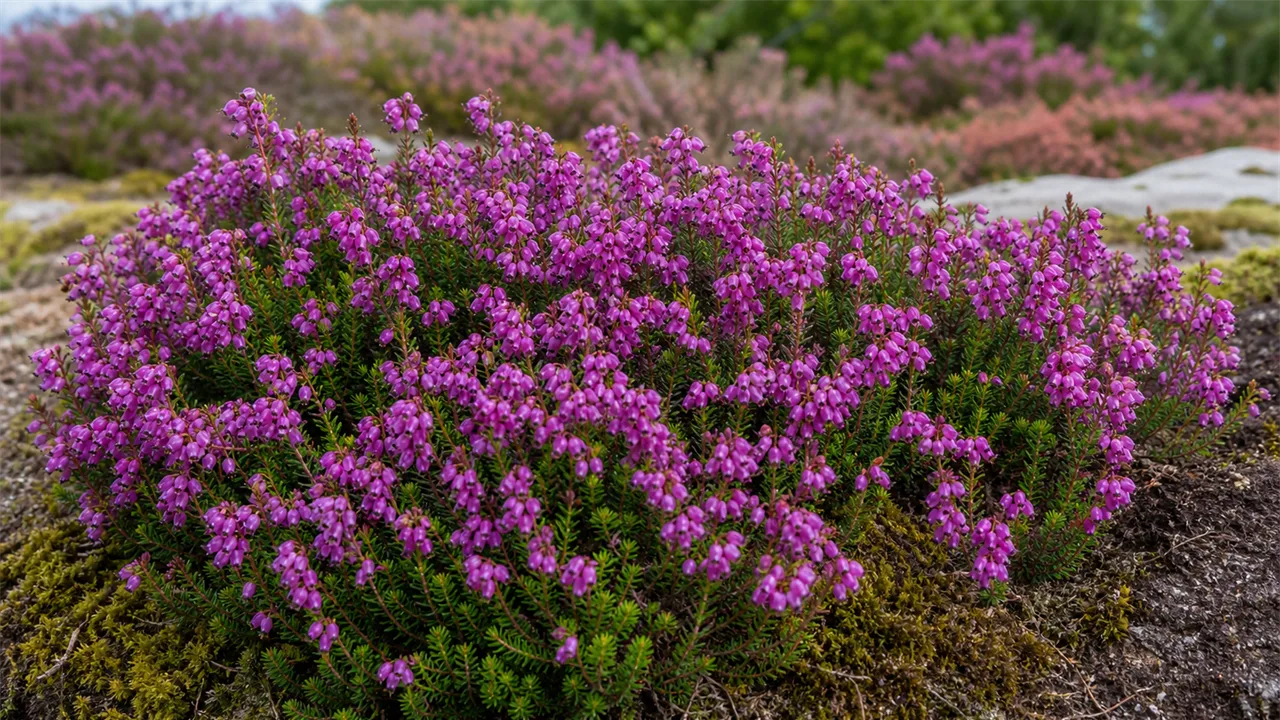
Thymus vulgaris is a compact, woody subshrub with a creeping or slightly upright habit, the older stems becoming hard and gnarled with age while the current season's growth remains soft, square and green. The leaves are small, opposite, narrowly oval to lance-shaped, 4 to 12 mm long, and grey-green to dull mid-green; they are dotted with tiny oil glands that give the foliage its warm, pungent aroma when crushed. The flowering stems in late spring and summer carry loose whorls of small, two-lipped flowers at the upper nodes, forming short, interrupted terminal spikes usually 3 to 8 cm long, well above the leafy body of the plant. Individual flowers are typically pale lilac, pinkish-mauve or occasionally near-white, with a paler throat, and are followed by small dry nutlets in late summer. The overall effect is of a finely textured, mounded plant that softens the front of a border without crowding neighbouring plants, and that retains its foliage through the winter in most years, particularly in milder and coastal districts. A small number of cultivars are variegated, with cream or silver edges to the leaf. As plants age, particularly if they are not regularly trimmed, they become leggy and develop bare, woody centres, with leafy growth only at the tips of the branches; this is a normal stage in the life of the plant rather than a sign of ill-health.
Growing Conditions
Thymus vulgaris performs best in full sun, in poor to moderately fertile, sharply free-draining soil of near-neutral to slightly alkaline pH. It tolerates thin, stony and even gravelly ground far better than rich, moisture-retentive soil, and the most common cause of failure in British gardens is winter wet around the crown, which leads to die-back and, on heavy clay, to outright loss. In practice this means raised beds, the top of a dry wall, gravel gardens, alpine beds, the foot of a sunny south-facing wall, and containers of loam-based potting mix with added grit are all more reliable than a low-lying border on cold clay. The RHS rates Thymus vulgaris as H5, meaning it is hardy across most of the United Kingdom, including the colder parts of northern England, lowland Scotland and most of the Midlands; in exposed upland or northern gardens, siting plants against a warm wall and mulching the crown with coarse grit rather than bark or compost will improve winter survival. Thyme is intolerant of dense shade, of permanently damp ground, and of heavy mulches that hold moisture against the stems, and it flowers poorly and becomes soft and leggy in fertile, well-watered border soil. UK seasonal guidance is straightforward: new growth begins in March or April, the main flowering period runs from late May or June through July into early August, and growth slows through the autumn, with the plant largely dormant from December to February. In cold winters the foliage can become duller or bronze-tinged, but established plants usually re-grow strongly from the base once temperatures recover in spring.
Planting and Care
Plant container-grown specimens in spring, from late March to early May, or in early autumn, from mid-September to mid-October, avoiding the cold wet months of high winter. Space plants 25 to 30 cm apart for a dense mat, 35 to 45 cm apart for an open drift, and water in well after planting. For container cultivation, use a loam-based compost such as John Innes No. 2 mixed with about a quarter by volume of coarse grit, and raise the pot on pot feet so that excess water drains freely. Watering should be modest: keep the compost just moist for the first growing season, then allow the soil to dry out between waterings; established plants in the open ground rarely need supplementary watering except in prolonged summer drought. Feeding is light to unnecessary: an annual top-dressing of garden compost in spring, or a single application of a general-purpose granular fertiliser, is sufficient, and overfeeding produces soft, leafy growth that is more vulnerable to winter damage and less intensely flavoured. Pruning is the most important annual task. Each year, immediately after the main flush of flowers fades in late July or early August, trim the plant back lightly with shears to remove the spent flower spikes and neaten the mound, taking care not to cut into the old, leafless wood at the base, which rarely regenerates. A second, lighter tidy in early spring removes any winter-damaged tips. Plants left unchecked for several years are difficult to restore and are usually best replaced. Propagation is straightforward from semi-ripe cuttings taken in midsummer: 5 to 8 cm tip cuttings root readily in a gritty, free-draining compost kept shaded and lightly moist under a cold frame. Mature plants can also be divided in spring or layered by pegging a low shoot into the soil until it roots. Seed germinates readily but produces variable offspring, so named cultivars are propagated by cuttings rather than seed. Seasonal care follows a simple rhythm: light spring tidy in March and April, minimal summer watering, the main trim in late July or early August once the flowers fade, and a thin mulch of coarse grit around the crown going into winter rather than a moisture-retaining organic mulch.
Common Problems
The most common problem with Thymus vulgaris in the United Kingdom is winter die-back caused by cold, wet conditions at the crown, particularly on heavy or poorly drained soils and after wet winters. Symptoms appear in late winter or early spring as the foliage turning grey-brown and the plant failing to break into fresh growth from the base; affected specimens usually need to be replaced, particularly if the older wood is soft or discoloured. Aphids can colonise the soft tips of new growth in late spring and early summer, causing minor distortion and sooty mould, but they are usually kept in check by natural predators and rarely justify treatment. Red spider mite can be a problem on plants grown under glass or in very dry, sheltered courtyards during hot summers, producing a fine pale speckling on the leaves; improving humidity and removing the worst-affected shoots is usually sufficient. Honey fungus (Armillaria mellea) has been recorded on thyme but is uncommon, and the plant is generally regarded as largely trouble-free in well-drained soil in full sun. The plant is not considered toxic to humans or domestic animals and is widely used as a culinary herb, though, as with all plants not normally eaten, ingestion of large quantities may cause mild gastric upset. The chief cultural remedy for most of these problems is a sunnier, drier site and a lighter, grittier soil; a struggling thyme is almost always a wet or shaded thyme, and moving an ailing plant to a more Mediterranean-style position will usually resolve the issue more reliably than any treatment.
Popular Varieties
Thymus vulgaris 'Silver Posie' is one of the most widely planted cultivars in British gardens, with leaves edged and splashed with silver-white and the usual lilac-pink flowers; it holds the RHS Award of Garden Merit and is grown as much for its foliage as for its culinary value, reaching about 20 to 25 cm tall. The similar 'Silver Queen' is another variegated form, grown chiefly for its silver-white edged foliage as ornamental edging and in containers, and sharing the drought-tolerance and sun-loving habit of the species. 'Compactus' is a dense, low-growing form with small, fine leaves and a particularly neat, rounded habit, well suited to edging paths and growing in pots, where it forms a tidy mound roughly 15 to 20 cm tall. The broad-leaved French thyme, often sold as Thymus vulgaris 'French' or simply as 'French thyme', has noticeably wider, fleshier leaves with a sweeter, less pungent flavour than the species and is the form most often found in supermarket pots of fresh thyme, reaching about 25 to 30 cm tall. 'German Winter' is a particularly hardy selection with a low, spreading habit and a strong, traditional thyme flavour, useful in colder inland gardens. 'Tabor' is a more compact, upright form raised for the herb trade, with a tidy habit and a clean flavour. Thymus vulgaris should not be confused with creeping or wild thymes, such as Thymus serpyllum and Thymus 'Coccineus', which are grown chiefly as flowering ground cover in lawns and paving; the culinary forms discussed here all share the upright or slightly mounded habit of the species and the strongly aromatic grey-green foliage characteristic of common thyme.
Cultivars and Varieties
| Cultivar | Height | Flower | Notes | AGM |
|---|---|---|---|---|
| 'Argenteus' | — | — | silver thyme | |
| 'Silver Queen' | — | — | white-margined leaves, gained the Royal Horticultural Society's Award of Garden Merit | ✓ |
Pests and Diseases
| Problem | Symptoms | Management |
|---|---|---|
| Damping off | Seedlings collapse and rot at the base due to fungal infection in damp conditions. | Use free-draining seed compost, avoid overwatering, and ensure good air circulation. |
| Root rot | Foliage turns yellow or brown and wilts despite moist soil due to waterlogged roots. | Plant in well-drained soil and avoid heavy mulching around the crown. |
| Powdery mildew | A white, dusty fungal growth appears on leaves and stems, often in humid conditions. | Ensure good air circulation by pruning and avoid wetting foliage when watering. |
| Slugs and snails | Irregular holes chewed into young shoots and leaves, with slimy trails visible. | Use physical barriers like copper tape or organic slug pellets around new plants. |
| Winter dieback | Stems turn brown and brittle during wet, cold winters due to poor drainage. | Site in full sun with excellent drainage and avoid planting in heavy clay soils. |
For step-by-step help, read Dealing with Slugs and Snails and Treating Powdery Mildew. Or browse the full plant problem solver to diagnose an issue by symptom.
Common Thyme in our guides
- Container Gardening for Beginners: Pots, Compost and Care
- Creating a Herb Garden
- Designing a Cottage Garden
- Gravel Gardens Explained
- Small Garden Design Ideas
- The Blooming of the RHS Multiple Sclerosis Garden
Recommended Products
GardenWizz earns a commission from qualifying purchases made through affiliate links on this page (including links within the article) — as an Amazon Associate, and from Thompson & Morgan via the Awin network. This does not affect the price you pay. See our disclaimer for details.