Bell Heather
Erica cinerea
The Gardening Year
Best months in UK gardens · full planting calendar →
🖨 Printable care card (PDF)At a Glance
| Botanical name | Erica cinerea |
|---|---|
| Common name(s) | Bell heather |
| Family | Ericaceae |
| Plant type | shrub |
| Height × Spread | 15–60 cm × 50–100 cm |
| Position | Full sun |
| Soil | well-drained, neutral to acidic |
| Flowering | July–August |
| Toxicity | — |
| Native range | western and central Europe |
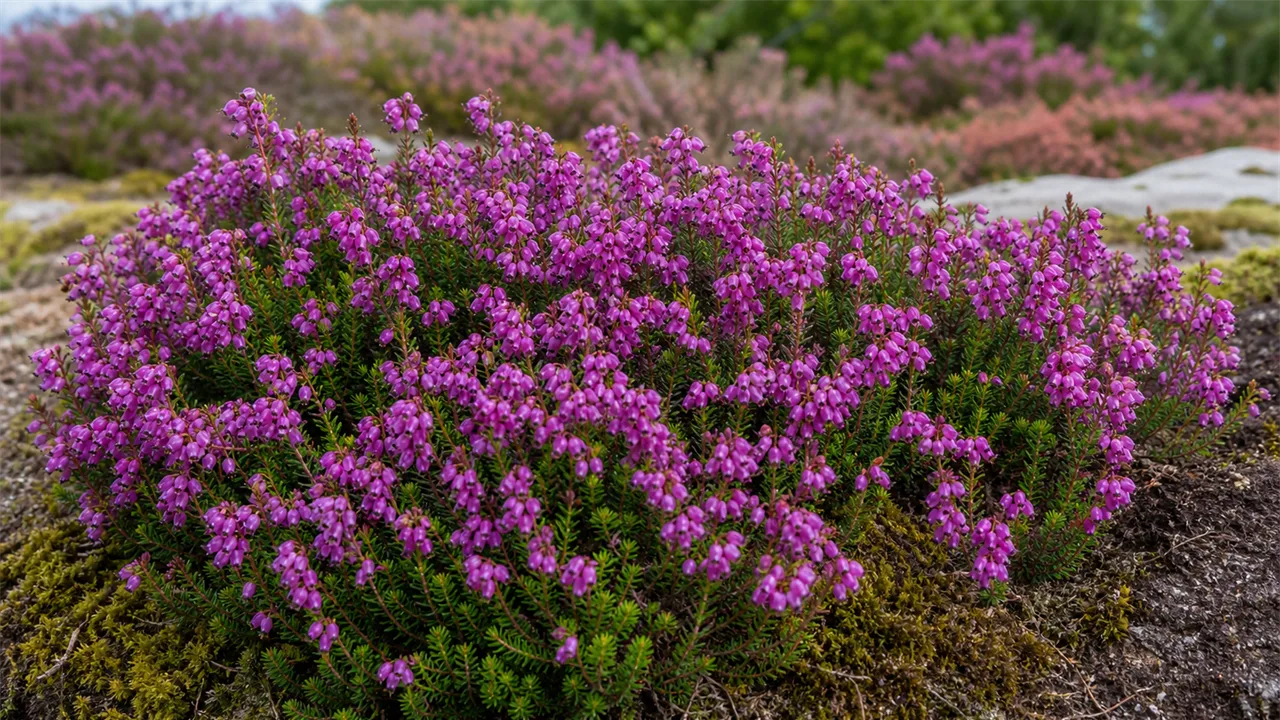
Bell heather (Erica cinerea) is a low-growing evergreen shrub of the family Ericaceae, native to the heaths and moors of western and central Europe. In British gardens it provides one of the most reliable midsummer flower shows among hardy heathers, forming spreading carpets of needle-like foliage topped with clusters of bell-shaped blooms from July into late August.
Overview
Bell heather belongs to the genus Erica, which contains more than 800 species of evergreen shrubs found across Europe, southern Africa and the Mediterranean basin. Erica cinerea is one of the two heathers most widely grown in British gardens alongside heather Calluna vulgaris, and it carries the Royal Horticultural Society's Award of Garden Merit as a species. Plants form low, spreading mounds of fine dark green foliage that, in mid to late summer, become densely clothed with small bell-shaped flowers in shades of purple, pink, magenta and, in selected cultivars, white. The species is hardy across most of the UK and is particularly valued for clothing banks, gravel gardens and the front of sunny borders where its tolerance of poor, acidic soils is an asset rather than a liability.
Appearance
Bell heather is a wiry, much-branched sub-shrub whose woody framework supports whorls of fine needle-like leaves arranged in threes along the stem. The leaves are typically only 4–7 mm long and a deep, slightly glossy green, giving established plants a dense, almost mossy texture when viewed at close range. Plants in cultivation usually grow 15–60 cm tall, depending on cultivar and situation, with a spread of 50–100 cm or more once mature.
Flowers are the principal ornamental feature. They are carried in short one-sided racemes at the tips of the previous year's shoots, opening from the base upwards over a long midsummer season. Individual blooms are urceolate, or urn-shaped, around 5–7 mm long and slightly constricted at the mouth. In the wild type the colour is a rosy purple, but cultivated varieties extend the range to deep magenta, clear pink, white and almost black-purple. The contrast between dark foliage and brightly coloured flowers is the source of much of the plant's garden value.
Growing Conditions
Bell heather performs best in open, sunny positions on well-drained, neutral to acidic soils. It is one of the lime-sensitive heathers: on strongly alkaline ground the foliage yellows and growth becomes thin and starved. Where the underlying soil is chalky or limy, successful cultivation depends on raised beds or generous containers filled with ericaceous loam-based compost. The plant tolerates poor, sandy and peaty soils and is widely used on the very freedraining substrates that defeat many garden shrubs.
The species is hardy throughout the UK and Ireland. Its hardiness is held in the structured plant record and rendered as a badge on the live page; readers should refer to the displayed hardiness rating rather than relying on a stated temperature. Good drainage is more important than any specific winter cold figure: cold wet ground at the root is the principal cause of winter losses, particularly on heavier soils in the wetter west and north.
In the south and east of England bell heather is straightforward in any well-drained sunny border. In the north and west, exposure to driving wind and persistent winter wet can shorten its life; planting on a slope or in a gravel matrix that sheds water away from the crown is usually the answer. Coastal gardens are a particularly favourable setting, as the plant tolerates salt-laden wind better than most ericaceous shrubs.
Planting and Care
Planting is best carried out in autumn or early spring, when the soil is workable and moisture levels are reliable. Container-grown stock can be planted at any time the ground is not frozen, although autumn establishment gives roots a full winter to settle before the first summer's drought. Bell heather is normally offered for sale as pot-grown plants rather than bare-root, and these should be planted at the same depth as they sat in their pots, with the rootball gently teased if it has become congested.
Watering is most important in the first growing season. Water thoroughly at planting and during dry spells of the first summer; established plants in suitable soil are notably drought-tolerant and only need supplementary watering in prolonged dry weather. Avoid waterlogged positions, which cause root loss in winter.
Feeding should be modest. A light dressing of an ericaceous fertiliser in spring, just as new growth begins, is usually sufficient. Over-feeding produces soft, leafy growth at the expense of flower and shortens the plant's life. A yearly organic mulch of bark or composted bracken, applied in spring and kept clear of the stems, feeds the soil, conserves moisture and helps maintain acidity around the root zone.
Pruning of bell heather is light. The traditional approach is to trim the plant lightly each year immediately after flowering, using shears or hand secateurs to remove the spent flower spikes and a small amount of the current season's growth. This keeps plants compact and flowering freely for many years. Avoid cutting into old bare wood, which rarely produces new shoots on Erica cinerea. Trimming should not be carried out after late autumn, as the regrowth produced can be vulnerable to winter damage.
Propagation is straightforward from cuttings. Semi-ripe heel cuttings taken in mid to late summer, dibbled into a 50:50 mix of peat-free ericaceous compost and perlite, root readily under a cold frame or in a shaded propagator. Layering is also effective: a low branch pinned to the soil will usually root within twelve months and can then be detached and potted on. Seed propagation is possible but slow, and cultivars do not come true from seed.
Seasonal care is otherwise minimal. The plant is evergreen and requires no winter protection in most of the UK. Watch for the build-up of weeds and self-sown seedlings at the base of the plant, which can shade out the lower foliage and shorten its productive life.
Common Problems
Yellowing foliage on a previously green plant
Cause: most often chlorosis from alkaline soil or compost exhaustion in containers. Fix: top-dress containers with fresh ericaceous compost and apply a chelated iron tonic. In open ground, mulch with ericaceous material and avoid liming nearby beds.
Sparse flowers, long leggy growth
Cause: plants left untrimmed for several seasons, or grown in too much shade. Fix: trim lightly after flowering to keep plants compact, and move container specimens to a sunnier position. Plants that have become bare at the base are usually best replaced.
Sudden collapse of an established plant in winter
Cause: waterlogging at the root, particularly on heavy clay or in a flat planting pocket. Fix: lift affected plants in spring, improve drainage with grit and re-plant on a slight mound, or relocate to a freedraining part of the garden.
Browning of shoot tips in late winter
Cause: cold drying wind combined with frozen soil, preventing roots from replacing moisture lost from the foliage. Fix: site new plantings where they are not exposed to the prevailing wind, or use temporary fleece in severe spells.
Few pests and diseases trouble bell heather. The principal insect pests of ericaceous plants in gardens are vine weevil and, occasionally, capsid bugs, both of which can be controlled by standard cultural and biological means if numbers rise. Honey fungus and Phytophthora root rots are the diseases that most often finish off older specimens, particularly on poorly drained sites.
Popular Varieties
Erica cinerea has given rise to a number of cultivars that have earned the Royal Horticultural Society's Award of Garden Merit and are widely available in UK nurseries. Among the most reliable are:
- 'C.D. Eason' — Bright magenta-pink flowers over dark green foliage. Found as a wild sport near Broadstone, Dorset, and named for its discoverer; compact habit, around 20–25 cm tall, and a long flowering season.
- 'Pink Ice' — Soft pale pink blooms with a slightly more upright habit than 'C.D. Eason', reaching around 30 cm. Slightly later flowering and useful for extending the season.
- 'Stephen Davis' — A particularly free-flowering form bearing vivid pink blossoms over glossy deep green foliage. Forms a tidy mound to around 25 cm and is one of the most popular AGM cultivars for groundcover use.
- 'Velvet Night' — Unusual dark purple, almost black flowers, providing a striking contrast with the green foliage. Needs a brighter position than paler cultivars to show its colour to best effect.
- 'Alba' — A white-flowered selection, useful for lighting up a darker corner and for combining with silver-leaved shrubs in a grey-and-white planting scheme.
Sources & Further Reading
- Erica cinerea — Royal Horticultural Society plant profile. Source: rhs.org.uk/plants/6607/erica-cinerea/details, accessed 2026-07-22.
- Erica (heathers) — RHS Plant Guide. Source: rhs.org.uk/plants/erica, accessed 2026-07-22.
- Erica cinerea — Wikipedia. Source: en.wikipedia.org/wiki/Erica_cinerea, accessed 2026-07-22.
- Heather Society — Cultivar gallery and AGM listing for Erica cinerea. Source: heatherworld.org, accessed 2026-07-22.
- BBC Gardeners' World — Heathers growing advice. Source: gardenersworld.com, accessed 2026-07-22.
- Gardenia.net — Erica cinerea cultivar pages ('C.D. Eason', 'Pink Ice', 'Velvet Night'). Source: gardenia.net, accessed 2026-07-22.
Pests and Diseases
| Problem | Symptoms | Management |
|---|---|---|
| Phytophthora root rot | Foliage turns brown and shrivels rapidly, often starting from the base of the plant in wet conditions. | Ensure excellent drainage by planting on a slope or in gritty, acid soil to prevent waterlogging. |
| Honey fungus | General decline with wilting leaves and white fungal growth under the bark at the base. | Remove infected plants completely and avoid replanting ericaceous species in that spot for several years. |
| Winter wet damage | Plants appear waterlogged, turn brown, and die back during prolonged periods of cold, wet weather. | Plant in well-drained soil and avoid heavy mulches that retain moisture around the crown in winter. |
| Slugs and snails | Irregular holes chewed into young shoots or flowers, particularly in damp, sheltered conditions. | Use slug pellets or beer traps during active periods, ensuring products are safe for ericaceous plants. |
For step-by-step help, read Dealing with Slugs and Snails. Or browse the full plant problem solver to diagnose an issue by symptom.
Recommended Products
GardenWizz earns a commission from qualifying purchases made through affiliate links on this page (including links within the article) — as an Amazon Associate, and from Thompson & Morgan via the Awin network. This does not affect the price you pay. See our disclaimer for details.