Honeysuckle Fuchsia
Fuchsia triphylla
The Gardening Year
Best months in UK gardens · full planting calendar →
🖨 Printable care card (PDF)At a Glance
| Botanical name | Fuchsia triphylla |
|---|---|
| Common name(s) | honeysuckle fuchsia |
| Family | Onagraceae |
| Plant type | shrub (Frost-tender deciduous shrub, grown under glass or overwintered frost-free in the UK) |
| Height × Spread | 60–90 cm × 50–100 cm |
| Position | Full sun, Partial shade |
| Soil | Moist but well-drained, humus-rich loam |
| Flowering | June–November |
| Toxicity | Berries are edible, but the plant is normally grown as an ornamental rather than a fruit crop. |
| Native range | Hispaniola |
Overview
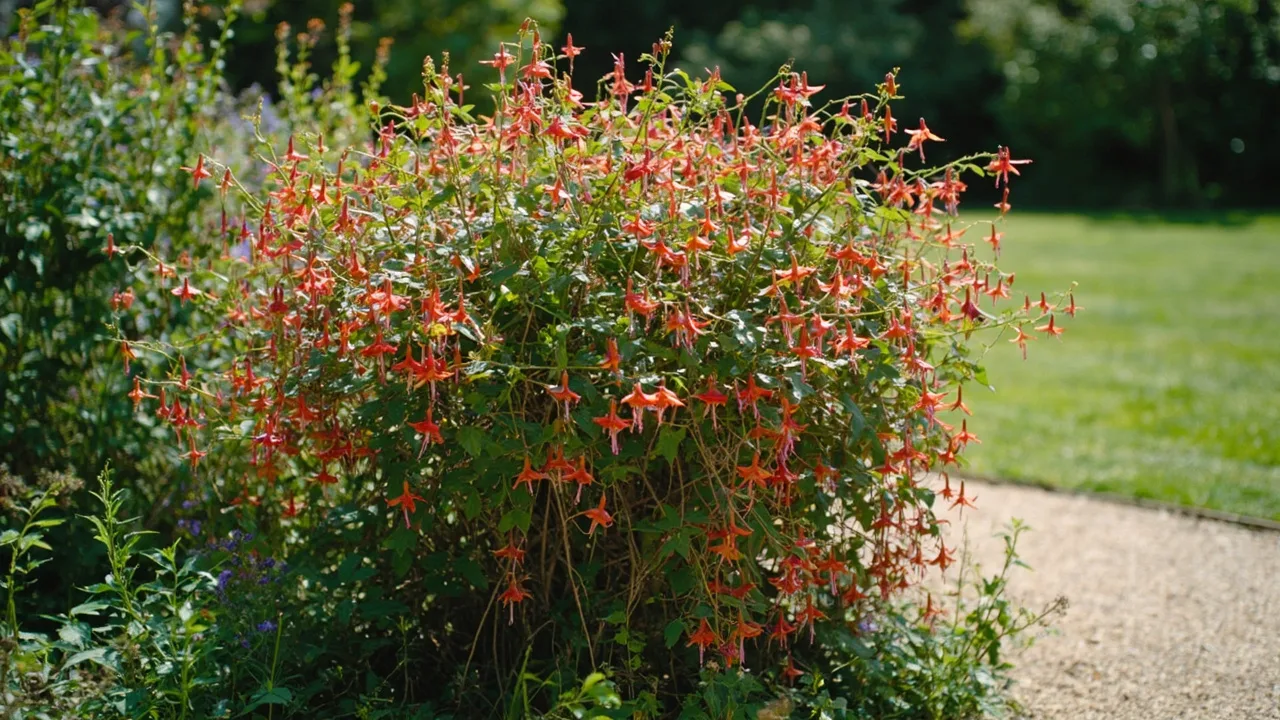
Fuchsia triphylla, the honeysuckle fuchsia, is one of the parents of the modern basket fuchsias but in its wild species form is a tender, large-leaved, long-flowered plant quite unlike the bushy hybrids most UK gardeners are familiar with. It comes from the Caribbean and central America and is not hardy outdoors anywhere in the British Isles; treat it as a conservatory or patio plant that comes in for the winter, or grow it as a lifted tuber the way many UK enthusiasts keep it. The species is grown for its long, tubular, coral-orange to scarlet flowers — the colour and shape of a small honeysuckle, which is where the common name comes from — and for the way the blooms cluster at the tips of the stems rather than hanging all along the branches. It flowers over a remarkably long season in UK conditions, often from early summer well into November if it is kept frost-free and fed.
Appearance
Fuchsia triphylla is an upright, sometimes rather lax shrub about 60–90 cm tall in a typical UK container, with strong, almost cane-like stems carrying leaves in distinct whorls of three — the botanical feature that gives the species its name. The leaves are lance-shaped, slightly downy, bronze-green above and often flushed purple underneath, and noticeably larger than the leaves of the common hybrid fuchsias. Flowers are produced in pendulous terminal clusters of long, narrow tubes about 4–6 cm long, opening at the mouth into a small set of slightly reflexed petals, and they sit in whorls along the inflorescence rather than hanging singly. The colour is a glowing coral-orange to vermilion-red depending on the clone, and the long corolla shape is unmistakable once you have seen it. In good light and warm conditions the plant blooms in flushes from early summer until cut back by the first frost.
Growing Conditions
Fuchsia triphylla needs a frost-free winter and warm, bright summer conditions to do well in the UK. The minimum temperature it tolerates is around 5 °C, which puts it firmly in RHS H1c territory — half-hardy at best, and not a plant to leave outdoors over winter anywhere in the British Isles. In summer it thrives in a sheltered spot in full sun or light shade with regular watering; container-grown plants in particular dry out fast and benefit from standing in a saucer during hot spells, or from being potted into a peat-free loam-based compost that holds moisture without going sour. Outdoors in UK summers it is most reliable in the southern and western counties; in colder inland and northern gardens it sulks in cool wet Julys and is best grown entirely under glass. Feed weekly with a high-potash liquid fertiliser from late spring through to early autumn to keep the flowers coming.
Planting and Care
Plant Fuchsia triphylla in late May or early June once the last frost is safely past, either into a large container of peat-free loam-based compost or into a sheltered border that has been enriched with garden compost. Pinch out the growing tips of young plants once or twice in spring to build a bushy framework before flowering starts; established plants need no formative pruning during the growing season. Cut back hard in late winter or early spring, reducing the previous year's stems to within one or two buds of the base, and repot container plants into fresh compost at the same time. The single most important job is overwintering: bring containers into a frost-free greenhouse, conservatory or bright porch before the first frost, and keep the compost just moist until growth restarts in spring. Plants grown in the ground can be lifted, potted up and treated the same way, or the tubers can be stored dry in a frost-free shed after the first frost has cut the top growth back.
Common Problems
Whitefly is the most persistent pest under glass, colonising the underside of the leaves in warm, dry conditions and building up quickly through summer; the practical UK response is regular biological control with the parasitic wasp Encarsia formosa, released from May onwards in the greenhouse, rather than reaching for a spray. Capsid bug damage shows up as small holes and distorted new growth on outdoor plants in late spring and summer, and is best controlled by encouraging natural predators in a mixed border rather than spraying. Botrytis grey mould can ruin the flowers in a damp, poorly ventilated conservatory; improve air movement, avoid overhead watering and remove spent blooms promptly. Vine weevil grubs are a real threat in containers, where they chew the roots over winter; use a nematode drench in September or pot into fresh compost each spring. Outdoor plants in milder UK summers also attract fuchsia rust, a fungal disease that shows up as orange pustules on the underside of the leaves; pick off affected leaves promptly and avoid wetting the foliage when watering.
Popular Varieties
The true species, Fuchsia triphylla, is widely sold in UK fuchsia specialists' catalogues and is the form to grow for the long coral-orange flowers and the strong upright habit. Most named garden cultivars sold as "triphylla-type" fuchsias are hybrids between F. triphylla and the larger-flowered hybrid fuchsias, and they inherit the long tubular shape and the whorled leaf arrangement. Among the most reliable in UK cultivation are 'Coralle', with slim coral-pink tubes on a compact plant, and 'Mary', a slightly tender but very free-flowering selection with vivid red-orange blooms that performs well in a warm conservatory. The closest species-level companion in UK cultivation is /plants/fuchsia-fulgens, the Mexican fuchsia, which shares the long tubular flower shape but has a more pendulous habit and paler, more yellowy-red blooms, with the leaves carried singly rather than in whorls of three — together the two species give a UK glasshouse or conservatory a pair of large-leaved, long-tubed fuchsias that flower from early summer until the first frost.
Recommended Products
GardenWizz earns a commission from qualifying purchases made through affiliate links on this page (including links within the article) — as an Amazon Associate, and from Thompson & Morgan via the Awin network. This does not affect the price you pay. See our disclaimer for details.