Brilliant Fuchsia
Fuchsia fulgens
The Gardening Year
Best months in UK gardens · full planting calendar →
🖨 Printable care card (PDF)At a Glance
| Botanical name | Fuchsia fulgens |
|---|---|
| Common name(s) | Brilliant fuchsia |
| Family | Onagraceae |
| Plant type | shrub |
| Height × Spread | 150–180 cm × 80 cm |
| Position | Full sun, Partial shade |
| Soil | moist-but-well-drained, humus-rich |
| Flowering | June–November |
| Toxicity | — |
| Native range | Mexico and Central America |
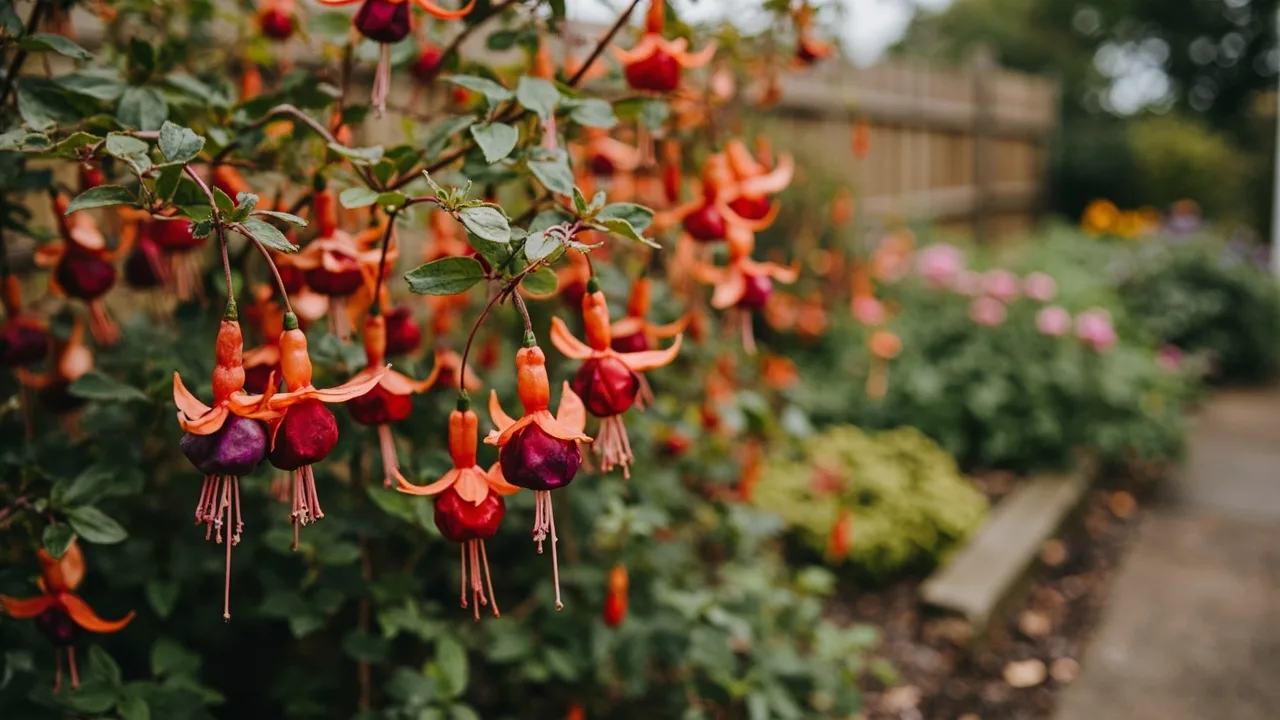
Fuchsia fulgens, the brilliant fuchsia, is a tender, soft-wooded species native to the cool mountain cloud forests of central and south-western Mexico. It is grown in British gardens chiefly as a container or conservatory plant for its unusually long, tubular, orange-red flowers, which are produced from midsummer well into late autumn. The species is one of the genetic parents of the modern triphylla-type hybrid fuchsias, including 'Thalia' and 'Gartenmeister Bonstedt', both widely grown in UK conservatories.
Overview
Fuchsia fulgens belongs to the evening primrose family (Onagraceae) and is one of roughly 100 species in the genus Fuchsia, the great majority of which originate from Central and South America with a smaller number extending north into Mexico. The species was described from material collected in the highlands of central Mexico and has been cultivated in Europe since the 1830s; it was an important parent in early Victorian hybridisation work at the Royal Horticultural Society's gardens at Chiswick, contributing the long tubular flower shape that defines the triphylla group. Unlike the hardy Fuchsia magellanica commonly grown in British gardens, F. fulgens is a true tender species and is best treated in most of the UK as a pot or conservatory plant, overwintered under glass in a cool, frost-free place.
Appearance
Fuchsia fulgens forms an upright, somewhat open subshrub reaching 1.2–1.8 m tall and roughly 60–80 cm across in cultivation under glass. The stems are pale green to reddish and slightly succulent at the base, where the plant produces thickened, tuberous underground storage roots that help it survive the dry season in its native range. Leaves are opposite, broadly ovate to heart-shaped, 8–15 cm long, with a softly downy surface and a pale green midrib; the margins carry fine, shallow serrations. The pale-green, slightly heart-shaped leaves give the plant a fresh, almost subtropical appearance even when out of flower, and it associates well in mixed conservatory plantings with other broad-leaved tender species.
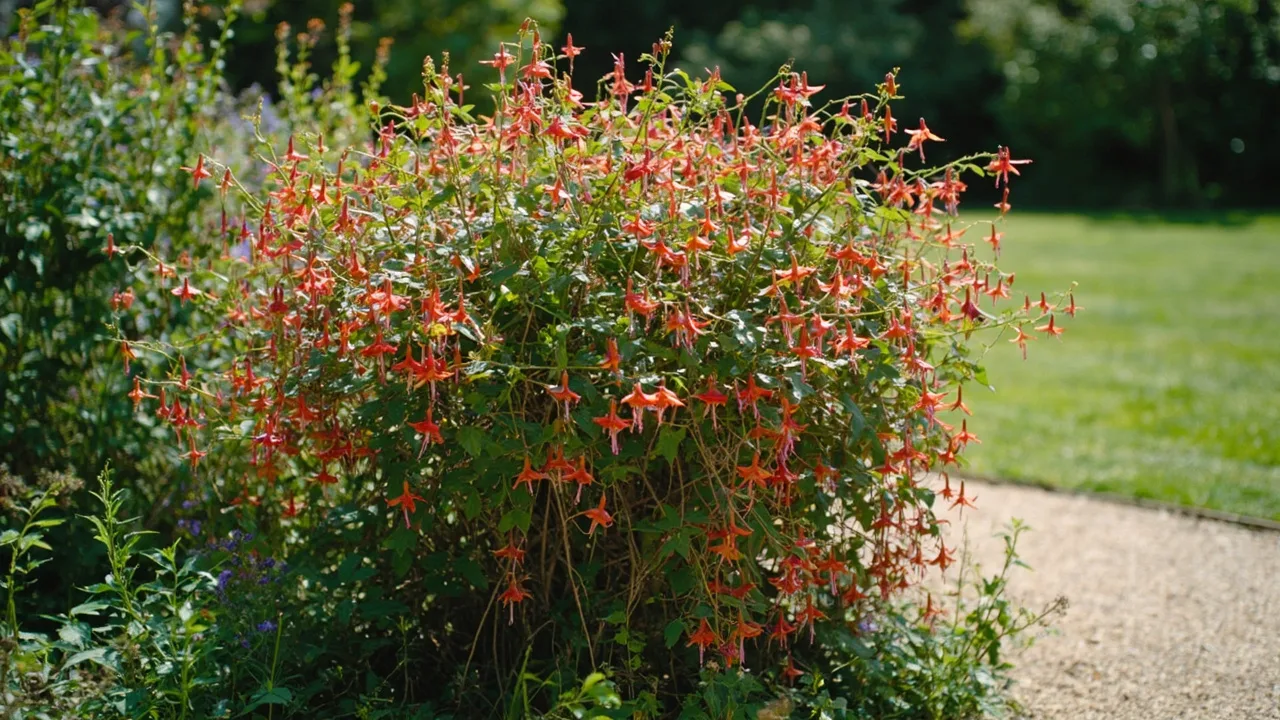
The flowers are borne in pendulous terminal clusters (racemes) of six to twelve blooms from midsummer into late autumn. Each bloom is tubular rather than the open, bell-shaped flowers of common bedding fuchsias: a long, narrow tube 4–7 cm in length, coloured rose-pink to dull scarlet, with four small, pointed sepals at the tip and four shorter, deeper-red petals that barely open. The shape and warm orange-red colour are thought to be an adaptation to hummingbird pollination in its native habitat. The flowers are followed by small, oblong, dark purple berries around 1–2 cm long, which are edible but not particularly palatable.
Growing Conditions
Fuchsia fulgens prefers a bright position out of direct midday sun, ideally with morning light and afternoon shade, or the dappled shade of a west-facing wall. In its native Mexican cloud forest it grows as a lithophyte or epiphyte on oaks and rocks in upland forest habitats, so a freely draining but moisture-retentive medium is essential: a loam-based potting mix such as John Innes No. 2 with added leaf mould and grit suits container-grown plants well. Outdoors for the summer months, plant in moist but well-drained, humus-rich soil that does not dry out; the species resents drought at the root and will shed flower buds if allowed to wilt. A site sheltered from cold east winds is important, as late spring frosts on soft new growth can knock plants back severely even in otherwise mild districts.
The species is tender and will not survive UK winters in the open ground in most regions. Cultivation is straightforward in a frost-free greenhouse, conservatory, or enclosed porch kept above freezing in a cool range suitable for tender fuchsias. Plants tolerate only brief, very mild drops near freezing and lose leaves in prolonged cold; the tuberous roots may survive short, light frosts if the crown is heavily mulched, but reliable year-round growth requires lifting the container under cover before the first hard frost of autumn, typically in late October or early November in most of the UK. For general advice on UK climate and tender plants, see our frost dates and seasonal calendar pages.
Planting and Care
Pot or repot in spring as new growth begins, moving plants on by one pot size at a time into fresh peat-free multipurpose or loam-based compost. Water during active growth so the root ball does not dry out completely, but allow the top 2–3 cm of compost to dry between waterings and ensure the pot drains freely; permanently saturated compost causes root rot. Feed container plants every 10–14 days during active growth with a balanced liquid fertiliser, switching to a high-potash feed in late summer to support continued flowering.
Pruning is light: pinch out the soft shoot tips in spring to encourage branching, and tidy or shorten leggy stems after the main summer flush. Hard pruning into old tuberous wood is rarely needed and is best avoided unless the plant has been cut back by frost, in which case damaged stems can be removed to healthy live tissue in mid-spring once regrowth is clearly visible.
Propagation is straightforward from softwood cuttings taken in late spring or early summer. Cut healthy non-flowering shoots about 7–10 cm long, trim below a leaf joint, remove the lower leaves, and root in a small pot of moist peat-free cutting compost under a clear cover at 18–21 °C. Cuttings usually root in two to three weeks. Established plants can also be divided at potting time in spring where the tuberous rootstock has produced multiple crowns.
Overwintering: as growth slows in autumn, reduce watering and stop feeding. Keep the plant in a cool, frost-free, well-lit glasshouse or conservatory at about 5–7 °C through the winter and resume normal watering and feeding in spring when new shoots appear. In regions with very mild, sheltered gardens in southern England and the Channel Islands, mature plants in the open ground have been known to survive mild winters against a south-facing wall with a thick dry mulch of bracken or bark over the crown; this should not be relied upon as standard practice outside the mildest locations, and even there severe winters will usually kill top growth.
Common Problems
Whitefly and aphids colonise soft new growth under glass from late spring onwards. Inspect shoot tips weekly and treat with a horticultural soap or introduce the parasitic wasp Encarsia formosa in the greenhouse. Outdoors for the summer, aphids are usually kept in check by hoverflies, lacewings and ladybirds, and treatment is rarely needed.
Red spider mite is the most damaging pest in warm, dry conservatory conditions. Fine yellow speckling on the upper leaf surface and fine webbing on the undersides are early signs. Increase humidity by damping down the floor in hot weather and consider a biological control (Phytoseiulus persimilis) before resorting to sprays.
Vine weevil grubs attack the tuberous roots of container-grown plants, particularly in peat-based composts. Pot on into fresh loam-based John Innes in early spring and apply a biological nematode (Steinernema kraussei) in September where grubs have been a problem. Adult vine weevils notch the leaf margins at night and can be caught on bark refuges.
Botrytis (grey mould) can affect damp, congested foliage in autumn. Improve ventilation, remove fallen leaves from the compost surface, and avoid overhead watering late in the season. Remove and destroy any affected tissue promptly.
Powdery mildew may appear on drought-stressed plants in late summer. Maintain even moisture at the root and water early in the day so foliage dries before nightfall. See our problem solver entry on powdery mildew for further detail.
Fuchsia rust (Pucciniastrum epilobii) is occasionally reported on outdoor plants in warm, humid summers, producing orange-yellow pustules on the undersides of leaves. Remove and destroy affected leaves at first sight and avoid overhead irrigation.
Fuchsia gall mite (Aculops fuchsiae) is a notifiable pest in the UK; affected shoot tips become swollen, distorted and discoloured. Prune out and bin affected growth immediately and report suspected outbreaks to the Animal and Plant Health Agency via the UK Plant Health Information Portal.
Popular Varieties
Fuchsia fulgens has a long history in British horticulture and figures prominently in the ancestry of modern triphylla-type hybrids. The species itself is rarely sold in mainstream UK garden centres but is offered by a small number of specialist fuchsia nurseries and plant-hunting suppliers. The following are established selections within or directly derived from the species:
- Fuchsia fulgens var. grandiflora — a vigorous form with longer flowers and brighter scarlet tubes; the form most often encountered under the name "brilliant fuchsia".
- Fuchsia fulgens 'Rubra Grandiflora' — an old, easily grown selection noted for its late start into growth and prolific autumn display.
- Fuchsia 'Speciosa' — a nineteenth-century hybrid between F. fulgens and F. splendens, considered one of the foundation parents of the modern triphylla-type fuchsia hybrids.
- Fuchsia 'Thalia' — a triphylla-type hybrid with F. fulgens ancestry, bearing long, slim, orange-scarlet tubes in dense pendent clusters from June to October.
- Fuchsia 'Gartenmeister Bonstedt' — another triphylla-type descendant, valued for bronze-tinged foliage and continuous flowering in semi-shade.
For related tender species see our profiles of <em>Fuchsia triphylla</em> and <em>Fuchsia boliviana</em>, and our gardener's guide to growing fuchsias.
Pests and Diseases
| Problem | Symptoms | Management |
|---|---|---|
| Fuchsia gall mite | Shoot tips become swollen, distorted, and discoloured with yellowish-green or reddish tissue instead of normal leaves. | Prune out affected growth immediately and dispose of it in household waste to prevent spread. |
| Slugs and snails | Irregular holes chewed in soft new foliage and stems, often accompanied by silky slime trails. | Use physical barriers like copper tape or apply iron phosphate-based pellets around the base of plants. |
| Aphids | Clusters of small green or black insects on new growth and flower buds, often leaving sticky honeydew. | Squash infestations by hand or spray with a strong jet of water; introduce ladybirds for biological control. |
| Red spider mite | Fine webbing on leaves and stippled, yellowing foliage, particularly in dry, warm greenhouse conditions. | Increase humidity around plants and treat with a horticultural oil or insecticidal soap if infestation is severe. |
| Powdery mildew | White, powdery fungal growth on leaves and stems, potentially causing leaf distortion and premature drop. | Ensure good air circulation and avoid wetting foliage when watering; treat with a sulphur-based fungicide if necessary. |
For step-by-step help, read Controlling Aphids Naturally, Dealing with Slugs and Snails and Treating Powdery Mildew. Or browse the full plant problem solver to diagnose an issue by symptom.
Recommended Products
GardenWizz earns a commission from qualifying purchases made through affiliate links on this page (including links within the article) — as an Amazon Associate, and from Thompson & Morgan via the Awin network. This does not affect the price you pay. See our disclaimer for details.